Part 4: Step-by-step Fermentation – How to Ferment Vegetables

Published by Wednesday, August 1, 2012 Permalink 0

Part 4: Step-by-step Fermentation

by Diana Zahuranec

How to Ferment Your Own Vegetables

I said in my first fermentation post that I found a couple of particularly helpful websites:

Sandor Ellix Katz, “Making Sauerkraut”
Mary N. Mennes, “Make Your Own Sauerkraut”
Recipes from a German Grandma, “Make Your Own Sauerkraut”

Katz’s was detailed and informative, and I completely trusted his judgment because he is the undisputed wild fermentation expert. Also, he helped my friends and I make cheese, which turned out edible, if squeaky. The unnamed German Grandma had pictures, which I took too and I’ll provide them here for you fermentin’ folks.

Equipment used:

2 big glass bowls
2 freezer bags
Saran wrap
Big plastic tray

Ingredients used:

Click here for French/British/American converter

1 head of cabbage
1 onion
2-3 hot peppers
2 carrots
Stems from a bunch of catalogna (chicory (or a type of), a leafy green with tough stems that I didn’t want to throw out)
1/3 C mildly spicy coarse hot pepper
Salt, water: 3 T salt per 5 pounds of vegetables
Whey from yogurt

Procedure:

Note: This outlines what I did, and might not be the ultimate, end-all-be-all way to ferment; I’m just sharing the experience and knowledge I gained along the way!

(chicory (or a type of), a leafy green with tough stems that I didn’t want to throw out)
1/3 C mildly spicy coarse hot pepper
Salt, water: 3 T salt per 5 pounds of vegetables
Whey from yogurt

Procedure:

Note: This outlines what I did, and might not be the ultimate, end-all-be-all way to ferment; I’m just sharing the experience and knowledge I gained along the way!

[caption id="attachment_27484" align="alignleft" width="319"] Chopped vegetables


Continue Reading…

Never miss a post
Name: 
Your email address:*
Please enter all required fields
Correct invalid entries

Part 1: Food Fermentation for Beginners

Published by Tuesday, July 24, 2012 Permalink 0

Part 1: Food Fermentation for Beginners

by Diana Zahuranec

Cultures all over the world and for thousands of years have developed fermented foods and drinks. Japanese miso, Korean kimchi, kefir from Eastern Europe and the Middle East, sauerkraut from Germany; yogurt, sourdough bread, and even chocolate are some examples. While scarfing down some quickly “pickled” carrots I had made, I thought, why not make real fermented vegetables? I have a penchant for salty, sour foods, so why not ferment a big batch of it? The nutritional value actually builds and multiplies in fermented foods. I would satisfy my cravings, indulge in a natural, traditional super-food, learn about an ancient practice, and have a project to boot.

To learn the scientific details behind fermenting, I picked up Harold McGee’s On Food and Cooking: The Science and Lore of the Kitchen. For fermentation how-to, I quickly found an article on Sandor Ellix Katz’s blog (who, before, helped my friends and I make cheese). For a fermentation step-by-step picture guide, I found Recipes from a German Grandma.


I wanted to settle the nagging doubt about using equipment no more advanced than big glass bowls picked up in a used goods store. Pickl-It jars, Harsch crocks , and other crocks aren’t found easily in Italy, my home-away-from-home, or if they were I wouldn’t carry them around on my back while biking from store to store in the sweltering heat. Ideally, I would use Pickl-It jars or a Harsch crock over my open crock method, because I’ve never fermented vegetables and believe I’ve already made a few mistakes (ahem…this I will find out in roughly two weeks). Small batches of fermenting veggies are prone to come into contact with air when using the open crock method, causing you to lose some of the precious little you’ve made.

I don’t know which I would choose over the other, but apparently there are Team Pickl-It and Team Harsch Crock sides to this debate.

Too late now. I’ll find out if my haphazard but enthusiastic open crock method works in about two weeks. That will be the turning point in my brief fermentation career in making a major decision: to buy or not to buy a Pickl-It jar.

Pickl-It jars


Along with growing doubts as I read about fermentation, the more fascinating information I find. This post will be just the beginning of a short fermentation series that sort of follows along with my own method: dive right in knowing the basics, then nervously twist a strand of hair as I read more about it, then fixate on all things fermentation.

Harsch crock. I didn’t have strong doubts about the open crock method. No one 500 or 2,000 years ago had Pickl-It jars or a standard Harsch crock. Unfortunately, and after I already had my kraut for a day and a half, the more I read about it, the more uncertain I’ve become. Sandor Ellix Katz’s directions seemed straightforward, but some other articles worried me.


Let the fermentation begin!

Here are some other links I found useful:

Make your own sauerkraut, by Mary E. Mennes
Comparison of Vegetable Fermentation Methods, by Kimi Harris
Homemade sauerkraut, by Jenny
Vegetable Fermentation Further Simplified, by WildAdmin
Fermented Foods Webinair, by Jenny

Never miss a post
Name: 
Your email address:*
Please enter all required fields
Correct invalid entries

Cheesemaking: To know how cheese is made is different from knowing how to make cheese!

Published by Monday, February 6, 2012 Permalink 0

by Diana Zahuranic

“Let’s make cheese!” To my friends and me, the idea sounded satisfyingly artisanal. Cheesemaking is simple enough in practice so that anyone with some background can try their hand at it. The theory is more complicated, but because my friends and I had that part down pat, actually putting it to use would be an afternoon well-spent.

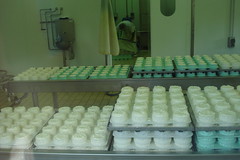
Cheesemakers in Chaource

Cheesemakers in Chaource


Or so we thought. Yes, the craft of cheesemaking is simple compared to the amazing, diverse world of cheese that it produces (or rather, that Europe produces, with no laws prohibiting unpasteurized cheese aged less than 60 days – which is 100s to 1000s of varieties). But the first thing the nine of us did in my friend’s tiny Italian kitchen was say, “Doesn’t anybody know how to make cheese?”

Continue Reading…

Never miss a post
Name: 
Your email address:*
Please enter all required fields
Correct invalid entries

UA-21892701-1