
It’s just a paint chip — prescott green. But longing and intensity are vividly present, and the writer’s sincerity is unquestionable. A scrap off the Internet that delivers — oh, man. What would you write on your paint chip? What color would it be?
|
|

A Literary Culinary Journal
It’s just a paint chip — prescott green. But longing and intensity are vividly present, and the writer’s sincerity is unquestionable. A scrap off the Internet that delivers — oh, man. What would you write on your paint chip? What color would it be?
|
|

Of the Dutch painter Adriaen Coorte, very little is known, not even the year of his birth or death. He was active for about three decades, in the late 17th and early 18th centuries. Only one contemporary matter of record truly stands out: in the provincial city of Middelburg, where he lived and worked, he was taxed for selling a painting without being a member of the local painters’ guild, after which he joined up. His simple compositions, their dark backdrops, their few and plain props, put him out of fashion, for he painted during the Dutch Golden Age, when nimiety ruled the still-life genre. He was forgotten until the 1950s. Since then, however, his 55 known works, a significant number of them depictions of asparagus, have gained a luster not bestowed on them during the artist’s life. In 2011, a newly discovered painting by Coorte went at auction for more than $4,000,000.
When an artist sticks with a subject over time, it’s natural to wonder why. In the 1600s, asparagus was a luxury food, as it is now. One might make the case that, in any era, an expensive food is a love food on those grounds alone, but asparagus was in the 17th century considered a love food for its special properties. The English physician and botanist Nicholas Culpeper, in his Complete Herbal (1652), wrote of asparagus that “being taken fasting several mornings together, [it] stirreth up bodily lust in man or woman (whate’er some have written to the contrary.)”
Did the reach of the Complete Herbal, a runaway bestseller for its time, extend to Middelburg, then a slave-trading hub whose first university came as late as 2004? How I wish I knew. But Coorte’s images — fruit, butterflies, shells, asparagus — are rich in the symbolic language used by painters of his time, and lit with a radiant specificity that suggests the deeper meaning will be revealed with contemplation.
Still Life with Asparagus, Adriaen Coorte, 1697. Oil paint on paper mounted on a panel, h. 25cm × w. 20.5cm. The Rijksmuseum, Amsterdam, The Netherlands Elatia Harris is a writer and consulting editor in Cambridge, Mass. She is most often at work on books and articles about food, wine and travel. Contact her at elatiaharrisATgmailDOTcom or via text at 617-599-7159.|
|
Program for Beginning Writers
A. Start where you are (Beginning Writer)
Dear Diary
Writing about the things you wouldn’t talk about if someone asked you casually: How was your trip? How was the big dinner?
Dear Friend
In the world as a writer
Writing a letter to a dear, or even an imaginary, friend
Dear Reader
Building a repertoire of work for readers who don’t know you yet
How to engage them
Craft of Writing Checkpoints
Making sure the nuts and bolts are in place – this is grammar, spelling, word count, formatting, proper computer use, and other issues that ignoring will deal you out.
B. Becoming More Vivid and Unmistakable as a Writer (Next after completing Beginning Writer, or Jump in here for people who skip beginning writer)
Sensuality Upgrade
Good Observer Upgrade
Story-telling and suspense building
Building your brand as a writer, building a body of work (your own blog)
Classes one-on-one or very small group
Critique, edit, get a finished product, develop a plan
|
|
18 – 21 SEPTEMBER 2014
with James Flewellen and Jonell Galloway
Through a series of tutored workshops, this 4-day weekend workshop will help unlock your tastebuds and introduce the richness of aromas, flavors and textures present in food and wine. Our exploration is enabled through local food from the Beauce and wine from the Loire Valley and coincides with the Chartres Festival of Lights and the Autumnal Equinox.
For course details click here and to make your reservation click here.
|
|
If you like TRE, you’ve seen the site is in transition. And you’ll like the changes being made there. Here’s what’s staying the same: fabulous articles about food, wine and travel, with visuals to match. Here’s what’s going to be different: a new kind of hub for food writers, unlike anything else on the Internet.
|
|
Welcome to the archives of the original The Rambling Epicure, edited by Jonell Galloway. You should find all the categories we’ve included in the past in the headings below. Enjoy your read!
Please note that these posts are still available using the Search tab at the top right.
|
|

The art patron Charles Ephrussi (1849 –1905), one of the Parisians on whom Proust based the character Swann, was deeply appreciative of contemporary painting, and agreed to buy from Edouard Manet the delightful still-life, topmost above, for 800 francs. So great was his pleasure in ownership, however, that he paid the artist 1000 francs for it.
Not one to miss the chance for a witty flourish, Manet swiftly sent Ephrussi a smaller painting, of a single asparagus, with a note to say that one had slipped from the bunch.
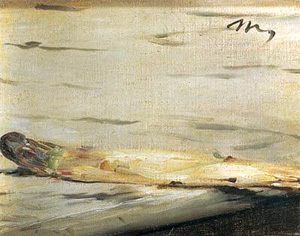
Both paintings may be viewed by the public, but not together. The mother painting is in the Walraff Museum in Cologne, the solitary asparagus in the Musee D’Orsay in Paris.
Top: Édouard Manet (French, 1832-1883). Bunch of Asparagus, 1880. Oil on canvas. Wallraf-Richartz-Museum & Fondation Corboud, Cologne, Germany Bottom: Edouard Manet (French, 1832-1905) One Asparagus, 1880. Oil on canvas, the Musee D’Orsay, Paris, France Elatia Harris is a writer and consulting editor in Cambridge, Mass. She is most often at work on books and articles about food, wine and travel. Contact her at elatiaharrisATgmailDOTcom or via text at 617-599-7159.|
|

Keep calm and use a style guide.
|
|

 From the Archives: Simon Says: Daily Food Quote, January 28, 2011
by Simon de Swaan
“A” is for dining Alone… and so am I, if a choice must be made between most I know and myself. This misanthropic attitude is one I am not proud of, but it is firmly there, based on my increasing conviction that sharing food with another human being is an intimate act that should not be indulged in lightly.–M.F.K. Fisher, An Alphabet for Gourmets
M.F.K. Fisher, born in 1908, is perhaps America’s best-known food essayist. She redefined the way Americans write and talk about food, and is therefore a true reference in American food writing. Gourmet wrote a lovely homage to her in 2008, the 100th anniversary of her birth.
Alphabet for Gourmets was originally published in Gourmet magazine in 1948.
Read more about her classic The Art of Eating.
Photo courtesy of Cliff 1066
.
|
|


by Jonell Galloway
I was recently interviewed for a Swiss Info documentary called “Finding the Right Food Formula.” In the context of recent childhood obesity figures in Switzerland, Veronica De Vore is exploring the Swiss relationship to food and how that might have changed, how it might be related to the rise in childhood obesity.
Click here to listen to the show. I cooked a Kentucky Fried Chicken feast for Veronica, while discussing the more serious matter of relationships to food in the context of my work in mindful eating. (The article also includes an abridged recipe for my grandmothers’ traditional Kentucky Fried Chicken.)
|
|
 Meet Jonell Galloway, a freelance writer and editor specialized in French cuisine.


