Recent Posts by Jonell Galloway

On Culinary Writing: Revisiting M.F.K. Fisher

Published by Thursday, September 25, 2025 Permalink 0


On Culinary Writing: Revisiting M.F.K. Fisher

by Betina Mariante Cardoso

Click here for Portuguese, translated and adapted from the Portuguese by Jonell Galloway

Reading M.F.K. Fisher (Mary Frances Kennedy Fisher) far surpasses the literary pleasure of her pure, lucid writing: it brings me deep, personal enrichment. What is my favorite book by M.F.K. Fisher? It’s so difficult to choose, but reading The Gastronomical Me had a phenomenal transformative power on me.

Despite the fact that Mary Frances explores her own stories and subjective perspectives on them, we come to realize that each of us, for whom the culinary act is precious, could occupy the identity of this ‘Gastronomical Me’; actually, each of us, Humans, could occupy this identity, because themes as ‘eating’ and ‘hunger’- subjects she meets head on- reflect our deepest Human Being: these actions or conditions correspond to the deepest of what humans feel and share.

Fisher lets us put ourselves into her place in the stories, told from her point of view, so that we can step in and experience what she has lived. We take on a role in the story. We move through it in the first person, we discover tastes through her words. This ability lends great power to her writing, in particular through the use of the first-person singular. Being able to read ourselves through her sensations, perceptions and life events is to accept that she conducts us in a travel to our own narratives. Hence, an autobiographical promenade. And I ask you: isn´t cooking also an autobiography, a storytelling about ourselves?

So there are various points of enlightment in this book, which awakens the reader to reflection. I got surprised just from the beginning, in the very opening of the work:  “To be happy you must have taken the measure of your powers, tasted the fruits of your passion, and learned your place in the world.”George Santayana

As I flipped through this book, I noted several chapters with the same name, written on different dates, and interwoven with different texts. “The Measure of My Powers is repeated several times, bringing to light and interweaving different passages of Santayana; repeating sometimes to the point of using a specific title, however giving it a different twist, such as in the tone of “The Gastronomical Me.” As I go through the pages, I feel the incredible depth, as if the author were telling her culinary stories, but also her discoveries and reflections. And as if, in each chapter entitled “The Measure of My Powers,” she referred back to the initial period, recounting her quest for so-called “happiness.”  “To be happy you must have taken the measure of your powers,” says the passage, and  Mary Frances attempts to retrieve a certain order in terms of the chapter titles, as her answer to the point ‘to be happy…’ This search seems to be the axis of her  subjective writing.

Though the strength here appears more in tune with “to be happy,” we read between the lines an even deeper quest: a quest for her identity, for her own forces and potential, for facets of herself that she translates through her relation to the universe of eating and cooking.  I my opinion, it is in this very aspect that the “I,” the first person singular, becomes plural: “we”; it is in this aspect that the book title ‘The Gastronomical Me’ is directed to a ‘plural’ of individuals who identify themselves with the sensations, experiences and feelings written by the author. Individuals from all parts of the world. It is in this aspect that she lends her own name, “me,” to the reader, also lending her five senses so that we too can experience, through words, all the tastes, aromas, textures, sounds, flavors, and colors of her scenes. And it is  possible to go beyond this understanding: writing about the dimension of her powers, or while expressing emotions and memories in these texts, Mary Frances not only lends us her hunger, she shares it with us, her readers. Hunger that we, Humans, feel.

Hunger?

That’s the keyword of the renowned introduction to this book, in which she explains why one should write about food, and not about the fight for power or security or about love or war. “The easiest answer is to say that, like most other  humans, I am hungry”, she answers. In addition, when she writes with great mastery about hunger, in truth she is “writing about love and the hunger for it, and warmth and the love of it, and the hunger for it”. “I tell about myself (…), and it happens without my willing it that I´m telling too about the people with me then, and their other deeper needs for love and happiness.”

Being food an essential part of our lives, as well as emotions and perceptions arising from our senses, each individual is somehow present in this author´s writing: her experiences coincide with our own memories. We have our humanity in common, and, as she says, our hunger. For moments, we feel ‘characters’of her writing; at other times, we feel The Gastronomical Me that writes the stories. The hunger is the same.

And then the beauty of the last paragraph of the foreword is the sharing of her  emotions with those of the reader: “There is a communion of more than our bodies when bread is broken and wine drunk. And that is my answer, when people ask me: why do you write about hunger, and not wars or love?

Be it  seeing her grandmother making jam, be it sharing a meal with her sister and her father, be it looking at a menu attentively  and choosing her desire for the first time: in every story Mary Frances tells, there is something of ourselves. Because, if emotions are so diverse in our subjectivity, there is a point in common, as human beings, that that makes us “co-authors” of these texts: we eat, we feel tastes (or fail to); we are hungry, we prepare food, we feel pleasure ( ‘on’ or ‘off’) .. Any time or geographic location, food and emotions wake us up or put us to sleep, satisfy us or empty us, nourish us or destroy us. Come what may, food and emotions respond to our primordial need: hunger, the one Mary Frances Kennedy Fisher puts into words with such a depth.

It is about each one of us she is talking, when she writes a text titled “The Measure of my powers”. You may not want to cook, nor want to write on food or on the culinary act; nevertheless,  reading this book is a firm and pleasant pace to mindful eating. And for sure it is also a firm pace to our way into the consciousness of our hunger for love, for affection, for safety, for happiness.

My reading? Our search is, over the long run, for the “measure of our powers,” and for the satiation of our hunger, the more we get to know ourselves. Reading or cooking, we discover passages related to our own subjective way of being, we experiment with our own five senses and feelings. We are all there, reflected in the seasoning as well as in the words. What do we need then? Only our hunger for self-awareness…

_____________________________________________________________________


MY TRANSLATION IN DRAFT FORM

Reading M.F.K. Fisher (Mary Frances Kennedy Fisher) far surpasses the literary pleasure of her pure, lucid writing: it brings me deep, personal enrichment. What is my favorite book by M.F.K. Fisher? It’s so difficult to choose, but if I go back through the many lines, The Gastronomical Me was a phenomenal transformative power.


The Gastronomical Me. by MFK Fisher, photo courtesy of http://www.chanticleerbooks.com/shop/chanticleer/20267.html


Yes, the title may seem lightweight, but there is great power and symbolism in its purposefulness. Despite the fact that Mary Frances explores her own stories and subjective perspectives on them, we come to realize that each of us could, through our own precious culinary experiences, take on the identity of The Gastronomical Me. Any of us could step right in to the identity of eating and hunger, subjects she also meets head on, because these actions or conditions correspond to the deepest of what humans feel and share.

Fisher lets us put ourselves into her place in the stories, told from her point of view, so that we can step in and experience what she has lived. We take on a role in the story. We move through it in the first person, we discover tastes for ourselves. This ability lends great power to her writing, in particular through the use of the first-person singular. We must let ourselves go and read with our senses, perceptions, changeability, and acceptance as the author leads us through her own narrative. It’s an autobiographical stroll of sorts. And you ask yourself: cookbook, hardly, and autobiography, yes, but also a story about yourself?

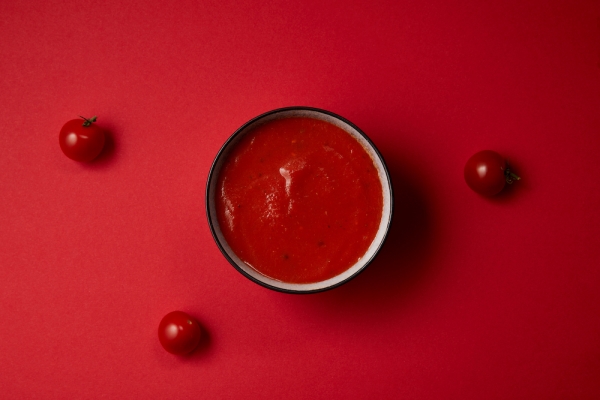
Recipe by Betina Mariante Cardoso, sweet and sour tomato dip

Sweet and sour tomato dip, recipe by Betina Mariante Cardoso


So, let’s look at the various focal points in this work, without forewarning, without getting overly excited, and without reading and taking time to reflect upon it. This surprising discussion, to which we’ve already opened the door, is:

“To be happy you must have taken the measure of your powers, tasted the fruits of your passion, and learned your place in the world.”George Santayana

As I flipped through this book, I noted several chapters with the same name, written on different dates, and interwoven with different texts. “The Measure of My Powers is repeated several times, bringing to light and interweaving different passages of Santayana; repeating sometimes to the point of using a specific title, however giving it a different twist, such as in the tone of “The Gastronomical Me.” As I go through the pages, I feel the incredible depth, as if the author were telling her culinary stories, but also her discoveries and reflections. And as if, in each chapter entitled “The Measure of My Powers,” she referred back to the initial period, recounting her quest for so-called “happiness.”  “To be happy you must have taken the measure of your powers,” in the passage where Mary Frances attempts to retrieve a certain order in terms of the chapter titles, trying hard to continue pursuing the common thread of her very subjective writing.


 Mercado Público: convite aos sentidos... / Covered market: let your senses go, by Betina Mariante Cardoso


Though the keynote here appears more in tune with to not “be happy,” if we read between the lines, the quest goes even deeper: a quest for her identity, for her own forces and potential, for facets of herself that she translates through her relation to the universe of eating and cooking.  In this aspect, the “I,” the first person singular, becomes plural: “we.” The Gastronomical Me in fact addresses a plurality of subjects: sensations, existence, feelings that Fisher writes about. Subjects that are universal. And so she chooses to lend her own name, “me,” to the reader, also lending her own meaning so that we too can experience, through words, all the tastes, aromas, textures, sounds, flavors, and colors of her meals. And if possible, to go beyond this simple understanding, and to approach the the outer boundaries of meaning with all your strength and express your emotions and memories not in line with the words you read, since the author hardly gives it true form, writing more to share her knowledge with her readers, and hungry that we, as human beings, feel.

Hungry?

That’s the keyword of the renowned introduction to this book, in which she explains why one should write about food, and not about the fight for power or security or about love or war. “When we exist without thought or thanksgiving we are not men, but beasts.” In addition, when she writes with great mastery about hunger, in truth she is writing about love and the hunger for it, about warmth and the love of it, and the hunger for them.“So it happens that when I write of hunger, I am really writing about love and the hunger for it, and warmth and the love of it and the hunger for it… and then the warmth and richness and fine reality of hunger satisfied… and it is all one.” Betina: your sentence is this? The easiest answer is to say that, like most other humans, I am hungry.


OLYMPUS DIGITAL CAMERA
Brazilian coconut candy, traditional and full of flavor

Being and eating are essential parts of life for all human beings, but the emotions and perceptions arising out of feelings are unique to each person, and each and everyone is present in the author’s writing. Our experiences coincide with our own fond memories. We have our humanity in common, as she says, and we are hungry. For a brief moment, in the character-driven feelings of her writing; at other times, in the feelings in The Gastronomical Me that writes the stories. Healthy hunger is the same.

Sendo o alimento parte essencial da vida de todos nós, bem como as emoções e percepções através dos sentidos, cada indivíduo está presente no texto desta autora; suas experiências coincidem com as nossas próprias lembranças. Temos em comum a humanidade e, como ela refere, a ‘fome’. Por instantes, nos sentimos personagens de sua autoria; noutras vezes, nos sentimos o ‘Eu Gastronômico’ que escreve as histórias. As fomes são as mesmas.

And now, the beauty of the last paragraph is the dividing point of her emotions with those of the reader: “There is a communion of more than our bodies when bread is broken and wine drunk. And that is my answer, when people ask me; why do you write about hunger, and not wars or love?”

OLYMPUS DIGITAL CAMERA
Partilha do meu pão de salame e
funcho, no primeiro dia de 2013…

Seja ao ver sua avó fazendo geléias, seja ao partilhar uma refeição com sua irmã e seu pai, seja ao olhar com atenção um cardápio e escolher seu desejo, pela primeira vez: em cada história contada, há algo de nós. Porque, se as emoções são tão diversas em nossa subjetividade, há um ponto em comum em nós, humanos, e que nos torna co-autores destes textos: comemos, sentimos o sabor (ou a falta dele), temos fome, preparamos o alimento, sentimos prazer(aceso ou apagado)…Em qualquer tempo e geografia, comida e emoção nos despertam ou adormecem, nos satisfazem ou nos incompletam, nos nutrem ou nos destroem; seja como for, comida e emoção respondem à nossa necessidade primordial, a fome. Esta, de que Mary Frances Kennedy Fisher fala com tanta profundidade.

Be it to see your grandmother making jam, be it sharing a meal with your sister our your father, be it looking at a menu attentively  and choosing for the first time. In every story we tell, there is something of ourselves. Because our emotions are so diverse and subjective, yet we have a point in common, as human beings, and that makes us “co-authors” of these texts: we eat, feel or taste (or fail to); we are hungry, we cook or eat; we feel pleasure, we extinguish our hunger or get it excited)… Any time or geographic location, food and emotions wake us up or put us to sleep, satisfy us or leave us wanting, nourish us or destroy us. Come what may, eating and feeling respond to our primordial need: hunger, which Mary Frances Kennedy Fisher puts into words with such a depth.

“A dimensão de minhas forças.” You may not desire to cook, nor desire to write about cooking or culinary matters; nevertheless, but reading this work at a steady pace leads to a more conscious form of eating. And this path of consciousness also makes us aware of our hunger for love, for affection, for safety, for happiness.

É de cada um de nós que a autora conta, quando escreve um texto que intitula: ‘A dimensão de minhas forças’. Você pode não desejar cozinhar, nem desejar escrever sobre a comida ou sobre o ato culinário; entretanto, a leitura desta obra é um passo firme, e prazeroso, na trajetória do comer consciente. E, com certeza, também na trajetória da conscientização de nossa fome pelo amor, pelo afeto, pela segurança, pela felicidade.

bolinhos para o dia dos namorados
Bolo para celebrar o amor!

“To be happy you must have taken the measure of your powers, tasted the fruits of your passion, and learned your place in the world.” Santayana

[Para ser feliz, você deve ter conhecido a dimensão de suas forças, experimentado as frutas de sua paixão e aprendido qual é seu lugar no mundo]- Santayana

The easiest answer is to say that, like most other humans, I am hungry”
A resposta mais fácil é dizer que, como a maioria dos Humanos, eu sinto fome“.

“I tell about myself (…), and it happens without my willing itthat I am telling too about the people with me then, and their other deeper needs for love and happiness”
Conto sobre mim mesma (…), e acontece, sem que eu queira, que estou contando também sobre aqueles que estão comigo, e sobre sua necessidade mais profunda pelo amor e pela felicidade.”

“There is a communion of more than our bodies when bread is broken and wine drunk. And that is my answer, when people ask me; why do you write about hunger, and not wars or love?”
Há uma comunhão para além dos nossos corpos, quando o pão é partido e o vinho é bebido. E esta é minha resposta, quando as pessoas me perguntam: ‘
por que você escreve sobre fome, e não sobre guerras ou amor?‘”

My reading? My quest, and, over the long run, for the “dimension of our forces,” and for the satiation of our hunger, especially we learn how to know each other and ourselves. Reading or cooking, we discover passages related to our own subjective way of being, we experiment with our own feelings and sentiments. We are all there, reflected in the seasoning as well as in the words. We put an end to our hunger; we replace it with awareness.


_____________________________________________________________________

Sobre Betina Mariante Cardoso

Sou Betina Mariante Cardoso, brasileira, trinta e poucos anos. Nasci e moro  em Porto Alegre, no Sul do Brasil, cidade que amo de coração e onde  vivencio o apego, o calor da família e a constância, virtudes necessárias na  minha vida. Paradoxo, tenho encantos por viajar, romper a linearidade  rotineira, esquecer o mapa no hotel e perder-me pelas ruas dos lugares que  visito. Por quê? Para ter a chance de conhecer aquela confeitaria antiga na  rua lateral, coisa que só o acaso permite.  Tenho uma ligação forte com o conforto do cotidiano mas, quando me torno viajante, parto em busca das descobertas, do desconhecido. É quando  me entrego à Serendipity que as viagens propiciam. E é com este mesmo estado anímico que venho para a cozinha: trazendo comigo a aventura, a curiosidade, o ímpeto pelo novo. Gosto de criar minhas receitas, mas sou também fã dos cadernos culinários, escritos à mão e com manchas de vida em suas páginas. Outro paradoxo. 

Agradam-me os livros, as revistas, os blogs de forno-e-fogão. E tenho verdadeiro encanto pelas ‘Histórias do como-se-faz’, as narrativas orais que transmitem o conhecimento empírico, prático e caseiro, de geração a geração. Escutar uma história de cozinha é, para mim, uma riqueza única, porque faz parte de uma conversa, de uma partilha entre as pessoas. Sou médica psiquiatra e psicoterapeuta, profissão que exerço com amor e dedicação, e que dispara meu olhar para o subjetivo de nossas entrelinhas. Minha segunda atividade profissional é como proprietária de uma pequena editora, a Casa Editorial Luminara, ligação entre  trabalho e espaço de liberdade.

No tempo livre, meu hobby principal é a culinária, desde a infância. Hoje, com a descoberta da ‘food writing‘, realizar a escrita culinária é, para mim, uma prática tão lúdica quanto cozinhar. Realizo algo que chamo de ‘cozinha perceptiva’. Nesta, escrita e a fotografia são ferramentas, pois ampliam a percepção e a descrição dos detalhes do ato culinário, ampliando também a exploração sensorial e a atenção ao presente, com benefícios para o autoconhecimento. Escrever, curiosar, ler, fazer colagens, blogar, viajar e  fotografar são também experiências prazerosas para mim, com altas doses de felicidade.

Espero você nos próximos textos!

Related articles


Never miss a post
Name: 
Your email address:*
Please enter all required fields
Correct invalid entries

Writing Programs

Published by Wednesday, July 30, 2025 Permalink 0

Food Studies Programs

Boston University, Boston, Massachusetts U.S.A.

NYU, Steinhardt, New York City, U.S.A.

University of Gastronomic Sciences, Bra, Italy

Never miss a post
Name: 
Your email address:*
Please enter all required fields
Correct invalid entries

Writing Doctor Services

Published by Tuesday, July 29, 2025 Permalink 0

Writing Doctor

Based on the needs of writers we already work with, we are premiering a distinctive array of services to writers. Whether you are looking for a quick once-over or for an assist with extensive revision, we provide it. Yes, we will write for you — sometimes that’s the fastest way for you to meet your goals.

Our classes are conducted via group phone call or Webinar — very simple technologies that leave no one out. That many writers join in makes them an excellent value and a great way to build your network. Writing can be lonely work, especially if you are new to it. You’ve heard the classic advice to just start where you are. We make that very easy.


Continue Reading…

Never miss a post
Name: 
Your email address:*
Please enter all required fields
Correct invalid entries

A Woodcock, Girolles, A Baguette, and a French Inn

Published by Wednesday, October 23, 2019 Permalink 0

Bécasse*, a story in two parts: A Hundred Years of Bécasse: Part I

by Dorette Snover

I wanted to fix what was wrong, here, in this – this place, this time I remembered so well. When I loved. Where I loved. And yet how ironic as here was where everything started unraveling on the first night of the Bécasse.

The drive into the setting sun from Agen made me wish we hadn’t missed our earlier train. But we had. It was my fault, but how could I leave Paris without visiting Rue Daguerre and picking up a perfect brie, rosy pears, a few chestnuts? 

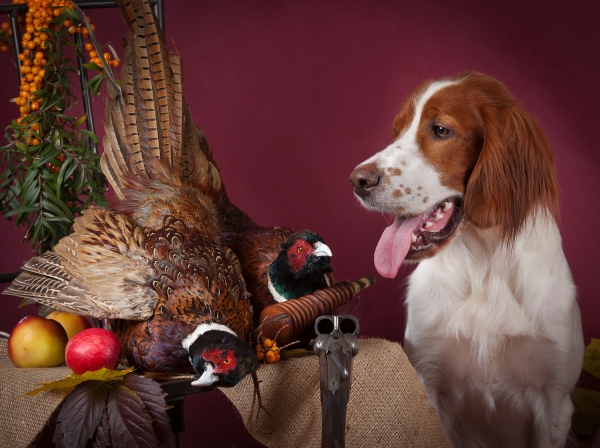
The Hunt: woodcock and hunting dog.

After the hunt: woodcock and hunting dog.

We pulled into the Auberge and barely missed hitting the stone wall. The millhouse still sat undisturbed by time, hell, it was time itself. Flanked by the millpond and the rushing river, the river Gélise coursed through it, cleansing and cooling the fires inside.

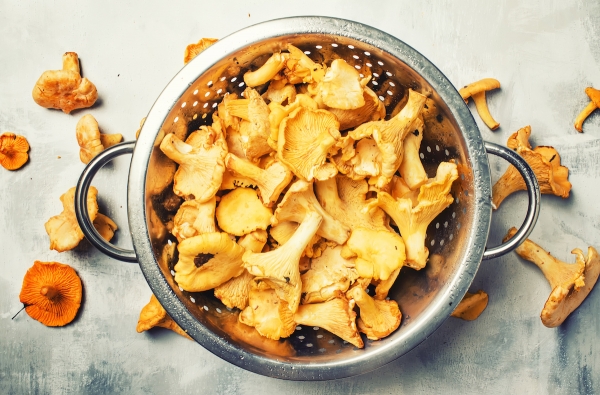
Once inside it seemed important not to disturb the shadows and gentle aura by flicking a switch and turning on a light. That would be too easy. I wanted to remember, I had to be careful. With the last little bit of sun on the kitchen, I found a white plate for the bruised tomatoes from the Paris market. The girolle mushrooms looked small and insufficient, but they had survived better than the poor tomatoes; all they needed was heat and a little butter. There was plenty of time for that in the morning. I was already relishing coming down in the morning and hearing the whoosh of the burners.

French baguette/bread.


In the shadows of the kitchen, the baguette might be a knotted tree, the baker’s slashes on the crust that birthed the ears and eyes of the bread. My husband drew the knife from the block and pressed its teeth against the curved length. I gently took it away and slid the saw-toothed beast back in its slot.

“Wait. “ I touched his arm. “Open the wine, while I light a fire?”

“I’m starving!” he said.

I was nervous to get it going, adjusting the air and the draft. The wood was damp, and my mind leaped ahead to the next day and perhaps finding cèpes or porcini in the forest. The bottle slowly emptied. Maybe she wouldn’t let the fire begin again. She being grand-mère. Had she forgiven me? I had kept her secret. I hadn’t told the tale of what happened here. Yet, that time was over now. It was safe to begin again. We sat back and raised our glasses. The flames twirled like the bird in the tapestry, the Bécasse, flying past the whispers of clouds over the moon, and the millhouse.

Cooking woodcocks or bécasse over a wood fire.

Cooking woodcocks or bécasse over a wood fire.

 The Auberge was unchanged, I breathed, wasn’t it? Twenty years was nothing in a place already hundreds of years old.

Much to his satisfaction we broke the crust, and playfully teased the heels of the baguette over the fire, turning and toasting. Smearing the hot pain with soft cheese.

I peered around the dark room, the fire reflecting our forms in the picture window.

To be continued.

***

*A bécasse in French is a woodcock.


Influenced by French heritage and traditions of the Pennsylvania Dutch country where she was born and raised, Dorette Snover graduated from the Culinary Institute of America, was a private chef to the rich and eccentric, a food stylist, NPR commentator, and now teaches les bases de la cuisine at her cooking school, C’est si Bon!

In writing, Dorette’s plat du jour is strong female characters woven from her thirty years in the world of cuisine. and her personal journey through landscapes of culinary history. Dorette also leads tours to France for adults looking for truffles in all the right places and for teens interested in exploring the world through a culinary map.


Never miss a post
Name: 
Your email address:*
Please enter all required fields
Correct invalid entries

Nana: A Love Story

Published by Tuesday, September 24, 2019 Permalink 1

by Leo Racicot

Along with an uncanny mastery of seven languages perfected while she was a scholarship student at L’Université de Paris plus a crystalline singing voice that gained her entrée to the finest church choirs in Europe, my Nana brought with her to, of all places, Lowell, Massachusetts, the Egyptian/Syrian cooking she learned as a girl in her native Alexandria. Sudden love for a fellow Egyptian émigré, Ralph, a barber, took Adele away from her academic and musical aspirations.

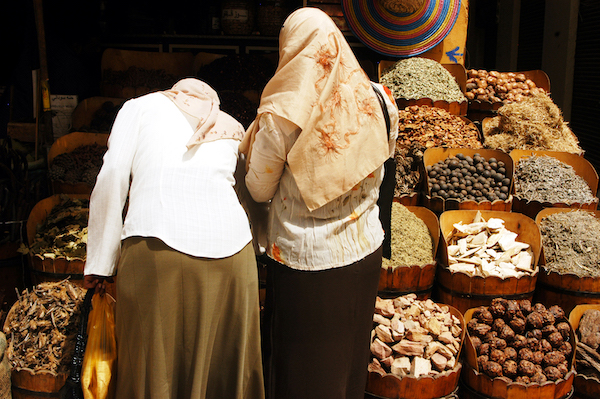
Egyptian women in market in Aswan

Muslim women in Aswan market, Egypt.

Ralph had an idea that opening his own shop in America, the land of opportunity, would put him and his new bride on roads paved in silver and gold. Before she knew what hit her, Adele (called by everyone Lena) found herself transplanted to a blue-collar town with a blue-collar man. The pair had four children in quick succession, each born two years apart: Mariam (Marie), Helen, George and my mother, Edna, nicknamed “Topsy.” Life and the barbershop landed them if not on Easy Street at least on This is Okay Way until Ralph died suddenly and young of a massive heart attack. My mother was six months old. Nana, unable to work full-time and raise four, small children alone (Lowell, after all, wasn’t Paris), took a job doing piecework in Hub Hosiery, one of the city’s many sweatshops and reluctantly put the kids in Franco American Orphanage where they would remain until they came of age.

Pistachio baklava

Middle Eastern pistachio baklawa or baklava.

By the time I knew her, Nana had left her dashed aspirations and heartbreak on the curb and gone about the business of “getting on with it.” Perhaps to make a second stab at rearing the children she, herself, had been unable to raise, she and Marie, who stayed single and made a home for her mother and herself, became co-parents to my sister, Diane, and me. We, too, had been orphaned at a very young age, leaving our mother in the same mess her mother had known. I grew up then with all women: my mother, my sister, my aunt, my Nana, the nuns at school. I witnessed firsthand the power of the female ethos, the banding together of women when Fate has removed all men from the picture, to step in and nurture, as individuals and as a group. I loved my women, but Nana I adored. The love life denied her giving to her own children she heaped on Diane and me. A more caring, hospitable, convivial spirit I have never known. And so, this is how, among other facets and aspects of my growing up years, I was exposed to the Syrian/Egyptian kitchen.

Assorted mezze.

Assorted mezze.

I loved being with Nana in her kitchen, watching her cook. We learn so much from watching. An almost pastoral calm would come over her as the small, old bones of her hands deftly tucked the Mahshi (Malfouf) mixture into the cabbage. In a flash, the stuffed wonders would layer up to the brim of the kettle (Nana pronounced it “cuttle”) to be doused with ripe, good garden tomatoes, homemade tomato sauce, and some water. Even more fun to watch was the way she would fashion a design, using only two turkey needles, into the top of a baked Kibbeh loaf. With the greatest care, too, she placed pine nuts (Snooba) strategically throughout the neat cake (not too many, not too few!). Kibbeh Nayyeh (raw hamburger or lamb) was also a staple of our family table.

People cringe now hearing that we ate raw meat (chased with raw onion). “Cannibals!,” they cry. I don’t know how I, so picky an eater I wouldn’t put a plain slice of American cheese in my mouth, got to love uncooked meat, but I could never get enough of the stuff – one of the treats of going over to my best friend, Anthony Kalil’s house, was the always-waiting Nayyeh on the table – Anthony’s father was a butcher so the house was well-stocked with the very best cuts. I loved the hurry-scurry of Anthony’s three brothers — his poor mom, outnumbered — racing in-and-out of the kitchen on their way to a date, a ballgame, a concert, tearing a piece of Syrian bread (the term, “pita” came into use much, much later on), scooping up a clump of Nayyeh, a bite of onion and chowing down. What with today’s heavy chemical treatment of meats and other No-No’s in meat products, I’m not so sure I would “go raw” now but I can still taste the sting of onion, the salted, peppered meat on my tongue and in my tummy. Good nourishing food.

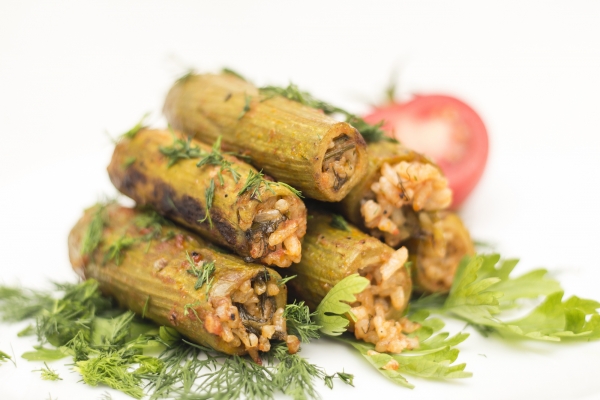
Never-ending were the delights to be had in Nana’s kitchen. There was Gusa (stuffed zucchini though any squash could be used) with its aromatic garden flavors, bitter to the taste in a good way. Baba Ganoush, a tangy yogurt/eggplant spread, perfect for dipping or eating plain. Nana was never 100% satisfied with her own yogurt. “Is it too tart? A little bit, huh?” There was Makdous, tiny, marinated eggplants sprinkled with walnuts, Fatoush, a fresh lettuce and tomato salad splashed with lemon juice and sumac – a regular visitor to Nana’s table, it made my cheeks pucker. Halami, Halwah (pronounced ‘Ha-lay-wee’), Baklawa, Hummus, Tabouleh, M’jadara (lentil porridge), Za’atar (the best!). How could anyone not leave the table fat and happy?

Egyptian-style stuffed zucchini.

Egyptian-style stuffed zucchini.

Special Sunday trips were to nearby Lawrence and Bishop’s (Aunt Marie at the wheel) where, if the Arabic food wasn’t quite as good as Nana’s, well, “Hey, I’ll take it!” Our friend, Al, the waiter, would bring us extra olive oil, extra mint, extra bread. Al had a genial face. He looked like Abe Burrows and Sam Levenson, popular humorists of the day, and was funny the way they were funny. After feasting, we would go tramping unsavory neighborhoods in search of Melia A’asi, a girlhood friend of Nana’s in Alexandria. Nana knew Melia lived “somewhere in Lawrence.” Melia became somewhat of a legend in family lore. We never did find her. (Interesting aside: years later, after I told M.F.K. Fisher this story, she thought it would be fun to co-write a mystery novel with me, The Case of Missing Melia A’asi. My pseudonym, she decided, would be “Ricochet Raincoat.” Like Melia, though, the book never materialized.) At least Aggie Michael, Nana’s Lowell friend, existed. Nana and I would regularly visit her home peopled with life-sized statues of every saint in the canon. Aggie was a funny, fat, little Buddha with Orphan Annie hair. I liked her, but Nana and I always heeded Marie’s warning, “Don’t ever eat anything there; she cooks spaghetti in the same pan she washes her feet in.”

Nana’s desserts were my favorite. I could eat Ma’moul, the anise-and-date-scented pastries ‘til they came out of my ears. When Anthony and I brought along a paper bag full of them on our choirboys’ field trip to Boston’s Museum of Science, the other kids made throwing up sounds ‘til we passed the tantalizing cookie-cake-y wonders around. Everybody was our friend that day.

My most-loved sweets were Ka’ak, Proustian in its fragrance and its tastes, Turkish Delights, plump with pistachios, homemade Marzipan (not as hard to make as you’d think) and – heaven in a cup – the Egyptian delicacy, Umm Ali, its circus-y colors beckoning you to become a professional glutton.

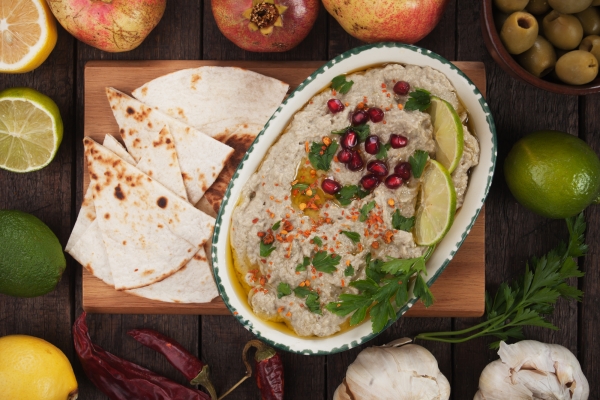
Baba Ganoush or eggplant purée.

Baba Ganoush or eggplant purée.

I liked few things better than being with my Nana, sitting beside her in her kitchen waiting for everything to cook. I can still hear the good heat bubbling up from oven cups of custard, cinnamon-laced, rice and grape-nut puddings, too, and Knefe and Atayef. My whole boyhood early on was exoticized by almonds, the scent of sesame, strong licorice, black and running out of the corners of my mouth. Nana is teaching me how to make tissue paper carnations, pink. I’m not a very good student. Her chatter is punctuated by delightful Malapropisms, mangling the names of favorite entertainers: Florence Welch (Lawrence Welk), Furry Como (Perry Como), Pranky Pontaine (for Frank Fontaine), Ed Solomont (Ed Sullivan) and the funniest – Alfred Pitchfork (He was a bit of a devil!). We crack each other up; she, correcting my Arabic, I, correcting her English. Nana was petite, her white hair pulled up into a donut at the top of her head (very Marseille market). Nana was an anomaly; raised as an Ottoman Jew in Alexandria, schooled in Paris, she came to the new country equipped with a repertory of Baptist hymns (go figure!). Diane and I, per order of our very Catholic dad, were raised in his faith. So Nana and I would alternate dueling music genres: myself trilling The Angelus, The Kyrie and she, in her sweet, clear soprano intoning the old hymns: In the Garden, The Old, Rugged Cross, Abide with Me. Our songs and our laughter lifted the kitchen curtains high while the food cooked and heaven hovered quiet just over in a corner. I never heard her put on airs. She was plain, without make-up or pretensions. I never heard her speak an unkind word against anyone. She did like to thumb her nose behind Marie’s back whenever Marie criticized her about spoiling Diane and me. “Next thing, they’ll want we should build them their own Taj Mahal.”

Turkish delight or lokum

Turkish delight or lokum.

If there were times whole oceans rose up in her old eyes, well, we knew why; thoughts about a life that might have been. But she never let tears wet her bosom for long – she moved on – in acceptance, in grace, loving her life, her family, her kitchen.

The kitchen and her heart went dark in the year of The Bicentennial. So broken by grief was I, I ran away to avoid the wake. I couldn’t bear to say goodbye. I keep every day for saying goodbye by firing up the stove for cooking up a cauldron of Koshari, frying up a mess of onions in good olive oil for M’jadara, closing my eyes and conjuring up Nana in her kitchen, persimmons in ceramic bowls, hard candies and oranges and apples for anyone who might drop by. We learn so much from watching. We celebrate the nurturing women in our lives by nurturing ourselves and others. We nourish ourselves. We eat.

Never miss a post
Name: 
Your email address:*
Please enter all required fields
Correct invalid entries

Neapolitan Ragù or Ragù Napolitano

Published by Wednesday, September 4, 2019 Permalink 0

Ragù (or Sugo) di Carne

by Marlena Spieler

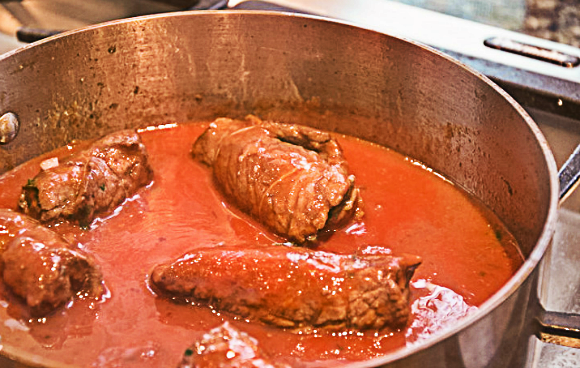
Whether it’s Ragù Napolitano “Classico” or “Leggere,”  this richly flavored sauce is a perfect example of traditional, long, slow-cooked (slow, very slow) food, the sort of memory-filled dish that makes all Neapolitans, rich or poor, remember their childhood and nonnas or grandmothers with even just one bite; or even with just one sniff of the bubbling sauce.

Because it needs to be looked after, slowly cooked and attention paid that it doesn’t burn or scorch, it was given the name sugo della guardaporta, the doorkeeper’s sauce, as it needed someone to watch over it as it slowly, slowly, slowly bubbled its way to perfection.

Though now it has come to symbolize family food, it was no doubt created in the 19th-century kitchens by the chefs of aristocratic Naples — its abundance of meat and attention-demanding cooking method would have been beyond the means of the city’s poorer inhabitants, which meant most of the population. Its name came from the French ragout, or saucey stew. The Neapolitan ragù is exactly that: a large piece of meat simmered in either tomatoey or oniony (La Genovese) sauce unlike the ragù of other
regions, which include small pieces of chopped meats and vegetables.

San Marzano tomatoes

San Marzano tomatoes.

Continue Reading…

Never miss a post
Name: 
Your email address:*
Please enter all required fields
Correct invalid entries

Food Favors Three, and So Do We

Published by Tuesday, August 27, 2019 Permalink 0

by Amy Cotler

Three satisfies, inviting us to plunge in, while kindly reminding us of life’s impermanence, because soon there’ll be two, then one.

One summer afternoon in New England I ran out to our garden, arriving back with a scant handful of the first cherry tomatoes. Soon, three lazy, but colorful halves topped salads for my husband, daughter and me. Our eyes bounced from red to red orb before we pounced. Why is the odd number three our culinary queen? Two on a plate sit symmetrically sad while only one looks like a cherry on top.


We’re three too — my daughter Emma, husband Tommy and I. I’ve been lured in by that number again and again in life and in food. My sisters Joanna, Ellie and I. My Dad’s writing, Mom’s cooking and me at the point of the triangle, borrowing from both. Young Emma’s PBJ sandwich cut point to point into triangle halves, so pleasing on the plate. Or in my catering days, a cluster of canapés waiting patiently on my cater-waiter’s tray, ready to be served. Those three points of bread work in tandem with three primary ingredients. Like bread and flinty ham topped with mustard sprouts, the bread showing at the edges to express itself just a bit. Or a swirl of gravlax with crème fraîche, a dill sprig propped on top.
Continue Reading…

Never miss a post
Name: 
Your email address:*
Please enter all required fields
Correct invalid entries

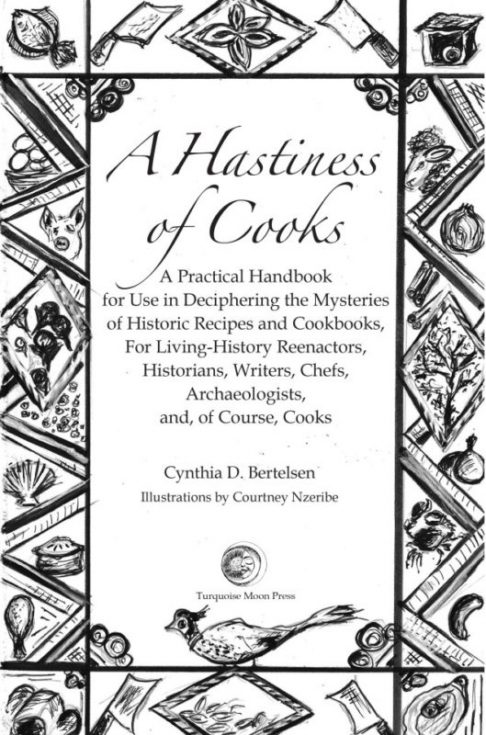
Book Review: A Hastiness of Cooks, by Cynthia Bertelsen

Published by Monday, August 12, 2019 Permalink 0

Book Review: A Hastiness of Cooks

by Margie Gibson

I’ve flirted with historic cooking for years, but somehow, the relationship never took off. I would get frustrated by arcane language and ingredients and turn to something more familiar and easier to cook. Cynthia Bertelsen’s new book, A Hastiness of Cooks, has provided the catalyst that just may spark a beautiful relationship.

This slim volume’s subtitle, A Practical Handbook for Use in Deciphering the Mysteries of Historic Recipes and Cookbooks, For Living-History Reenactors, Historians, Writers, Chefs, Archaeologists, and, of Course, Cooks, precisely summarizes the book’s aims and audience. Courtney Nzeribe’s many illustrations remind the reader that the book’s ultimate subject is food and its preparation.

Bertelsen has provided the organizational structure and clarity that will help the reader analyze recipes from earlier centuries. This volume concentrates on the food on European tables from the Middle Ages to the 1700s. Spanish and English recipes get prime attention—after all, the territories that Spain and England conquered were huge and were the source for a steady stream of new foods entering the European repertoire. Interestingly enough, England, whose early cooks were influenced by France, Italy, Persia, the Iberian peninsula, and Turkey, led the way in the production of manuscripts on cooking—which suggests to me that British cooking may have gotten a bad rap in the years since World War I.

Continue Reading…

Never miss a post
Name: 
Your email address:*
Please enter all required fields
Correct invalid entries

Cutting the Mustard

Published by Wednesday, July 31, 2019 Permalink 0

Cutting the Mustard

by Gary Allen

Mustard is second only to ketchup in the pantheon of popular condiments. 

All mustards start with seeds (of various colors and Brassica species). The suspended particles of ground powdered mustard or seeds, left whole, or used in combination, produce a variety of textures and flavors.

Mustard seeds

Mustard seeds (R).

Continue Reading…

Never miss a post
Name: 
Your email address:*
Please enter all required fields
Correct invalid entries

The Four Courses of the Apocalypse

Published by Thursday, July 25, 2019 Permalink 0

Remembrance of Food Past:

The Four Courses of the Apocalypse

by Leo Racicot

One of the glaring ironies of my life consisted of being pals with food goddesses Julia Child and M.F.K. Fisher, and yet not knowing how to make anything other than a peanut butter sandwich. My friends used to tease that, “Leo could burn boiling water if you don’t keep an eye on him.” When I was a kid, my poor mother, who often claimed I was her ticket to sainthood, would prepare the evening meal for my father, my sister, Diane and herself, and a lonely hamburger on a back burner of the stove for me because other than it and the peanut butter and bread, I refused to so much as look at any other kind of food. “This isn’t a restaurant,” my mother would say, but I was willful, wanted my burger and nothing else. So, in later years, it was of particular surprise to many, and especially to me, when I became a private cook to two former members of the Roosevelt administration, Hilda and Francis Shea, their son, Richard, and their live-in staff of 15 to 20 men.

Leo Racicot Julia Child in her Kitchen

Julia Child in her kitchen in 1997 (R).

I can boast a little bit now that I am quite the accomplished cook – I whip up a mean jambalaya and can flambé and sauté with the best of ‘em. But I did myself at the time no good throwing the names Fisher and Child around because that made Ms. Shea assume that I, too, knew how to cook. “Oh, Leo. Do you know how to make a Sauce Soubise?” she intoned, summoning up her most aristocratic accent. “Suuuuu-beeeeeze??” I said I did not and reminded her she had hired me to be Richard’s companion/caregiver. It led anyway to the dread question, “Well, did you ever take Chemistry 101 in school?” “Sure,” I said. I was then led by the nose over to shelves heavy with cookbooks of every decade and design, names so dear to me now but which instilled instant quivering in my spine when I first laid eyes on them: some vintage such as Michael Field’s Culinary Classics and Improvisations, and of course, the twin bibles of every serious kitchen: Irma Rombauer’s The Joy of Cooking and Julia’s Mastering the Art of French Cooking, and some quirky, even strange cookbooks such as Cook It Ahead, Live High on Low Fat, John Thorne’s Outlaw Cook, Only Kosher Cooking Matters, The Zodiac Cook Book. Ms. Shea waved her hand à la Vanna White showcasing letters of the alphabet and said, “Well, this is just like Chemistry 101, only with food.” She showed me where the apron was and left me to my folly.

Continue Reading…

Never miss a post
Name: 
Your email address:*
Please enter all required fields
Correct invalid entries

UA-21892701-1