Geneva, Switzerland: How to find food producers near you

Published by Tuesday, February 28, 2012 Permalink 0

The agricultural promotion office for the canton of Geneva (OPAGE) lets you fill out this A variety of punpkins at the Portland Farmers ..., telling them what you want, where, the producer’s or company’s name, etc. so you can find just about any local agricultural product you want. It makes it so easy!

A variety of punpkins at the Portland Farmers ...


Never miss a post
Name: 
Your email address:*
Please enter all required fields
Correct invalid entries

Stalking the Black-Eyed Villnösser Brillenschaf Sheep

Published by Tuesday, February 28, 2012 Permalink 0

by Diana Zahuranec

The most terrifying ride of my life was up a slick, steep mountain road in Alto Adige. Alto Adige is the northernmost region of Italy that touches Austria and melds with its language, architecture, and mountainous geography. This little-known region to the usual American tourist is prosperous, picturesque, and culturally stimulating. Before its annexation from Austria-Hungary as part of the Treaty of Saint-Germain in 1919, Alto Adige had been part of the Austrian Empire and the Holy Roman Empire for centuries. The identity of the region has been tugged between Austria and Italy ever since its annexation, a dual identity that is seen on everything from road signs to cultural heritage sites.

The charming architecture of Alto Adige


Alto Adige itself is divided into two other regions, Südtirol, or South Tyrol in the north, and Trentino in the south. The closer one gets to Austria, the stronger the Germanic influence is. In the northernmost parts of Alto Adige, the Austrian culture can be seen as the primary one, while the language and culture of Italy is definitely secondary.

The field trip that took a class of 26 and I to the Dolomite Mountains of the region was part of the curriculum of the University of Gastronomic Sciences, a school in Piemonte, Italy. Our journey was to begin with a monster of a man at odds with his traditional wear of embroidered, tan leather lederhosen, and end with the rare Villnösser Brillenschaf sheep breed with black fur “glasses” framing their dark eyes and black-dipped ears.

The man was burly, tall, straight out of a German-Austrian fairy-tale that could involve lumberjacks fighting giants, and he was our driver. We stood huddled in a damp group at the bottom of a hill, ready to be transported to the top of the mountain to see the sheep and learn about them. The charter bus we usually took could not go up the mountain, because it was too big. We were ushered into two large vans. The driver of mine was Herr Lumberjack (he was not a lumberjack, that I know of; but for lack of a name, this is it). I regret that I didn’t take a photograph of him, but he was a bit intimidating even with embroidered lederhosen. I felt – we all felt – we were in sure hands up this mountain road that grew steeper every ten feet, and which a charter bus could not hope to climb.


View from above: the Dolomites as seen from the bus


The road was much like other frightening mountain roads: unpaved, steep, narrow, and sans guardrail. I was not nervous at first, but the road was longer and steeper than we thought. The rain came down heavier and our breaths fogged the windows as we climbed in altitude into cold clouds. The hairpin turns were stomach-churning when Herr Lumberjack stopped, backed up a few inches towards the cliff – and a few more for room to turn – and looked back, grinning widely through the hand-wiped back windows to determine how much further he could go (answer: not another inch).

Looking over the edge from up high in a large van, my stomach dropped. It seemed from the high vantage point that the road’s edge was exactly at the tire’s edge. The trees were cut back at intervals, and the cliff of the mountainside fell away to reveal beautiful, jewel-toned landscapes, wet and saturated with color. I snapped a few hurried photos when I wasn’t gripping the headrest in front of me, because it was safer than closing my eyes and less frightening to look through a lens. All the photos turned out blurry; and talk about a photo not doing the real thing justice.

When the last switchback was so narrow that the inching, maneuvering wheels were too close even for our driver; when there was actually not enough room to turn at all; when Herr Lumberjack’s face was serious in concentration and not grinning manically; and when we were all sweating and silent from nerves was when we stopped to walk the rest of the way to the top. My legs were shaky, and the gravel slippery when I climbed down to solid ground from the steamy van. The air was cold, colder on the top of the mountain, and our breath came out in foggy, hot puffs. We hiked to the top.

Mountain top with Villnösser Brillenschaf sheep


We were greeted with a beautiful pastoral scene. In the dipping center of two hilltops was a small, wet wood cabin. Scattered between and up the vibrantly green hills was a small flock of sweet, white sheep, all with black glasses patterns circling their eyes. We walked with restraint, eager to see the peaceful scene with the stormy backdrop while not frightening the animals. Threatening, grey clouds opened to a steady, cold drizzle as the shepherds told us the history of the sheep. We huddled under shared umbrellas.

The Furchetta company, named after the mountain chain, tends to one of only two flocks of this breed of sheep, which is the oldest race in Alto Adige. It is seemingly a mixed breed with its black markings on white fur, and so had a tough time surviving during the Second World War when Hitler was bent on eliminating anything not of “pure” race. The Villnösser Brillenschaf was nearly eliminated, and about 400 survive today thanks to the shepherds and farmers of companies like Furchetta. The particular breed is also a Slow Food Presidia, which both protects and promotes it.

Villnösser Brillenschaf sheep are a Slow Food Presidia


Furchetta’s main product is cooked lamb prosciutto, which we had the pleasure of eating at lunch only an hour later at a restaurant in the foothills; but the farmers also realized that the high-quality wool was often going to waste. The price of wool has dropped significantly in recent decades and producing wool products is expensive. Furchetta strives to capitalize on the fact that, because the Villnösser Brillenschaf breed has extra-oily wool, its heat-retention and water-wicking properties are superior. The high quality and excellent taste of the prosciutto and various lamb salumi have encouraged chefs of Michelin star restaurants of the area to purchase the meat.

Cooked lamb salame


I would like to experience a little adventure like this for every food I eat. The harrowing ride into the clouds and the perfect scene at the end, offset to biting cold and wet weather with the promise of a full, hot meal at the end, were stimulating. The memories of the Villnösser Brillenschaf sheep and how we arrived to see them in their mountain environment connect to the meal we ate later, a meal whose memory would have already faded had it not been for all the elements of the experience.

Related articles

Never miss a post
Name: 
Your email address:*
Please enter all required fields
Correct invalid entries

Simon Says: Daily Food Quote, February 28, 2012

Published by Tuesday, February 28, 2012 Permalink 0

Simon Says: Daily Food Quote, February 28, 2012

by Simon de Swaan

When I was a little girl, I always wanted to be in the kitchen, because it is warm, and that’s where my mother was. You never lose that feeling.–Dolly Parton

Dolly Parton is an American singer-songwriter, author, multi-instrumentalist, actress and philanthropist, best known for her work in country music. She starred in the Dolly Parton 9 to 5, The Best Little Whorehouse in Texas, Steel Magnolias, Joyful Noise and Straight Talk. She is one of the most successful female country music artists of all time, with an estimated 100 million in album sales. Dolly is also one of the bestselling artists of all time. She is known as “The Queen of Country Music”.

She opened a movies theme park in 1985, and was later inducted into the Country Music Hall of Fame in 2000.

Watch a video performance of Dolly singing her great hit “Jolene” below.


Never miss a post
Name: 
Your email address:*
Please enter all required fields
Correct invalid entries

Food Art: Lamb Mint Meatballs, food photography by Meeta Khurana Wolff

Published by Tuesday, February 28, 2012 Permalink 0

See more food photo compositions at Meeta K. Wolff or in our Food Art category.

Never miss a post
Name: 
Your email address:*
Please enter all required fields
Correct invalid entries

Food Art: Pizza Cones, food photography by Sandeea

Published by Tuesday, February 28, 2012 Permalink 0

Sandeea is our latest food photography discovery. A woman of many talents, she is also author of the Food Play column. She writes in both English and Spanish.

Never miss a post
Name: 
Your email address:*
Please enter all required fields
Correct invalid entries

The Best Kebabs in Paris

Published by Tuesday, February 28, 2012 Permalink 0

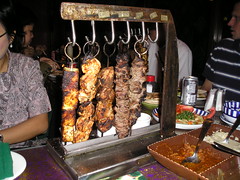
Good kebabs do exist — with homemade sauces, fresh vegetables, and high-quality meat — and this site has tested them for you. The Parisian version is also referred to as “Greek sandwich.”

Click here to go to site.

Kebab


Related articles
Never miss a post
Name: 
Your email address:*
Please enter all required fields
Correct invalid entries

Simon Says: Daily Food Quote, February 27, 2012

Published by Monday, February 27, 2012 Permalink 0

by Simón de Swaan

My kitchen is a mystical place, a kind of temple for me. It is a place where the surfaces seem to have significance, where the sounds and odors carry meaning that transfers from the past and bridges to the future.–Pearl Bailey

Pearl Mae Bailey (1918-1990) was an American actress and singer. After appearing in vaudeville, she made her Broadway début in St. Louis Woman in 1946. She won a Tony Award for the title role in the all-black production of Hello, Dolly! in 1968. In 1986, she won a Daytime Emmy award for her performance as a fairy godmother in the ABC Afterschool Special, Cindy Eller: A Modern Fairy Tale.

You can see her perform in the video at the bottom of the page.


Pearl Bailey in “St. Louis Woman”, 1946


Never miss a post
Name: 
Your email address:*
Please enter all required fields
Correct invalid entries

Food Art: Making Art from Buffet Ingredients

Published by Saturday, February 25, 2012 Permalink 0

How Sunday Lunch Can Turn into an Art Show

http://www.feedblitz.com/js/fbz_formopts.js, .F4912_fbz_button {padding:0.5em;line-height:1.7em;background-color:#E0E0E0;background-image: -webkit-gradient(linear, left top, top bottom, from(#E0E0E0), to(#ffffff));background-image: -webkit-linear-gradient(top, #E0E0E0, #ffffff);background-image: -moz-linear-gradient(top, #E0E0E0, #ffffff);background-image: -ms-linear-gradient(top, #E0E0E0, #ffffff);background-image: -o-linear-gradient(top, #E0E0E0, #ffffff);background-image: linear-gradient(top, #E0E0E0, #ffffff);border:1px solid #AAAAAA;border-radius:4px;moz-border-radius:4px;font-size:12px;padding:0.5em !important;text-align:center;margin:0;cursor:pointer;} .F4912_fbz_button[type="button"]:hover, .F4912_fbz_button:hover {background:#ffffff} .F4912_fbz_button[type="button"]:active, .F4912_fbz_button:active {background:#cfcfcf} .F4912_fbz_button[disabled=disabled], .F4912_fbz_button[type="button"]:disabled, .F4912_fbz_button[type="button"]:disabled:focus, .F4912_fbz_button[disabled]:disabled,.F4912_fbz_button[disabled],.F4912_fbz_button:disabled,.F4912_fbz_button:disabled:focus {opacity:0.5;} .F4912_fbz_row:hover {background: rgba(251,248,231,0.5);-o-transition: all 0.1s ease-in-out;-webkit-transition: all 0.1s ease-in-out;-moz-transition: all 0.1s ease-in-out;-ms-transition: all 0.1s ease-in-out;transition: all 0.1s ease-in-out;} .F4912_fbz_row_nohover:hover {background:transparent;} .F4912_fbz_form {border:3px solid #FFA000;background-color:#FAFAFA;border-radius:20px;moz-border-radius:20px;padding:0;line-height:1.3em;font-size:12px;} .F4912_fbz_form div {font-size:12px;line-height:1.3em;} .F4912_fbz_form tbody {border:0;padding:0;margin:0;font-size:12px;} .F4912_fbz_form td {border:0;margin:0;font-size:12px;} @media only screen and (max-width: 420px) {.F4912_fbz_label{display:none !important;} .F4912_fbz_abovelabel{display:block;} .F4912_fbz_input {width:95%;} .F4912_fbz_tabcell {display:block;}};
Never miss a post
Name: 
Your email address:*
Please enter all required fields
Correct invalid entries

This Week’s Top 10 Food Photos

Published by Friday, February 24, 2012 Permalink 0

February 24, 2012

We’ve started a food photography album! Every time we fall in love with a food photo, we add it to our gallery.


Baroque Lemons (C), by Alessandro Guerani

Continue Reading…

Never miss a post
Name: 
Your email address:*
Please enter all required fields
Correct invalid entries

One Green Planet: Infographic Explaining GMOs in an Easy-to-understand Manner

Published by Friday, February 24, 2012 Permalink 0

One of our columnists, Wendy Kirby, who runs the site La Phemme Phoodie, discovered this GMO infographic on One Green Planet. It illustrates GMOs extremely well for those of us who are trying to understand it better.

Please take a look!


Continue Reading…

Never miss a post
Name: 
Your email address:*
Please enter all required fields
Correct invalid entries

UA-21892701-1