A Mesolithic Dinner: Food, Wine and Art by Jane Le Besque

Published by Tuesday, June 4, 2013 Permalink 0

by Jonell Galloway

A Mesolithic Dinner: Food, Wine and Art by Jane Le Besque
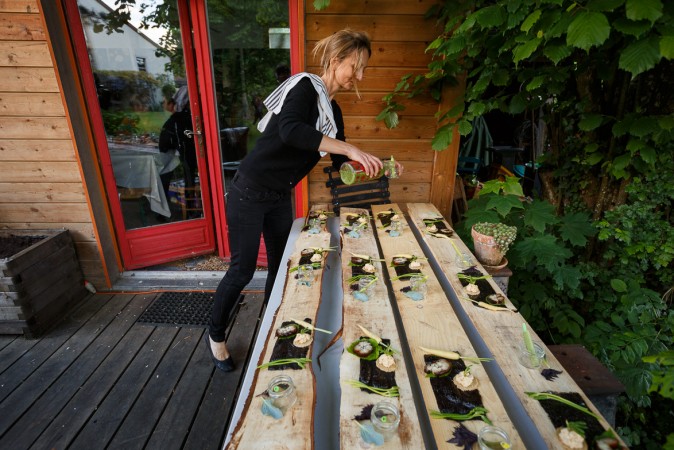
 

Jane Le Besque hosted a “mesolithic dinner” on June 30, 2013, in her home in the Pays de Gex just over the border in France, an event sponsored by Slow Food Geneva. The dinner was cooked using ancient flavor combinations and techniques, and served on split logs onto which slate plates were placed and used as plates.

What Food Did Jane Le Besque Serve at Her Mesolithic Dinner?

Although Jane’s dinner was labeled “Mesolithic”, it was indeed much more than that. She covered the evolution of food from the post-glacial hunter-gather periods, through the Mesolithic and Neolithic, and going on to the Ancient Greeks and Romans, centering on Europe.

It started with the Mesolithic era, with an assortment of coastal and lake fish, eel, root vegetables and wild greens. The meal then slipped in to the Neolithic era with galettes made from ground lentils, peas and barley, served with spit-roasted boar. The menu ended with an Iron-Age “travelers pack” of dried fruits and dried-porridge slices fried in cumin and butter. The Bronze Age brought blue cheese and butter.

Drinks consisted of mead, more often referred to as “honey wine,” more in the style of the ancient Greeks and Romans than of more ancient peoples, and beer.

What is the Mesolithic?

As a reminder, the Mesolithic Age refers to the pre-agricultural period between 10,000 and 5,000 BCE in Europe, and variations of this period in other parts of the world. The term “pre-agricultural” is key in understanding what ingredients were available. The three terms paleolithic, mesolithic and mesolithic refer to what is generally called the “Stone Age,” i.e. the post-glacial hunter-gatherer period, when humans started to use stone tools and food was gathered rather than farmed.


During the early Stone Ages or paleolithic (2.6 million years ago to around 10,000 BP), humans used some stone tools and utensils, but many tools were made from organic matter such as bone, fibers, and wood. Hunting and gathering were the chief ways of providing food. During the neolithic, starting around 10,200 BCE and ending between 4,500 to 2,000 BCE, depending on the location, we saw the beginning of farming. The mesolithic overlapped the other two ages, once again, at different times in different places. Metal tools brought these three Stone Ages to an end.
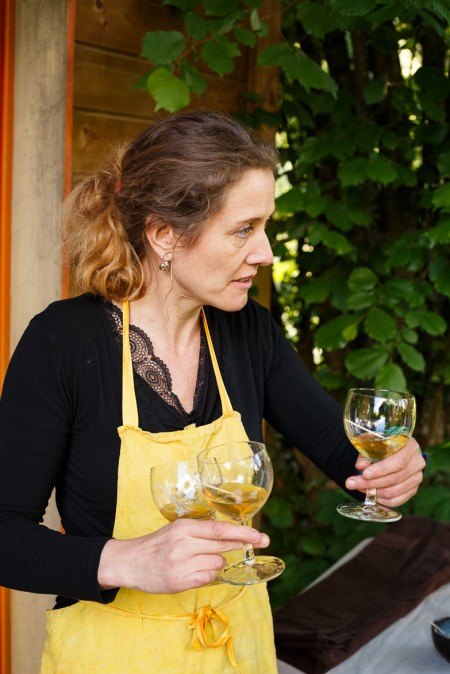
Jane Le Besque, artist and Mesolithic chef, serving mead


Early Stone Age cooking was generally on leaves or directly over the embers, although clay cookware has recently been found in China dating from 19,2000–20,000 years ago, during the ice age. Stone Age plates usually consisted of a rock or other flattish surface found in nature, such as the flattened split logs Jane used in the same manner as we use wooden tables today. Earthenware did not appear on the dinner table until much later.

What Did You Usually Eat at Mesolithic Dinners?

What did they eat? Pretty much whatever they found and killed that was edible: meat, fish, wild plants. The specifics of this depended on the location, climate and season. Meals included the day’s finds. This might consist of berries, wild greens and other wild vegetables and plants.

Meat and later fish were not an everyday affair. They were difficult to come by and difficult to preserve, depending on the location (salt was found in Romania as early as 10,000 years ago). Stone  Age people ate very little grain, since agriculture didn’t exist yet. Hazelnuts and other nuts were often roasted, and stored for winter. Wild boar was common; dairy products and cheese were on the menu, although a limited variety.

About Jane Le Besque

Jane Le Besque lives and works with her family at the foot of the French Jura, a few minutes from Geneva, in the foothills of the Jura mountains.

She was born in England and has a Breton grandfather, hence the name. Since graduating from Birmingham Art College in 1986, she continued her studies at l’Ecole des Beaux Arts in Paris. She afterwards lived and worked in Toulouse, London, and now outside Geneva.



Jane has always painted. She is her happiest walking through the woods and gathering berries, mushrooms, acorns, flowers and leaves to use in her cooking and painting.

One might say Jane has been interested in mesolithic cooking even before she learned the word. As a child, she spent her time gathering the wild things she now uses in her paintings,  making dresses out of them.

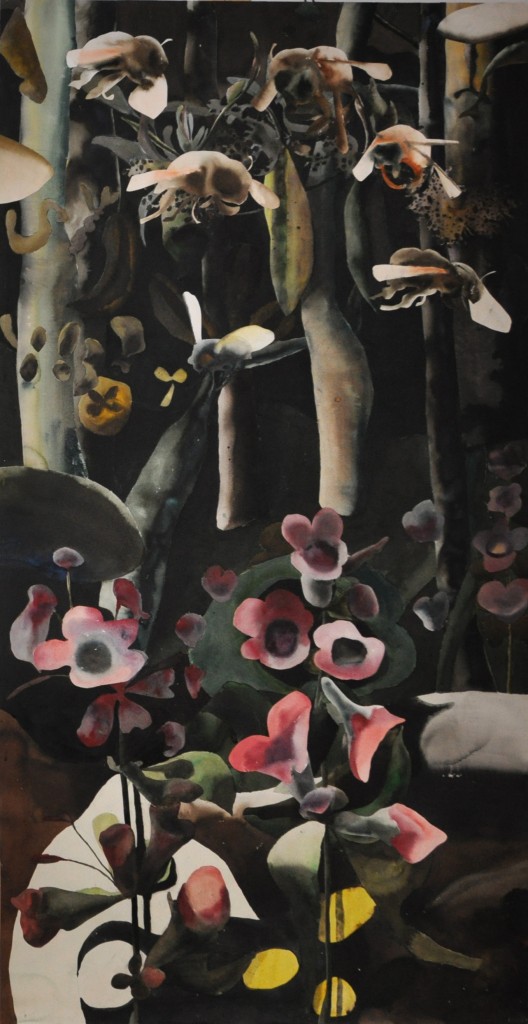
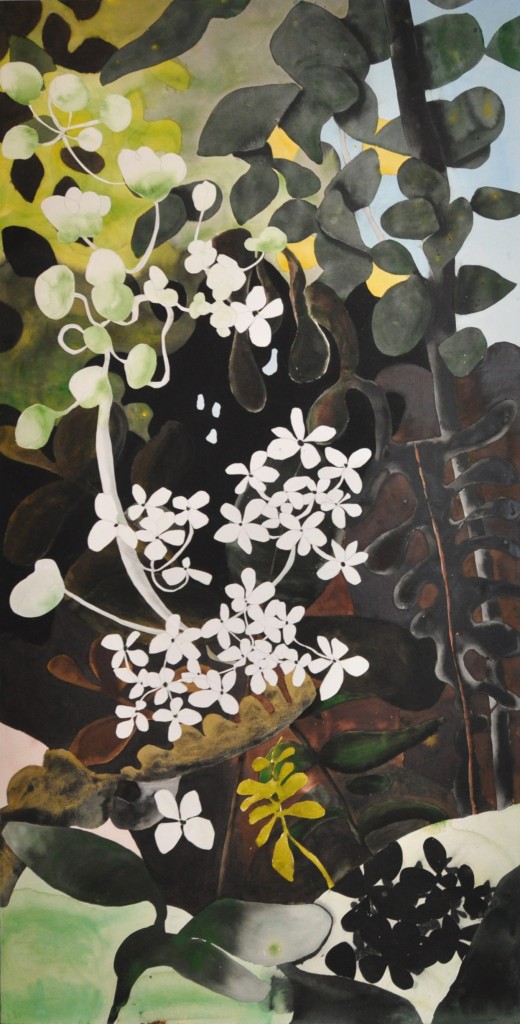
Her paintings are an intense reflection of her “gatherer” spirit. The Mesolithic dinner was held in her studio, lined with her paintings of flora of all types.


Never miss a post
Name: 
Your email address:*
Please enter all required fields
Correct invalid entries

Food Art: Kentucky Route 127 Yard Sale, a food & other photography exhibit by Dave Cronen

Published by Thursday, August 2, 2012 Permalink 0

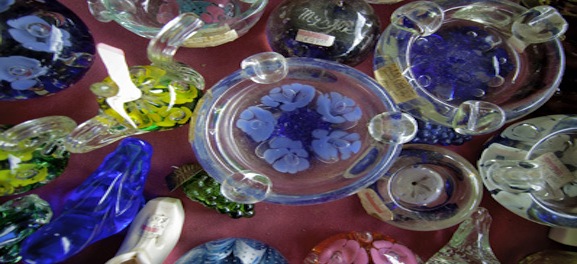
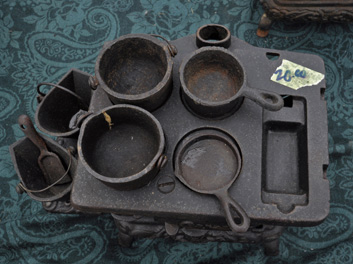
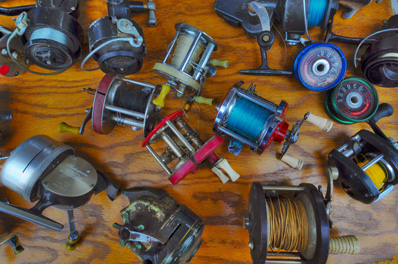
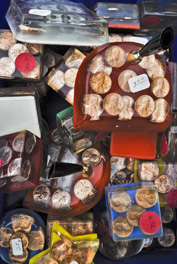
Interview with Dave Cronen: I am not a big fan of yard sales per se but I have to admit when you lump them all together for 400 miles (from Michigan to Alabama), they do have a draw. Once a year, usually in August, on a secondary road called Route 127, buyers and sellers meet to buy and sell their wares. One thing I have noticed is the inordinate amount of kitchen stuff. One is an item, 15 is a collection. I’ve enjoyed photographing the patterns and shapes and the colors of America throughout my career as a photographer.

Never miss a post
Name: 
Your email address:*
Please enter all required fields
Correct invalid entries

Part 1: Food Fermentation for Beginners

Published by Tuesday, July 24, 2012 Permalink 0

Part 1: Food Fermentation for Beginners

by Diana Zahuranec

Cultures all over the world and for thousands of years have developed fermented foods and drinks. Japanese miso, Korean kimchi, kefir from Eastern Europe and the Middle East, sauerkraut from Germany; yogurt, sourdough bread, and even chocolate are some examples. While scarfing down some quickly “pickled” carrots I had made, I thought, why not make real fermented vegetables? I have a penchant for salty, sour foods, so why not ferment a big batch of it? The nutritional value actually builds and multiplies in fermented foods. I would satisfy my cravings, indulge in a natural, traditional super-food, learn about an ancient practice, and have a project to boot.

To learn the scientific details behind fermenting, I picked up Harold McGee’s On Food and Cooking: The Science and Lore of the Kitchen. For fermentation how-to, I quickly found an article on Sandor Ellix Katz’s blog (who, before, helped my friends and I make cheese). For a fermentation step-by-step picture guide, I found Recipes from a German Grandma.


I wanted to settle the nagging doubt about using equipment no more advanced than big glass bowls picked up in a used goods store. Pickl-It jars, Harsch crocks , and other crocks aren’t found easily in Italy, my home-away-from-home, or if they were I wouldn’t carry them around on my back while biking from store to store in the sweltering heat. Ideally, I would use Pickl-It jars or a Harsch crock over my open crock method, because I’ve never fermented vegetables and believe I’ve already made a few mistakes (ahem…this I will find out in roughly two weeks). Small batches of fermenting veggies are prone to come into contact with air when using the open crock method, causing you to lose some of the precious little you’ve made.

I don’t know which I would choose over the other, but apparently there are Team Pickl-It and Team Harsch Crock sides to this debate.

Too late now. I’ll find out if my haphazard but enthusiastic open crock method works in about two weeks. That will be the turning point in my brief fermentation career in making a major decision: to buy or not to buy a Pickl-It jar.

Pickl-It jars


Along with growing doubts as I read about fermentation, the more fascinating information I find. This post will be just the beginning of a short fermentation series that sort of follows along with my own method: dive right in knowing the basics, then nervously twist a strand of hair as I read more about it, then fixate on all things fermentation.

Harsch crock. I didn’t have strong doubts about the open crock method. No one 500 or 2,000 years ago had Pickl-It jars or a standard Harsch crock. Unfortunately, and after I already had my kraut for a day and a half, the more I read about it, the more uncertain I’ve become. Sandor Ellix Katz’s directions seemed straightforward, but some other articles worried me.


Let the fermentation begin!

Here are some other links I found useful:

Make your own sauerkraut, by Mary E. Mennes
Comparison of Vegetable Fermentation Methods, by Kimi Harris
Homemade sauerkraut, by Jenny
Vegetable Fermentation Further Simplified, by WildAdmin
Fermented Foods Webinair, by Jenny

Never miss a post
Name: 
Your email address:*
Please enter all required fields
Correct invalid entries

New column: Quelling Quitchen Qualamities

Published by Tuesday, March 6, 2012 Permalink 0

by The Quonstant Quonnoisseur

[This is the first in an occasional series of  short items by the QQ. Preventing kitchen mishaps, and adroitly recovering from any that do occur, will figure as an important topic in these updates.]

The problem: Overheating low-fat milk

The cause: Low-fat milk products cannot be boiled, unlike cream. Low-fat milk must be kept below 82° C or 180° F to avoid curdling or “breaking.” Using overheated low-fat milk that has curdled will  result in grainy ice cream, pudding or other dish.

The solution: To avoid this qualimity, invest in a clip-on thermometer and watch your low-fat milk like an anxious Dad with a pretty 19-year-old daughter.

Continue Reading…

Never miss a post
Name: 
Your email address:*
Please enter all required fields
Correct invalid entries

Everything you need to know about the dangers of food packaging

Published by Tuesday, January 31, 2012 Permalink 0

by Jonell Galloway

Fooducate gives a layman’s explanation for understanding the differing degrees of danger with regard to food packaging, and how much BPA you might actually have in your bloodstream.


BPA stands for bisphenol A. According to the Mayo Clinic and the FDA, the U.S. Food and Drug Administration, it may well pose a wide variety of harmful effects to health.

Continue Reading…

Never miss a post
Name: 
Your email address:*
Please enter all required fields
Correct invalid entries

Swiss Cookware: Unbeatable Quality and Made to Last a Lifetime

Published by Wednesday, December 21, 2011 Permalink 0
by Jonell Galloway

A Perfect Last-minute Christmas Gift for Foodlovers

High-quality Swiss cookware is a world away from supermarket style non-stick pans and traditional French copper.

Double-walled Durotherm pan.
Photo courtesy of Kuhn Rikon.


I lived in France for many years, and swore by my French copper pans and Godin gas stove. On arrival in Switzerland, where many homes (at least ours) were long ago converted to convection cookers, I longed for my Godin and shiny copper pans, all shaped to meet the special purpose they were made for.

But since my philosophy in life is to “go local”, whether I’m in the Sahara or Geneva, Switzerland, I immediately started doing my research, and was more than pleasantly surprised at Swiss engineering and design skills when it comes to modern cookware. Their cookware is not only made to last a lifetime; it is made to conserve vitamins and is ecological.

So to get to the end of this long-winded tale, I would suggest the following gifts for any cook, whether gourmet or amateur. They will thank you every time they use it, and they will most likely use it every day for just about the rest of their lives.

Swiss Diamond Cookware

I already gave Swiss Diamond a rave review in my post of 12 June 2009, The perfect non-stick frying pan: Swiss Diamond. I haven’t changed my mind. Because they are made of thick, cast aluminium, they sear meat and fish like an old-fashioned iron skillet, but using less fat. The non-stick finish is unbeatable, practically unscratchable, because it really is made with minuscule diamond chips!

Kuhn Rikon Durotherm Pans

Kuhn Rikon Durotherm heavy-duty, double-walled pans allow you to steam vegetables, meat or fish with no fat and little water. The water turns to steam and recirculates inside the pan, thus allowing you to maintain the vitamins and eat fat-free. Thanks to the double wall, the pans maintain the heat for 2 hours after cooking, so it’s great for cooking up dishes before guests arrive.

Durotherm pans are good for one-dish meals and cooking vegetables on an everyday basis. They also cook vegetables more quickly than boiling in a normal saucepan, and vegetables are never water-logged. The steam recirculation method prevents the vitamins from “leaking out” into the water.

I often steam my vegetables in a Durotherm, and then at the end carefully lay a piece of fish on top of the vegetables, making sure no water touches it, and put the lid on and let it steam-cook. It takes about 5 minutes for an average-size piece of cod, for example.

The Glories of Swiss Engineering

Swiss diamond cookware,
available at many butcher shops.


OK, I’ll end this lengthy tale with a summary, praising the glories of Swiss engineering, which applies not only to bridges, tunnels, and roads, but also to cookware.

It is true that these pans require a greater investment than the lighter weight, supermarket versions, but in the long run, they work out to be much cheaper.

When you scratch a frying pan with a regular PTFE non-stick coating, many health experts advise throwing them away. All it takes is a nick with a metal knife or fork, and it’s ready for the bin. Swiss Diamond coatings are of a much hardier sort.

Durotherm pans are also energy-saving and water-saving. They come with a made-to-size serving base that allows you to set them right on the table, and they are attractive enough to do just that.

In addition, all these pans are made of a much heavier metal, so not only do they cook better, they do not bend out of shape when put on high heat. They really are long-term investments, thus making them ecological as well, since you don’t have to continuously renew your cookware and throw out the old ones.

Continue Reading…

Never miss a post
Name: 
Your email address:*
Please enter all required fields
Correct invalid entries

That’s So Corny, Irene!

Published by Friday, August 26, 2011 Permalink 0

by Alice DeLuca

A Brief History of Creamed Corn and What to Pack in Your Hurricane Survival Kit

This season, our thoughts turn to hurricanes and the darker part of the year.  My own thoughts wander quite a bit, as a matter of course, and I find myself thinking about creamed corn, and specifically canned creamed corn, a staple of the American baby boomer childhood larder.

Creamed corn and a particular type of silver-labeled canned peas are tied to deep memories of preparations for stormy weather. We always had cans of corn, peas and baked beans, and kerosene and candles, in case of emergencies, storms, and power failures.

Continue Reading…

Never miss a post
Name: 
Your email address:*
Please enter all required fields
Correct invalid entries

Our new boutique with items hand-picked with our readers in mind

Published by Saturday, October 9, 2010 Permalink 0


The Rambling Epicure is opening a kitchenware and kitchen-related boutique, with items hand-picked with our readers in mind. Click here to take a peak.

We’re in the process of picking the items, so keep your eyes peeled!


Related articles


Never miss a post
Name: 
Your email address:*
Please enter all required fields
Correct invalid entries

UA-21892701-1