David Downie: Awesome & Easy Seafood Pesto Recipe, Great Lunch at Da Mirin

Published by Wednesday, February 9, 2011 Permalink 0
by David Downie


(Photo shown: Alison Harris’ cover shot for Enchanted Liguria, which shows the church of San Rocco di Camogli)

The perched village of San Rocco di Camogli could fit in a picnic hamper, yet it boasts a famous bakery (Maccarini), a great butcher shop (Arturo Paolucci), a Michelin-praised restaurant (Nonna Nina) and a friendly little trattoria with fresh fish and a nice terrace and eager owners: Da Mirin. Co-owner Sandro does the cooking, while his wife and fellow proprietor, Elena, waits and runs the show.

Today Sandro whipped up some succulent fresh fish mousse with local olive oil, salt and pepper – not the creamy, heavy kind of mousse you get in fancy restaurants or in France. We nibbled on that with focaccia while waiting for the Pesto di Mare. This too is Sandro’s invention. First you clean and mince or process a bunch of fresh, fragrant basil, tossing in a fistful of plump pine nuts. Then you set the salsa aside. (Yes, salsa. In Italy, sugo = “sauce” and it is cooked, whereas salsa is raw, always). You take a handful of fresh, ripe tomatoes, simmer them at low heat in excellent olive oil, with a pinch each of salt and pepper. You prepare a couple of handfuls of fresh shrimp. You boil pasta like trenette or linguine or tagliolini or even fresh gnocchi. While the pasta is cooking, you toss the shrimp in with the tomatoes. A few seconds before the pasta is al dente, you take the sauce off the heat, put it in a serving bowl and stir in the salsa (the pesto of basil and pine nuts – no cheese, no garlic). Then you toss in the hot pasta and serve pronto. Awesome. Super, really, killer awesome.

Never miss a post
Name: 
Your email address:*
Please enter all required fields
Correct invalid entries

The Rambling Epicure Voices

Published by Monday, February 7, 2011 Permalink 0

Food writer, Culinary Chemistry, The Rambling EpicureJenn Oliver writes our column Culinary Chemistry. She has a Ph.D. in science, where she explains the scientific aspects of what really goes on when you cook (the next Harold McGee?). She’s been running a gluten-free blog, Jenn Cuisine, since 2008 and her kitchen is more like a laboratory than a kitchen. She’s focuses her chemical calculations and experiments on figuring out how to make traditionally glutinous food gluten-free.

Esmaa Self writes the Wild Woman on Feral Acres column. She lives on a small farm in Colorado where she employs organic and sustainable methods to grow fruits, vegetables and herbs, raise chickens, bees and fish and where she routinely turns out imaginative, healthy, guilt-free meals from scratch. One of her numerous blogs recounts her farming adventures: Backyard Eggs. She also writes novels and contributes to numerous organic farming and green publications, and runs a sustainable living site, Homeostasis.

Simon de Swaan is Food and Beverage Director at the Four Seasons hotel in New York City. He studied at the Culinary Institute of America and has an incredible collection of antique cookbooks and books about food and eating, from which he often posts interesting and unusual quotes. In his column Simon Says, he gives us daily food quotes from his tomes.

Jean-Philippe de Tonnac is an essayist, editor and journalist. He directed the special editions of the Nouvel Observateur for almost ten years and and has published twenty books. As preparation for publication of his Universal Dictionary of Bread (Dictionnaire universel du pain, Bouquins Laffont, 2010), he obtained a baker’s certificate (CAP) at the Ecole de Boulangerie et Pâtisserie de Paris in 2007, and traveled worldwide to countries where bread held a particular cultural significance.

Continue Reading…

Never miss a post
Name: 
Your email address:*
Please enter all required fields
Correct invalid entries

David Downie: Pandolce, Italian Riviera Icon

Published by Monday, February 7, 2011 Permalink 0

by David Downie

Pandolce is one of the Italian Riviera’s culinary icons. It’s found from the Cinque Terre near Tuscany, to Genoa, all the way to Ventimiglia on the border with France. Ligurians call pandolce “pandöçe” in their challenging, tongue-dislocating dialect. For lack of a better description in English, you might reasonably call it a Christmas fruit cake.

Pandolce comes in two basic formats. The old-fashioned one, made in bakeries or at home (by about 10 people in the entire region) is tall, porous, airy and leavened twice, and has a round or dome-shaped form. It’s the Riviera’s answer to Milanese panettone.

The other Ligurian variety, which everyone mistakenly calls all’antica (it’s much more recent in invention) stands only a few inches high, is dense and heavy and fabulously good: take a look at the pic on this page (by Alison Harris, of course).

Continue Reading…

Never miss a post
Name: 
Your email address:*
Please enter all required fields
Correct invalid entries

David Downie: World’s Best Tortellini in Paris?

Published by Wednesday, February 2, 2011 Permalink 0

by Pellegrino Artusi’

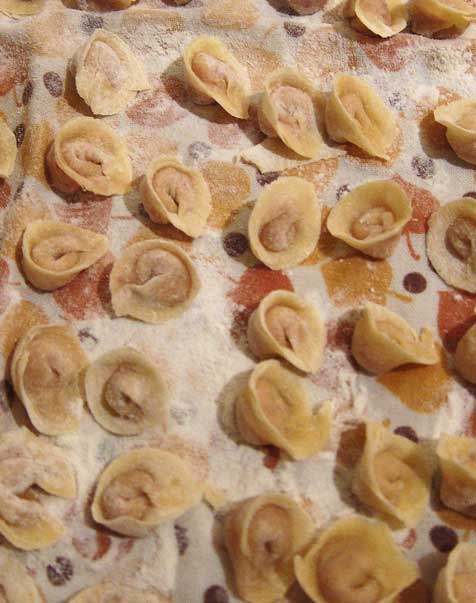
The other night, for our collective birthdays – three of us – our dear friend Daniela X (she is modest and does not wish to be identified) made classic tortellini alla bolognese in brodo. Anyone who has been to Bologna, Parma, Modena or the other great-eating-cities in the Emilia region, will know the authentic item.

Tortellini are a variety of navel-sized (and shaped) filled pasta — see the photo of Daniela’s tortellini, courtesy Kimmo Pasanen. They’re cooked in a sumptuous broth made from several types of meat (usually chicken or capon, veal, and, optionally, cotechino), and served in the broth, period. Purists don’t even sprinkle them with grated Parmigiano. But that may be going too far.

Continue Reading…

Never miss a post
Name: 
Your email address:*
Please enter all required fields
Correct invalid entries

David Downie: Vintage Beaune

Published by Wednesday, January 19, 2011 Permalink 0

by David Downie

Many wine lovers know that in the Middle Ages monks at the abbey of Cluny in southern Burgundy perfected the art of winemaking. But few outside the region have heard of Rector Eumenus’ speech in 312 AD to Emperor Constantine at Augustodunum, today’s Autun. Even locals don’t realize that fine wines were being grown in Constantine’s day on the limestone hills of the Côte d’Or.

Eumenus extolled in particular the vineyards of a pleasant village called Belenos, on the Roman road from Lyon to Paris, in the sunwashed Sâone River Valley. Still the capital of winegrowing in Burgundy, modern Belenos, better known as Beaune, hosts more wineries within or near its medieval ramparts than any mere mortal—except, perhaps, Robert Parker—could reasonably discover in anything less than a three-day visit.

Continue Reading…

Never miss a post
Name: 
Your email address:*
Please enter all required fields
Correct invalid entries

UA-21892701-1