Do you know this painting? Well, here’s the recipe

Published by Friday, July 1, 2011 Permalink 0

by Miriam Garcia

Do you know this painting?
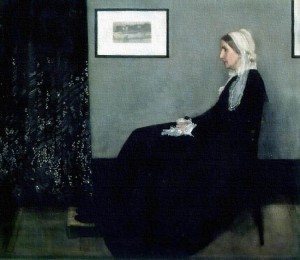
Photography by courtesy of Wikimedia Commons

Its formal name is Arrangement in Grey and Black: The Artist’s Mother, but it is commonly known as Whistler’s Mother. Its creator, American artist James McNeill Whistler, happens to be one of my (many) favorite painters. In August 1995, while on vacation in London, I stumbled upon a little book with this painting grazing its front cover. It was Whistler’s mother’s cookbook, with the recipes collected by Anna McNeill Whistler (1804-1881) through the years. The recipes are recreated and annotated for the modern cook, but included the endearing original writing of Mrs. Whistler, with all its own spelling and punctuation errors. Go figure, a book that coupled two of my most serious addictions, cooking and painting. I had to buy it.

Whistler’s mother’s recipes were among a collection of books and letters that were bequeathed by Whistler’s sister-in-law to the University of Glasgow after his death. Whistler lived in Europe most of his working life. Mrs. Whistler led quite a remarkable life herself for a 19th-century housewife; she went from the United States, via Russia and sudden widowhood at a young age, to London with her son, where she recorded in her diaries visits to the Whistler household from such artists as Algernon Swinburne and Dante Gabriel Rossetti. The book’s fascinating account of the Whistler household in America, Russia and Britain offers a unique and delightful glimpse into 19th-century family life and cooking. The recipes are simple and transmit the flavors and aromas of good home cooking.

As a token of that age and to bring to the pressed 21st century some 19th century calm and simplicity, I have chosen to replicate a recipe of her apple pudding, called Marlborough pudding.

RECIPE

Apple Marlborough Pudding
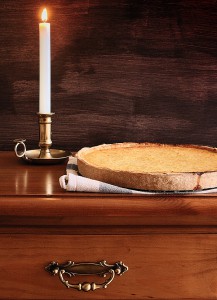
Ingredients:

1 sheet of store-bought or homemade puff pastry or shortcrust
5 medium-sized cooking apples
1 lemon, juice and peel

200g (1 cup) sugar
5 medium eggs

200ml (4/5 cup) whipping cream
50ml (1/5 cup) whole milk

Click here for metric recipe converter

Method:

  1. Preheat the oven to 180°C if convection type, to 160°C if radiation.
  2. Prepare the pudding base: butter and flour a 30-cm (12inch) pie mold. Roll the crust, transfer to the mold and press to set. Trim the excess off the edges. Bake the crust blind for 10-15 minutes. Then take out of the oven and let cool a bit. Lower the oven temperature 20°C.
  3. Prepare the filling. Peel and core the apples, sprinkle them with lemon juice to prevent them from browning. Put them in a bowl, cover and microwave them 3-4 minutes, until tender.
  4. Transfer the apples to a food processor, add the rest of the ingredients: lemon juice and peel, sugar, cream, milk and eggs. Process to the desired “chunkiness”.
  5. Pour the mixture on the pie crust (this amount yields a large pie and a small cup of filling left) to the brim, then bake 1 hour. Watch it during the last stages to prevent it from excessive browning; lower the temperature if needed. After that baking time, take the pudding out and let cool completely.


I personally loved this Marlborough pudding. I love any dessert with apple though (well, except roast apples). It is lemony, creamy, light and only slightly crunchy. And as rustic and homely as I expected. Accompany it with a strong tea and open a snuff box for you to feel exactly like Whistler. And the next time you see this painting I’m sure you will remember that this lady baked delicious pies for her family.

Sources:
“Whistler’s mother and the West Coast”, BBC website
Whistler’s Mother Cook Book, Margaret McDonald

The Scottish Roots site says:

This unconventional portrait of a grey-garbed matron, commonly known as “Whistler’s Mother,” patiently sitting for her artistic son became an American icon and an emblem of motherhood. The subject of the painting, Anna Matilda McNeill Whistler, was born in North Carolina in 1804 to a middle class family of Scots descent.

Anna led a remarkable life for a 19th-century housewife; moving from the United States, via Tsarist Russia and sudden widowhood at a young age, to London with her son “Jemsie,” where she recorded in her diaries visits to the Whistler household from such literary and artistic luminaries as Algernon Swinburne and Dante Gabriel Rossetti. A traditional woman with a strong sense of morality, Anna Whistler upheld the conventional family values of the time, turning a blind eye to her artistic son’s bohemian amorous involvements in favour of encouraging his genius.

Widowed in 1849, she wore mourning for the rest of her life.

The book’s fascinating account of the Whistler household in America, Russia and Britain offers a rare and delightful glimpse into 19th-century family life and cooking. The recipes are simple and transmit the flavors and aromas of good home cooking.

Never miss a post
Name: 
Your email address:*
Please enter all required fields
Correct invalid entries

Rosa’s Musings: My Swiss Grandmother’s Cooking: the Deep Roots, Bonds and Nostalgia of Food

Published by Tuesday, June 28, 2011 Permalink 0

by Rosa Mayland

My Swiss Grandmother and Her Glorious Cuisine

“As a grandmother of six, I believe that it is crucial that we make time to pass on our recipes, cooking and growing skills and other crafts to our grandchildren.”— Darina Allen, president of Slow Food Ireland

Grandmothers link us to our culinary heritage

In our modern world, most women choose or have to work, and countless couples don’t have the time or energy to become kitchen bees. Many people prefer buying prepackaged food and don’t see any point in spending their free time preparing homemade snacks. The majority of 21st-century grandmothers hail from a generation of females who cut themselves off from old traditions, therefore nowadays, very few kids are lucky enough to have grandmothers* who cook or enjoy cooking, and who are able to share their family’s culinary legacy with their grandchildren.

Continue Reading…

Never miss a post
Name: 
Your email address:*
Please enter all required fields
Correct invalid entries

Cross-Continental Cooking: Slow-Roasted Strawberries

Published by Wednesday, May 25, 2011 Permalink 0

by Tricia Martin and SandeeA

Para leer la versión en español, pinche aquí

My partner SandeeACocina and I partner on a recipe once a month.

This month, we wanted to go with something a little sweeter than usual. Strawberries are in season both in the U.S. and Spain, so it only made sense to use strawberries. Every May I look forward to tasting that perfect jeweled basket of aromatic, sweet strawberries and I couldn’t be more thrilled to find a friend across the Atlantic who revels in some of these same simple pleasures of life. So strawberries it is this month.

We keep the recipes we make each month a “secret” from each other until the very last moment. We don’t see what the other has done until the day before we post. We then swap recipes — Sandee translates into Spanish and I create the photo montages of our pictures — it’s great teamwork!

This month we were both surprised and delighted with the hot/cold aspect of our recipes. The roasted strawberries are hot, messy, and sexy. Sandee’s ice bowl with sangria is cold, composed, and has a lovely surprise finish.

I was inspired to try roasted strawberries when a blog post over at Tricia Martin, by Dimity Jones, popped into my inbox. I was totally seduced by the simplicity of the recipe and the idea of roasting a spring fruit (not even a vegetable) — I tend to save cooking methods like roasting for fall and winter time foods — but am so glad I broke out of that box.

The Balsamic complimented the sweetness of the berries, further intensifying their naturally bright color. The brown sugar did its job of creating the most amazing caramelized strawberry ooze that just begged to be scraped from the pan and licked from the fork.

And the smell — the smell! — of these babies cooking is absolutely intoxicating. My apartment was literally as fragrant as strawberry fields forever as they sizzled on their hot little pan, eeking out beautiful dark red juices and creating one of the best strawberry desserts I’ve had in a long while.

I ate them straight from the pan! I promise I tried to put them on a plate, but alas, the forks in the photo do not lie: I ate this directly from the pan and I would have had all my friends do the same if they had been around, rather like when you share a fondue. The berries would however be smashing over some crumbly short bread, a Southern-style biscuit or with a dollop of crème fraiche.

Three to One

Recipe

Slow-Roasted Strawberries

Recipe inspired by Tricia Martin

Ingredients

Click here for metric recipe converter

2 pounds strawberries
6 tablespoons dark brown sugar
3 tablespoons balsamic vinegar
1-2 teaspoons flaky sea salt

Instructions

Preheat the oven to 250 degrees F. Toss the strawberries, brown sugar, and balsamic vinegar to coat. Pour onto a baking sheet and bake for 1.5 hours. You’ll know when they are getting near done, your house will fill with the most amazing smell of strawberries. When finished, take the pan out of the oven and sprinkle with the sea salt, serve warm with an optional scoop of creme fraiche, vanilla ice cream, or chopped dark chocolate. However, they really are fantastic on their own.

Never miss a post
Name: 
Your email address:*
Please enter all required fields
Correct invalid entries

Recipe: Double-chocolate Walnut Biscotti

Published by Friday, October 29, 2010 Permalink 0

Make your Own Chocolate Biscotti, Swiss Ticino style

Here is a great double-chocolate walnut biscotti recipe by Patricia Turo, born into an Italian family in the US, but now living in the Klosters ski resort in Switzerland. This recipe is therefore more in the spirit of Ticino, the Italian-speaking part of Switzerland.

Be careful about the quality of chocolate you use: Avoid buying the American chocolate chips in a bag. You’d be better off buying a bar of dark chocolate from your favorite local chocolate maker and crumbling it up into bits. The same goes for the cocoa powder. Make sure it is good quality, preferably from a good chocolate maker.

To convert the measurements, refer to How to convert measurements for American recipes.

This article was originally published on GenevaLunch.Com.

Never miss a post
Name: 
Your email address:*
Please enter all required fields
Correct invalid entries

UA-21892701-1