by Jamie Schler
Destination Dessert: Far Breton aux Pruneaux, Baked Flan with Prunes from Brittany
 Wild, windy and awe-inspiring, Brittany is like nowhere else in her untamed beauty and her quaint villages, her fabulous seafood and her intriguing history; we stand perched atop the low cliffs, the wind whipping our hair, eyes squinting against the elements, and gaze in awe and wonder at the waves crashing onto the shore, battering the craggy heaps of rocks which form the uneven coastline. Gulls swirl overhead, dipping, diving and screeching at each other and us as they spot what could be food. Fishing boats in the distance bob on the choppy, midnight blue water amid the white-tipped peaks and our voices and laughter are snatched up and whisked out to sea. Only those born and raised in this part of the world, the true Bretons, dare strip down and dive in for a brisk swim in the chilly mid-summer as those less hardy huddle together, shivering, basking in the warmth of the occasional lull in the wind and ray of sunshine. The silence once back inside the car, the doors shut tight against the raging weather, is deafening. We drive back towards the beautiful port town of Le Conquet to meet the fishing boats as they come ashore at 5 o’clock every afternoon and wait impatiently as they display the catch of the day. Large, plump crabs and scoops of tiny bigorneaux are ours for the asking and we rush home to light the stove and make a festive meal of these simple treats.
 Our Dessert Destination is Brittany, rugged and spectacular, proud of her heritage and culture. This is a region of hardy, good, generous people who still live a relatively simple, humble life. Ancient towns and even earlier remains, Brittany is a fascinating part of France, a land of legends and wondrous tales, the great northwest, that reaches back beyond Ancient Gaul, a rich history traced all the way back to Neolithic times. Celtic tribes ruled this country before Romans arrived, and both cultures have left their mark not only in the monuments and chateaux still found standing throughout the region, but in her music, language, arts and culture as well. Throughout their embattled, turbulent history, the tug-of-war between Britain and France, the back and forth of independence mixed with years of revolt and years of suppression, the Bretons have held tightly onto their culture, their language and their pride, and even today there still exists a separatist movement fighting for her independence.
We’ve spent many a holiday in Brittany and each time I wander over her landscape, I am awestruck by her savage beauty, the craggy landscape and the rustic towns. We’ve boated out to the tiny uninhabited isles out in the ocean waters and wandered the sandy coastlines. We’ve touched mysterious menhirs and dolmens scattered over this region, still standing, and listened to the moving, emotional chant of the bagpipes and harp or tapped our feet to the wild, joyous music of the violins and drums, the same music and spirit played, sung and danced to generation after generation, a constant flow of festivals, concerts and fairs keeping this dynamic culture alive. Brittany’s seafaring culture has given birth to and guided their commerce, crafts and music. And their cuisine.
 The cuisine of Brittany is truly rustic and familial, hearty yet so simple. And, of course, one of the sea: crabs and lobsters, sea scallops, mussels, clams and of course oysters, are served simply, eaten raw, steamed or simmered in wine. The seafood platter or huge bowlfuls of steaming mussels cooked in wine are gastronomic standards. La Cotriade, a type of fish and seafood stew, is the perfect way to warm up a blustery winter day. Or how about kig-ha-farz, a type of pot-au-feu based on lard, pork and hearty, earthy vegetables like potatoes, onions, rutabagas, carrots and cabbage. Yes, Brittany pork is an appreciated local specialty and is often eaten in the form of Andouille de Guémené, Breton pork sausage. Or how about a classic galette, a savory crêpe made of local buckwheat flour, filled with almost anything you please but more often than not, something with a seafood or pork twist to it. And all of it washed down with cider, the favored drink of this region.
But while much of their cooking is rather simple, the desserts of this region are much more decadent and butter-rich. Most of us are familiar with the crêpe filled with cooked apples, jam or jelly or even caramel au beurre salé, salted butter caramel. But once you spend a bit of time in the region, you learn about the other traditional favorites like the Kouign Amann, a cake made of butter and sugar-infused bread dough covered with a fine layer of puff pastry. Once cooked, this treat becomes a meltingly sweet, dense, caramelized treat. And the Farz Buan, a quick dessert somewhere between a flan and a crêpe, or the palet, Brittany’s own butter cookie. And never forget that all desserts from this coastal region are made with salted butter!
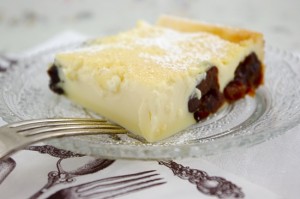
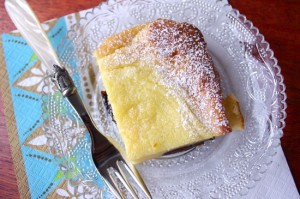
 Today’s dessert is one of Brittany’s secret gems, a delicious local specialty, Far Breton aux Pruneaux. Far Breton is a dense, oven-baked, custard-like flan only creamier, lighter than the one most of us are familiar with, and it is usually studded with sweet prunes macerated in rum. The first written mention of Far was in the 18th century when there was both a savory and a sweet version. Like the Breton crêpes, the savory version was made with local buckwheat flour and eaten as a side dish with meat, while the sweet Far was made with regular wheat flour. But while the savory version seems to have faded from the Breton culinary repertoire, the sweet dessert is still a much-loved mainstay.
All one needs to make a fabulous Far Breton is the best quality eggs, butter, salted of course, sugar, flour and whole milk along with prunes and a splash or two of rum. Preparing the batter is as easy as and similar to making batter for crêpes and while it is resting just toss a cup of prunes with rum and let the fruit macerate as you wait. Then just bake. Nothing is easier, nor can you find a tastier, homier dessert than the Far Breton!
My good friend Isabelle, Bretonne born and bred, offered me her own recipe for Far. But like all great French home cooks, my husband and his mother included, they cook “au pif”, by intuition, following their better instincts and feel rather than follow precise recipes or measurements. So I fiddled around with Isabelle’s recipe and second try was the charm! This recipe makes a perfect Far Breton, creamy and smooth and even chilled it never gets too firm or dense like a flan. And I added a bit more sugar than Isabelle because I thought my first try had no sweetness at all. With just one more tablespoon of sugar it is lightly sweet, yet nowhere near sugary. Just perfect! And the prunes? Well, what can I say? Gorgeous!



 At Lalbenque, 10 kilometers southeast of Le Montat in southwest France, legendary truffle-hunter Marthe Delon awaited me with her spotted pig.
 For Marthe, lack of summer rainstorms is the key to falling harvests. Dogs, too, may be part of the problem. “Everyone had pigs, you ate them afterwards, like my Kikis. No need to train them, they love truffles, but only ripe truffles, so they don’t dig up immature ones the way dogs do,” she said, pawing at the air. “How are immature truffles supposed to reproduce?”
 Scrupulously noting the day’s 92 basketfuls, totaling 45 kilos, veteran French government agricultural statistics recorder Odet Bazalgues tipped back his cap as he spoke to me. “Down from a year ago,” he sighed, tapping his notebook. “Again.” Tons of truffles used to be traded weekly in Lalbenque, he remarked. “It’s still among France’s main markets. Wholesale prices for the rest of the country are set here.” The day’s top-quality truffles sold for 850 euros per kilo. “Good news?” Bazalgues ironized. “Fewer brumales this season.”
 Marre agreed with others I had spoken to that the French and Italian passion for truffles showed no signs of abating. “Scarcity is the prime worry,” he said.