A Brief History of Confit and Food Preservation in France
Uneingénuitéconfitedevieillefille. / The preserved naivité of a spinster.–Colette, LaNaissancedu Jour / Break of Day
I like my man to be a bit confit.Confit is my favorite French word. It can mean many things, but the meaning always implies intensity to the point of being almost sweet, and sometimes sickly sweet.
The word comes from the Latin, conficiere, meaning “to do” or “to make,” and is the root of other familiar words like confiture and confection,” says Kate McDonough. “It can equally describe flavoring and preserving foods in other substances, as fruit in sugar, olives in oil, pickles in vinegar, or capers in salt.”
In the food world, there are two main meanings, although the term basically means “preserved;” there are, of course, many ways of preserving food. The first refers to something candied or crystallized, such as the fruits confits so popular in France, especially at Christmas and during other holiday periods. The second refers to a savory food either cooked in its own juices or preserved.
The French confit we know best is canard confit, or duck confit, which is traditionally cooked in a copper pot over a fire for up to 24 hours so that its fat oozes out and envelops it. It is then stored in its own fat and conserved in a jar for up to a year.
Pickles and salted capers also count as confits. Another common one is tomates confites, or confit tomatoes, which are slow-cooked like duck in a low-temperature oven until they become almost sweet like candy. Intense, yes.
The French eat 90% of the foie gras they make themselves. That’s how much they like it, but they didn’t invent it. Although the Egyptians might have force-fed their birds, we’re not sure that they ate foie gras. The Greeks probably did, since the 4th-century Greek poet Archestratus wrote about it in his Gastronomy. The liver is the soul of the goose, he said.
Foie gras is made using a process called gavage, which consists of force-feeding ducks or geese through a feeding tube to fatten them. The Romans stuffed dried figs down their throats. In Latin, the word for liver even comes from fig, ficus. Scipio Metellus, a Roman chef, had the idea of soaking still warm livers in honey and milk to swell them even more before cooking.
Apart from the region of Béarn in the southwest, this practice disappeared in medieval France, coming back to life in the southwest and Alsace during the Renaissance.
French foie gras is made by force-feeding corn to geese and ducks, and still, occasionally, figs, which swells the livers.
Goose foie gras has traditionally been the most cherished because it is fattier, but it cannot be produced year round. Duck liver is less fatty, and can be produced year round and industrially, meeting the ever-increasing demand.
The fattened liver can be made into terrine, pâté, mousse, parfait, and a host of other things, and, in more recent times, there is a trend of cutting fresh foie gras into thin slices and pan-searing it. It can be eaten fresh or preserved in glass jars, and can be seasoned with truffles, port, Armagnac or Sauternes. Southwesterners prefer a simple, less perfumed foie gras, while Alsacians like to add flavor.
When purchasing, there are legal distinctions in names that indicate the purity and therefore determine the price:
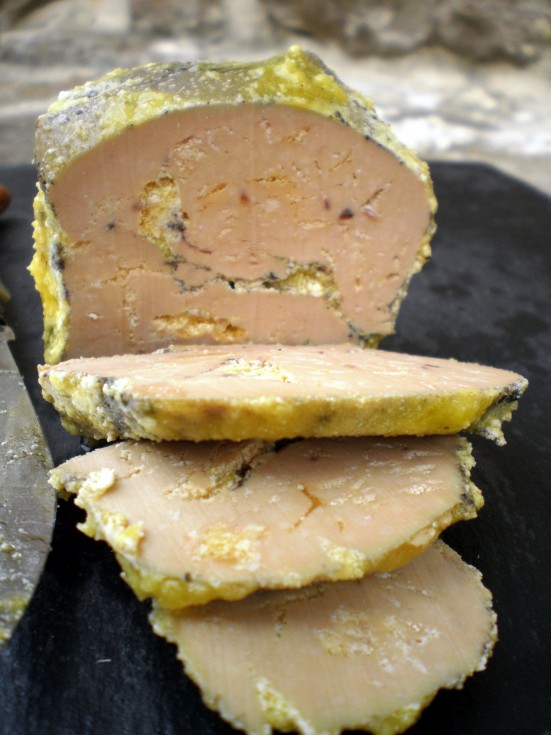
Foie gras entier means that it contains the actual lobes of the liver. The only legally allowed addition is truffles. As it’s solid, you cut it with a knife, just like you do extra-tender beef filet.
Foie gras consists of pieces of liver that are put back together and pressed.
Bloc de foie gras is reconstituted liver combined with other ingredients, but containing at least 50% foie gras for goose, and 30% for duck .
Parfaits are preparations containing 75% foie gras and made by mechanical means, to which regular, unfattened liver is added.
Médaillon or pâte de foie de canard or d’oie contains 50% duck or goose foie gras or bloc de foie gras in the middle, surrounded by forcemeat.
Galantine is a butcher’s mixture of meats and other forcemeats, with no defined percentage of foie gras.
Mousse contains 50% foie gras mixed with forcemeat, giving it the texture of foie gras.
Terrine is pure foie gras pressed into pâté shape.
Forcemeat can consist of one or several ingredients, including pork, veal or chicken fat; pork or chicken liver; scraps from deveining; poaching fat; eggs; milk; lactoproteins; flour, and starch.
Foie gras comes in a jar, plastic package or can or fresh from the butcher. When purchasing, be aware of the different cooking preparations, since the temperature at which it is cooked and the method of cooking change the flavor and shelf-life. Generally speaking, fresh is better.
It is important to make sure you are being sold what you ask for in both restaurants and shops. As a consumer, you have a legal right.
The French don’t eat foie gras every day. Traditionally, it is for special occasions and holiday meals, especially Christmas and New Year’s celebrations.