
Click here to keep up with the latest in world food and wine news.

Related articles
|
|

A Literary Culinary Journal
Some form of restaurant has existed ever since humans have been eating. The phenomenon grew as large cities formed, and as people traveled on the ancient silk roads in the Middle East and China, and in the Roman Empire, often in the form of inns where one could both sleep and eat.
Street kitchens and food trucks are by no means a modern invention. Jean-Robert Pitte says in his essay “The Rise of the Restaurant”:
Throughout the world, the principal type of eating establishment has always been the street kitchen, where a person can buy a precooked dish for a modest sum. They have always existed in China and still exist throughout Asia, even in industrial and postindustrial countries such as Japan…Street restaurants are still common in Latin America and the Middle East and Africa… (from A Culinary History: Food, edited by Jean-Louis Flandrin and Massimo Montanari)
|
|
 by Simón de Swaan
Americans, more than any other culture on earth, are cook-book cooks…–John Thorne

John Thorne is a culinary writer born in Quincy, Massachusetts, who has written a number of best-selling books on food history and culture, including The Outlaw and Pot on the Fire: Further Exploits of a Renegade Cook.
A graduate of Amherst College, he began to teach himself to cook frugally while living briefly in New York City’s Lower East Side, where he sought to become a writer of some sort as a very young man during the 1960s.
|
|
Including a food trend prediction for 2012…
by Alice DeLuca
When first married, I received lots of advice on how to stay married, which is of course so much more complicated than “getting” married. For example, Sally told me that both a happy marriage and a career had been possible for her because she created and froze 4 quiches at a time. I immediately pictured 4 quiches in the deep-freeze, carefully labeled for rotation of the stock so as to avoid freezer-burn and waste. The quiches would keep.

|
|
In the Middle Ages, Geneva was running over with parsnips, which they referred to as “white carrots”. It was almost always included in their “eternal pots” of soup, which consisted of seasonal vegetables that they just kept adding more vegetables to as needed, and a piece of meat once a week.
After World War II, many root vegetables went out of fashion in Europe, because people had had to survive on them and nothing else during the war, so farmers eventually stopped growing them. The same went for pumpkin. People in the north of France who had lived through the war and eaten pumpkin every day couldn’t bear the thought of eating pumpkin ever again.
In recent years, these old-fashioned vegetables, including parsnips, have again become available, and chefs are going crazy with new ideas on how to use them.
Parsnips are plentiful at the moment and there’s nothing better than soup to warm you up on a cold winter’s day. Eric Burkel, former financial analyst, entrepreneur and now president of his local food coop in Paris, got this recipe from one of the farmers who supplies vegetables to the coop.
|
|
Kathleen Wall, the amazing Colonial Foodways Culinarian at Plimoth Plantation in Plymouth, Massachusetts, a living history project sponsored by the Smithsonian Institute, shared this on her Facebook page the other day. It’s a DVD about the true history of Thanksgiving, made by Kathleen herself.
The story of Thanksgiving, with its costumed Pilgrims, turkeys and pumpkin pie, zigzags through American history with some surprising twists. At the iconic Thanksgiving feast of 1621 — no pumpkin pie or cranberry sauce was served, and that event was wiped from the history books for 200 years! In the 19th Century, some southern states thought Thanksgiving was an abolitionist plot and refused to celebrate it. Thanksgiving didn’t become an annual national holiday until World War II! What started as a somber Puritan day of prayer is now about football and food. How did we get there?
Click here to listen to “Miles Standish” talk about the first harvest in Plymouth.

|
|
Once a turnip said, “I taste very good with honey.” “Go you boaster,” replied the honey, “I taste good without you.“–Russian folktale

|
|
My favorite sayings are the ones that yoke together metaphorically sexual desire, or passionate love, with the act of eating. There is an earthiness about these expressions that to English ears sounds faintly embarrassing and possibly in bad taste. You might say of a sexually appealing person, Esta como un queso: “He (or she) is like a cheese.” (It would have to be a ripe, oozingly delicious cheese)…–Paul Richardson, A Late Dinner: Discovering the Food of Spain
Good Reads is an English writer and author of 6 books. He lives in Spain. Good Reads says of him: “He traces the roots of Spanish cooking to the landscape, the people, and the history of this beautiful and complex country.”

|
|
 by here
Chicken tikka masala, New Indian or fusion?
Chicken tikka masala is quite likely one of the most popular Indian dishes the world. The irony of chicken tikka masala, better known as “CTM,” is that what is often enjoyed in restaurants as a traditional Indian dish has very little to do with authentic Indian cuisine. It is closer to “Britain’s true national dish.”
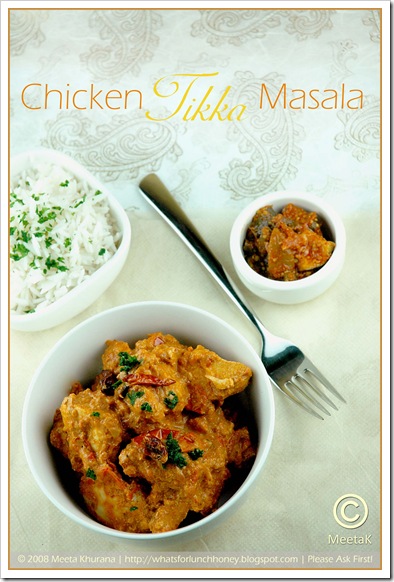 It was former British Foreign Secretary, Robin Cook, who proclaimed chicken tikka masala as the new national dish of Great Britain, in an attempt to set an example of British multiculturalism. The chicken tikka masala Mr. Cook was referring to was in actual fact the gravy-based dish invented in Britain.
|
|
 Meet Jonell Galloway, a freelance writer and editor specialized in French cuisine.


