Food Writing Prompts: Your Own Desk is a Prompt

Published by Wednesday, August 13, 2014 Permalink 2

by Elatia Harris

So many great writers need their writing rooms to meet precise specs. E.B. White preferred a rough-hewn, minimalist space, with nothing but a typewriter. Virginia Woolf needed lots of green around her, and took some serious kidding about it from her sister. I have noticed that a writing room is almost never gender-neutral, even when the writer is going for a low-key, orderly space that gives little away. There’s something I need, that I’ll give up things I like to get: a window. Looking at photos like the National Trust photo above, of Vita Sackville-West’s writing table at Sissinghurst, I always notice — does the writing table face a window, or a wall?

Which leads me to wonder — how much of a writing prompt is your desk itself? It has four corners, like the ancient Chinese idea of the Universe. Within that space, you can put anything you have that helps. When you look up from your work, are you still seeing with the mind’s eye? What could you arrange to see, physically, that would give you the most of what you needed to keep writing?


Elatia Harris is a writer and consulting editor in Cambridge, Mass. She is most often at work on books and articles about food, wine and travel. Contact her at elatiaharrisATgmailDOTcom or via text at 617-599-7159.


Never miss a post
Name: 
Your email address:*
Please enter all required fields
Correct invalid entries

Music as Food: Homage to Alice Herz-Sommer

Published by Thursday, March 6, 2014 Permalink 0

Music as Food: Homage to Alice Herz-SommerJonell Galloway, The Rambling Epicure

by Jonell Galloway

Alice Herz-Sommer died on Sunday, March 2, 2014, at her home in London, at the age of 110. She was the oldest known survivor of the Holocaust.

Mrs. Herz-Sommer was a concert pianist in her native Czechoslovakia before the war, and said that it was Frédéric Chopin who had “fed” both her and her audiences in over a hundred concerts she gave in her two years in the ghetto-concentration camp in Theresienstadt. She spent most of her time perfecting Chopin’s Études, a set of 27 solo pieces known for their technical innovation and sheer mechanical difficulty. Chopin became her food; it nourished her soul.

 Images from the book The Garden of Eden in Hell. Photograph: Droemer (C)

Images from the book The Garden of Eden in Hell. Photograph: Droemer (C)


In Theresienstadt, her son would often ask her, “Mother, why don’t we have anything to eat?” She believed human beings don’t need food when they have something spiritual. “The concerts, the music was our food.” But wasn’t it painful to not have food? “No, I was always laughing,” although she slept on a stone slab floor with no covers and no pillow.

If she could play the piano, she was happy. She was glad to be alive with her son; her concerts ensured that she and her son would survive. Her secret to happiness was to be thankful, thankful for everything. Thankful for seeing the sun, for seeing a smile, for a nice word from someone. Everything we experience is a gift; we have to be thankful for it all, was her philosophy.

Alice Herz-Sommer with her son


She learned Bach by heart. When she got cancer at 83, her doctor told her that knowing Bach by heart was more healing than all the pills she could take.

Sometimes she was thankful to have been at Terezin. “We all learn from mistakes.” Bad has to exist, she said with a smile, always a smile. I lived my life backwards, looking back at all the beautiful and wonderful things I have had.


And she learned from the bad, saying hatred eats the soul of the hater. Reminiscent of the Dalai Lama, she said complaining is a waste of time. “I know about the bad, but I only look at the good things.” Everything you receive is a present and arises out of how you look at the world.

Wealth is of the spirit, she told The Guardian.

She never hated, not even the Nazis, saying that we all do wrong sometimes: forgiveness of the ultimate sort.

Alice Herz-Sommer. Sheet Music Background


Until virtually the end of her life, she practiced for three hours every day, and it is what helped her survive the death of her son Raphael in 2001.

Music was the food of her soul, and her music fed the souls of so many. It kept them living when they had no food to eat. Her music continues to resonate, as does her example as a human being. She continues to nourish us, even though only in spirit.

Why don’t we have anything to eat, Mommy? Not to worry, we have music. Paraphrasing Shakespeare, “if music be the food of life, play on.”


Sources: A Few Precious Moments with Alice Herz-Sommer,Alice Herz-Sommer, 1903–2014: remembered by Ed Vulliamy, Alice Herz-Sommer, Who Found Peace in Chopin Amid Holocaust, Dies at 110, Oldest-Known Holocaust Survivor Dies; Pianist Was 110, Alice Herz-Sommer: Practice the Chopin Études, they will save you


Never miss a post
Name: 
Your email address:*
Please enter all required fields
Correct invalid entries

Saffron Culture: A Pictorial Cycle on Santorini, Part II

Published by Thursday, January 23, 2014 Permalink 1

Saffron Culture: A Pictorial Cycle on Santorini, Part II

Mistress of the Animals – Did She Make Powerful Medicine with Saffron?

by Elatia Harris

Mistress of the Animals from Xeste 3 on Thera

Mistress of the Animals from Xeste 3 on Thera.

Part Two in a series of articles on aspects of saffron. Photos of wall paintings from the excavated areas of Thera (also called Santorini), are taken from a magnificent site that has expired off the Internet, www.therafoundation.org. Other photos credited where possible. Part One examines the origins of saffron culture in Western Asia, with an overview of the saffron-dominated fresco cycle on Santorini, dating to the 17th century B.C.E. The present article looks at saffron in cultic rituals.

Mistress of the Animals

It is hard not to look at the goddess on the saffron cushion. Though her state of preservation is less than optimal, she is the focal point of the cycle.  In 1996, the archaeologist Paul Rehak undertook a gendered reading of the Xeste 3 fresco cycle – one that pointed up many subtleties in both the organization of society on Thera and the medicinal use of saffron, by and for women. In his monograph, “Myth, Medicine and Matriarchy: Reconstructing a Female Homosocial Environment in the Thera Frescoes,” he raises as well the issue whether the Xeste 3 frescoes were painted by women, for women – a possibility worth considering.

Necklaces with a duck and a dragonfly motif hang in an arc from the throat of the main image. Her blue and white costume is richly embroidered with a saffron crocus motif, the easily recognizable silhouette of the wild-growing C. cartwrightianus that is everywhere represented in Xeste 3 – clinging to rocks, garlanding its gatherers, piled into baskets, and patterning the creamy white field on which all the images are painted.

To us, perhaps the most compelling aspect of the goddess is not her regalia, but her expression.

akrotiri1

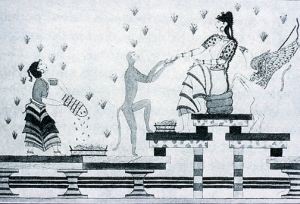
Drawing from Nanno Marinatos -- Wall of Xeste 3, with Mistress of the Animals

Drawing from Nanno Marinatos — Wall of Xeste 3, with Mistress of the Animals.

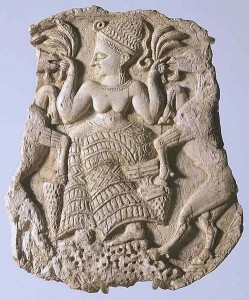
Head turned in profile, her eye is starry with interest, her lips parted as if in speech with the blue monkey to her right offering a handful of saffron. A gryphon flanks her left, present only in paw and wing. She may command girls to gather saffron and bring her tribute, but her companions are animals, on the same platform as herself. We do not know her name on Thera, but she is known to us anyhow. This is the Mistress of the Animals — potnia theron — one of the oldest goddesses of ancient times. And this is not her first or last iteration. As we enter historical times, she often takes the form of Aphrodite.
minetelbeidagoddess


Elatia Harris is a writer and consulting editor in Cambridge, Mass. She is most often at work on books and articles about food, wine and travel. Contact her at elatiaharrisATgmailDOTcom or via text at 617-599-7159.

Never miss a post
Name: 
Your email address:*
Please enter all required fields
Correct invalid entries

Simple Sustenance: Roasted Red Onion, Fennel and White Bean Soup

Published by Thursday, October 4, 2012 Permalink 0

by Renu Chhabra

The essence of pleasure is spontaneity.–Germaine Greer


Spontaneity in the kitchen can be fun sometimes and a challenge at other times. But it does get our creative juices rolling, and pushes us to bring out our best. Often times, with no set plans, and working with what we’ve got produces great results. New recipes are born, and new talents are discovered. That’s the beauty of spontaneity. Who wouldn’t like that?

Continue Reading…

Never miss a post
Name: 
Your email address:*
Please enter all required fields
Correct invalid entries

Simon Says: Daily Food Quote, September 25, 2012

Published by Tuesday, September 25, 2012 Permalink 0

by Simón de Swaan

Feasts must be solemn and rare, or else they cease to be feats.–Aldous Huxley, 1929

Aldous Huxley English novelist and critic, best known for his novel Brave New World (1931). Besides novels he published travel books, histories, poems, plays, and essays on philosophy, arts, sociology, religion and morals. Even today, Brave New World is so influential that an entire website is devoted to his writing.


Never miss a post
Name: 
Your email address:*
Please enter all required fields
Correct invalid entries

Simon Says: Daily Food Quote, October 17, 2011

Published by Monday, October 17, 2011 Permalink 0

by Simón de Swaan

Edible: good to eat and wholesome to digest, as a worm to a toad, a toad to a snake, a snake to a pig, a pig to a man, and a man to a worm.–Ambrose Bierce, c. 1900

Ambrose Bierce was American satirist and writer (1842-1914? He went off to join Sancho Villa and was never seen again).

When William Randolph Hearst asked Ambrose Bierce what he collected, he replied: “I collect words. And ideas. Like you, I also store them. But in the reservoir of my mind. I can take them out and display them at a moment’s notice. Eminently portable, Mr. Hearst. And I don’t find it necessary to show them all at the same time.”


Never miss a post
Name: 
Your email address:*
Please enter all required fields
Correct invalid entries

UA-21892701-1