David Downie: Artful Parisian Pastry, Part 2: Paris Present

Published by Wednesday, June 19, 2013 Permalink 0

Parisian Artful Pastry, Part 2: Paris Present

by David Downie

The minimalism of contemporary pastry art can be spectacular. A Paris-trained American pastry chef friend of mine from New York came to dinner carrying a hatbox. She lifted the lid and everyone gasped. “It’s a pastry radiator,” I couldn’t help exclaiming. The “radiator’s” buttery pastry fins were filled with ethereal cream, shielded by dark chocolate plates and mounted on a hard nougatine U-shaped base reminiscent of Bakelite.

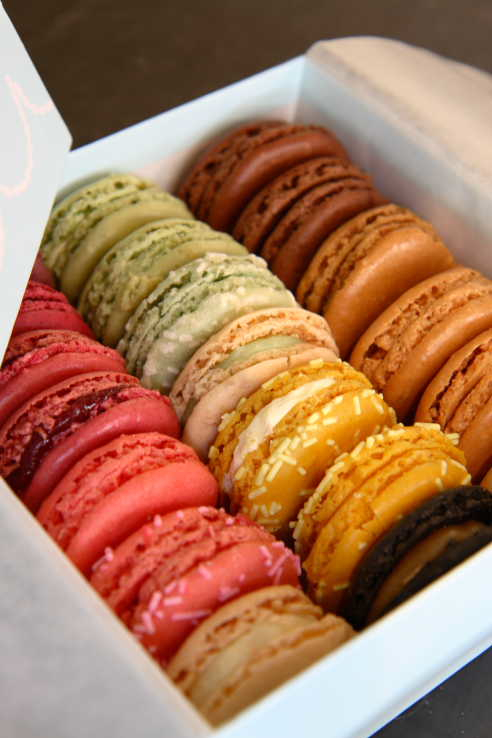
Classic chocolates from Jean-Paul Hévin ©Alison Harris

“Actually it’s a vertical millefeuille,” my friend explained as she heated the blade of a long knife—the only way to slice this incredible, gorgeous delicacy without destroying it.

The “radiator” turned out to be the conceptual-art brainchild of culinary designer Marc Brétillot, whose creations have often been spotted in the pastry department at the Bon Marché’s Grande Épicerie.

“Pastry is art,” Philippe Muzé, for a decade the wonder-worker at Paris’s bastion of traditionalism, Dalloyau, told me (he has since moved on and on and won many awards). “It’s poetry,” he added. “You can turn sugar, chocolate, herbs, spices and fruit into a million flavors and colors.” I hesitated before deconstructing his green Gâteau Vert, discovering a raspberry-colored biscuit, pear mousse, hot Szechwan pepper, cardamom, thyme and paprika.

Continue Reading…

Never miss a post
Name: 
Your email address:*
Please enter all required fields
Correct invalid entries

David Downie: Artful Parisian Pastry: Paris Past, Part 1

Published by Monday, June 17, 2013 Permalink 0

David Downie: Artful Parisian Pastry: Paris Past, Part 1

by David Downie

What do the glories of ancient Greece and imperial Rome, baroque Naples and pre-revolutionary “Let-them-eat-cake” France have in common with contemporary Paris?

Easy: artful pastry.


Toss out a euro coin nowadays and it will probably land on a Paris pâtisserie whose chef is bent on titillating customers’ taste buds while dazzling eyes and lightening wallets. White chocolate roses crown red powdered-sugar lips. Fruit still-lifes à la Caravaggio top praline plinths. Dark chocolate treasure chests enclose luscious layer cakes, and bras are not of silk but of purest chocolat.

Training in artistic Parisian pastry making is also in vogue: ever since the renowned École Grégoire-Ferrandi cooking school began partnering with mega-star Pierre Hermé, the chef Vogue has dubbed “the Picasso of pastry”, the “Haute Pâtisserie” concept has ruled Paris tastes.

“The fine arts number five,” wrote Marie-Antoine Carême in the late 18th century, “painting, sculpture, poetry, music and architecture, the principal branch of which is pastry.”

Ever the tongue-in-cheek wit, not for nothing Carême was known as “the king of chefs and the chef of kings”. His claim to pastry fame was the invention of Pièces Montées—precursors of today’s tiered wedding cakes. Remember Tony Curtis and Marilyn Monroe in Some Like it Hot? Carême pièces were big enough to hide a man, like the cakes machine gun-toting Mafiosi burst from in gangster movies.

Continue Reading…

Never miss a post
Name: 
Your email address:*
Please enter all required fields
Correct invalid entries

Food Quote: The Tragedy of the Absence of Hunger, by Amélie Nothomb

Published by Sunday, June 9, 2013 Permalink 0

Food Quote: The Tragedy of the Absence of Hunger, by Amélie Nothomb

We have yet to focus on the tragedy that the absence of hunger causes.–Amélie Nothomb, The Life of Hunger, 2006

L’absence de faim est un drame sur lequel nul ne s’est penché.–Amélie Nothomb, La biographie de la faim, 2006


Amélie Nothomb was born in Japan in 1967 to Belgian diplomats. She has had long periods of anorexia, which she swears to have conquered, and truly knows the feeling of hunger.

Her eccentric, complex personality, behavior and dress have made her somewhat of an icon on the French-language literature scene. She publishes one novel every fall in September, drinks champagne while she works, always wears a tall black hat similar to a witch’s hat, and only sleeps four hours a day.


Never miss a post
Name: 
Your email address:*
Please enter all required fields
Correct invalid entries

Food Poetry: Organic Fruit, by Diane Lockward

Published by Wednesday, May 15, 2013 Permalink 0

Organic Fruit

I want to sing

a song worthy of

the avocado, renegade

fruit, strict individualist, pear

gone crazy. Praise to its skin

like an armadillo’s, the refusal

to adulate beauty. Schmoo-shaped

and always face forward, it is what it

is. Kudos to its courage, its inherent love

of democracy. Hosannas for its motley coat,

neither black, brown, nor green, but purple-hued,

like a bruise. Unlike the obstreperous coconut, the

avocado yields to the knife, surrenders its hide of leather,

blade sliding under the skin and stripping the fruit. Praise

to its nakedness posed before me, homely, yellow-green,

and slippery, bottom-heavy like a woman in a Renoir, her

flesh soft velvet. I cup the fruit in my palm, slice and hold,

slice and hold, down to the stone at the core, firm fist at the

center. Pale peridot crescents slip out, like slivers of  moon.

Exquisite moment of ripeness! a dash of salt, the first bite

squishes between tongue and palate, eases down my

throat, oozes vitamins and oil. Could anything be more

delicious, more digestible? Plaudits to its versatility,

yummy in Cobb salad, saucy in guacamole, boldly

stuffed with crabmeat. My avocado dangles from

a tree, lifts its puckered face to the sun, pulls

all that light inside. Praise it for being small,

misshapen, and durable. Praise it for

the largeness of its heart.

Continue Reading…

Never miss a post
Name: 
Your email address:*
Please enter all required fields
Correct invalid entries

Food Vocabulary: What’s a Femivore?

Published by Monday, May 13, 2013 Permalink 0

by The Femivore’s Dilemma

Are you a Grist? This word was recently added to the Urban Dictionary.


Origin of the Term “Femivore”

The word was coined by Peggy Orenstein in her essay “The Femivore’s Dilemma” for today’s New York Times Magazine, says Natural News, and is obviously inspired by the term “locavore.”

Educated career women, or “femivores”, all over the U.S. are choosing to give up their careers and go back to the farm (sometimes an urban farm) and back to the kitchen — often the same women who refused to take anything even vaguely similar to a Home Economics class, much less a class in agriculture. DIY, raising chickens and gardening are back, and there is an abundance resources available on the Internet for those who are new at it offering detailed how-to’s and recipes for all of it, with popular DIY sites such as Mother Earth News, Middleground Farm, and Mother Earth News. Femivores often reach out from their newly chosen isolation through blogs and social networks, and share their discoveries, successes and failures with other femivores, such as writer Esmaa Self on Middleground Farm or “backyard eggs”.

This became the subject of a heated debate a few weeks ago when Michael Pollan’s book came out. On Is Michael Pollan a sexist pig? Emily Matchar questioned whether Pollan was a “sexist pig” in saying “we need to get back in the kitchen,” since “American women cook 78 percent of dinners, make 93 percent of the food purchases, and spend three times as many hours in the kitchen as men.”


Never miss a post
Name: 
Your email address:*
Please enter all required fields
Correct invalid entries

Simon Says: Daily Food Quote, May 10, 2013

Published by Friday, May 10, 2013 Permalink 0

Simon Says: Daily Food Quote, May 10, 2013

by Simón de Swaan

A good cook is the peculiar gift of the gods. He must be a perfect creature from the brain to the palate, from the palate to the finger’s end.–Walter Savage Landor

Walter Savage Landor


Walter Savage Landor was an English writer and poet who lived from 1775–1864. He wrote in both English and Latin, but much preferred Latin, which put him at a disadvantage in terms of readership. His best known works were the prose Imaginary Conversations, “five volumes of imaginary conversations between personalities of classical Greece and Rome: poets and authors; statesmen and women; and fortunate and unfortunate individuals” (Wikipedia), and the poem “Rose Aylmer,” but the critical acclaim he received from poets and reviewers such as John Milton, T.S. Eliot, and John Butler Yeats was not matched by public popularity.


Never miss a post
Name: 
Your email address:*
Please enter all required fields
Correct invalid entries

Simon Says: Daily Food Quote, May 9, 2013

Published by Thursday, May 9, 2013 Permalink 0

Simon Says: Daily Food Quote, May 9, 2013

by Simón de Swaan

It is true that I live almost entirely on bivalves.  I prefer them as they are – and I think that oysters au naturel are as much a mental as a material enjoyment: you are eating the whole ocean.–Isak Dinesen


Karen von Blixen-Fineck was a Danish writer who wrote principally under the pseudo name Isak Dinesen — but also under the names Osceola and Pierre Andrézel — in Danish, French and English. She was married to her Swedish second cousin, the . She is best known for her book Out of Africa about her time living on her coffee plantation in the hills of Kenya, and for her short story “Out of Africa,” both of which were adapted into Academy Award-winning films.


Never miss a post
Name: 
Your email address:*
Please enter all required fields
Correct invalid entries

Simon Says: Daily Food Quote, May 8, 2013

Published by Wednesday, May 8, 2013 Permalink 0

Simon Says: Daily Food Quote, May 8, 2013

by Simón de Swaan

What a flavor (oysters) have – mellow, coppery, with almost a creaminess when you chew and analyze. I drank some good beer with them and floated on a gastronomically sensual cloud.–James Beard


James Andrew Beard was an American chef, cookbook writer, cooking teacher and television celebrity. Beard became active in the culinary community in New York soon after World War II, going on to become a true culinary reference in the United States. He helped Americans discover, identify and define their culinary heritage through his travels, teaching, and work, and through some 20 cookbooks, about half of which are still in print. His lively and sometimes eccentric personality made him somewhat of a celebrity, but his true measure lies in “his vast culinary knowledge; they are the measure of the times, too. The James Beard collection is a slice of American history. Written between 1940 and 1983, the books tell us through the language of food what we had and what we longed for, who we were and whom we hoped to become,” said Alexandra Zohn and Peggy Grodinsky in James Beard (1903–1985): The Complete Works.

His work lives on through the Beard Foundation which continues to provide culinary education and encourage excellence in American cuisine.


  • Snapshots with Chefs at the 2013 James Beard Foundation Awards
  • Blue Hill Tops James Beard Food Awards, Chef Title Split – Bloomberg
  • And the 2013 James Beard winners are …
  • Dan Barber’s Blue Hill wins top James Beard Foundation award
  • Beards name ChopChop top food publication of 2013
Never miss a post
Name: 
Your email address:*
Please enter all required fields
Correct invalid entries

Simon Says: Daily Food Quote, May 7, 2013

Published by Tuesday, May 7, 2013 Permalink 0

Simon Says: Daily Food Quote, May 7, 2013

by Simón de Swaan

Almost every person has something secret he likes to eat.— M.F.K. Fisher


Mary Frances Kennedy Fisher was a preeminent American food writer. She was also a founder of the Napa Valley Wine Library. She wrote some 27 books, including a translation of The Physiology of Taste by Jean-Anthelme Brillat-Savarin, an authoritative classic about eating as a sensory experience. Two volumes of her journals and correspondence came out shortly before her death in 1992, Stay Me, Oh Comfort Me: Journals and Stories, 1933-1941.


Never miss a post
Name: 
Your email address:*
Please enter all required fields
Correct invalid entries

Simon de Swaan of Simon Says is Back! Daily Food Quote, May 6, 2013

Published by Monday, May 6, 2013 Permalink 0

Simon de Swaan of Simon Says is Back! Daily Food Quote, May 6, 2013

by Simón de Swaan

Bad French cuisine is perhaps the most unfortunate on earth.–Craig Claiborne


Craig Claiborne was an American restaurant critic, food journalist and book author. A long-time food editor and restaurant critic for The New York Times, he was also the author of numerous cookbooks, including New York Times Cookbook, a great American classic.  Click here to listen to an audio interview with him.


Related articles

Never miss a post
Name: 
Your email address:*
Please enter all required fields
Correct invalid entries

UA-21892701-1