Those who have a profound indifference to the pleasures of the table are generally gloomy, charmless and unamiable.–Lucien Tendret
Lucien Tendret (1825-1896) was a French lawyer and gastronome, and great nephew of Brillat-Savarin.
|
|

A Literary Culinary Journal
Those who have a profound indifference to the pleasures of the table are generally gloomy, charmless and unamiable.–Lucien Tendret
Lucien Tendret (1825-1896) was a French lawyer and gastronome, and great nephew of Brillat-Savarin.
|
|
 by Jonell Galloway
You don’t have to cook fancy or complicated masterpieces – just good food from fresh ingredients.–Julia Child (1912 – 2004)

Julia Child, (1912 – 2004), American cookbook writer, TV personality and tremendous contributor to the food world, introduced Americans to the techniques of French cooking with her classic book, Mastering the Art of French Cooking, Volumes I and II.
Julia Child brought French food to post-war America. When her husband Paul was posted to Paris, she studied at L’Ecole du Cordon Bleu, and went on to form her own cooking school with fellow students Simone Beck and Louisette Bertholle. The threesome went on to write the 2-volume classic Mastering the Art of French Cooking, which covered all the basic techniques and dishes of classic French cuisine.
|
|
 by Jonell Galloway
Noncooks think it’s silly to invest two hours’ work in two minutes’ enjoyment; but if cooking is evanescent, so is the ballet.–Julia Child
Julia Child, (1912 – 2004), American cookbook writer, TV personality and tremendous contributor to the food world, introduced Americans to the techniques of French cooking with her classic book, Mastering the Art of French Cooking, Volumes I and II.
Julia Child brought French food to post-war America. When her husband Paul was posted to Paris, she studied at L’Ecole du Cordon Bleu, and went on to form her own cooking school with fellow students Simone Beck and Louisette Bertholle. The threesome went on to write the 2-volume classic Mastering the Art of French Cooking, which covered all the basic techniques and dishes of classic French cuisine.

Image via Wikipedi
|
|
Nouvelle cuisine was so specifically French that it was, and still is, misunderstood in the rest of the world. You have to be dominated by Escoffier before rejecting him becomes meaningful.–Mark Kurlansky, Choice Cuts (2002)
Mark Kurlansky’s Choice Cuts features more than 200 essays on what great thinkers, writers, musicians and sometimes even foodies thought about food in all its forms throughout time. It is essential to any cookbook collection and serves as an amusing read at any time of the day.

|
|
It took architects years to get established, to show that they weren’t just artisans, and that’s what I hope will happen with gastronomy. For some reason people don’t consider cooking a serious business, but it’s like any discipline, and it’s a passionate and fascinating one.—Julia Child
Julia Child brought French food to post-war America. When her husband Paul was posted to Paris, she studied at L’Ecole du Cordon Bleu, and went on to form her own cooking school with fellow students Simone Beck and Louisette Bertholle. The threesome went on to write the 2-volume classic Mastering the Art of French Cooking, which covered all the basic techniques and dishes of classic French cuisine.
And indeed she proved to be right. It is only now, 60 years later, that cooking has established itself as gastronomy, and only when referring to a few great American chefs.
Read other French food quotes here:

|
|
A woman’s movements when in her kitchen need no interpretation; they are like the musician’s movements when he is playing his instrument, like those of a painter as he sits in front of his canvas. No words are required to understand.
Les gestes d’une femme dans sa cuisine sont immédiatement intelligibles, comparables un peu à ceux du musicien qui joue d’un instrument, à ceux du peintre devant sa toile. Nul besoin de paroles alors.
—Anne Bragance, Un goût du soleil

|
|
 by Jonell Galloway
I wish I were a poet so I could write an ode to the peach. For your pleasure, sing of its unique beauty, its velvety skin splattered with green, yellow, red, pink and golden spots, which are really neither green nor yellow… My palette isn’t familiar with the colors of the sublime.
J’aimerais être poète pour composer une ode à la pêche. Pour vous plaire, chanter son unique beauté, sa peau de velours éclaboussée de taches vertes, jaunes, rouges, roses et dorées qui ne sont évidemment ni vertes, ni jaunes… Ma palette ne connaît pas les couleurs du sublime.
–Hubert Michel, Mes péchés bretons

French writer Hubert Michel was born in Brittany in 1960.
|
|
In life, gathering fruit counts for nothing.
But all fruit not gathered rots, thereby reaping a little less joy in the world.
La cueillette ne compte pas pour des prunes, dans la vie.
Car tout ce qu’on ne cueille pas pourrit, et il s’ensuit qu’un peu de joie se perd.
–Alina Reyes, Cueillettes
____________________________
Alina Reyes is best known for her literary treatment of eroticism, and her first novel, The Butcher, which was translated into many languages and adapted for the theatre.
Alina Reyes est surtout connue pour son traitement littéraire de l’érotisme, et pour son premier roman, Le Boucher, traduit dans de nombreuses langues et adapté pour le théâtre.
|
|
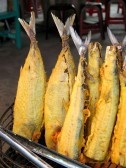
Frying gives cooks numerous ways of concealing what appeared the day before and in a pinch facilitates sudden demands, for it takes little more time to fry a four-pound carp than to boil an egg.–Jean-Anthelme Brillat-Savarin
Jean-Anthelme Brillat-Savarin (1755-1826) was a French gastronome, lawyer, magistrate and author who helped to develop the art of food writing. His most famous and influential book, The Physiology of Taste, consists of 8 volumes and was published in December of 1825, two months before his death at the age of 71. His influence is so significant that a cow’s milk cheese, a rum yeast cake, and a ring mold are all named after him. He is considered by many to have been the best food critic ever.

|
|
Nothing would be more tiresome than eating and drinking if God had not made them a pleasure as well as a necessity.–Voltaire
François-Marie Arouet de Voltaire was born into a middle class family in Paris in 1694. He is perhaps the very embodiment of the Enlightenment, serving as a crusader against tyranny and bigotry on the part of the Catholic church as well as government and society, as a result of which he spent time in the Bastille prison and in exile in England, Holland and Geneva. He is best known for his book Candide, a scathing view of humanity, where he concludes the best one can do in life is, “Il faut cultiver notre jardin,” i.e. look after your own garden. He died in 1778.

|
|
 Meet Jonell Galloway, a freelance writer and editor specialized in French cuisine.


 by
by 


