Related articles
|
|

A Literary Culinary Journal
Food Art: Still Life with Bread and Bowl of Fruit, painting by Travis Schlaht, contemporary. You can see more of Travis’ work at The Hidden Place.
I think we got spoiled by eating cheap food from all over the world. That put us out of sync with nature and skewed the price of local produce and products vs. produce and products from distant places, leading us to waste what we once had held precious because it was seasonal and local and therefore rare. Slow Food USA and Josh Viertel were right in fighting for fair wages for our own farmers and trying to lead us back to a way of eating that is in line with nature, which of course means paying a little more, but improving our health and local economy.

There are many more arguments to be put forth. Let’s talk about it: the pros and cons, your experiences, your convictions, etc. We’d love to get a big discussion going here.
Click here to watch Building a Slow Food Nation, outlining the history of Slow Food in the U.S., and including Josh Viertel’s view.
|
|
As the Mayan-predicted end of the world is upon us, I am sitting on the precipice of civilization, looking at seemingly the last remaining pay phone in the world. Pay phones used to be easy to find. They weren’t perfect. Some coin-operated telephones had broken cords, no handset, no phone book. Many phone booths had been used for unspeakable activities. Others were like a dream, with all parts intact, clean and working, the kind of place that Superman and Dr. Who might step in to, in an emergency.
When pay phones ruled the sidewalks, anyone with a dime could make a call, and if you had a pocketful of change you could talk for minutes, clanging in additional coin-of-the-realm whenever the operator “horned in” and threatened to disconnect the call. College students shared the one pay phone on their dormitory hall to phone home. Women walking alone could seek assistance at any functioning pay phone. We knew where the pay phones were, even if we were a bit afraid of the voice of the operator, interrupting, in that all-powerful voice like Lily Tomlin’s Ernestine.
You could game the system if you were short of cash. If you called “collect” and hung up quickly after saying your name (“Will you accept a collect call from Fred?”), your friend could call you back “on their nickel.” Expats living in Paris knew that a long line of waiting immigrants standing in line by a phone signaled a phone that had been broken (now we would say “hacked”) so this special pay phone could be used for free to call home in some faraway country.
Today, the American pay phone industry claims there are just a one and a half million pay phones in existence. One hundred and forty million Americans have no cell phone, and fourteen million have no home phone either. That’s a lot of people who must still know where the pay phones are.
The pay phone was the automat of communication, but instead of opening a little door to pull out a piece of pie, as was possible at the Horn and Hardart automats in New York City, you put in your dime and presto! there was a person talking at the other end of a line. The automat, that magical drive-up window for pedestrians, is a thing of the past. So is the omnipotent “phone company,” and so is the shared experience of the pay phone.
The IPhone 5 is available now, and who doesn’t lust after its shiny, sleek profile holding a box of mysteries and enchantments? It will only cost you $1,000 a year, all told, or ten thousand dimes. These phones work, their phone books don’t have pages missing, and they are personal and clean. But where do recent immigrants go to make a call at low cost?
And, where is the common experience that binds us all together in today’s America?
I find hope for the common experience at the increasing number of local diners run by recent immigrants, often from Central America and Brazil. At these local diners the coffee is hot, the plates are mismatched because there are no matching plates, not by design, and the prices are reasonable. The waitress prices your meal as “sides” to save any diner a few bucks.
You can tell you are in the right place because the menu includes an option of a large bowl of fruit. Rich and poor, we all come in for the fruit. The fruit is uniformly fresh and juicy, never defrosted from a bag of institutional frozen fruit salad. Frozen melon has a squishy, spongy consistency because all the cell walls have been compromised by freezing. Frozen melon is not good, and there is nothing more to say about it. The local diner fruit bowl is truly the “low-hanging fruit”, to use a horrible term from business-speak, and I am picking it now, just before the end of the world.
To be continued…..
|
|
In Salone del Gusto versus Good, Clean, and Fair: Part 1, I’ve already mentioned some healthy skepticism about the presence of two big Italian names at Salone del Gusto: Lavazza Italian coffee, and the supermarket Coop.
Lavazza takes on the responsibility of Fair Trade coffee, but wearing a label doesn’t necessarily prove honest actions behind it. There are loopholes to be jumped in any policy. Without venturing beyond the comfort of online research to the plantations in South America, however, I couldn’t say with utter certainty how good, clean, and fair they are. My main conclusions? Don’t check off the Good Deed Done for the Day box just by buying Fair Trade, without knowing all the facts behind it.

It just doesn’t look Slow Food-y
As for Coop, I was very surprised to see this popular Italian supermarket in a haven of small-time producers at the Salone. Coop is no WalMart nor, on this side of the Atlantic, EuroSpin; shopping in my local Coop store, I’ve noticed very high quality, Alpine mountain cheeses, for example, alongside the added-preservatives-colors-skim-milk-binder, generic salumi; and I suppose I notice more organic produce overall. As far as the realm of supermarkets is concerned, my limited observations earn Coop a dull gold star. But a place at Salone del Gusto? Hardly, I thought.
Asking fellow Slow Food members what they thought, a Swiss friend informed me that it was in large part thanks to Coop, a charter member of Slow Food, that Slow Food Switzerland was initiated and is running strong today. Polish that gold star!
In fact, Slow Food and Coop have a partnership, with Coop supporting and promoting Slow Food values through selling local products as well as over 100 Presidia products (a Presidia labeled food being the equivalent of a protected or endangered animal in the food world).
Coop’s powerful, positive presence in the world of local producers and Presidia was brought home when I sat in for a tasting of some products during Salone del Gusto. Not that I wanted to taste anything. By the end of one of Salone’s last days, I had done as much tasting as my belly and buds could bear. But my legs were tired, and Coop had set up a booth lined with dangling Prosciutto legs, plastic chairs in rows, and a tasting of jam and juice. I didn’t resist.
The tasting was introduced by a Coop Quality Control employee and a representative of a Bosnian company based in Bratunac called Frutti di Pace, or “Peace Fruits.” Together, they told a story of how the Coop employee traveled to Bosnia for this product, met with the Bosnian woman, and formed an instant friendship that was strengthened, as in all cultures, over an abundant welcoming meal.
The employee found that the hardworking spirit and community of the women of Frutti di Pace were as charming as the incredible, all-natural flavors of their products were delicious.
Frutti di Pace was established after the Bosnia and Herzegovina War in 1992-1995. The members of this cooperative, mostly widowed women or women with husbands injured from the war, wanted to spur growth: of the local economy, of a long-held tradition ground to a halt from the war (raspberry production), and of a sense of community and confidence.
The first product we tasted was a thick raspberry juice. No colors, sugars, or conservatives were added – just water and red raspberry. It was exactly like plucking a handful of raspberries from a bush, squishing them all into your mouth, and squeezing out the juices with your tongue. The jams were next, and equally impressive in their bright, strong raspberry flavors. It lacked seeds, but that’s a personal preference of mine for raspberry jams.
Frutti di Pace spent ten years trying to get into the European market. The speaker was overwhelmed almost to tears when she recalled how happy they had been when Coop began selling their products. “’To hope’ is still difficult after everything we’ve been through,” she said.
My knee-jerk reaction to “supermarket” is “too much fluorescent light!” and then, “against all things Slow Food.” But this is not true (well, the second one). Today’s food market is pulled in two directions: one towards a global system made of imports, exports, and oil, the other towards local, small production, trends, and being organic. It’s important to consider the possibility that, between these two polar opposites, not everything is black and white. The grey areas will be necessary to marry two things that won’t go away for better or for worse: supermarkets in many parts of the world, and the importance of strong, local economies and good, clean, and fair food in all parts of the world.
Selling local food (or organic, or from a small producer, etc.) through a medium that everyone uses and will continue to use as long as it exists is ethically responsible and also quite genius.
The question remains: Does Coop Italia earn the good, clean, and fair award? It is still a supermarket that sells items ranging from low to high quality, from all parts of the world, and at prices too low to actually be profitable for the producer. But the answer is nevertheless yes – just, in a rather grey way.
|
|
//

As fall slips into winter, the open air markets in Turin, Italy push nature’s seasonal fruits and vegetables to make early appearances in the crates and boxes stacked inside each bancarella, or stand. Oranges, grapefruits, and clementines from Calabria and Sicily showed their waxy globes in the middle of October; bitter turnip tops called cime di rapa were available by the end of September; spiky artichokes, still not technically in season, have been around for weeks.
The sweet, crispy finocchio, or fennel, one of my newly-discovered favorites, entered the scene two weeks ago at the beginning of November. Last year’s discovery that I’ve waited impatiently for since the end of September is the sweet, soft kaki vaniglia, the persimmon, which has a designated corner in my refrigerator. These bombs of juicy, fruity sugar are an after dinner treat that could almost replace autumn pies. Almost.
According to the illustrated and finely detailed wheel of seasonal fruits and vegetables that I bought at Eataly, citrus fruits have just begun their yearly cycle in November. I pat myself on the back, since I resisted buying these until a few days ago. There was one mysterious exception in the form of yellow-green skinned citrus fruits, easy to peel and sour-sweet inside. They came from Calabria, and the hulking, big man that sold them ensured me they were sweet and ripe, never mind their greenness. The man who sold them seemed to have been plucked from another time and place, where people can and still do pick oranges in the fields all day for decent wages, the weakening winter sun warm on their backs. His nails were dirty and his accent thick (presumably Calabrian).
Once at a food photographer’s studio in Emilia-Romagna, the chefs and food stylists there prepared a tangy, salty, sweet salad from the South. It had been inspired by the chef’s Sicilian roots. It’s now one of my favorite meals, and I have to wait for these seasonal fruits and vegetables before I can enjoy it. It evokes flavors from a land where the sun shines across fields with rows and rows of citrus trees, bright orbs decorating the branches in a warm Christmastime.
The traditional olives to pair with this are black ones, but I had green, which I might actually prefer. Being the salt queen that I am, a shot of capers hits the spot, but I don’t know how “traditional” that is. Also, blood oranges knock the pretty factor up a notch for this already aesthetically-pleasing plate.

|
|
A cook, when I dine, seems to me a divine being, who from the depths of his kitchen rules the human race. One considers him as a minister of heaven, because his kitchen is a temple, in which his ovens are the altar.—Marc Antoine Désaugiers
by Rosa Mayland
Even though being betrayed by your camera or computer, denied access to your blog platform, or lacking all inspiration is bad enough, having your cooker die on you is probably one of the worst things that any food blogger and pastry lover can experience, as it leaves you feeling completely lost and powerless. Without this essential home appliance (my personal favorite together with my KA), your major working tool, you are absolutely nothing! Well, that’s exactly what happened to me not long ago and it was one terrible and stressful nightmare, especially wince we were quasi-penniless and could not afford to buy a replacement straight away.
|
|
 by Renu Chhabra
One should eat to live, not live to eat” –Benjamin Franklin

Peaches are synonymous with summer.
California being the largest peach-producing state, we are blessed with an abundance of them. Farmers markets are flooded with these fuzzy yellow beauties. So many of them. Different varieties with vibrant colors. Juicy, sweet, and simply delicious.
Farm-fresh peaches have flavor that can’t be found in supermarket ones. I have tasted a few California varieties that need no explanation. Instead, just close my eyes and bless the soil and the farmers who nurtured them. It’s nature’s bounty at its best.

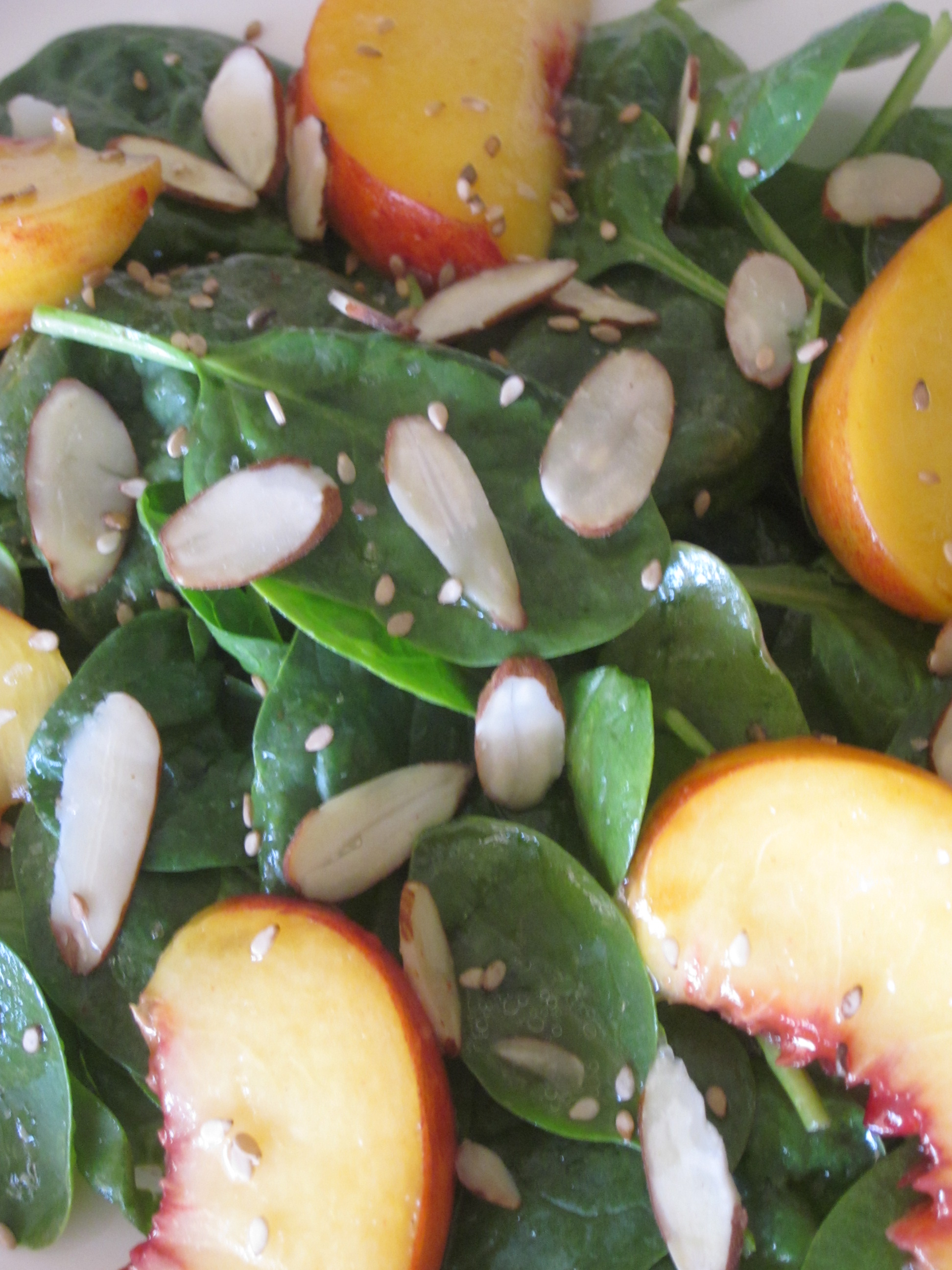
These peaches are in season from May through September. Baking, grilling, roasting, and poaching are definitely a few ways to enjoy them. But nothing beats the joy of savoring them in their natural form. So, I made a salad with this seasonal fruit and paired it with baby spinach.
Another ingredient that gives this salad a little zing is the peach balsamic vinegar. My culinary find that is absolutely delicious. Drizzle a little on salads, grilled vegetables, toasted baguette, or ciabatta, with or without olive oil. It stands out on its own. Its peachy flavor is the star that shines through.


A few other ingredients that complete this salad are ginger, honey, almonds, raw sesame seeds, and roasted sunflower seeds. Ginger and honey, a classic combination goes well with peaches. Raw sesame seeds and roasted sunflower seeds add earthiness and texture. Finishing with a grind of good sea salt (I used pink salt) and pinch of red pepper flakes complements the sweet peaches and honey. All together it makes it a sweet, salty, and spicy experience.
Garnish
Sliced raw almonds



Note: Use dressing to your taste, but be careful not to drench the spinach with too much of it.
 Meet Jonell Galloway, a freelance writer and editor specialized in French cuisine.


 Related articles