by Leo Racicot
Are you the type of person who savors? Do you “ooh” and “ahh” over the garnish before a fork ever touches the plate? Do you sniff the bouquet of a wine bottle with the intensity of a bloodhound before allowing the sommelier to pour?
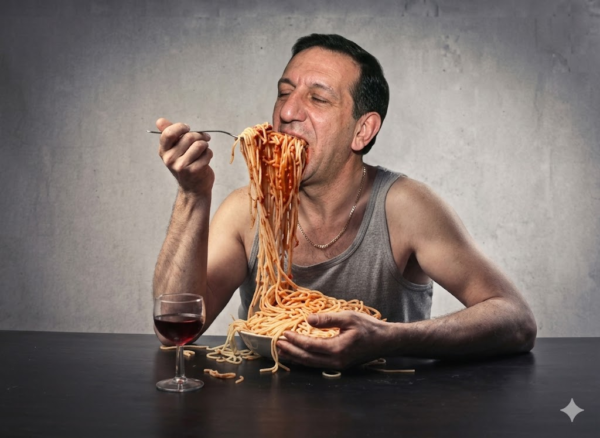
I am not that person. I am a “dig in and devour” sort of soul, a man with zero regard for ceremony. I suspect this habit was forged in the fires of public humiliation. Every time we went to a restaurant, my aunt would look at the server and bark: “Pile it on; Little Leo’s got a big hole to fill,” most decidedly not a charming thing to say to a total stranger about a sensitive child.
Years later, therapists would use clinical terms like “out-and-out abusive behavior” or “shaming.” At the time, I just felt like a glutton—a pig in a clip-on tie. Consequently, I never learned to savor. I only learned to hide. In formal company, I eat daintily, performing a slow-motion ballet with my peas. I have a friend, Joe—a lifetime Member of the Clean Plate Club—who eats so slowly it makes me lose my appetite. He divides his food into geometric sectors; neat little architectural piles he forks up until the ceramic beneath is squeaky clean. Dishwashers must want to marry him.
But when I’m alone? I am a human Hoover. I wolf down the meal before it has a physical chance to cool. There is a specific, quiet shame in outrunning the steam on your own plate. In school, they teach us “moderation.” Those lessons didn’t just miss me; they hit a wall and died. When I’m stress-eating, I have no idea what I’m shoveling into my face. I’m just a conveyor belt for salty-sweet snacks—popcorn, chips, and candies engineered by scientists to turn humans into addicts.
I once ate a banana I liked so much that I immediately proceeded to eat eleven more. I paid the price for that potassium heist for three days. I was apparently born with elastic bowels, or maybe decades of “gourmandizing” transmogrified them into a Power Gut.
The result? I am a relentless, world-class farter. My “Ozark Mountain Bear” blasts earned me the nickname Fartman among housemates. It’s a dubious distinction—one Stan Lee never saw fit to include in the Avengers, though the Gas-Based Avenger certainly has a ring to it and could easily send scurrying for the hills huge numbers of villains.
If you look at photos of me before age seven—before my father died— you see a happy, slender boy. Photos taken after “Papa’s Leave taking reveal a somber face, a much heavier body. A deep, caloric depression had set in.
Well into my twenties, I remained a melancholy entity; I’d pose, looking heavenward, as if expecting an apparition of the Virgin Mary to manifest on the ceiling. The only panacea for grief was a giant bowl of tortilla chips and a half-gallon of Ben & Jerry’s Cherry Garcia. The concept of “saving some for tomorrow” never occurred to me. Willpower? I don’t know her.
I hated being heavy. Fat makes the simple act of existing uncomfortable; chores become marathons and bending over becomes a logistical challenge. I put myself on a thousand Lenten sacrifices that never outlasted the sunrise. Whenever I’d hear a fellow fattie proclaim they were “fat and happy”, I’d abandon my abstinence in a flash—at least until I had to walk five feet to the corner store and ended up huffing and puffing like a broken locomotive.
I even tried Ayds. Yes, the 1970s weight-reduction candy with the most unfortunate name in marketing history. It tasted like “The Farm”—and not the good part of the farm. My mother eventually staged an intervention: “I’d stop taking those if I were you.”
My counselor says I have body dysmorphia; in my head, I’m always just a “Fat Guy” walking around belching. But I’ve found grace in odd places. Once, at the legendary M.F.K. Fisher’s table, I let out a burp I couldn’t stifle. She rescued me instantly, explaining that in Japan, a loud belch is a mandatory compliment to the cook. Suddenly, my gastrointestinal lapses weren’t “crude”—they were “international etiquette.”
There are, however, limits. I once sat through a field trip lunch where my classmates dared me to eat cow’s tongue. I declined, focusing instead on the “sides”. Then there was my friend Edmund White. Bless him, he was trying to cook a “comeback” meal after a series of strokes. The problem was, Ed had just been… intimate with a less-than hygienic 8th Avenue street hustler. After his encounter, he didn’t wash his hands before tearing the lettuce and buttering the bread.
When he plopped the steak down, it was so rare I thought he’d dragged the cow in straight from the arena. I gagged. I spent the night “appreciatively” chewing on lettuce leaves, unable to tell him that his “achievement” was my culinary cauchemar. I’ve noticed the trajectory of the human body. In our 50s and 60s, we thicken and bloat. We expand to fill the space. But then, as the clock winds down, the body begins to dissipate. It wears out.
In a way, I think it will be a relief to make that final return to the slender boy of my early youth. One day, the relentless craving for mountains of ice cream and cookies will simply stop. The “Big Hole” will finally be filled.
|
|