WHAT TO EAT IN FRANCE: CAMEMBERT

Published by Thursday, May 28, 2015 Permalink 0

Unspeakably Awesome / Foter / CC BY-NC 

CAMEMBERT, THE FAVORITE CHEESE OF THE FRENCH

by Jonell Galloway

Sometimes I think I’m liquefying like an old Camembert.–Gustave Flaubert

History of Camembert

The legend goes that Marie Harel invented Camembert in 1791 in the village of Vimoutiers in Normandy, a froward priest giving her the instructions, which she guarded preciously hidden away. Camembert is not taken lightly in France. In 1928, Alexandre Millerand, former president of France, inaugurated a statue in Vimoutiers in honor of Harel’s great “achievement.”

The legend lives on, despite the fact that the family name Harel has never appeared on the list of cheesemakers or business people in the Camembert region, and that the first historical recording of the cheese was in 1708, well before Harel supposedly lived.

How Camembert is Made

Camembert is made from unpasteurized whole milk, abiding by specific requirements if it is to be labeled “Camembert de Normandie.”  The milk is first skimmed, then the lactobacillus bacteria is added as a starter. The milk is left at 12° C to coagulate for several hours and is then heated to around 30° C.

These curds are then sliced vertically and ladled into perforated cheese moulds. This manual operation is repeated four or five times over the space of 40 minutes, allowing the curds to drain off all excess water. After about 12 hours, the cheese is turned over and a stainless steel plate is placed on it, putting pressure on it so that it continues to drain overnight.

how camembert is made in Normandy


The next day, the cheese is removed from the moulds and salted. It is left for a week in a curing room with 100% humidity, where it is turned regularly. Thanks to the Pénicillium candidum in the atmosphere of the room, a natural crust is formed. (Some modern facilities spray the cheese with Pénicillium candidum to start the process.) French regulations require that it then be placed in a curing room with 50% humidity for a week.

The Camembert de Normandie A.O.C./A.O.P. is then ready for packaging. It is wrapped in plastic and then enclosed in a thin, round poplar box.

There are numerous variations on this process, depending on the manufacturer, but all makers more or less follow these steps, whether on a farm or in a larger establishment.

How to Choose a Camembert

Labeling

The first thing to look for is the origin. It will probably be Camembert de Normandie or Camembert fabriqué en Normandie. Only Camembert de Normandie is made from raw milk and and has the legal right to bear the A.O.C. or A.O.P. label. This category includes some 500 milk producers and 9 or 10 cheese makers. In any case, Camembert de Normandie is always hand-made and the dairy cattle have been let out to pasture for a minimum of 6 months. It should always be marked moulé à la louche, indicating that it is hand-made using a ladle.

This name has been protected since 1983, and only represents 4.2% of all Camembert made in France. Look for all these indications on the packaging. Labeling can often be deceptive. Study the images in this article so you’ll be able to tell whether it’s real Camembert and to get a picture of the deceptive practices used. In any case, it should bear this label:
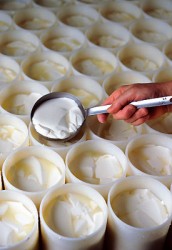
camembert in ladle


Camembert fabriqué en Normandie simply means it’s made in Normandy. There are no regulations controlling how it is made, so it will most likely be made in a factory, but there are certainly some artisanal cheese makers who for one reason or another don’t qualify for the strict Camembert de Normandie label, but whose cheese is of a high quality.

Then there are manufacturers from other parts of the country who make what they call Camembert. This is usually made with pasteurized milk and most often in factories. We have no way of knowing whether it is made according to the rules of the trade or whether it is good except by tasting. It might even be made with milk from another country.

Appearance

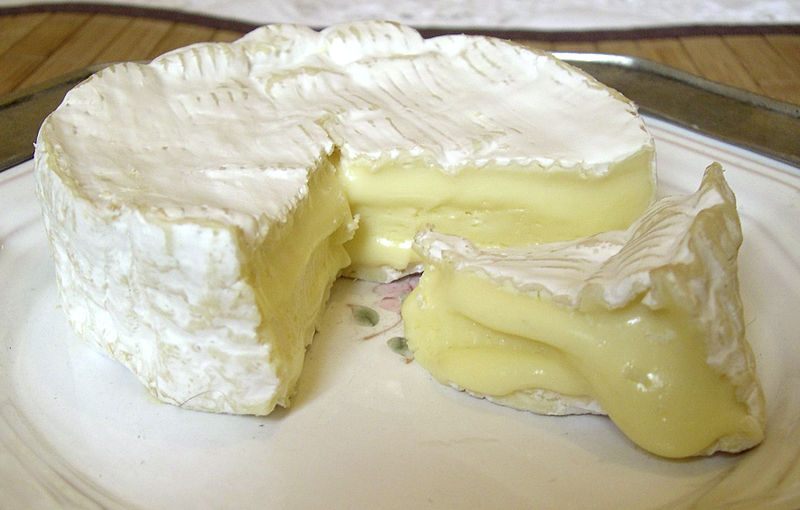
Camembert should be perfectly round and flat. The crust should be white, but slightly brownish, and should not be cracked. The brownish spotting is the result of healthy mould and ripening. The entire surface should be the smooth and even. The edges should be slightly yellow.

Smell the Camembert. Any whiff of ammonia indicates that it is too ripe. It should smell fruity and ripe like you’d like it to taste, but not overwhelming.

Touch the edges, then press the middle.  It should be neither too hard nor too soft.

When you cut into the cheese, it should be light yellow in color and creamy in texture.

Note: raw milk Camembert is best in the spring and autumn.

How to Eat Camembert

The French eat their cheese after the main course, either with or after a green salad. It is eaten as is, at room temperature, with bread, and followed by dessert. Some nicer restaurants will serve dried fruit, jam or nuts with the cheese course.


Never miss a post
Name: 
Your email address:*
Please enter all required fields
Correct invalid entries

WHAT TO EAT IN FRANCE: HOW TO EAT FOIE GRAS

Published by Thursday, May 21, 2015 Permalink 0

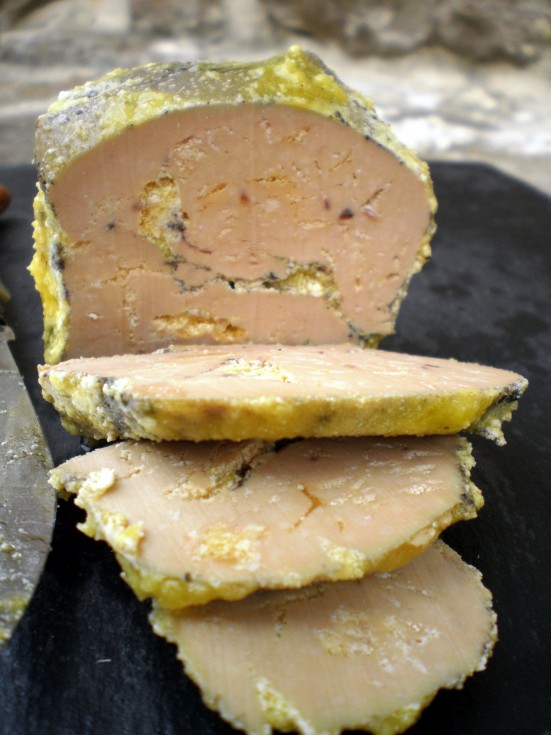
WHAT TO EAT WITH FOIE GRAS

by Jonell Galloway

I tell you it will be more tolerable for the Fejee that salted down a lean missionary in his cellar against a coming famine; it will be more tolerable for that provident Fejee, I say, in the day of judgment, than for thee, civilized and enlightened gourmand, who nailest geese to the ground and feastest on their bloated livers in thy pate-de-foie-gras.”–Herman Melville, Moby Dick (1851)

In What to Eat in France: Foie Gras, we talked about how foie gras is made and the different legal classifications, which determine both the quality and price. Let’s move on to the fun part now. We’ve bought our high-quality foie gras and we want to eat it in the best way possible. Here are some ideas, both traditional and inventive.

Cooked Foie Gras

So you’ve bought a foie gras entier, a foie gras, or a bloc de foie gras. You’ll be eating pure or fairly pure foie gras, but how do you eat it and with what?

There is no one way to eat it. The Romans soaked it in honey and milk to fatten it still more before cooking. The first recipe on record comes from Apicius in his fourth century De re culinaria: Thinly slice the foie gras with a reed. Soak in garum. Crush some pepper, lovage and two bay leaves. Wrap in a caul. Grill and serve.

Today we eat it differently. Cold foie gras is most often eaten with something acidic to help digest the fat. This traditionally includes cold, sweet garnishes such as apple, rhubarb, fresh or dried figs, grapes, or pears, and toast, but contemporary chefs venture outside these limits, serving it with dried fruit and nuts and toasted brioche or raisin-fruit bread. More contemporary garnitures are onion jam or caramelized onions, Balsamic vinegar, port or Sauternes jelly, chutney, cassis berries, raspberries, blueberries or coarse sea salt.

Some people simply eat it with green salad, although I find that salad dressing deadens the natural depth of flavor. It’s also possible to eat it with cornichons and pickled onions. like one does with regular pâté, but once again, the vinegar is likely to overpower the delicate flavor.

Cooked foie gras should never be reheated. It should be eaten just colder than room temperature, so take it out of the refrigerator about 45 minutes before serving. Slice it with a knife while it is still cold. It is usually served with cold garnishes, most often as a starter.

Continue Reading…

Never miss a post
Name: 
Your email address:*
Please enter all required fields
Correct invalid entries

MarketDay: Everything You Need to Know About Indian Mangoes

Published by Wednesday, April 27, 2011 Permalink 0

by Jonell Galloway

Indian Mangoes: Alphonso, Alphonso!

Indian mangoes are in season from March to May. They are the ugliest mangoes around, but for me, there is no question they are the best. Not surprising, since mangoes come from India in the first place. They have an almost spicy taste that nicely compliments the sweetness.

Indian mangoes may be the ugliest ones, but they are the tastiest!

How to choose a mango

Indian mangoes often look bruised and half-rotten compared to other varieties when in fact they are at their very best. All you have to do is feel them to check how ripe they are. They should be slightly soft and smell full and fruity.

I buy them by the carton in Geneva’s Boulevard Helvétique market, or from Indian supermarkets. It’s all right to buy some that are not quite ripe so that you can eat them over a period of several days, or use some of them in green mango recipes. Indian mangoes ripen better off the tree than other varieties.

Mango shelf life

Mangoes keep well in the refrigerator for a week and often even two. Don’t put them in plastic. Leave them loose in the fruit bin or in the carton if you’ve bought a whole carton.

If they’re not ripe enough, put them in a paper bag and leave them at room temperature until they’re ready, just like for avocados.

India is the largest producer of mangoes in the world, with 2,143,000 hectares harvested, according to the Wikipedia. Indians eat them both ripe and green, rather like papayas, and like papayas, they contain an enzyme that aids digestion.

A single mango can contain up to 40% of the fiber you need daily, and is full of antioxidants and potassium.

How to eat a mango

Mango as a fruit on its own

The “How to Eat a Mango” section on the freshmangoes site explains step by step with illustrations for cutting and eating.

Mango as an accompaniment to a meal or a condiment

Mango chutney is good with fish, and makes a simple, healthy meal when served with Basmati rice. Green mango sauce is an easy way to liven up a piece of grilled meat or chicken. The freshmangoes site gives recipes of every imaginable type.

And of course, what is more delightful than a fresh, ripe mango to clean your palate and help you digest after a big meal.

If mangoes are your favorite fruit, and you think you can’t live without them (which is my case), Jonathan Allen’s article in the New York Times is a must.

The Buddha supposedly lived under a mango tree, and above all, this “king of fruits,” as it is often referred to, is associated with “abundance, joyousness and the carefree innocence of childhood,” says T.S. Satyan. I remember the first time I ever tasted mango juice, as they call it in India (it’s actually just puréed mango). I certainly felt enlightened!

A version of this article was originally published on GenevaLunch.

Never miss a post
Name: 
Your email address:*
Please enter all required fields
Correct invalid entries

UA-21892701-1