Jonell Galloway: The many colors of summer tomatoes

Published by Monday, July 18, 2011 Permalink 0

by Jonell Galloway

Red, yellow, green, and orange tomatoes now available in Lake Geneva region

Tomato season is well under way, and here are a few suggestions for using them.

How to choose a tomato

Remember you can’t judge a tomato by its cover. By that I mean, the best tomatoes may well be the ugliest. They have not been sorted to meet some regulation as to size, shape and color. They can even be marked “Geneva,” “Lausanne” or “Vevey”, and never have had a root in the earth. Tomatoes can be grown hydroponically just about anywhere, so the fact that it’s marked with a local name is not absolute assurance that it will be full of flavor like a summer tomato should be and that it has been grown using traditional methods.

There are a lot of resellers in farmers markets, and then there are direct producers. Don’t hesitate to ask the vendors in your farmers market if they grew their tomatoes in a field or if they were grown hydroponically or in a greenhouse (often referred to as sous tunnel or en serre). “Field” tomatoes are obviously likely to have more taste.

The best way to be sure is of course to grow them yourself, but we do not all have the possibility, of course.

The appearance is just one factor. Smell is just as important. A natural, ripe tomato smells fragrant when you put it to your nose. A small tomato can have as much taste as a big one. Tomatoes should be soft, but not blemished or split open. If they are hard and are not aromatic, they are probably not field tomatoes.

A tomato can have hard black “calluses” on it, but that has no effect on its flavor. Simply trim them off.

In general the darker the color, the stronger the taste and the more acidic. Yellow and orange tomatoes are sweet, rather like fruit. Red tomatoes have more pizzazz. The darker, purplish ones are strong-flavored and not to everyone’s taste.

Green tomatoes tend to be more acidic. Most people prefer them cooked rather than raw, but this is a matter of taste.

How to eat a summer tomato

There are million ways to eat tomatoes, but ripe summer tomatoes need very little.

My favorite way of eating them is simply with salt and pepper, and perhaps a drizzle of olive oil. A beautiful addition to any summer lunch is a large plate of sliced tomatoes of different colors, served in this way. It is always a hit, both aesthetically and as a dish.

Tomatoes are also good grilled over the coals. For this, choose medium-size tomatoes, so they won’t fall through the grille. Simply cut them in half and grill for about 3 minutes on each side. This intensifies the flavor, giving it what the French call a confit flavor. What it really does is evaporate most of the water, leaving behind the most flavorful part, the flesh. The natural sugar in the tomato also caramelizes, making it taste sweet rather than acidic.

Tomatoes, courgette (zucchini), and aubergines (eggplant) — the classic Mediterranean vegetables — are all in season at about the same time. There are endless recipes one can think up, but one of my favorite is to mix finely diced tomatoes, zucchini and chopped onions marinated in a generous helping of vinaigrette made with Balsamic vinegar, Chardonnay vinegar and olive oil.

And then there’s the all-time favorite: mozzarella served with tomatoes and fresh basil. This too can be livened up by using tomatoes of different colors.

This article was originally published by Geneva Lunch.

Never miss a post
Name: 
Your email address:*
Please enter all required fields
Correct invalid entries

Wild Woman on Feral Acres: Backyard Poultry Skills

Published by Tuesday, July 5, 2011 Permalink 0

by Esmaa Self

We’ve had a backyard flock seven years and have sold extra eggs for about four. I have been around and kept my own layer flocks before moving here and working to massage a thriving farm from our rocky span of hogback. And we’ve been sold out of eggs for three full years, but I wouldn’t call myself an expert on chicken behavior.

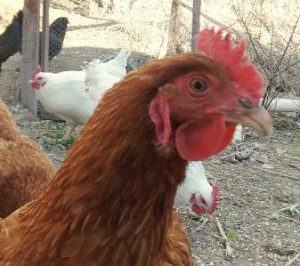
One of our 'girls'.

Continue Reading…

Never miss a post
Name: 
Your email address:*
Please enter all required fields
Correct invalid entries

Simon Says: Daily Food Quote, June 8, 2011

Published by Wednesday, June 8, 2011 Permalink 0

by Jonell Galloway

I am not bound for any public place, but for ground of my own where I have planted vines and orchard trees, and in the heat of the day climbed up into the healing shadow of the woods.–Wendell Berry (1954-)

Wendell Berry is a Kentucky poet, novelist, essayist, philosopher and farmer. He has always remained close to the land, continuing to farm on his family farm, and this is reflected in much of his work. His most well known book, The Unsettling of America, provides a classic critique of industrial agriculture which is foundational to today’s agrarianism and a precursor of the Slow Food movement and the current food revolution taking place in the U.S.


Never miss a post
Name: 
Your email address:*
Please enter all required fields
Correct invalid entries

Market Analysis: Organic Food from Supermarket vs. Straight from the Producer

Published by Thursday, April 28, 2011 Permalink 0

by Eric Burkel

Don’t allow the wool to be pulled over your eyes by supermarket organic food!

While discussing the issue of sustainable agriculture and the virtuous model of direct-channel (straight from the producer) with a friend the other day, she told me proudly that she usually buys organic food at her supermarket.

It made me think that most of us do the same and therefore we are content in the knowledge that we have most duly earned some sacrosanct “organic” brownie points!

However, it is a pact with the devil for dupes, when you boil it down. In a direct-channel model, whereby middlemen are cut out, the producer/breeder/grower gets decent compensation for his or her efforts. In a supermarket chain, the same “squeeze-the-supplier-till-he-squeals (or dies!)” modus operandi applies. How else can you explain that the major chains in France are offering organic deals at 1 € a day, for instance?

Organic growing is inherently risky and mechanically more expensive than intensively grown food. Weeds? They have to be pulled out by hand, not sprayed with the latest and greatest herbicide. Bugs? You can’t just spray the nasty freeloaders with a new-fangled pesticide.

When I asked our favourite organic Bordeaux wine-grower if he had sold out of his 2007 production (there was none to be found on his price list), he responded matter-of-factly: “We had a fungus that year and lost our whole crop.” You can imagine that it would have been soooooo much easier to spray some fungicide and make it all go away.

After factoring in such vagaries of organic farm life (without forgetting that yields are invariably lower on organic farms), someone needs to explain how in an ideal world you can have the cut-price organic prices we see in commercials all the time. Unless of course, someone is still getting shrift in the loop, as is often par for the course in our zero-sum world.

Some supermarket chains have understood the nuance and are trumpeting their programs to promote “local” procurement. This is a step in the right direction, no doubt.

So great, the chains have brought organic food to forefront our collective conscious and that must be goodness. But we must keep them on their toes to ensure that they are not just surfing the latest fad and using it their sole advantage, to sucker us once again.

Or better yet, go out of our way and support the direct-channel by joining a CSA (Community-Supported Agriculture) or buying directly from local producers.

Never miss a post
Name: 
Your email address:*
Please enter all required fields
Correct invalid entries

Back to the Land: From City Living to Farming, the Young Farmers Movement

Published by Tuesday, April 26, 2011 Permalink 0

by Cozette Russell

Brookford Almanac:  A Documentary Film about a Year in the Life of First-Generation Farmers in the U.S.

I’m a filmmaker interested in the relationship between people and landscape, so in 2008 when I read an article in The New York Times about the trend of young people moving out of the city to farm, I knew this was a story I wanted to film. I wanted to find out why highly educated people would walk away from specific career paths to choose a life of farming. Why would they embrace the risks of a life of hard work that offers such little security?

My film, Brookford Almanac, a cinema verité documentary currently in production, tells the story of Luke and Catarina Mahoney and their lively farm apprentices who run Brookford Farm in Rollinsford, New Hampshire.

Luke and Catarina are first-generation farmers. They came to farming through their desire for a connection to the land, not from their family’s expectations. The Mahoneys have embraced the rewards and frustrations of a life centered on the small-scale production of local food. But without inherited land, a major obstacle for first-generation farmers, they must lease their farm with little security for the future.

I discovered the Mahoneys through my father, John Carroll, a professor at the University of New Hampshire who has written several books about New England farming. I decided to spend a year documenting the Mahoneys lives at Brookford Farm because they are not only new to farming but also run a biologically diverse farm and organic dairy. Before long I found myself filming at the breakfast table, riding in the tractor, slogging through cow pastures, attending business meetings and farmer’s markets, and hanging out in the pasture with the cows well before dawn. I learned the dedication it takes to farm and how the rigorous labor of each day is always interrupted by an inevitable drama such as animals breaking out or tractors dying or storms approaching. For a filmmaker the tensions of life on a farm are exciting and unexpected.

Every documentary filmmaker starts out with one idea for their film and watches that idea ebb and flow as life unfolds in front of the camera. When I began, I envisioned Brookford Almanac as a celebratory portrait of a year in the life of a farm family. At that time, I could not have predicted the changes that would take place both on the farm and in my film. Luke and Catarina have expanded their operation considerably. With this expansion has come problems with their landlord, a strong-willed, retired farmer who holds different opinions as to how things should be done. Sadly, because of these divergent philosophies, the landlord has decided not to renew the Mahoneys’ lease.

The issue of land access – something almost all first-generation farmers struggle with – is now no longer just a looming issue for Luke and Catarina; it is a harsh reality in their lives and it has come front and center in my film. The making of Brookford Almanac continues as I film life at Brookford Farm for a second farming season.

To continue this second year of production I am raising money through Kickstarter, a popular online crowd-funding tool. To learn more about the film and to join the production, please visit my Kickstarter page by clicking here below by April 30th.

_________________

Cozette Russell is a documentary filmmaker. She is currently a fellow at Harvard University’s Film Study Center, and she lives with her husband and creative partner Julian Russell in Lee, New Hampshire.

Never miss a post
Name: 
Your email address:*
Please enter all required fields
Correct invalid entries

Spontaneous Cuisine: Strawberry-Rhubarb Compote, It’s in Season!

Published by Monday, April 18, 2011 Permalink 0

by Jonell Galloway

Recipe: Strawberry-Rhubarb Compote

I always get really excited when the strawberries and rhubarb come on the market. For me it’s literally like “breaking news.” They’re really the first local fruit.


Photo courtesy of Happy Hoarfrost.

One of my favorite dishes is strawberry-rhubarb compote. It’s healthy, full of fiber and vitamins; it’s also versatile and can be used in many ways.

In addition, it’s about as easy as you can get.

Continue Reading…

Never miss a post
Name: 
Your email address:*
Please enter all required fields
Correct invalid entries

Un boulanger ne fait pas le printemps mais y contribue (2)

Published by Friday, April 15, 2011 Permalink 0

Dictionnaire Universel du Painpar Jean-Philippe de Tonnac

Click here for English version

La révolution du Berger

La boulangerie française est en secrète révolution. Elle s’adapte à un monde qui change. Elle redécouvre avec étonnement son passé immémorial. Elle se réinvente à la lumière des expertises scientifiques qui lui font mieux connaître les blés, les ferments, le sel, l’eau avec lesquels elle travaille. Elle cherche à dynamiser ses équipes dédiées à la production et à la vente. C’est dans ce dernier secteur que l’Etoile du Berger innove résolument.

Franck Debieu, son créateur, donne l’impression de s’être échappé d’un tableau de Fragonard. Extrême douceur mariée à une exigence extrême. Les mariages, c’est son obsession. Les atouts de ce boulanger entrepreneur sont multiples. Intelligence des matières et des hommes. Sens de la boulangerie qui retrouve sa place dans une société française en totale dé/recomposition. Intuitions, audaces, sens du commerce. Il a voyagé pendant sept ans comme compagnon sur le Tour de France, puis comme expert auprès des boulangers dans le monde entier. Il a étudié différentes formes de levain, dont un levain liquide qui a fini par avoir sa préférence. Il a ouvert trois magasins à l’enseigne de l’Etoile du Berger à Sceaux, Fontenay aux Roses et Meudon, aux portes sud de la capitale, où il propose un pain qui tient les promesses qu’on avait placé dans ce compagnon boulanger.

L’Etoile désormais allumée au firmament de la boulangerie, Franck s’est attelé à cette tâche innovante et prometteuse : évaluer le potentiel exact d’une équipe de boulange(è)r(e)s – pâtissie(è)r(e)s aguerris, d’une part, d’une équipe de vendeu(r)s(es) d’autre part et imaginer entre l’une et l’autre des passerelles, des transferts, des complicités cachées. La boulangerie a commencé à se réinventer en France par les fournils, une fois libéré la force créatrice des artisans (libération des prix en 1987 et décret de la baguette de tradition française en 1993), mais elle est encore loin d’avoir traduit ces changements au niveau de la vente. Demeure une ligne Maginot entre le fournil et le magasin, traditionnellement entre le boulanger et son épouse, même si les protagonistes ont changé, les fonctions évolué.

La petite révolution de l’Etoile est donc d’inviter ceux qui produisent à vendre et ceux qui vendent à produire. Inacceptable, l’attitude du boulanger enfermé dans son fournil qui ne se soucie pas de ceux qui vont manger son pain. Inacceptable, l’attitude de la vendeuse qui annone sa leçon à propos du pain « sur levain liquide » et qui n’a jamais plongé ses mains dans l’onctueuse pétrissée durant ses longues heures de pointage. Si la vendeuse franchie les portes du fournil, enfile le tablier, inventorie les entrants de la recette dont elle ne connaît que le stade final (la « tourte du grenier », le « pavé du Berger », l’ « épeautre et graines de lin bio », le « torchon abricot », le « cœur de rêve », etc.), fait tourner le pétrin, façonne, enfourne, écoute la petite musique du ressuage, alors il y a une sorte de « déclic », une petite illumination, après quoi la vente n’aura plus jamais la même saveur. Ni le monde. Ces jours dans le fournil lui donnent des ailes. Même chose pour le mutique artisan qui montre le bout de son nez enfariné dans le magasin et découvre tout à trac ce que sont les mangeurs de pain. Bigre !

Ajoutez à ces roques, le sentiment partagé par quelques-uns dans la profession qu’il est temps de féminiser les fournils, à partir du moment où la mécanisation du process permet de solliciter musculairement les acteurs d’une manière plus yin. « Féminiser les fournils | masculiniser la vente » pourrait être le devise d’un Berger qui cherche à favoriser toutes les mobilités et partant, of course, la c.r.é.a.t.i.v.i.t.é.

Sabrina Tesan, responsable d’une équipe de vente et actuellement en formation pour passer son CAP de pâtissière : « Plus que tout, c’est de vivre ce rapport à la matière qui me donne du plaisir. » Stéphanie Jiménez King, responsable des ventes : « L’Etoile du Berger m’a permis de vivre une énorme évolution en commençant en tant qu’apprentie pour devenir responsable des ventes. L’Etoile n’est pas pour moi qu’une boulangerie de haute qualité. Elle est une école de la vie. » Mathieu Taillasson, responsable de site : « Le fait d’avoir suivi une formation en management m’a beaucoup apporté dans la gestion des relations humaines. » David Johanet, responsable pour les trois sites : « Le fait de devenir responsable boulanger de l’ensemble des sites m’a permis de développer mes compétences et ma capacité d’ouverture pour mieux écouter mes collaborateurs et ainsi mieux les épauler. J’ai aussi développé mon écoute pour comprendre les attentes des autres secteurs comme la vente, ce qui nous permet de mieux gérer l’organisation et l’humain. »

La réussite de Franck Debieu ne se qualifie pas seulement en terme de chiffre d’affaire. D’une manière qui saute aux yeux lorsqu’on découvre l’une de ses boulangeries, le pain fait chez lui des heureux de deux sortes : ceux qui le dégustent | ceux qui le font & le vendent. Un mariage, donc, entre le phalanstère et la libre entreprise, le muscle et le cœur, l’acidité (du levain) et la douceur.

Never miss a post
Name: 
Your email address:*
Please enter all required fields
Correct invalid entries

National Sustainable Development Week in France, Paris AMAPs in Full Swing

Published by Friday, April 8, 2011 Permalink 0

by Eric Burkel

Without actually achieving that holiest of grails, sustainable development, and without going doing the path of ascertaining whether Mother Earth really needs more development, sustainable or otherwise, a world-leading auditing firm outside Paris opened its doors yesterday at lunchtime to host an event to offer up a few solutions that might help its employees reduce their environmental footprint.

Continue Reading…

Never miss a post
Name: 
Your email address:*
Please enter all required fields
Correct invalid entries

Switzerland: MarketDay, April 6, 2011

Published by Wednesday, April 6, 2011 Permalink 0
Never miss a post
Name: 
Your email address:*
Please enter all required fields
Correct invalid entries

Kids in the Kitchen: Teach Your Kids How to Shop for Food

Published by Wednesday, April 6, 2011 Permalink 0
by Jonell Galloway

Spring and summertime are the perfect time to start!

Farmers market

Going to the farmers market can be made into an exciting, weekly event. Summer offers lots of fresh fruit that they can choose to make their smoothies, to put on their breakfast cereal, or to make fruit salads. Vegetables are tastier in summer than in winter, and there is a larger selection, so it is also an occasion to encourage them to try more vegetables. If they choose fruit and vegetables themselves, they will feel more part of the process, and are more likely to eat them.

Continue Reading…

Never miss a post
Name: 
Your email address:*
Please enter all required fields
Correct invalid entries

UA-21892701-1