4th of July Healthy Recipe Roundup

Published by Monday, July 2, 2012 Permalink 0

4th of July Recipe Roundup

by Christina Daub


With the fourth of July right around the corner, it’s time to clean the grill and get ready to barbecue. Whether you are using charcoal or gas, Independence Day just wouldn’t be the same without the smell and the sizzle of a big steak wafting through the backyard.

For my taste buds, however, nothing beats the old-fashioned, three-legged charcoal grill, whose heat has been reduced nearly to embers and tinged with hickory chips I’ve soaked to add that delicious smoky flavor that enhances grilled food so well. Unfortunately, in Switzerland, unless you have a personal source of wood chips, you’ll have to use regular charbon de bois, or wood charcoal, which is usually a mixture of several different woods.

To get juicy, flavorful steaks, try slathering each side with mustard, Worcestershire sauce and soy, then let the meat sit while the charcoal reduces itself for slow cooking.

When grilling ribs (the pork variety), soak your wood chips in apple juice for about 30 minutes, then wrap them in foil, perforate it, and lay it on the coals. This gives a slightly sweet taste to the ribs which complements the saltiness of the pork.

Traditional or healthy accompaniments?

While the kids line up for hot dogs (in the Lake Geneva region, local pork butchers or charcuteries often make their own homemade frankfurters) and hamburgers (get the butcher to grind it for you fresh on the morning of the 4th), think about what you want to serve with your grilled delicacies.

Traditionally, there was potato salad, great lumps or cubes of potatoes swamped in mayonnaise, with perhaps a scallion or two to give it some punch. However, not being a fan of such cholesterol- and fat-filled fare, I have always opted for the healthier green salad, loaded with a variety of lettuces and pea shoots I can get by hitting the farmers’ market early enough. In Switzerland, there is an endless choice of greens, herbs and shoots at this time of year in any farmers’ market you go to.

A platter of just-cut, ripe red tomatoes (local if you can find them), sprinkled with salt and drizzled with high quality olive oil and a local full bodied red wine round out the meal. Until  dessert.

Dessert: a healthier version than in the old days

Christine Koh
Photo used with authorization of Christine Koh

I have to say while the all-American barbecue meal totally sates me, I never pass up dessert, and this is one time of the year it’s really fun to use color in making dessert. There are a number of red, white and blue desserts I’ve come up with in the past, but everyone’s favorite seems to be what I call the “flag cake.”

This is a flat rectangular sheet cake that I cover either in white icing or whipped cream. On top, I create horizontal rows of raspberries for the red stripes of the flag and in the left corner, I intersperse blueberries so that the icing can shine through as “stars.”

For a lighter, but equally festive dessert, I layer yogurt with berries in parfait glasses, alternating the raspberries (you can also use strawberries or currants) with the blueberries in between the layers of yogurt. The kids seem to prefer vanilla yogurt, but for the adults I use plain, sweetened with a bit of honey.

Let the fireworks begin!

Christina Daub studied at L’Ecole du Cordon Bleu in Paris. She now lives in Washington, D.C. She is a poet, and teaches poetry at George Washington University and other writing workshops around the country.

Photos compliments of GenevaLunch.

Continue Reading…

Never miss a post
Name: 
Your email address:*
Please enter all required fields
Correct invalid entries

Food Art: Sights and Flavors of Crete, a photography exhibit by Linda Psillakis

Published by Monday, July 2, 2012 Permalink 0

My name is Linda Psillakis, free-lance photographer based on the Greek island of Crete. From the Atlantic Ocean, to the rolling hills of Tuscany stretching to the Mediterranean Sea and as far as the Himalayas, life has gifted me with unforgettable colors and stories which I  have lovingly documented with my camera. Click here to visit my travel photo website.


Never miss a post
Name: 
Your email address:*
Please enter all required fields
Correct invalid entries

Simon Says: Daily Food Quote, June 15, 2012

Published by Friday, June 15, 2012 Permalink 0

by Simon de Swaan

All cooks, like all great artists, must have an audience worth cooking for.–André Simon

André Simon was a wine merchant, gourmet, and prolific writer about wine. Hugh Johnson describes him as “the charismatic leader of the English wine trade for almost all of the first half of the 20th century, and the grand old man of literate connoisseurship for a further 20 years.”


Never miss a post
Name: 
Your email address:*
Please enter all required fields
Correct invalid entries

Lost in Translation: Brown Sugar

Published by Friday, June 15, 2012 Permalink 0

Brown sugar and molasses can be made from both cane and sugar beets

Over more dinners with friends than I can remember, chocolate chip cookies have become synonymous with coming to my house. While my dorm neighbors were making tartiflettes and curries to plant little seeds of home in campus life, I was either making apple crumbles in a roasting pan, or trying to beat butter and sugar until fluffy with a wooden spoon. This is really not as sophisticated or even as homey as it sounds, considering that our 50-year-old kitchens had a decorating scheme typical of a detention centre, and faulty wiring that’s led the university to demolish the buildings. Still, the sentiment was there.


Neglecting the brownie, the chocolate chip cookie might be the greatest American delicacy that is almost untraceable on this side of the ocean — apart from some pretty pathetic, grey-looking supermarket things and the greasy mondo version from Millie’s Cookies branches in shopping centres. No matter which recipe I use, the chocolate chip cookie is one I’m asked for more than anything else by friends from all over the place (and is the main reason some called me “Monica” for being anal enough to write “226 grams of butter”).

In those beginning days in university halls, the oven was so temperamental that it was okay to make sweeping substitutions with whatever you had on hand, because you never knew what would come of it. (Seriously – there was always a poor and hungry Frenchie willing to vacuum up the disasters.) It wasn’t until I moved kitchens that I realized my “randomize” approach just wasn’t cutting it. I needed to test several recipes, and I needed to know which one was the best…and so began the Great Chocolate Chip Cookie Quest!

A chocolate-chip cookie.

A chocolate-chip cookie.


One thing that stood out immediately was the small but obvious difference in taste and texture between the light brown sugars found in North America and the UK  — an ingredient essential to the success of a good chocolate chip cookie recipe. Inspired by fellow expat David Lebovitz, I set about finding out the difference, and here’s what I found.

Disclaimer: I researched general processes — not those of specific companies — and I am no food scientist. The further I dug into the subject, the more I wanted to learn (and I’d heartily welcome any corrections).

3 TYPES OF COMMONLY USED BROWN SUGAR

To figure out what kind of product I’m actually trying to reproduce, I looked at light, dark, and muscovado (or “regular”) brown sugars. Light brown sugar consists of a small proportion of molasses at 3.5%; dark brown sugar at 6.5%; and muscovado sugar at nearer 10%.


Brown sugar examples: Muscovado (top), dark br...

Brown sugar examples: Muscovado (top), dark brown (left), golden brown (right).


SUGAR CANE vs. SUGAR BEETS


Sugar is made from a variety of plants, but most of the sugar that we reach for in the baking aisle comes from either sugarcane or sugar beets; which one you use is all about climate. Sugar cane grows exclusively in tropical climates like in Hawaii. Brazil and Indonesia, making it the main import in the US market. Sugar beet grows exclusively in “temperate” climates like parts of Russia, the American Midwest, and East Anglia in the UK, making it the standard in Britain and the surrounding European countries.

It seems that sugar beet in the UK has a greater consumer loyalty (than the non-loyalty of North Americans to a specific plant), due to sugar beet being viewed as a more “green, local, British” product. This is also true for the parts of the States that grow sugar beet, but because we’re a huge country with such varied climates, branding a ‘national’ sugar source presents some problems.

English: Sugar beet Sugar beet at Blue Barn Farm

English: Sugar beet Sugar beet at Blue Barn Farm


Fun fact: it takes about 6-9 kg (or 4-6 bulbs) of sugar beet to produce a kilogram of refined white sugar, and about 8 kg (or 5-6 stalks) of sugar cane to produce a kilogram of brown sugar. (Brown and refined white sugars have surprisingly similar densities.)

Cane sugar is often touted as being more beneficial for health, due to its roots reaching further into the ground beyond topsoil that may have had many of its nutrients washed away. But this appears to be true only of unrefined — and not refined white — sugars. White sugars are refined by stripping all flavorful minerals and “impurities” from plant juice by centrifuging out the syrup by-products from the crystallized sugar, the only slight and indiscernible difference between cane and beet sugars being that during the treating and whitening of beet juice, a few more natural agents are used due to its different chemical composition. This difference in processing has absolutely no effect on the flavor and little effect on the natural composition of the final product in white sugars. (Recent studies have shown that it is possible to ‘fingerprint’ a beet or cane sugar particle and reveal trace elements leeched from the soil where it was produced, and lock down regional connections, but any elements found are in such small quantities that differences are pretty negligible to nutrition. Pretty cool, eh?)

Venezuelan sugar cane (Saccharum) harvested fo...

Venezuelan sugar cane (Saccharum) harvested for processing.


But I’m getting sidetracked: the principal difference between cane and beet brown sugars is in the nature of the syrupy by-products from each plant.

English: Ox-wagons transporting harvested suga...

English: Ox-wagons transporting harvested sugar cane to the sugar factory in the Netherlands.


In sugarcane processing, the molasses syrup that results from removing sugar after each stage of boiling can be categorized as either sulphured or unsulphured. Sulphur dioxide is added in the first case to preserve sugarcane which has been picked ‘young’, and unsulphured molasses is derived from fully mature stalks which have sun-ripened over 12-15 months. Regardless of whether sulphur dioxide has been added or not, the first boiling of juice yields ‘mild’ molasses and the second yields ‘dark’. ‘Blackstrap’ molasses is obtained from the third and final round of boiling, after which the proportion of sugar in the syrup is too small to be extracted economically. This makes blackstrap molasses the lowest in sugar content and the most rich in “impurities” (like B6, calcium, magnesium, potassium and iron). That’s why it’s promoted for good health, providing the most concentrated dosage of all of those minerals and accounting for up to 20% of their recommended daily amounts!
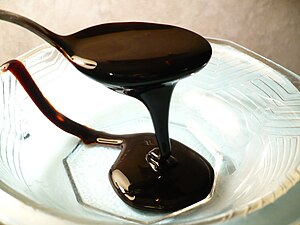
English: Organically produced blackstrap molas...

Refiners’ syrup, used widely in the commonwealth countries under the name golden syrup, is made by refining and filtering the pre-boil, concentrated cane juice through bone charcoal. It’s similar to molasses, but consists of only certain sugars and moisture – and does not include any of the minerals and other “impurities” in molasses that cause its distinct flavors.
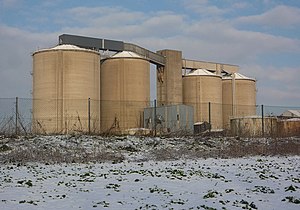
English: Old sugar beet factory A landmark on ...

English: Old sugar beet factory A landmark on this side of Ipswich, in view from the A14 but seen here at close hand from the Gipping footpath.


On the other hand, sugar beet processing yields different results. Molasses can be produced from beet sugar, but it only appears after the second round of boiling (because of this, the first and second boils are called the ‘high’ and ‘low’ greens, or raws). Sugar beet molasses, obtained from the second or third boil, contains a lot of salts and compounds which don’t make it very tasty for humans, so it’s used predominantly in the production of cattle feed. In the Low Countries, sugar beet molasses is sold as “sirop de candi“, in a normal version branded as ‘sweet’ — due to a higher proportion of remaining sugars — and also the third boil, very dark version. Sirop de candi is used as an ingredient in traditional treats like speculoos biscuits (cookies), or as a topping for toast or waffles. Beet molasses is also used as a coating for road salt, due to its low melting point and de-icing properties (which actually ends up attracting deer to road networks in cold weather, but that’s a tangent for the transportation engineer in me!). Refiners’ syrup can also be made from beet sugars by a different process than that used to obtain it from cane.
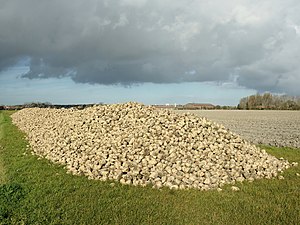
Sugar beet clamp at Vlissegem, Belgium

Sugar beet farm at Vlissegem, Belgium.


It’s important to note here that some of the products we know as molasses in North America (such as Grandma’s Own Original Molasses) are, in fact, reduced cane syrup: molasses which has been gently heated, but not boiled, and had none of its sugars removed. This is sometimes referred to as ‘high-test’ molasses, and is not a by-product of sugar production. As a result, what most people recognize as normal pantry molasses is much less bitter than black treacle here in the UK, which is a 50/50 mixture of blackstrap molasses and golden syrup. Bottom line: unless your North American recipe calls for ‘dark’ molasses, don’t use black treacle as a substitute and expect exact results!

THE BIG DIFFERENCE ACROSS THE POND

Essentially, all of this means that most standard brown sugars in the UK have to have the less palatable beet molasses completely extracted, and then add in ‘dark’ sugar cane molasses to the refined white beet sugars. (So that package of “British” brown sugar actually has a pretty large carbon footprint!) This alone doesn’t cause any variations — even most brown cane sugar producers totally refine their sugar and then re-add the extracted molasses, in order to control variations in the harvest and make a uniform product with a standard molasses content. It’s the processes commonly used for re-adding the cane molasses to either kind of white sugar which makes a difference. While the molasses added to the cane sugar is combined via a stage of re-boiling, the molasses added to beet sugar is always sprayed over the granules. This coating of the white sugar creates coarser and less saturated particles, and totally explains why North American light brown sugars are softer and more compactable than the relatively free-flowing light brown sugars in the UK — like the difference between slightly moist and just-drying sand.

So after all of that technical mumbo jumbo — now what? To make your own brown sugar at home, molasses can be re-added to white sugar at a recommended proportion of 1 tablespoon to 200 grams. But which grade of molasses to add is never mentioned! This is because the syrup that is said to be re-added into white sugars at the factory is always a blend of molasses and/or treacle varieties produced and sold differently to companies in different parts of the world. Whichever blend is used contributes to the different flavors found in every country.

Now that I’m itching for a factory tour, I want to reproduce this in my own kitchen. The homemade method means that the molasses content is roughly 7.5% if using the ‘blackstrap’ variety.  Using my highly developed engineering skills, I calculated that in order to get a 3.5% molasses content, one tablespoon of molasses must be at around 60% sucrose content; dark second-boil molasses contains about 55% sucrose, as does black treacle. Like most things worth doing in baking, I might play mad scientist, go try some British-made cane sugars, or even make my own, and see what happens. All in the name of chocolate chip glory!


This post has previously appeared on Rowth an’ Scowth, where Melissa writes about baking and expatriation from Edinburgh, Scotland.



Never miss a post
Name: 
Your email address:*
Please enter all required fields
Correct invalid entries

A Leave of Absence: Nurturing and Nourishing in Kentucky

Published by Monday, May 7, 2012 Permalink 0

There are moments in life when you don’t have to ask where your priorities lie. You know — without a single doubt; with your heart, your soul, your gut, your entire being. If you have not heard from The Rambling Epicure team for the last week, it is because that is what the editor is experiencing.

I spend most of my life writing about how to nourish the body through healthy, sustainable food. The nourishing and nurturing I’ve been doing this week fall into a much less concrete realm.

I had news of my mother’s health, and I knew unquestionably that I should drop everything, go to the airport and go straight to her.

So that is where I am, in the green rolling fields of Kentucky, sitting with my mother, holding her hand, covering her with kisses, telling her what a wonderful mother she is; telling her, as I did as a child, “I love you bigger than the world; you’re the best mother in the whole wide world.” Listening to the birds and crickets, taking in the chlorophyll, while listening to her tell me stories of her life. Reading poetry, reciting Tennyson, her favorite poet. Repeating nursery rhymes. She’s even been writing a few new poems from her bed. The last couple of days she has told me about her boyfriends, which almost sounded juicy for the proper Southern lady she is.

Continue Reading…

Never miss a post
Name: 
Your email address:*
Please enter all required fields
Correct invalid entries

Daily Food Quote: April 27, 2012

Published by Friday, April 27, 2012 Permalink 0

From “Channeling MFK Fisher: An Everlasting Meal, ” by Kurt Michael Friese, on Civil Eats

“In a time when we can all appreciate the value of frugality in the kitchen, when each of us can ring a wry smile from the Tuscan proverb she quotes: Si stava meglio quando si stava peggio (“We were better off when things were worse”), it is refreshing to know that with just a little effort, and a lot of love, delicious healthy meals are waiting to be awakened from their slumber in the back of the pantry.”

Continue Reading…

Never miss a post
Name: 
Your email address:*
Please enter all required fields
Correct invalid entries

Quelling Quitchen Quatastrophes: Letters from my Fans

Published by Friday, April 27, 2012 Permalink 0

by Adventures in Good Eating, The Quonstant QuonnoisseurThe Count of Monte Cristo

Gentle readers, your correspondent is grateful for all of the letters and postcards that you have sent.

TQQ gets along fine with his mail carrier.

While it is not possible to respond individually to all information requests, The Quonstant Quonnoisseur here will answer some of the most frequently-received inquiries.

Continue Reading…

Never miss a post
Name: 
Your email address:*
Please enter all required fields
Correct invalid entries

Highlights from First #FutureFoodWriting Live Twitter Chat

Published by Thursday, April 26, 2012 Permalink 0

by Melissa Bedinger

For those reeling from the ‘virtual whiplash’ of following so many threads, or for those who were unable to attend, here are a few excerpts and key points from panelists and participants of The Rambling Epicure’s first live Twitter chat on the future of food writing. Very special thanks to our panelists: Amanda HesserJohn BirdsallCorie BrownDianne JacobMonica BhideGloria Nicol, and Wilson Dizard III.


ON THE FUTURE OF FOOD WRITING

@MichaelDChing: RT @BillDaley: @writes4food Indeed. But the future won’t be like the past. Keep mind, options open! #futurefoodwriting April 20, 2012, 6:04 pm

@mbhide: There is a future.. but I see myself more as a business person than a writer. I have to do diff things to make a living #futurefoodwriting April 20, 2012, 6:04 pm

@John_Birdsall: @mbhide I think food writers always had to be business people, though. #futurefoodwriting April 20, 2012, 6:05 pm

@mbhide: @writes4food I wrote about creative rebirth http://t.co/sQfT5GQ4 #futurefoodwriting April 20, 2012, 6:08 pm

@PeteDulin: @wotsforteatoday – True. Research, dig up new angles, build rep for quality. #futurefoodwriting Distinguish from what exists already. April 20, 2012, 7:36 pm

Continue Reading…

Never miss a post
Name: 
Your email address:*
Please enter all required fields
Correct invalid entries

Food Writing Tips: Aristotle on Writing

Published by Thursday, April 26, 2012 Permalink 0

by Jonell Galloway

Since the April 20, 2012, #futurefoodwriting live Twitter chat was such a success, I’ve decided to start posting writing tips from time to time. I’m thrilled so many people are interested in improving their writing.

The first quote is not about food writing in particular, but about writing in general. It applies to food or blog writing, or to any other kind of writing. One could say the same about the second quote: always seek to make your writing better. Check it and check it again. If you’re still not sure, have someone else you trust read it. Making excellence a habit, of course, relates to whatever we do in life, not just writing.

To write well, express yourself like the common people, but think like a wise man.Aristotle

Excellence, then, is not an act but a habit.–Aristotle

Bust of Aristotle. Marble, Roman copy after a ...

Bust of Aristotle. Marble, Roman copy after a Greek bronze original by Lysippos from 330 B.C.; the alabaster mantle is a modern addition.

Continue Reading…

Never miss a post
Name: 
Your email address:*
Please enter all required fields
Correct invalid entries

Yummy Umami: The 6th Basic Taste?

Published by Thursday, April 26, 2012 Permalink 0

Yummy Umami: The 6th Basic Taste?

by Diana Zahuranec

Quick, name the 5 basic tastes: sweet, sour, bitter, salty…and the fifth one is umami. Umami is the word that describes the savory taste of food, or perhaps “meatiness” of a food. It is the taste of the amino acid L-glutamate. The Japanese singled out this flavor in the early 1900s thanks to a chemistry professor from the Imperial University of Tokyo, Kikunae Ikeda, who isolated the glutamic acid compound C5H9NO4. Glutamic acid is found in both free and bound forms. The free form, which is formed when the protein molecule breaks down and releases glutamic acid, is the one we taste. “Umami” means in Japanese, literally, deliciousness.

Kikunae Ikeda, the Chemist who singled out MSG

A few years ago, I remember there was some hype that spread virally through America’s highly-informed (and often misinformed) consumer culture about MSG.

What is this lethal-sounding additive in the foods we eat, so cleverly covered up by only using three letters to trick us when we know better? It was soon known that MSG, or monosodium glutamate, is an ingredient added to most processed foods in order to enhance their flavors. In the media, MSG was linked to many ills, including migraines, nausea, and cancer, among others.

Wariness and fear of MSG actually began in the 1970s, after Dr. Ho Man Kwok wrote in the New England Journal of Medicine that he was experiencing all sorts of uncomfortable after-effects from a Chinese dinner, including numbness, weakness, and palpitations. He did not specifically link his symptoms to MSG, but a year later a study was done on baby mice by injecting high dosages of MSG (up to 4 grams per kilogram of body weight) and observing the brain lesions the mice suffered afterwards. Thus was born Chinese Restaurant Syndrome (CRS). Studies, anecdotes, and reports were quick to follow suit afterwards, claiming that MSG was linked to all sorts of ills. Some prominent nutritionists today are convinced that added MSG is harmful, especially for children.

Continue Reading…

Never miss a post
Name: 
Your email address:*
Please enter all required fields
Correct invalid entries

UA-21892701-1