Sealed With a Quiche: Brief History of Quiche in America with Recipe Ideas

Published by Wednesday, February 8, 2012 Permalink 0

Including a food trend prediction for 2012…

by Alice DeLuca

When first married, I received lots of advice on how to stay married, which is of course so much more complicated than “getting” married. For example, Sally told me that both a happy marriage and a career had been possible for her because she created and froze 4 quiches at a time.  I immediately pictured 4 quiches in the deep-freeze, carefully labeled for rotation of the stock so as to avoid freezer-burn and waste. The quiches would keep.

English: Different kinds of quiches.


Continue Reading…

Never miss a post
Name: 
Your email address:*
Please enter all required fields
Correct invalid entries

Simon Says: Daily Food Quote, February 7, 2012

Published by Tuesday, February 7, 2012 Permalink 0

by Simón de Swaan

XIII: It is heresy to insist that we must not mix wines: a man’s palate can grow numb and react dully to even the best bottle after the third glass from it.–Anthelme Brillat-Savarin, from The Physiology of Taste


Jean Anthelme Brillat-Savarin was a French lawyer and politician who gained fame as an epicure and gastronome. Many consider him the best food critic ever. His 8-volume, famous work, Physiologie du goût (The Physiology of Taste), was published in December 1825, two months before his death.

Continue Reading…

Never miss a post
Name: 
Your email address:*
Please enter all required fields
Correct invalid entries

Cheesemaking: To know how cheese is made is different from knowing how to make cheese!

Published by Monday, February 6, 2012 Permalink 0

by Diana Zahuranic

“Let’s make cheese!” To my friends and me, the idea sounded satisfyingly artisanal. Cheesemaking is simple enough in practice so that anyone with some background can try their hand at it. The theory is more complicated, but because my friends and I had that part down pat, actually putting it to use would be an afternoon well-spent.

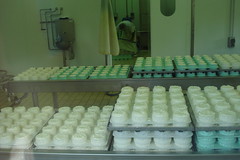
Cheesemakers in Chaource

Cheesemakers in Chaource


Or so we thought. Yes, the craft of cheesemaking is simple compared to the amazing, diverse world of cheese that it produces (or rather, that Europe produces, with no laws prohibiting unpasteurized cheese aged less than 60 days – which is 100s to 1000s of varieties). But the first thing the nine of us did in my friend’s tiny Italian kitchen was say, “Doesn’t anybody know how to make cheese?”

Continue Reading…

Never miss a post
Name: 
Your email address:*
Please enter all required fields
Correct invalid entries

We love this food timeline/infographic!

Published by Monday, February 6, 2012 Permalink 0

If you’re interested in food history, take a look at this food timeline/infographic discovered by Rambling Epicure contributor Alice DeLuca. It covers just about everything there is to cover, from prehistoric grains such as emmer grain circa 17,000 B.C. and einkorn grain circa 16,000 B.C. to modern food terms such as Twecipes & Recessipes. This is a true reference for  lovers of food history, and definitely one to be bookmarked.

Einkorn wheat

Never miss a post
Name: 
Your email address:*
Please enter all required fields
Correct invalid entries

Simon Says: Daily Food Quote, February 6, 2012

Published by Monday, February 6, 2012 Permalink 0

by Simón de Swaan

When the stomach is full, it is easy to talk of fasting.–St. Jerome, c. 395

St. Jerome (formerly Saint Hierom) was a Roman Catholic priest, confessor, theologian and historian, who also became a Doctor of the Church. He is best known for his translation of the Bible into Latin (the Vulgate), and writings are extensive.


Related articles
Never miss a post
Name: 
Your email address:*
Please enter all required fields
Correct invalid entries

Simon Says: Daily Food Quote, February 3, 2012

Published by Friday, February 3, 2012 Permalink 0

by Simón de Swaan

We plan, we toil, we suffer — in the hope of what? A camel-load of idol’s eyes? The title deeds to Radio City? The Empire of Asia? A trip to the moon? No, no, no, no. Simply to wake just in time to smell coffee and bacon and eggs. And, again I cry, how rarely it happens! But when it does happen — then what a moment, what a morning, what a delight?–J.B. Priestley

John Boynton Priestley, OM known as J. B. Priestley, was an English novelist, playwright and broadcaster. He published 26 novels, notably The Good Companions (1929), as well as numerous dramas, such as An Inspector Calls. His output included literary and social criticism.


Continue Reading…

Never miss a post
Name: 
Your email address:*
Please enter all required fields
Correct invalid entries

Simon Says: Daily Food Quote, February 2, 2012

Published by Thursday, February 2, 2012 Permalink 0

by Simón de Swaan

A daydream is a meal at which images are eaten. Some of us are gourmets, some gourmands, and a good many take their images precooked out of a can and swallow them down whole, absent-mindedly and with little relish.–W. H. Auden

Anglo-American poet Wystan Hugh Auden, who published under the name W. H. Auden, was born in England, and later became an American citizen. He is regarded by many as one of the greatest writers of the 20th century. The central themes of his poetry are love, politics and citizenship, religion and morals, and the relationship between unique human beings and the anonymous, impersonal world of nature.

Click here to read his poems.

Continue Reading…

Never miss a post
Name: 
Your email address:*
Please enter all required fields
Correct invalid entries

Simple Sustenance: Lemon Thyme-Flavored Spaghetti Squash with Green Olives

Published by Wednesday, February 1, 2012 Permalink 0

 by Renu Chhabra

“I feel a recipe is only a theme, which an intelligent cook can play each time with a variation.”  Madame Benoît

Flavor Combination Discoveries


Around this time of the year, our love for squash grows.  I’m part of that “our.” I love their oddball shapes, different textures, and sweet flesh. I always find myself admiring them in grocery stores, as if they were art objects, each one unique in its color and shape. And since coming to the States, I have discovered more “oddballs” than ever to fall in love with. What can I say? They intrigue me. In fact, I’ve been writing about them consistently on my new blog, Simple Sustenance for Us, with great enthusiasm.

Continue Reading…

Never miss a post
Name: 
Your email address:*
Please enter all required fields
Correct invalid entries

Switzerland: Coop’s Pro Montagna Label: 5 Years of Protecting Traditional Swiss Food Products

Published by Wednesday, February 1, 2012 Permalink 0

Switzerland: Coop’s Pro Montagna Label: 5 Years of Protecting Traditional Swiss Food Products

by Jonell Galloway

In 2005, Andy Imfeld, a montagnard and organic food producer, started discussing the possibility of selling Swiss mountain products directly in Coop supermarkets. After long negotiations as to how it should work, it was decided that for each mountain product sold, a certain amount of the payment would go directly to the families of farmers or projects in mountain regions.


Coop labeled the products Pro Montagna, and the project has been a great success, with some 200 products to date, from yogurt to bread, and including meat products and wooden toys.

Continue Reading…

Never miss a post
Name: 
Your email address:*
Please enter all required fields
Correct invalid entries

Will the “lost decade” change our wasteful ways when it comes to food?

Published by Monday, January 30, 2012 Permalink 0

by Jonell Galloway

The Hard Facts, the Numbers

Launched in 2007 by WRAP, the 'Love Food, Hate...


Now that food prices are on the rise and people in developed countries are tightening their purse strings, we are beginning what IMF Managing Director Christine LaGarde refers to as the “lost decade.” We are starting to think about food waste and food budgets — not something we talked much about over the last few decades. Unless we were in finance, we watched the price of cacao, but not much else.

“The average British shopper estimates that they bin almost 10% of the food bought in their weekly shop, while 8% admit to throwing away as much as a quarter of their food on a regular basis, according to new research on Monday,” says The Guardian.

Continue Reading…

Never miss a post
Name: 
Your email address:*
Please enter all required fields
Correct invalid entries

UA-21892701-1