Simon Says: Daily Food Quote, November 11, 2011

Published by Friday, November 11, 2011 Permalink 0

by Simón de Swaan

X. Men who stuff themselves and grow tipsy know neither how to eat nor how to drink.–Jean Anthelme Brillat-Savarin

Jean Anthelme Brillat-Savarin was a French lawyer and politician, and gained fame as an epicure and gastronome. His famous work, Physiologie du goût (Physiology of Taste), was published in December 1825. The full title is Physiologie du Goût, ou Méditations de Gastronomie Transcendante; ouvrage théorique, historique et à l’ordre du jour, dédié aux Gastronomes parisiens, par un Professeur, membre de plusieurs sociétés littéraires et savantes. The book has never been out of print since it first appeared, two months before Brillat-Savarin’s death. Its most notable English translation was done by food writer and critic M.F.K. Fisher, who remarked, “I hold myself blessed among translators.” Her translation was first published in 1949.

Continue Reading…

Never miss a post
Name: 
Your email address:*
Please enter all required fields
Correct invalid entries

Simon Says: Daily Food Quote, November 10, 2011

Published by Thursday, November 10, 2011 Permalink 0

by Simón de Swaan

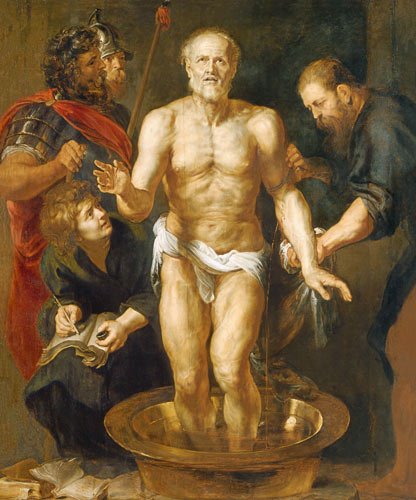
A great step toward independence is a good-humored stomach, one that is willing to endure rough treatment.–Seneca, c. 60

Lucius Annaeus Seneca (often known simply as Seneca) (c. 4 BC – 65 AD) was a Roman Stoic philosopher, statesman, dramatist, and, in one work, humorist, of the Silver Age of Latin literature. He was tutor and later an adviser to Emperor Nero. While he was later forced to commit suicide for alleged complicity in the Pisonian conspiracy to assassinate Nero, the last of the Julio-Claudian emperors, he may have been innocent. His father was Seneca the Elder and his older brother was Gallio.


Never miss a post
Name: 
Your email address:*
Please enter all required fields
Correct invalid entries

Simon Says: Daily Food Quote, November 9, 2011

Published by Wednesday, November 9, 2011 Permalink 0

by Simón de Swaan

Hors d’oeuvres have always a pathetic interest for me; they remind me of one’s childhood that one goes through wondering what the next course is going to be like – and during the rest of the menu one wishes one had eaten more of the hors d’oeuvres.–Saki, 1904

(18 December 1870 – 13 November 1916), better known by his pen name Saki, and frequently as H. H. Munro, was a British writer whose witty, mischievous and sometimes macabre stories satirized Edwardian society and culture. He is considered a master of the short story and often compared to O. Henry and Dorothy Parker.


Never miss a post
Name: 
Your email address:*
Please enter all required fields
Correct invalid entries

Simon Says: Daily Food Quote, November 8, 2011

Published by Tuesday, November 8, 2011 Permalink 0

by Simón de Swaan

VIII. The table is the only place where man is never bored for the first hour.–Jean Anthelme Brillat-Savarin

Jean Anthelme Brillat-Savarin was a French lawyer and politician, and gained fame as an epicure and gastronome. His famous work, Physiologie du goût (Physiology of Taste), was published in December 1825. The full title is Physiologie du Goût, ou Méditations de Gastronomie Transcendante; ouvrage théorique, historique et à l’ordre du jour, dédié aux Gastronomes parisiens, par un Professeur, membre de plusieurs sociétés littéraires et savantes. The book has never been out of print since it first appeared, two months before Brillat-Savarin’s death. Its most notable English translation was done by food writer and critic M.F.K. Fisher, who remarked, “I hold myself blessed among translators.” Her translation was first published in 1949.


Never miss a post
Name: 
Your email address:*
Please enter all required fields
Correct invalid entries

Welcome the newest member of our team, Alice DeLuca

Published by Monday, November 7, 2011 Permalink 0

by Jonell Galloway

Alice DeLuca writes the column Sauce for Thought and the popular website Gf-Zing!, noted for its fine gluten-free recipes and do-it-yourself sauces. She started acquiring cookbooks in 1964 (with a 49 cent paperback) and now has a collection that threatens to overtake her home. She weaves her fascination with the history of food into her writing about modern recipes. She is automatically drawn to any book with a one-word title – Salt, Cod, Tea, Spice, Potato etc. – and proudly wears food-themed earrings.

Alice has trained “on the job” in restaurant kitchens, once as the only American, only female cook in an Indian restaurant. She has cooked over 32,000 meals “from scratch” for her large extended family and friends, and has lived and traveled in many regions of the United States and Europe, adding recipes from the cuisines of France, Italy, India, the American Southwest, Midwest, Northeast and Hawaiian Islands to her extensive repertoire.  She translates French and Spanish recipes so that she can bring the indigenous recipes of the Americas to her readers.

Never miss a post
Name: 
Your email address:*
Please enter all required fields
Correct invalid entries

The Rambling Epicure is now available on your Smartphone!

Published by Monday, November 7, 2011 Permalink 0

The Rambling Epicure is now available in an easy-to-read format on your smartphone.

If you’d rather read the articles in regular format, scroll to the bottom and simply disable the Mobile Theme.

Never miss a post
Name: 
Your email address:*
Please enter all required fields
Correct invalid entries

Simon Says: Daily Food Quote, November 7, 2011

Published by Monday, November 7, 2011 Permalink 0

by Simón de Swaan

It is not from the benevolence of the butcher, the brewer, or the baker that we expect our dinner, but from their regard to their own interest.–Adam Smith, 1776

Adam Smith was a Scottish social philosopher and a pioneer of political economy. One of the key figures of the Scottish Enlightenment, Smith is the author of The Theory of Moral Sentiments and An Inquiry into the Nature and Causes of the Wealth of Nations. An Inquiry into the Nature and Causes of the Wealth of Nations, generally referred to by its shortened title “The Wealth of Nations,” is the magnum opus of the Scottish economist and moral philosopher Adam Smith. First published in 1776, it is a reflection on economics at the beginning of the Industrial Revolution and argues that free market economies are more productive and beneficial to their societies. The book is a fundamental work in classical economics.


Never miss a post
Name: 
Your email address:*
Please enter all required fields
Correct invalid entries

Rosa’s Musings: Sachertorte, The Pride Of Vienna

Published by Friday, November 4, 2011 Permalink 0

by Rosa Mayland


Colors burst in wild explosions
Fiery, flaming shades of fall
All in accord with my pounding heart
Behold the autumn-weaver
In bronze and yellow dying
Colors unfold into dreams
In hordes of a thousand and one
The bleeding
Unwearing their masks to the last notes of summer
Their flutes and horns in nightly swarming
Colors burst within
Spare me those unending fires
Bestowed upon the flaming shades of fall.
Dark Tranquility, With the Flaming Shades of Fall

Each season has a significant impact on our behaviour and spirit. All four seasons impart a special mood as well as a certain rhythm to our existence. The explanation for that is very simple: no plant, animal or human being can break loose from the forceful and capricious powers of the Universe to which they are submitted and depend on. We just have to accept the fact that there is a greater plan (I’m not talking about God, but about the force behind the entirety of the cosmos) and that most of the time it completely escapes our understanding. There is no other choice for us than to cooperate with the elements in order to benefit from them. Fighting against them will get you nowhere. Save your vigor and be in harmony with them…

Continue Reading…

Never miss a post
Name: 
Your email address:*
Please enter all required fields
Correct invalid entries

Simon Says: Daily Food Quote, November 4, 2011

Published by Friday, November 4, 2011 Permalink 0

by Simón de Swaan

Sadder than destitution, sadder than a beggar is the man who eats alone in public. Nothing more contradicts the laws of man or beast, for animals always do each other the honor of sharing or disputing each other’s food.–Jean Baudrillard, 1986

French theorist Jean Baudrillard (1929–2007) was one of the foremost intellectual figures in modern history. His work combines philosophy, social theory, and an idiosyncratic cultural metaphysics that reflects on key events of phenomena of the period.


Related articles
Never miss a post
Name: 
Your email address:*
Please enter all required fields
Correct invalid entries

Editorial: Why I don’t like French salads

Published by Thursday, November 3, 2011 Permalink 0

by Jonell Galloway

We all know what a Francophile I am, especially when it comes to food and wine.

But there is ONE thing the French do which really gets on my nerves!

In the first place, rare is the restaurant that uses good lettuce. Mesclun is considered some kind of luxury, and now that I’ve lived in Switzerland, I’m accustomed to eating the wild greens and mesclun fresh from the mountains. So the supermarket lettuce in France is really not to my liking.

The other thing that really annoys me is that they just throw a bit of mesclun on top of the salad, and the bowl is invariably too small to allow one to mix the greens and the vinaigrette without spilling it out onto the table, so I inevitably end up feeling like a klutz.

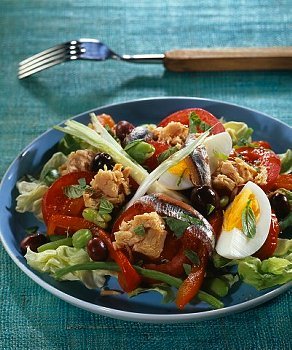
Of course, Julia Child’s Niçoise salad, when made with top quality, fresh, local ingredients, is impeccable. Ironically and unfortunately, Nice is about the hardest place to find a good Niçoise. The tomatoes are invariably hothouse from Holland, even in the middle of the summer, and the green beans are frozen in the height of the green bean season.

My conclusion is that French restaurants most often just throw salads together, and don’t consider it real cuisine, so they can’t be bothered. But if you really like or yearn for a salad, this is disappointing, especially since the salads are overpriced, as if they were “real” cuisine.

Continue Reading…

Never miss a post
Name: 
Your email address:*
Please enter all required fields
Correct invalid entries

UA-21892701-1