by Jonell Galloway
Click here to keep up with the latest in world food and wine news.
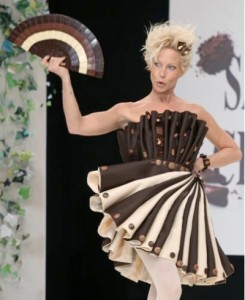
Black and white chocolate cocktail dress, Salon du Chocolate 2011, Zurich, Switzerland.
Related articles
|
|

A Literary Culinary Journal
by Jonell Galloway
Click here to keep up with the latest in world food and wine news.
Black and white chocolate cocktail dress, Salon du Chocolate 2011, Zurich, Switzerland.
|
|

Here in Australia we sometimes feel a little left out of things. As I check out conferences and happenings in the world of food writing, blogging and photography, I frequently envy the short travel distances that those in the Northern hemisphere enjoy to get to any number of exciting events. Here we have three options – we can ‘grow our own’, pay thousands of dollars in airfares & spend many, many hours traveling to get to international events, or simply miss out.
In 2010, a group of passionate Melbourne food bloggers got together and produced Australia’s first-ever national food blogging conference — Eat Drink Blog. It was much appreciated by those who attended and declared a success. Last year I attended – and hugely enjoyed – the second national Australian food bloggers conference. I travelled to Sydney for the event and took the chance to put faces to some of the names whose writing, recipes and photos I had been enjoying, and to meet plenty whom I had yet to come across in the ether. We spent a terrifically informative day picking up writing, photography and SEO tips, networking and, of course, eating, and I came away vowing to make every effort to get to the next one. Apparently the gods agreed with me on that as, while I was on my recent holiday in Italy, an email from the organisers of last year’s event winged its way into my inbox asking me to be involved in putting this year’s event together in Adelaide, South Australia.
Last year’s event was extraordinarily well planned and coordinated, completely sponsored, and a unanimous hit with the attendees so we knew we had a pretty tough act to follow. However, we South Australian food types pride ourselves on our food and wine credentials. We have a remarkable array of both commercial and artisan food producers and are not called the wine state for nothing, so we were sure we could put on a pretty special event.
A couple of weeks ago we very proudly announced the program for Eat Drink Blog 2012 and I think we’ve managed to pull together a remarkable array of local, national and international talent to share their knowledge and skills with bloggers from all over Australia. With confirmed speakers including a nationally award-winning photographer, internationally recognised Australian food bloggers and, the icing on our cake, Dianne Jacob — author of “Will Write for Food” — our conference will comprehensively cover food writing, social media, career opportunities, restaurant reviewing, SEO, ethics, blog design, photography, photo editing, food styling, and legal matters. In addition, the delegates will have the opportunity to visit some of South Australia’s premium wine and food regions, sampling the specialties of the regions, spend some time touring the iconic Adelaide Central Market and enjoy a gourmet dinner featuring the very best of our local produce and beverages.
Oh, and it’s all still fully sponsored, so all the delegates have to pay for is their travel and accommodation!
So maybe it’s time for the rest of the world to be just a little envious of us?
For full details of Eat Drink Blog 2012 check our website here.
|
|
 by Simón de Swaan
All the gifts are nothing. Money gets used up. Clothes you rip up. Toys get broken up. But a good meal, that stays in your memory. From there it doesn’t get lost like other gifts. The body it leaves fast, but the memory slow.–Meir Shalev, Four Meals
Israeli journalist and television host Meir Shalev is also one of Israel’s most celebrated novelists. His other books include The Blue Mountain and A Pigeon and a Boy, for which he won the Brenner Prize, Israel’s highest literary recognition.

|
|
I wanted to share #futurefoodwriting panelist and veteran journalist Wilson Dizard III‘s thoughts about the state of food writing. Dizard is author of our “Quelling Quitchen Qualamities” column. It should serve as food for thought for your questions at tomorrow’s Twitter chat.
He says:
I think that, somewhere there has to be disclosure of potential conflicts of interest.
Here in D.C. we are in a bit of a special environment because we are beset by PR flacks from all over the world who would just love to get press passes and represent the house organs (magazines) of their trade associations as bona fide media outlets.
With all the money sloshing back and forth over issues like health care reform, etc., the only way to keep those vile flacks in check is to draw a bright line: members of the Periodical Press Gallery (the basic D.C. press pass) are required to receive all of their income only from bona fide news organizations rather than lobbies or trade associations.
So, I do understand that reporters elsewhere do have less rigid prohibitions on accepting baksheesh from the industries they cover.
So: if those people can’t live without that money…then…at the very least, they should disclose those financial links.
Because otherwise, how would you know if Monsanto wasn’t paying your editor’s mortgage, if you were a food writer?
Especially in the Slow Food field, I would think that disclosure, at the very least, is a step in the right direction.
That’s available now, to reporters who join organizations like the SPJ (Society of Professional Journalists).
Ever since the beginning of commercial public relations by food companies, those companies have used recipes to promote use of their own products as ingredients.
So: by this means, countless recipes entered the global hivemind of food knowledge, uncopyrighted.
To some degree, this was a good development, insofar as packaged food is and was healthful.
But: insofar as manufacturer-sponsored cookbooks and recipes infiltrated high school and university home economics programs in the 1940s, 1950s and later (and they are coming back again, sometimes under a different moniker), they promoted practices and consumption not wholly in the consumers’ interests.
For example: the Chicago meatpacking industry relentlessly promoted its effectiveness in “using everything but the squeal” as it promoted canned pork products and lard. But: abuses in that industry prompted the Pure Food and Drug Act.
After that law was passed (largely because of Upton Sinclair’s novel The Jungle and similar exposes by muckrakers), the food and pharmaceutical attorneys started working steadily and successfully to tame the FDA.
One of the great meatpacking industry successes, politically, was to shift regulation of slaughterhouses to the Agriculture Department. Abattoirs in the U.S. today are, in many cases, absolutely disgusting. Poor slaughterhouse regulation actually is responsible for multiple consumer deaths annually, because of the spread of pathogens like salmonella, etc, through those filthy slaughterhouses. Meanwhile, working conditions are so horrible that many of them have greater than 100 percent employee turnover annually — even when they rely on labor contractors to provide illegal immigrants as their labor force.
The decline, if not the actual suppression, of food safety, health and cooking education in the U.S. at the hands of budget-cutters in state legislatures has left food education in the hands of the supermarket and packaged food industries. So: would you trust Wal-Mart to teach your kids how to eat? The mind recoils, and the gorge rises.
If the Slow Food movement, and the writers who promote it, can pick some targets of opportunity among the unhealthy practices promoted by the packaged food industries, then they’ll gain my respect. What if they targeted the soft drink vending machines in schools?
I can’t tell you how revolted I am by all the propaganda about child obesity, when it focuses on minority and low-income populations. It’s no comfort at all that that openly racist “blame the victim” ideology goes hand in hand with the deadly neuroses promoted by the fashion industy, namely, anorexia, bulimia, and other disorders associated with body image problems, like cutting.
Socially responsible education about food is too important to be left to the Walton family. Kraft and Altria will have America’s kids gobbling transfats while smoking Kools and drinking God knows what if it feeds their profit numbers.
Could these food writers agree to hammer out a manifesto for ethics in food writing? Or a pro bono approach to home economics so that there’s some alternative to Barbie’s Dream Kitchen in American homes?
As far as the funding from sponsors: at the end of the day, the key is disclosure.
The goal is, quite simply, just to not try to trick the readers. Which of course, the PR types are all about: hijacking a food writer’s credibility to flog their pink slime, or other product.
|
|
by Simón de Swaan
The golden rule when reading the menu is, if you cannot pronounce it, you cannot afford it.–Frank Muir
here was an English comedy writer, radio and television personality, and raconteur.
Click  to see him in a TV commercial for milk.
|
|
 by Simón de Swaan
We plan, we toil, we suffer — in the hope of what? A camel-load of idol’s eyes? The title deeds to Radio City? The Empire of Asia? A trip to the moon? No, no, no, no. Simply to wake just in time to smell coffee and bacon and eggs. And, again I cry, how rarely it happens! But when it does happen — then what a moment, what a morning, what a delight?–J.B. Priestley
John Boynton Priestley, OM known as J. B. Priestley, was an English novelist, playwright and broadcaster. He published 26 novels, notably The Good Companions (1929), as well as numerous dramas, such as An Inspector Calls. His output included literary and social criticism.

|
|
Click here to watch the Paris Salon du Chocolat fashion show 2010 opening. Loads of dresses in chocolate, decorated in chocolate. Only in Paris!


|
|
by Simón de Swaan
De gustibus non disputandum es. –Latin proverb
There is no disputing taste.

|
|
by Jonell Galloway
To register, Just click Sign Up at the top left of the screen to become a member. We’ll keep you posted as to how you can post your own food photos, share your recipes, start your own mini-blog, join groups, and participate in discussion boards.
The gray menus you see at the top of the home page and the headings at the bottom right of the sidebar, marked Groups and Members, are already up and running, albeit not perfectly.
To join a group, click on the menu in the far top right marked Visit. You can already join the Food Photography group, run by Meeta Khurana Wolff, and the Culinary Chemistry group, run by Jenn Oliver. We’ll be adding new features every day.
A fun time is to be had by all!
|
|
Chartres makes for an easy, affordable weekend jaunt. There is no lack of things to do.
The Gothic cathedral is of course, the main thing to see, and you can spend 2 days just exploring that.
The cathedral itself, both inside and out, is truly one of the wonders of the world. The crypt includes a Romanesque church on top of which the cathedral was built, Roman ruins, an old Druid well, and a gallery that was probably used by the Druids to worship Bellissima, and later converted into a chapel dedicated to the Mother and Child of Chartres (it is said that the Druid goddess Bellissima also held a baby in her arms, although in a different position from the classic Christian manner).
|
|
 Meet Jonell Galloway, a freelance writer and editor specialized in French cuisine.


