Beef Brisket Lover Recipe: Bookmark This
Chicago Tribune‘s Bill Daley interviews Daniel Rose in Paris about how the French make beef brisket. Rose, who runs , formerly in Chicago and now in Paris, shares his beef brisket recipe.

Related articles
|
|

A Literary Culinary Journal
Chicago Tribune‘s Bill Daley interviews Daniel Rose in Paris about how the French make beef brisket. Rose, who runs , formerly in Chicago and now in Paris, shares his beef brisket recipe.
|
|
 by Alice DeLuca
The Day of the Dead and Halloween are nearly upon us and I am frantically digging for recipes that can protect the living against the Un-dead. Books and papers fly as I paw through shelves and piles, seeking something to ward off the Zombies, Vampires and Werewolves that may be lurking outside the door, or that may invade my kitchen at any moment. They all have highly specialized dentition designed to make swift work of the main course – me!

I’m calling on restaurateurs — please, this time of the year, an amuse-bouche for the living might be just the thing to calm the customer’s nerves. Could chefs please get a little creative, and instead of offering me a puddle of olive oil, or herbed olive oil, or olives in a lake of olive oil with obligatory bread (that I don’t eat anyway), could they provide something that will protect our table from monsters? Let’s get our priorities straight please; safety comes first!
|
|
Some form of restaurant has existed ever since humans have been eating. The phenomenon grew as large cities formed, and as people traveled on the ancient silk roads in the Middle East and China, and in the Roman Empire, often in the form of inns where one could both sleep and eat.
Street kitchens and food trucks are by no means a modern invention. Jean-Robert Pitte says in his essay “The Rise of the Restaurant”:
Throughout the world, the principal type of eating establishment has always been the street kitchen, where a person can buy a precooked dish for a modest sum. They have always existed in China and still exist throughout Asia, even in industrial and postindustrial countries such as Japan…Street restaurants are still common in Latin America and the Middle East and Africa… (from A Culinary History: Food, edited by Jean-Louis Flandrin and Massimo Montanari)
|
|
 by Jonell Galloway
Click to see the Tasting Week program for the entire country. Tasting week runs from 13 to 23 September 2012.
This year many of the events are sponsored by Savoring a week of ‘slow food’ across the country.

|
|
//

 Switzerland: Restaurants in Geneva open on Sunday night
Lai Thai is in an elegant setting. The owner went to Swiss hotel school, so you are always greeted like a king or queen and the service is impeccable. A wide range of Northern Thai dishes you don’t ordinarily find in hole-in-the-wall type Thai restaurants, such as the special Thai rice and fish fritters with a delicious dipping sauce, as well as great massamans. Set menus go for CHF 55, 65 and 78 and the servings are generous. Located in what was formerly a Geneva institution, the Café Gothard.
Rue du Gothard 11
1225 Chêne-Bourg
Tel. +41 (0)22 348 48 17
Traditional Italian cuisine in a chic contemporary decor, located in Plainpalais near the Musée Patek Philippe. The bar serves tapas with the cocktails and is a hangout for young people.
Avenue du Mail 15bis
1205 GenevaTel. +41 (0)22 328 07 01Site.
|
|
 by Simon de Swaan
“Often, admiring a chef and getting to know him is like loving goose liver and then meeting the goose.”–George Lang
“Mr. Lang, a native of Hungary who escaped a forced-labor camp and imminent execution during World War II, came to New York in 1946 with a few dollars, no English and dreams of becoming a concert violinist,” says The New York Times, but found his calling as a restaurateur. He created the restaurant The Four Seasons and Café des Artistes in New York, as well as a long list of other restaurants.

|
|
//

 by Jonell Galloway
Every weekend the Hotel Intercontinental Geneva opens its large outdoor swimming pool to the public. The poolside restaurant serves light, healthy, inventive dishes, such as vegetable tempura (shown below) and mezzes, as well as healthy drinks such as the Detox Smoothie (shown below). They use local and Swiss ingredients as much as possible, buying them directly from farmers and producers and working in close conjunction with OPAGE, the Geneva cantonal promoters for agriculture, so the vegetables and fruit are of a surprising freshness.

The price is 50 CHF for the entire day during the week, and 90 CHF on weekends. It is best to reserve ahead, since on nice sunny days people head for the lake or pools, and Geneva is lacking in large outdoor pools. The spa is right next door and poolsiders, and it is also available pool guests.


|
|
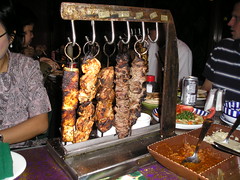
Good kebabs do exist — with homemade sauces, fresh vegetables, and high-quality meat — and this site has tested them for you. The Parisian version is also referred to as “Greek sandwich.”
Click here to go to site.
|
|
We all know what a Francophile I am, especially when it comes to food and wine.
But there is ONE thing the French do which really gets on my nerves!
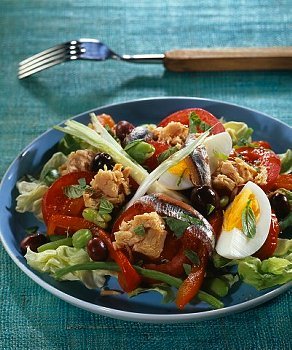
In the first place, rare is the restaurant that uses good lettuce. Mesclun is considered some kind of luxury, and now that I’ve lived in Switzerland, I’m accustomed to eating the wild greens and mesclun fresh from the mountains. So the supermarket lettuce in France is really not to my liking.
The other thing that really annoys me is that they just throw a bit of mesclun on top of the salad, and the bowl is invariably too small to allow one to mix the greens and the vinaigrette without spilling it out onto the table, so I inevitably end up feeling like a klutz.
Of course, Julia Child’s Niçoise salad, when made with top quality, fresh, local ingredients, is impeccable. Ironically and unfortunately, Nice is about the hardest place to find a good Niçoise. The tomatoes are invariably hothouse from Holland, even in the middle of the summer, and the green beans are frozen in the height of the green bean season.
My conclusion is that French restaurants most often just throw salads together, and don’t consider it real cuisine, so they can’t be bothered. But if you really like or yearn for a salad, this is disappointing, especially since the salads are overpriced, as if they were “real” cuisine.
|
|
by Jonell Galloway
The Guardian says Ferran and Albert Adrià, the culinary visionaries of El Bulli, will be performing the superstar restaurant’s cocktails at Tickets in Barcelona, paired with a “greatest hits collection” of food: Parmesan ice cream, Iberian ham “airbag-uette,” mango leaves with marigold, yogurt pistachulines, and steamed brioche with mozzarella. So what next, Ferran?
Click here to watch the video.

|
|
 Meet Jonell Galloway, a freelance writer and editor specialized in French cuisine.


