Wine & Food Pairing with Classic French Dishes

Published by Monday, August 19, 2013 Permalink 0

James Flewellen photo, wine tasting expert, The Art of Tasting Wine: James FlewellenJames Flewellen: Wine & Food Pairing with Classic French Dishes

by James Flewellen


Strawberries with red wine
Strawberries with red wine3liz4 / Foter / CC BY-NC-ND


 Cassoulet This depends on the choice of meat in the dish. Try a Chianti or another Tuscan wine, with more savoury notes for deeper-flavoured meats. Or a Barbera, or even a youthful claret if there’s more pork than game in the dish.

 Choucroute garnie If you stick to local Alsatian wines for this dish you really can’t go wrong. Use the same wine you’ve used in cooking if possible (typically Riesling), or go for a Pinot Gris.

Confit de canard (duck confit)
(from Southwest, cooked over
a fire in its own fat)
For this rich dish we have two options. One is to stay local and go for a spicy red wine from the south-west of France – a Tannat from Madiran or a Malbec from Cahors. Alternatively a full-bodied, oaked Chardonnay would also work. The acidity of the white wine will cut through the duck fat nicely. Choose a robust wine with enough body to stand up to the rich flavours though – Meursault from Burgundy, or a Californian pretender.

Coq au vin While red Burgundy is the classic pairing for this dish, a claret will also go very well. Choose one with a few years’ bottle age so the savoury developed notes complement the complex herbs in the sauce.

Andouillettes (sausage
made with chitterlings)
A tough dish to pair with on account of its strong flavours and somewhat acquired taste! Both reds and whites could work here. Light reds such as Beaujolais or Chinon will do well to complement the dish without dominating it with too much tannin. On the white side, a light, fresh style is best: perhaps Chablis, or the mountain-air notes of an Arbois from the Jura.

Escargots de Bourgogne (snails
baked in their shells with
parsley butter)
My favourite pairing for escargots in butter is champagne. The acidity helps out with the fat in the butter but the wine does not overpower the delicate flavours of the snail. A Chablis or other unoaked Chardonnay would also work.

Quenelle (flour; butter; eggs;
milk; and fish, traditionally pike,
mixed and poached)
The wine pairing depends on the fish used in the quenelle, typically pike. A fish quenelle would go very nicely with a Picpoul de Pinet. The lively, clean flavours of this wine complement fish nicely, and there is great acidity to cut through the butter and eggs.

Brandade de morue (puréed
salt cod)
Strongly flavoured fish dishes can be hard to find wine companions for. I’d suggest a very dry Alsatian or German Riesling. Being a bit more adventurous, you could also try a white wine from the Rhône – something based on Marsanne or Rousanne.

Bouillabaisse (a stew of
mixed Mediterranean
fish, tomatoes, and herbs)
For Bouillabaisse you want a wine that keeps pace with the rich flavours of the dish, but doesn’t detract from them. Keeping local, I would go for a Provençal rosé, or possibly a quality white wine from the south of France. If you’re in the mood for reds – try a light-bodied, acidic wine such as a Cabernet Franc from Chinon or a German Spätburgunder (Pinot Noir).

Ratatouille (a vegetable stew
with olive oil, aubergine, courgette,
bell pepper, tomato, onion
and garlic) with white fish
I go Italian when matching wine to tomato-based dishes. Try a juicy Dolcetto, Barbera or Primitivo. You could also go for Primitivo’s Californian cousin: Zinfandel.

Duck à l’orange Pinot Noir is the classic pairing for duck, however I find the orange in this dish doesn’t quite gel with the flavours in Pinot. Try a Grenache-based wine from the Southern Rhône, such as Châteauneuf-du-Pape. The extra spice in the wine complements the orange.

Pot au Feu A hearty red wine is just the ticket for this meal. I’d go for a Merlot-based Claret from Pomerol in Bordeaux, but wines based on Cabernet Sauvignon, Syrah, Malbec, or Grenache will also do beautifully. Just avoid something that is too jammy in fruit profile.

Blanquette de veau I can’t go past an Alsatian Riesling for this dish. Dry, austere, acidic – the perfect foil for the cream – and the fruit profile won’t obscure the meat.

 Sole meunière This dish cries out for a fruity, crisp, light white wine. My pick would be an Albariño from Galicia in Spain.

 Tournedos Rossini My classic pairing for this would be a juicy Left Bank claret. To take a step away from the norm, try a Tempranillo-based wine from Ribera del Duero. Unlike its cousins in Rioja, Ribera wines are more robust and full-bodied – ideal for the steak – and usually avoid the sweet-scented American oak.

Foie gras (terrine), served with
figs or onion jam
I’ve tried many things with foie gras and really don’t think you can go past the classic Bordelais pairing of Sauternes. The sweetness in the wine works beautifully with the salt in the terrine and the fruit profile goes well with the figs and onion jam.

 Steack-frites with Béarnaise sauce Let’s face it steak and red wine go together like a hand in a glove. If you want to emphasise the pepper in the Béarnaise then go for a peppery Syrah from the Northern Rhône or Shiraz from the Barossa.


Sign up for Jonell Galloway and James Flewellen’s  “Celebrate the Chartres Festival of Lights & Autumnal Equinox with a Food & Wine Tasting Masterclass” in France from September 19 to 22, 2013.


_____________________

Dr James Flewellen is The Rambling Epicure wine columnist. James is a biophysicist at the University of Oxford. Originally from New Zealand, James learned his trade in taste through the Oxford Blind Wine Tasting Society, of which he was the President from 2010-2012. During his term, he represented Oxford at many international blind tasting competitions – twice winning the prestigious ‘Top Taster’ Award in the annual Varsity blind tasting match against Cambridge University and captaining winning teams in competitions throughout Europe.

James runs wine education courses in Oxford through the Oxford Wine Academy and is completing the WSET Professional Diploma in Wine and Spirits. He is the founder of  The Oxford Wine Blog and co-author of the forthcoming book: The Concise Guide to Wine and Blind Tasting.


Never miss a post
Name: 
Your email address:*
Please enter all required fields
Correct invalid entries

Elements of Wine 3: Sugar

Published by Wednesday, July 31, 2013 Permalink 0


//

Elements of Wine 3: Sugar

Wine Tasting with James Flewellen

James Flewellen photo, wine tasting expert, The Art of Tasting Wine: James Flewellenby James Flewellen

As mentioned in my previous post on alcohol in wine, sugars accumulate in grapes as they ripen. At harvest time, grapes have a level of what is termed ‘potential alcohol’, that is the alcoholic strength of the future wine should all sugar in it be fermented to alcohol by the action of yeast cells. However, in some cases not all the sugar is fermented, leaving what is termed ‘residual sugar’ in the wine and a noticeable sweetness on the palate.

There are a number of ways to obtain sweetness in wine. The fermentation may be stopped deliberately, perhaps through addition of sulphur dioxide, which kills yeast, or through passing the wine through a membrane filter to remove the yeasts. This results in a wine of lower alcoholic strength and some residual sugar. A classic example is Riesling from the Mosel in Germany, which typically has 7-9% abv (Alcohol By Volume) and varying levels of sweetness depending on the initial level of ripeness of the grapes.

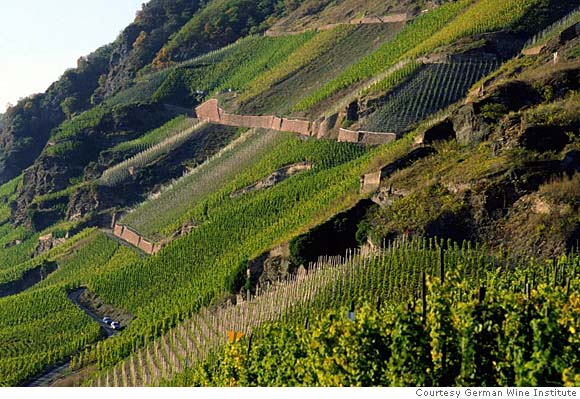
Steep Mosel vineyards in Germany, photo by http://lastingimpressionswineblog.wordpress.com/2011/02/23/german-wine-wineblog-20/

Steep vineyards of the Mosel vineyards in Germany


In other cases, there may be too much sugar for the yeast to convert it all to alcohol. Somewhere around 13-15% abv yeast stops being able to effectively ferment sugar to alcohol and naturally dies off. Super-ripe grapes will thus result in a wine with relatively high levels of alcohol and some residual sweetness. This sweetness can be quite subtle, or it can be syrupy and luscious – as found in dessert wines, which have very high concentrations of sugar in the harvested fruit.

Tasting sugar in wine is a difficult process. We can usually tell if something is ‘moderately sweet’; however it’s very hard to estimate the sweetness level in full-blown dessert wines. Wines with a little bit of residual sugar often have their sweetness masked by acidity and flavour compounds.

Sweet/Dry Wine Chart, Creative Commons photo by http://www.primermagazine.com


Sweetness in wine should be matched by a refreshing acidity for balance. This is especially true for dessert wines, which can come across as cloying without sufficient acidity. On the other hand, a touch of residual sugar, while not tasteable to most people, can give a welcome sense of roundness to a sharply acidic wine.


Sign up for Jonell Galloway and James Flewellen’s  “Celebrate the Chartres Festival of Lights & Autumnal Equinox with a Food & Wine Tasting Masterclass” in France from September 19 to 22, 2013.

___________________________


About James Flewellen

Dr James Flewellen is a biophysicist at the University of Oxford. James learned his trade in taste through the Oxford Blind Wine Tasting Society, of which he was the President from 2010-2012. During his term, he represented Oxford at many international blind tasting competitions – twice winning the prestigious ‘Top Taster’ Award in the annual Varsity blind tasting match against Cambridge University and captaining winning teams in competitions throughout Europe.

One of James’s goals is to clarify the complex and hard-to-navigate world of wine for both novice and experienced tasters. He applies his scientific training to wine education, illuminating concepts of taste, tannin and terroir in an approachable, entertaining manner. James runs wine education courses in Oxford through the The Oxford Wine Blog and is completing the WSET Professional Diploma in Wine and Spirits. He is the regular wine writer for The Rambling Epicure and is the founder of  The Oxford Wine Blog. He is also currently co-authoring The Concise Guide to Wine and Blind Tasting – a book surveying the wine regions of the world and how to blind taste.

Never miss a post
Name: 
Your email address:*
Please enter all required fields
Correct invalid entries

The Art of Tasting Wine with James Flewellen: Top 10 White Wine Grapes

Published by Sunday, June 23, 2013 Permalink 0

The Art of Tasting Wine with James Flewellen: Top 10 White Wine Grapes

by James Flewellen

With over 1,300(!) vine varieties out there making commercial wine, it’s a tough task to narrow down to only 10. Nevertheless, here are my ‘top 10’ white wine producing grapes. The order is my own preference, based on commercial importance, potential quality of the grape and whether it produces a ‘classic style’.

10. Albariño

Deutsch: Albariño-Weingut. Weingut Granbazan. ...

Bodega Granbazán en las Rías Baixas, producer of Albariño


Perhaps a controversial start to the list, Albariño is a rising star in my book. The grape can produce well-balanced aromatic, peachy wines with fresh acidity, suitable as an aperitif or with fish and vegetarian dishes. It’s not yet grown much outside its native Galicia in Spain (and parts of Portugal), yet its stature is certainly on the up and much interest is being shown in growing the grape in a number of new world countries.

9. Gewurztraminer

Tramin - Gewurztraminer Grapes

Tramin – Gewurztraminer Grapes (Photo credit: Lynne Hand)


A very distinctive grape producing ‘love-em or hate-em’ wines. Gewurztraminer has its spiritual home in Alsace, France, though can be found throughout Central Europe and in many new world countries. The grape is typically pink-skinned and produces an abundance of sugars in the right growing conditions. This leads to deeply-coloured, rich, full-bodied wines – many of which are off-dry, or even sweet. Gewurztraminer wines are flamboyantly fragrant with unmistakable notes of lychee, pot pourri and sometimes cloves.

8. Viognier

English: Viognier grapes ripening on a vine in...

Viognier grapes ripening on a vine in Amador county, California.


Another full-bodied, distinctively aromatic wine. Viognier brings forth characteristic notes of peach, apricot and ginger. The very best examples come from the tiny appellation of Condrieu, in the Rhône Valley in France. However, it is found in the blended white wines of southern France, and increasingly in the new world. A single producer in the Barossa, South Australia — Yalumba — could be credited with re-popularising this grape and bringing it to a new audience in the modern era.

Continue Reading…

Never miss a post
Name: 
Your email address:*
Please enter all required fields
Correct invalid entries

The Art of Tasting Wine with James Flewellen: Wine Diamonds in White Wine

Published by Tuesday, May 28, 2013 Permalink 0

by James Flewellen

Wine Diamonds in White Wine

There are a number of legitimate reasons for sending a wine back at a restaurant: the wine could be oxidised, be contaminated by ‘cork taint’, suffer from excess volatile acidity, or have unpleasant Brettanomyces aromas. One common cause for complaint, however, is the presence of tartrate crystals or ‘wine diamonds’. Wine diamonds in white wine are a natural occurrence.

These are clear crystalline deposits found usually in certain white wines, especially Riesling. They are either potassium bitartrate (a.k.a. cream of tartar) or calcium tartrate — both found naturally in grapes, and which follow through to the final bottle in the winemaking process. They are certainly not tartaric acid, sugar, or bits of glass! These wine diamonds are perfectly natural and completely harmless. In the glass, they sink to the bottom and will barely impose on your enjoyment of the wine. Or, the wine can simply be decanted, with the crystals remaining in the bottle.

Wine diamonds in white wine left over from a glass of excellent Austrian Gruner Veltliner.

These crystals can be removed before bottling, however it is an involved process involving chilling the wine and passing it through filters. This is energetically expensive and the filtration process can remove flavour compounds that give the wine its complexity and character. Producers of fine wines prefer to mess with the wine as minimally as possible to deliver the best possible quality to the consumer.

So if you do see some wine diamonds in your wine, this is not a cause for complaint. Rather, be assured that the winemaker cares about his wine so much that he has chosen not to remove them to deliver the best possible wine to you!

__________________

James Flewellen is The Rambling Epicure wine columnist. James is a biophysicist at the University of Oxford. Originally from New Zealand, the huge range of wine James discovered in Europe spurred his interest in all things vinous. He became involved in the University’s Blind Wine Tasting Society and has recently completed a two-year term as its President. During this time he represented the University in a number of domestic and international wine tasting competitions, winning several awards. He is currently completing the WSET Diploma in Wine and Spirits. James has a passion for wine communication and education and runs the Oxford Wine Blog and wine tasting courses through the Oxford Wine Academy.


Never miss a post
Name: 
Your email address:*
Please enter all required fields
Correct invalid entries

The Art of Tasting Wine with James Flewellen: The Waipara Wine Region

Published by Tuesday, February 19, 2013 Permalink 0

The Art of Tasting Wine with James Flewellen: The Waipara Wine Region

by James Flewellen

About 45 minutes drive north of my hometown of Christchurch, NZ, lies the North Canterbury wine region of the Waipara Valley. The valley is nestled between the Teviotdale Hills, which shelter the region from the cool Pacific, and the foothills of the Southern Alps. The everchanging interplay of light and shadow on these surrounding hills and the immense Cantabrian skies make this one of my favourite places to visit.

Hills in the Waipara wine region

New Zealand’s wine industry is still very young (about 30 years) by global standards, yet the Waipara region has been recognised for less than half of that. While there are some well-established names in the area (Pegasus Bay, for instance), many of the wineries have only been around a decade or so, and a whole host have sprung up in the last two or three years. I’ve long been impressed with the quality of wine issuing from Waipara’s small-scale, boutique wineries. A recent visit over the New Year reconfirmed for me why this spectacular region is receiving a surge of interest and that the future looks stellar for quality wine production.

Inasmuch as such a young region can be ‘known’ for a particular style of wine, Waipara is fast becoming a home to Riesling in New Zealand, an alternative base for Pinot Noir, and a lighter, less pungent style of Sauvignon Blanc. Chardonnay is also planted and there are small plantings of other reds including Syrah, Cabernet Sauvignon and Malbec.

Unfortunately, my visit coincided with a public holiday, so I was unable to see many of the region’s top wineries on this trip; however, we had a lovely tasting and lunch at well-established winery Waipara Springs, newcomer Black Estate wines opened their doors up especially for us, and a trip to a family friend’s farm at Limestone Hills resulted in a tasting of their very small-scale (and delicious) Syrah and seeing a champion truffle-sniffing dog in action!

Waipara Springs

Waipara Springs is one of the more established wineries in the region. They have a well-equipped tasting room and a charming garden restaurant serving delicious food designed to match with their own wines. Waipara Springs produces a wide variety of styles. I was most impressed with their 2012 Sauvignon Blanc, which was very smartly-made, melding fresh gooseberry and passion fruit flavours with a high-acid, dry palate and a long, lemony finish.

Their ‘Premo’ series wines all showed great character and were a significant step up in quality from the house wines. The Premo Riesling, 2008, showed toffee notes of bottle age, zesty lime fruit, and was medium-sweet. Quite a full, luscious  body for a lowish alcohol wine and a refreshing tartness to the finish. The Premo Chardonnay, 2011, I found to be a rather light, elegant wine. Perhaps not one for those who like their Chardonnays to be bold and assertive, but a very pleasing wine nonetheless. The Premo Pinot Noir, 2010, seemed to me to have a bit much oak on the nose; the wine is aged in French oak for about 15 months, 20% of the barrels are new wood. But this is something that will resolve with time. Otherwise, the wine showed lovely concentration of dark plum fruit on the nose, an appealing sour cherry palate with green, herbal notes, crisp acidity and finely-etched tannins.

You can find a list of their overseas distributors here.

image

A delicious light lunch at Waipara Springs

Black Estate

While the Black Estate winery and cellar door is reasonably new, the site was planted back in 1993 with Chardonnay and Pinot Noir. The purchase by the Naish family in 2007 has seen the estate extend its plantings, with a constant eye on terroir and what the soil and mesoclimate bring to the wine. Their first Riesling release was in 2008, and I tried their 2011 incarnation. A beautiful nose with lime blossom, cream, mint leaf and sage was followed up by a rather intense lime sorbet palate. Crisp acidity was balanced nicely by the off-dry sweetness; medium alcohol (11%) and a medium length, but very pleasant finish.

Interestingly, the winery releases two different Chardonnays and Pinot Noirs: Black Estate and Omihi Series. Each comes from separate plantings with artisanal winemaking techniques (such as foot treading, and avoiding pumping) designed to bring out the terroir character in each wine. I enjoyed all of the wines and it was fascinating to see the difference the vineyards made. The Omihi Series Chardonnay, 2011, was a lean, delicate and very well-balanced wine. I discerned lighter, floral notes, with apple, cream and some truffle hints on the nose. By contrast, the Black Estate Chardonnay, 2011, had more apricot and peach notes on the nose and a heavier, more rounded body.

The Omihi Series Pinot Noir, 2010, was very aromatic, with a bright slightly estery, raspberry note along with hints of mushroom. The palate began with this bright fruit character and evolved savoury, stemmy notes all the way through to a crunchy, firm yet quite finely-etched tannic finish. Delicious, though my one criticism was the finish came through a bit hot. The Black Estate Pinot Noir, 2010, had more boysenberry on the nose, was less estery, with appealingly Burgundian ‘cooked carrot’ and white pepper hints. The palate showed a riper entry than the Omihi, with less of a progression to savoury (at least at this stage in its evolution); however, a slightly fuller, ‘gutsier’ body I felt balanced the alcohol on the finish more.

Black Estate wines are imported to the UK by Lea & Sandeman.

Limestone Hills

A highlight of the day was seeing Rosie the truffle-snuffler unearth an enormous truffle at the Limestone Hills farm. Well, I thought it was enormous, though Gareth Renowden, our host, assured me it was probably only a about 200 grams and therefore just a ‘medium sized one’! Gareth also grows Pinot Noir and Syrah grapes for his own wine made in vanishingly small quantities. I tasted the 2011 Limestone Hills Syrah and found a very interesting complex nose: black plum and berry fruit with medicinal, peppery hints alongside lavender and manuka honey. The palate showed only a medium body – a far cry from the full-bodied Shiraz of much of Australia, and even lighter than many Northern Rhone examples. Green, herbal flavours came through on the palate with a rich concentration of spicy strawberry and peppery plum. The wine had moderate acid, well-integrated alcohol and the classic, ‘ragged’-textured tannin profile I associate with Syrah. Overall a fascinating and very palatable wine.

Rosie the champion truffle-snuffler unearths some black gold at Limestone Hills farm

Waipara certainly is a region to watch in the very near future. One of the risks with hyped-up new regions is that many people can flock to invest there, resulting in huge increases in quantity and a dramatic decrease in average quality. However, as Bob Campbell MW suggests in this article, the difficulty of securing reliable yields in Waipara means that viticulturists and winemakers really do need to focus on quality to bring about a return. Long may this continue!

Never miss a post
Name: 
Your email address:*
Please enter all required fields
Correct invalid entries

The Art of Tasting Wine with James Flewellen: Top 10 Wines of 2012

Published by Saturday, December 22, 2012 Permalink 0

by James Flewellen

recent post by my friend Tom Parker on his top wines of the last year inspired me to go through my notes to consider the same question. Wine tasting being the highly subjective and opinionated business that it is, it is nigh on impossible to narrow down a list of the best wines one has tasted in a year. Thus, I’ll go for the most enjoyable wines I can recall from the past 12 months to create my list of the top 10 wines of 2012.

Enjoyment of wine is predicated on many things other than the quality of the wine itself – the situation, the company, your frame of mind, for instance. And I’ve found that tasting great wines in a sterile, academic or commercial setting doesn’t really do justice to the mystic and sublime essence of a magical beverage. I’ve tried to take these factors into account in my list, as well as reflecting a range of styles and the locations I’ve visited throughout the year.

So, in no particular order:

Pewsey Vale vineyard, Eden Valley.

1. Pewsey Vale ‘The Contours’ Riesling 2006. Eden Valley, South Australia.

A beautiful wine from a beautiful place. ‘The Contours’ is made from the best fruit in one tiny sub-plot from the Pewsey Vale vineyard high above the Eden Valley floor. 2006 was the most recent release at the time. Lively lime,  blossom and tertiary notes developing. Refreshing and elegant.

2. Bollinger Grande Année 2002. Champagne, France.

I love rich champagne styles and Bollinger is always a sure performer for me in this regard. The superb 2002 vintage brings even more leanness and length to this wine. Still a baby in drinking terms but very hard to resist!

3. Brokenwood ‘The Graveyard’ Shiraz 2001. Hunter Valley, NSW, Australia.

Hunter Valley Shiraz is so unlike the jammy Barossan ‘fruit bombs’ that most outside of Sydney associate with Aussie Shiraz. It can be wonderfully complex, earthy and Hermitage-esque. ‘The Graveyard’ is one of the best, and it was a rare privilege to taste such a great wine at an age it deserved to be drunk.

4. Langmeil ‘The Freedom 1843’ Shiraz 2009. Barossa, South Australia.

Tiny amounts of this wine are made from one of the oldest plots of vines remaining in the world. 1843 refers to the year of planting. This wine is nothing like any Barossa Shiraz I’ve ever tasted. Incredibly concentrated and animally. Far too young at three years old, but an amazing wine to experience nonetheless.

Ancient Shiraz vine in Langmeil's 1843 Freedom vineyard.

5. Cornas, Les Grandes Terrasses, Paul Jaboulet Aîné, 2001, Northern Rhône, France.

Rounding out a trio of Shiraz/Syrah: I showed this wine at a recent tasting in Oxford and was mightily impressed by its length, complexity and great value for money. Drinking very well now.

6. Moss Wood Cabernet Sauvignon Reserve 2010 (barrel sample). Margaret River, Western Australia.

The most enjoyable barrel sample I’ve ever tasted. The wine had been blended from the individually-aged parcels and was into its second round of oaking. Incredibly taut, balanced and complex. Brimming with potential.

7. Phélan Ségur 1996. St Estèphe, Bordeaux, France.

During a trip to Bordeaux over the summer, Phélan stood out for their hospitality, their obvious attention to detail in the winery, and their delicious wines. We were so impressed that a friend hosted a mini-vertical of Phélan later in the year. The ’96 was the most mature, complex and enjoyable of these, although many of the other vintages will get there in time.

With David Ling at Hugel following a portfolio tasting.

8. Hugel Pinot Gris Sélection de Grains Nobles 1976. Alsace, France.

One of the most astonishing dessert wines I’ve ever had. Pulled completely out of the bag during a visit to the charming Hugel property in Riquewihr. Endless length and complexity and a beautiful balance between sweetness, acidity and the perceived dryness all great dessert wines get with age.

9. Pirinoa Road Reserve Pinot Noir 2008. Martinborough, New Zealand.

A brilliant pretender to the Burgundian crown of Pinot supremacy. Great balance between lively red fruit, floral overtones and meaty depths. Still young but starting to develop delicious tertiary character.

10. Marie-Thèrese Chappaz Grain d’Or 2010. Valais, Switzerland.

A fascinating and unusual wine. Marie-Thèrese Chappaz makes extraordinary wines from her vantage point in some of the world’s steepest vineyards overlooking the Rhône River in Switzerland. This wine is mostly Marsanne, from gnarly 90-year-old vines (with a good claim to being the oldest in Switzerland), and spends 18 months in barrel. Still too young, but it’s so hard to get your hands on a mature example of these wines — they are all sold in person every year in May at the winery!

Grain d'Or at the Chappaz vineyard in Valais.

Commended

Jansz Traditional Method Sparkling. Tasmania, Australia. When my budget won’t extend to champagne or English Sparkling, Jansz is my delicious, great value fallback option.

Three Choirs Midsummer Hill, 2011. Gloucestershire, England. Brilliant value, light, fruity English offering.

Macrocarpa Pinot Gris, 2011. Marlborough, New Zealand. Lovely single vineyard expression of Pinot Gris firmly in the Alsatian mould.

The Lane Chardonnay 2009. Adelaide Hills, South Australia. Delicious Chardonnay with judicious and balanced use of oak. Went with a delicious lunch at the winery.

McGuigan Semillon Bin 9000 1997. Hunter Valley, NSW, Australia. Hunter Valley Semillon is certainly one of Australia’s great gifts to the world of wine. Lovely to taste one with significant bottle age to bring out the subtle tarragon and nutty notes.

Duas Pedras 2009. Alentejo, Portugal. Touriga Nacional blended with Syrah, this is a powerful, rewarding wine that needs decanting in advance and has become one of my staple reds.

I hope you all have a wonderful Christmas and holiday season with plenty of good cheer and fine bottles. I’m not yet sure what I’ll be drinking on Christmas Day, but I have a feeling I’ll stick to my favourites: something French, something Kiwi, something sparkling, something Pinot…

__________________

James Flewellen is The Rambling Epicure wine columnist. James is a biophysicist at the University of Oxford. Originally from New Zealand, the huge range of wine James discovered in Europe spurred his interest in all things vinous. He became involved in the University’s Blind Wine Tasting Society and has recently completed a two-year term as its President. During this time he represented the University in a number of domestic and international wine tasting competitions, winning several awards. He is currently completing the WSET Diploma in Wine and Spirits. James has a passion for wine communication and education and runs the Oxford Wine Blog and the Oxford Wine Academy.

Never miss a post
Name: 
Your email address:*
Please enter all required fields
Correct invalid entries

UA-21892701-1