
Elements of Wine 3: Sugar

Published by Wednesday, July 31, 2013 Permalink 0


//

Elements of Wine 3: Sugar

Wine Tasting with James Flewellen

James Flewellen photo, wine tasting expert, The Art of Tasting Wine: James Flewellenby James Flewellen

As mentioned in my previous post on alcohol in wine, sugars accumulate in grapes as they ripen. At harvest time, grapes have a level of what is termed ‘potential alcohol’, that is the alcoholic strength of the future wine should all sugar in it be fermented to alcohol by the action of yeast cells. However, in some cases not all the sugar is fermented, leaving what is termed ‘residual sugar’ in the wine and a noticeable sweetness on the palate.

There are a number of ways to obtain sweetness in wine. The fermentation may be stopped deliberately, perhaps through addition of sulphur dioxide, which kills yeast, or through passing the wine through a membrane filter to remove the yeasts. This results in a wine of lower alcoholic strength and some residual sugar. A classic example is Riesling from the Mosel in Germany, which typically has 7-9% abv (Alcohol By Volume) and varying levels of sweetness depending on the initial level of ripeness of the grapes.
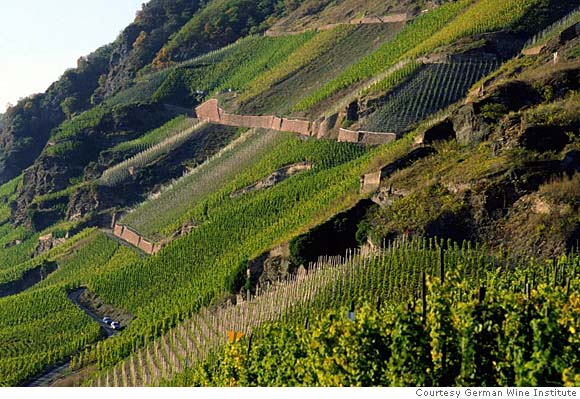
Steep Mosel vineyards in Germany, photo by http://lastingimpressionswineblog.wordpress.com/2011/02/23/german-wine-wineblog-20/

Steep vineyards of the Mosel vineyards in Germany


In other cases, there may be too much sugar for the yeast to convert it all to alcohol. Somewhere around 13-15% abv yeast stops being able to effectively ferment sugar to alcohol and naturally dies off. Super-ripe grapes will thus result in a wine with relatively high levels of alcohol and some residual sweetness. This sweetness can be quite subtle, or it can be syrupy and luscious – as found in dessert wines, which have very high concentrations of sugar in the harvested fruit.

Tasting sugar in wine is a difficult process. We can usually tell if something is ‘moderately sweet’; however it’s very hard to estimate the sweetness level in full-blown dessert wines. Wines with a little bit of residual sugar often have their sweetness masked by acidity and flavour compounds.

Sweet/Dry Wine Chart, Creative Commons photo by http://www.primermagazine.com


Sweetness in wine should be matched by a refreshing acidity for balance. This is especially true for dessert wines, which can come across as cloying without sufficient acidity. On the other hand, a touch of residual sugar, while not tasteable to most people, can give a welcome sense of roundness to a sharply acidic wine.


Sign up for Jonell Galloway and James Flewellen’s  “Celebrate the Chartres Festival of Lights & Autumnal Equinox with a Food & Wine Tasting Masterclass” in France from September 19 to 22, 2013.

___________________________


About James Flewellen

Dr James Flewellen is a biophysicist at the University of Oxford. James learned his trade in taste through the Oxford Blind Wine Tasting Society, of which he was the President from 2010-2012. During his term, he represented Oxford at many international blind tasting competitions – twice winning the prestigious ‘Top Taster’ Award in the annual Varsity blind tasting match against Cambridge University and captaining winning teams in competitions throughout Europe.

One of James’s goals is to clarify the complex and hard-to-navigate world of wine for both novice and experienced tasters. He applies his scientific training to wine education, illuminating concepts of taste, tannin and terroir in an approachable, entertaining manner. James runs wine education courses in Oxford through the The Oxford Wine Blog and is completing the WSET Professional Diploma in Wine and Spirits. He is the regular wine writer for The Rambling Epicure and is the founder of  The Oxford Wine Blog. He is also currently co-authoring The Concise Guide to Wine and Blind Tasting – a book surveying the wine regions of the world and how to blind taste.

Never miss a post
Name: 
Your email address:*
Please enter all required fields
Correct invalid entries

Elements of Wine 2: Alcohol

Published by Saturday, July 27, 2013 Permalink 0


//

James Flewellen photo, wine tasting expert, The Art of Tasting Wine: James FlewellenElements of Wine 2: Alcohol

Wine Tasting with James Flewellen

by James Flewellen

As grapes ripen, they accumulate sugars. At optimal ripeness, the grapes are harvested and sent to the winery for fermentation. Fermentation sees the pressed or crushed grape juice inoculated with yeasts that convert sugar to ethanol – the alcohol that ends up in our wine.

Red Wine Fermenting
Red wine fermenting


The alcoholic strength of a wine thus depends on the initial sugar levels present in the harvested grapes. Grapes grown in cooler climates accumulate sugars more slowly than those grown in hot climes, thus we expect, in general, lower alcohol wines to come from cooler sites. Most dry, unfortified wines fall between 11% and 15% alcohol by volume. A wine may have lower alcohol than this, but with some residual sugar – that is to say not all the available sugars in the grape have been converted to alcohol.

It is legal in some regions of the EU (and certainly throughout the rest of the world) to add sugar to the pressed grape juice prior to fermentation in order to boost the alcoholic strength of the resulting wine. This is called ‘chaptalisation’ (after M. Chaptal, then French Minister of Culture) and is frequently practised in cold vintages in northern Europe. The type of sugar used here is inconsequential as it is all converted to ethanol and contributes nothing to the flavour of the resulting wine.

Focused on wine
Let Ideas Compete / Foter / CC BY-NC-ND


In tasting, alcohol provides the main component of the ‘body’ of the wine – how the wine feels in the mouth. It dissolves certain chemicals found in food much better than water does (capsacain from chillies for instance) and also carries many of the aroma and flavour compounds that are less soluble in pure water. And of course, alcohol provides the intoxication that has been associated with the pleasures of drinking wine for millennia!

Greeny Goodness
sgs_1019 / Foter / CC BY-NC-SA


Alcohol levels can be assessed by aerating the wine as it is held in your mouth. Try this by breathing in over a small amount of liquid. Highly alcoholic wines will register a burning sensation on the back of your throat. As with all structural elements in wine, balance is key. The alcohol should be sufficient to support the flavours of the wine yet not so overpowering as to be the only noticeable feature in the wine. Wines with high levels of alcohol (14%+) can still work, yet they need to matched with a robust body and flavour profile.

Sign up for Jonell Galloway and James Flewellen’s  “Celebrate the Chartres Festival of Lights & Autumnal Equinox with a Food & Wine Tasting Masterclass” in France from September 19 to 22, 2013.

___________________________


About James Flewellen

Dr James Flewellen is a biophysicist at the University of Oxford. James learned his trade in taste through the Oxford Blind Wine Tasting Society, of which he was the President from 2010-2012. During his term, he represented Oxford at many international blind tasting competitions – twice winning the prestigious ‘Top Taster’ Award in the annual Varsity blind tasting match against Cambridge University and captaining winning teams in competitions throughout Europe.

One of James’s goals is to clarify the complex and hard-to-navigate world of wine for both novice and experienced tasters. He applies his scientific training to wine education, illuminating concepts of taste, tannin and terroir in an approachable, entertaining manner. James runs wine education courses in Oxford through the Oxford Wine Academy and is completing the WSET Professional Diploma in Wine and Spirits. He is the regular wine writer for The Rambling Epicure and is the founder of  The Oxford Wine Blog. He is also currently co-authoring The Concise Guide to Wine and Blind Tasting – a book surveying the wine regions of the world and how to blind taste.


Never miss a post
Name: 
Your email address:*
Please enter all required fields
Correct invalid entries

UA-21892701-1