WHAT TO EAT IN FRANCE: HOW TO EAT FOIE GRAS

Published by Thursday, May 21, 2015 Permalink 0

WHAT TO EAT WITH FOIE GRAS

by Jonell Galloway

I tell you it will be more tolerable for the Fejee that salted down a lean missionary in his cellar against a coming famine; it will be more tolerable for that provident Fejee, I say, in the day of judgment, than for thee, civilized and enlightened gourmand, who nailest geese to the ground and feastest on their bloated livers in thy pate-de-foie-gras.”–Herman Melville, Moby Dick (1851)

In What to Eat in France: Foie Gras, we talked about how foie gras is made and the different legal classifications, which determine both the quality and price. Let’s move on to the fun part now. We’ve bought our high-quality foie gras and we want to eat it in the best way possible. Here are some ideas, both traditional and inventive.

Cooked Foie Gras

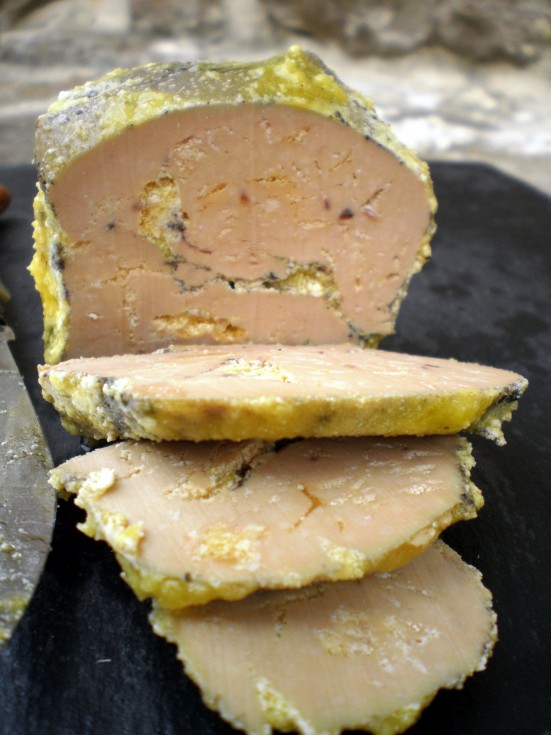
So you’ve bought a foie gras entier, a foie gras, or a bloc de foie gras. You’ll be eating pure or fairly pure foie gras, but how do you eat it and with what?

There is no one way to eat it. The Romans soaked it in honey and milk to fatten it still more before cooking. The first recipe on record comes from Apicius in his fourth century De re culinaria: Thinly slice the foie gras with a reed. Soak in garum. Crush some pepper, lovage and two bay leaves. Wrap in a caul. Grill and serve.

Today we eat it differently. Cold foie gras is most often eaten with something acidic to help digest the fat. This traditionally includes cold, sweet garnishes such as apple, rhubarb, fresh or dried figs, grapes, or pears, and toast, but contemporary chefs venture outside these limits, serving it with dried fruit and nuts and toasted brioche or raisin-fruit bread. More contemporary garnitures are onion jam or caramelized onions, Balsamic vinegar, port or Sauternes jelly, chutney, cassis berries, raspberries, blueberries or coarse sea salt.

Some people simply eat it with green salad, although I find that salad dressing deadens the natural depth of flavor. It’s also possible to eat it with cornichons and pickled onions. like one does with regular pâté, but once again, the vinegar is likely to overpower the delicate flavor.

Cooked foie gras should never be reheated. It should be eaten just colder than room temperature, so take it out of the refrigerator about 45 minutes before serving. Slice it with a knife while it is still cold. It is usually served with cold garnishes, most often as a starter.

Continue Reading…

Never miss a post
Name: 
Your email address:*
Please enter all required fields
Correct invalid entries

Part 3: What is Fermentation?

Published by Monday, July 30, 2012 Permalink 0

“Fermentation is one of the oldest and simplest means of preserving foods. It requires no particular kind of climate, no cooking, and so no expenditure of fuel: just a container, which can be a mere hole in the ground, and perhaps some salt or seawater,” quoted from the ever-insightful Harold McGee, author of On Food and Cooking: The Science and Lore of the Kitchen.

On Food and Cooking

Harold McGee’s “On Food and Cooking: The Science and Lore of the Kitchen”

vegetable


The third article in this mini-series is going to be scientific and a little bit nerdy. Get ready to learn the nitty-gritty behind fermentation.

Fermentation begins in the vegetable or fruit. The naturally-occurring microbes in the food proliferate under the right conditions – namely, under the lack of air. At the same time, these beneficial microbes suppress the growth of harmful microbes that rot the fruit or vegetable. The good microbes metabolize the plant’s sugars and carbohydrates before the bad microbes get a chance. In a way, fermentation is a “controlled-rotting” process: the difference between sauerkraut and rotting cabbage is which microbes are allowed to grow.

When protected from air, these microbes get to work producing lactic acid, alcohol, carbon dioxide, and other compounds and nutrients.

Ferments can be made by crushing the vegetables or fruit until enough liquid is let out, ensuring that the vegetables are covered and protected from the air. Usually, though, the vegetables need a little bit of help: salt draws out the liquids, sugars, and other nutrients, and so ferments are often dry-salted or submerged in a salt-and-water brine before being stored in a covered container.

Crushing: wine is also a form of fermentation

As the plants ferment, much of the material remains intact, hence crunchy kimchi and sauerkraut as opposed to being mushy or slimy (two problems which usually signify contact with air; check out a great troubleshooting link). As the vegetables ferment, not only do they retain their vitamins, but additional nutrients are formed in the process: namely Vitamin B, folate, and the production of enzymes. New flavors and aromas begin to develop, and continue to age and change for as long as you ferment your food.

The salt concentration of the brine and the temperature during fermentation are the two main components that determine which beneficial plant microbes flourish and, consequently, the flavors and aromas that result. Vegetables with a low-salt brine and fermentation under low temperatures will produce mild but complex flavors with Leuconostoc mesenteroides. Fermentation done in high temperatures will produce almost exclusively lactic acid bacteria, from the Lactobacillus plantarum microbe. Also, fermentations undergo a dual process: they produce the first microbe, Leuconostoc mesenteroides, which is then taken over by Lactobacillus plantarum during the second stage of fermentation.

Never miss a post
Name: 
Your email address:*
Please enter all required fields
Correct invalid entries

New column: Quelling Quitchen Qualamities

Published by Tuesday, March 6, 2012 Permalink 0

by The Quonstant Quonnoisseur

[This is the first in an occasional series of  short items by the QQ. Preventing kitchen mishaps, and adroitly recovering from any that do occur, will figure as an important topic in these updates.]

The problem: Overheating low-fat milk

The cause: Low-fat milk products cannot be boiled, unlike cream. Low-fat milk must be kept below 82° C or 180° F to avoid curdling or “breaking.” Using overheated low-fat milk that has curdled will  result in grainy ice cream, pudding or other dish.

The solution: To avoid this qualimity, invest in a clip-on thermometer and watch your low-fat milk like an anxious Dad with a pretty 19-year-old daughter.

Continue Reading…

Never miss a post
Name: 
Your email address:*
Please enter all required fields
Correct invalid entries

UA-21892701-1