
Our ongoing series of tapas photos from our latest food artist discovery: food photographer Steve Homer of Sabor de Almería in the southeast of Spain.
|
|

A Literary Culinary Journal
Our ongoing series of tapas photos from our latest food artist discovery: food photographer Steve Homer of Sabor de Almería in the southeast of Spain.
|
|
 by Jonell Galloway
Better than any argument is to rise at dawn and pick dew-wet red berries in a cup.— Wendell Berry

|
|
by SandeeA
Para leer la versión en español, pinche aquí
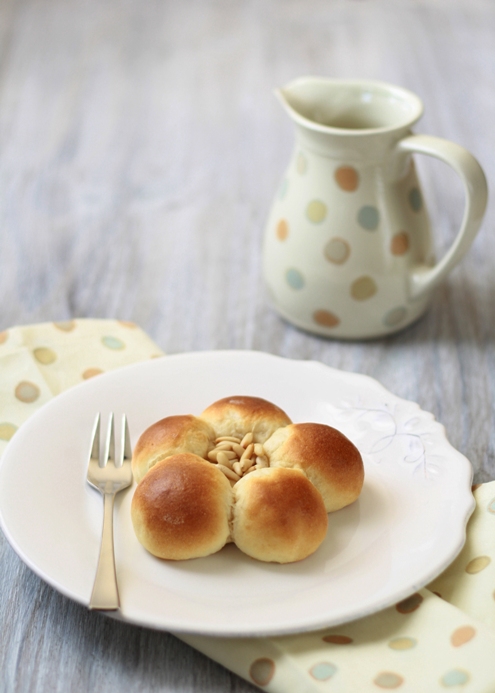
Saint John’s coca is a typical Catalonian sweetened bread eaten during the celebration of Saint John’s Eve in June. It is usually oval, but I wanted to give it a a playful twist… would you like to try some?
|
|
Food is a subject of conversation more spiritually refreshing even than the weather, for the number of possible remarks about the weather is limited, whereas of food you can talk on and on and on. Moreover, no heat of controversy is induced by mention of the atmospheric conditions (seeing that we are all agreed as to what is a good day and what is a bad one) and where there can be no controversy there can be no intimacy in agreement. But tastes in food differ so sharply…that a pronounced agreement in them is of all bonds a union the most intimate. Thus, if a man hates tapioca pudding he is a good fellow and my friend.–A. A. Milne, “Lunch” (1934)
Alan Alexander Milne was an English author, best known for his book about a teddy bear named Winnie the Pooh.

|
|

Our ongoing series of tapas photos from our latest food artist discovery: food photographer Steve Homer of Sabor de Almería in the southeast of Spain.
|
|
I must….descant a little upon the mint-julep, as it is, with the thermometer at 100 degrees F., one of the most delightful and insinuating potations that ever was invented, and may be drunk with equal satisfaction when the thermometer is as low as 70 degrees.–Captain Frederick Marryat’s diary (1838)
Captain Frederick Marryat (July 10, 1792 – August 9, 1848) was an English Royal Navy officer, novelist, and a contemporary and acquaintance of Charles Dickens, noted as an early pioneer of the sea story. He is now known for a widely used system of maritime flag signaling.
Click here for a mint julep recipe.

|
|
He who receives his friends and gives no personal attention to the meal which is being prepared for them, is not worthy of having friends.–Jean-Anthelme Brillat-Savarin (April 1, 1775 – February 2, 1826) The Physiology of Taste
Jean-Anthelme Brillat-Savarin, a French lawyer, magistrate, and politician, wrote one of the most celebrated works on food, Physiologie du goût (The Physiology of Taste), which was published only months before his death.
|
|
por SandeeA
Click here to read English version

La coca de San Juan es un dulce típico de Cataluña para celebrar la Noche de San Juan, que se celebra del 23 al 24 de Junio. La forma típica es de una coca ovalada, pero yo he querido darle un toque diferente… te animas a probarla?
|
|
[A Comice pear is] sweetly and subtly perfumed…so soft it is best eaten with a spoon, a tenderness more appealing to gourmets than to those who have to pick, ship, handle and store it in constant fear of ruinous spoilage.–Waverley Root, Food
Waverly Root, author of Food: An Authoritative and Visual History and Dictionary of the Foods of the World, was an American journalist and writer, best known for the book The Food of France published originally in 1958, and is still in print today. He died in 1982. Click here to read his obituary.
|
|
by Jamie Schler
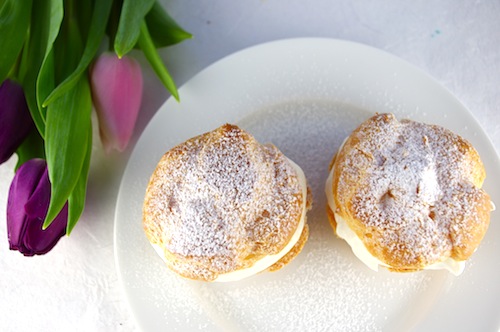
Chou: cabbage
Chou: cream puff, a type of pastry
Chou: cute
Chouchou: teacher’s pet
Mon petit chou: my little sweetheart, darling
It’s funny how one single food ties my old, American childhood to my new adult life in France. This one food, the perfect choux, was a favorite, one my father would make, light and airy, crispy and golden on the outside, so ethereal on the inside. He would shape them into perfect, saucer-sized rounds, bake them until they were puffed up into pillows and lovingly fill each one with thick, creamy pudding, chocolate, vanilla or pistachio. The almost flavorless choux puff was the perfect casing for the flavorful filling, tempering the sweetness and adding texture to the smooth creaminess of the pudding, and quickly became my most loved sweet treat of all that my father baked for us. My dear old dad passed away a mere two months before I married my French sweetheart (mon petit chou) and as I prepared to join my soon-to-be husband, I pulled the carefully clipped recipe off the refrigerator in my parents’ house, my childhood home, where it had been taped for decades, words and image now faded with time and handling, and tucked it lovingly and ever so carefully amongst my few worldly possessions in my suitcase and carried it with me across the ocean to France.
|
|
 Meet Jonell Galloway, a freelance writer and editor specialized in French cuisine.


