



Related articles
|
|

A Literary Culinary Journal
A number of rare or newly experienced foods have been claimed to be aphrodisiacs. At one time this quality was even ascribed to the tomato. Reflect on that when you are next preparing the family salad.–Jane Grigson

Jane Grigson was an English food writer. Grigson’s growing interest in food and cooking led to the writing of her first book, Charcuterie and French Pork Cookery (1967), which was translated into French, unusual for an English food writer. Elizabeth David read the book and was impressed by it, and recommended Grigson as a food columnist for The Observer, for which she wrote a column from 1968 until her death in 1990.
|
|
 by Simón de Swaan
Summer cooking implies a sense of immediacy, a capacity to capture the essence of the fleeting moment.–Elizabeth David
Elizabeth David was a British cookbook writer who, on her return from “exile” in Egypt after WW2, decided that action had to be taken with regard to the quality of food in Britain. She was outright hostile to second-rate cooking and the use of frozen, canned and out-of-season ingredients, and is, in many people’s mind, a precursor of the concept of Slow Food. In any case, she was a primary mover in bringing true traditional home cooking using quality ingredients back into the mainstream in Britain.
All her books are listed here, and most are still available at Book Depository or other online independent booksellers.

|
|
//

 Switzerland: Restaurants in Geneva open on Sunday night
Lai Thai is in an elegant setting. The owner went to Swiss hotel school, so you are always greeted like a king or queen and the service is impeccable. A wide range of Northern Thai dishes you don’t ordinarily find in hole-in-the-wall type Thai restaurants, such as the special Thai rice and fish fritters with a delicious dipping sauce, as well as great massamans. Set menus go for CHF 55, 65 and 78 and the servings are generous. Located in what was formerly a Geneva institution, the Café Gothard.
Rue du Gothard 11
1225 Chêne-Bourg
Tel. +41 (0)22 348 48 17
Traditional Italian cuisine in a chic contemporary decor, located in Plainpalais near the Musée Patek Philippe. The bar serves tapas with the cocktails and is a hangout for young people.
Avenue du Mail 15bis
1205 GenevaTel. +41 (0)22 328 07 01Site.
|
|
by Jonell Galloway
Sandrine and Olivier Chapuis in Veigy-Foncenex in France are the great specialists of juicy, full-flavored tomatoes in the Geneva area. They grow between 20 and 30 different varieties every year. There are yellow, orange, green, tiger stripe, red: a cornucopia of color and as sweet as fruit (of course they are fruit, technically speaking).

The market is flowing with oodles of summer vegetables.

The Chapuis also have the widest range of wild greens and mescluns I’ve seen in Geneva.


You can also buy directly from them in Veigy-Foncenex, but Sandrine prefers that you call beforehand because she is not always there. After all farmers have to work in the fields sometimes!
They produce all the produce they sell in the farmers market, so you can be sure that is both fresh and local. Sandrine, or “Sabi,” as she is nicknamed, has lots of great recipes in her head for every product she sells.
Since their fields are scattered out in various places, she prefers customers to tell her what they want, and she will have it ready for them when they come to pick it up. The best time is Tuesday or Friday between 4 and 8, or any other evening on appointment. The Chapuis are trying to set up a system for opening every evening, but are awaiting authorization from city authorities regarding parking, since they are right off the route nationale.
|
|

Before we get to tasting or even smelling it, the first of our senses to be engaged by a wine is our sight. Observing a wine is the first thing a wine judge or blind taster will do when assessing a new wine, but what exactly can the appearance of a wine tell us and what are we looking for?
Colour, ‘brightness’ or intensity, spritz, sediment, the difference between the core and the rim of the wine all give away subtle clues to the wine-making process, the possible age of the wine, and the grape variety.
Spritz is the term given to small bubbles of gas that may appear just under the surface of a wine immediately after pouring. They are usually carbon dioxide, which is a natural by-product of the fermentation process. Most of it is coaxed out of the wine during the winemaking through the racking process prior to bottling. However, in some wines — especially white wines fermented in airtight stainless steel tanks — some dissolved CO2 remains. In the vast majority of cases, spritz is absolutely fine and will dissipate after giving the wine a good swirl.

A glass of sparkling wine from the Limoux region of France.
Champagne and other sparkling wines, of course, make use of this by-product to obtain their characteristic sparkle. The appearance of bubbles in a sparkling wine actually has a lot more to do with the glass in which the wine is served than any inherent quality of the wine. Bubbles of CO2 nucleate at imperfections on the glass surface — deliberate or accidental scratches or microscopic bits of dirt or left-over detergent. A sparkling wine’s mousse — the French term for the fizz — is best assessed on the palate for quality purposes. That said, semi-sparkling wines will have a different character to the bubbles than a full-blown traditional method sparkling wine.

White Burgundy in the glass.
The colour of a wine is certainly the most obvious characteristic of a wine’s appearance. White wines have a colour spectrum from almost watery-white, through green, to straw, lemon, golden, and finally to coppery-orange for some dessert wines, although the vast majority fall under ‘lemon’ or ‘straw’ for me! Reds can be various shades of red (you’ll frequently hear the more poetic ‘ruby’) or purple, and rosé can go from a quite deep magenta through to a pale salmon-pink.
Both white and red wines converge to orange, or ‘brick’, as they age. This is due to the slow oxidation of the colour components in the wine. The best way to assess potential age of a wine is to tilt the wine in the glass over a white background and to look for any difference in colour between the ‘core’ of the wine (the greater body of liquid) and the ‘rim’ (the edge). This is a lot more obvious in aged red wines, where you’ll see a deeper ruby core progressing to a brick-orange at the rim. A wine that is thoroughly oxidised will be brown in colour — not necessarily a fault as some wines, Madeira for instance, are made in a deliberately oxidative style.
Wines of the same hue can vary in the depth, or opacity, of this colour. Thicker-skinned grapes imbue more colour to a wine than those with thinner skins — think of Malbec or Syrah versus Pinot Noir. Grapes tend to develop thicker skins in hotter and sunnier climates too, thus a Chilean Cabernet Sauvignon will typically be deeper in colour than one from Bordeaux. The winemaker also has a role to play, with different winemaking techniques allowing greater or lesser extraction of these colour compounds into the final wine during the maceration process. Winemaking explains most of the differences in depth of colour in rosé wines.

Thick skin wine grapes.
This idea is not limited to red wines, with Pinot Gris and Gewurztraminer two examples of relatively thick-skinned grapes that can yield a deeper-coloured white wine.
Some people pay a lot of attention to the ‘legs’ of a wine. That is to say, the ‘tears’ of alcohol that run down the inside of the glass following a swirl of the wine. They are an indication of viscosity, and related to alcohol, sugar and glycerol levels in the wine. The excellent wine tutor Michael Schuster once told me that he doesn’t worry about these – there’s far more information in the structure of the wine on the palate – and I’m inclined to agree. On the other hand, I learned from a French student of wine that these ‘legs’ are a good indication of age in sweet wines, Sauternes for instance. For me, the jury’s still out on that one – I’ll need to drink a lot more aged Sauternes to compare!
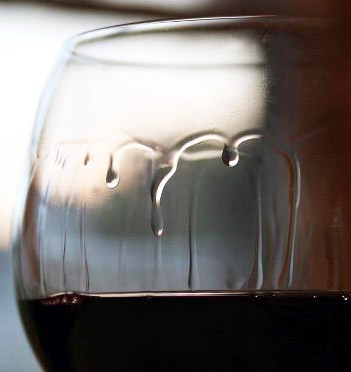
Legs or tears of wine on side of glass.
Finally we come to sediment in a wine. The only sediment you should see in a white wine is tartrate crystals. These originate from the natural tartaric acid in the wine and can solidify over time. They’re nothing to worry about, although many consumers have a perception that they are a fault. The only way to get rid of them is to chill the wine, prior to bottling, to at least -8°C for several days, and even then you may not get them all. As you can imagine, this is an expensive and energy-intensive exercise, which is one of the reasons the Riesling community in particular is trying to educate the public about the presence of these ‘wine diamonds’!

Sediment in wine.
Red wines will precipitate out tannins and colour molecules over time. The more tannic a wine is to begin with, the more potential for sediment it has. Very fine sediment, before it forms large clumps, can lead to a wine appearing slightly cloudy. These forms of sediment are nothing to worry about and can easily be dealt with by leaving a bottle upright for an hour or two to allow the sediment to collect at the bottom, or by decanting the wine before serving.
There’s a lot to an appearance of a wine, although ultimately its importance is superseded by what you smell, taste and feel about a wine. Thus for the average enthusiast, you’re more likely raring to get straight to the nose and the taste. If you are interested in puzzling over a wine’s appearance for tasting purposes, the important thing to remember is that there are few hard and fast rules. Each winemaker has a different approach to the next, which results in different wines – even if their vineyards are next door! The key is experience and observation. Make a note of what you’re drinking and use it to compare to other experiences. The huge variety of wines is what keeps blind tasting so interesting, so engaging, and is what makes it so hard!
|
|
“It’s difficult to think anything but pleasant thoughts while eating a homegrown tomato.”–Lewis Grizzard


How would you like to eat them? Any ideas for dinner tonight?
|
|
Wine Defender Geneva is sponsoring a wine tasting on August 9, 2012, from 7 p.m. to 10 p.m. at the Cave Do Bem, located at 14, boulevard James Fazy. The tasting will feature Spanish wines with tasty tapas and rock music provided by Bye Bye Chicken Head DJ, preceded by a tribute to Chavela Vargas. The cost of admission is 10 CHF.
Cave Do Bem is located just 2 minutes from the Cornavin train station. It is advisable to reserve ahead of time. Tel. 41 (0)76 273 88 27.

|
|

 Part 5 on Fermentation: Kimchi vs. Sauerkraut – Fermenting Vegetables
by Diana Zahuranec
Once again, Harold McGee’s The Science and Lore of the Kitchen comes to the rescue.
In fermented vegetables, remember that the two components that determine aroma and flavor are the salt concentration and temperature of fermentation. Those are the two main differences between kimchi and sauerkraut.

Bowl of kraut.
Sauerkraut, besides being cut more finely, has no other ingredients besides cabbage and brine. It ferments at 64-76 °F/18-24°C for 1 to 6 weeks. Its final salt content is 1-2%, and its final acidity level is 1-1.5%. That higher temperature for sauerkraut results in more lactic acid bacteria, giving it a tangier flavor.
Kimchi is cut into larger chunks and includes plant leaves and stems, too; and hot Korean chili pepper, garlic, and fish sauce are added for flavor. It’s fermented at a lower temperature than sauerkraut at 41-57°F/5-14°C for 1-3 weeks, with a higher salt content in the end (3%) and lower acidity (0.4-0.8%).
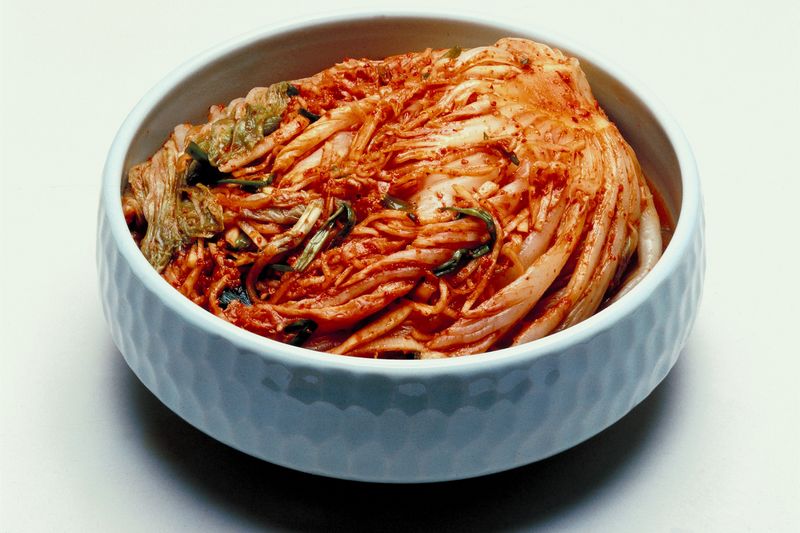
Bowl of kimchi.
|
|
 Meet Jonell Galloway, a freelance writer and editor specialized in French cuisine.


