Jonell Galloway grew up on Wendell Berry and food straight from a backyard Kentucky garden. She is a freelance writer. She attended Le Cordon Bleu and La Varenne cooking schools in Paris, worked for the GaultMillau restaurant guide, CityGuides and other restaurant guides in France and Paris, and for Gannett Company in the U.S., and collaborated on Le tour du monde en 80 pains / Around the World with 80 Breads with Jean-Philippe de Tonnac in France; André Raboud, Sculptures 2002-2009 in Switzerland; Ma Cuisine Méditerranéenne with Christophe Certain in France, and a biography of French chef Pierre Gagnaire. Before moving to Switzerland, she ran a cooking school called Spontaneous Cuisine in France, and in the U.S., a farm-to-table restaurant called The Three Sisters, which she owned with her two sisters. She organizes the Taste Unlocked bespoke food and wine tasting awareness workshops with James Flewellen, a wine tasting specialist. She is an active member of Slow Food and runs the food-writing website and Facebooks pages under the moniker The Rambling Epicure. Her work has been published in numerous international publications and broadcast on public radio.
A charlotte is traditionally fruit sautéed in butter which is then placed in a mold lined with bread. In our day, the bread is usually ladyfingers, but I’ve used financier, a dense almond flour cake made with beurre noisette, giving it a distinctive flavor.
Insteading of sautéing the strawberries, I’ve marinated them in rum and used the marinade to “wet” the cake, similar to the way the British make trifle.
600 g strawberries 2 T. brown sugar
1 tsp. cinnamon 4 T. rum 3/4 c. water 4 financier cakes, individual size (or other type of soft, but dense, almond cakes) 200 g thick cream 1/2 vanilla bean 2 T. brown sugar
4 parfait dishes
Top strawberries and cut in half. Place in mixing bowl.
Mix in 2 T. brown sugar and cinnamon.
Add rum and water. Mix gently.
Leave for 30 minutes, mixing gently from time to time. A natural sauce should form. If it doesn’t, add a little more water and rum.
Meanwhile, mix cream with vanilla from vanilla bean and brown sugar.
Break up 1/3 of each financier into each parfait cup. Spoon in 1/9th of strawberries into each cup, pouring some juice onto the cake to moisten it.
Cover with 1/9 of cream.
Add two more layers of financier, strawberries and cream, in the same proportions, ending with cream.
Decorate top with bits of strawberry, mint, or dark chocolate.
Chartres-style Blanquette de Veau Recipe / Apple, onion, carrot and veal stew in apple juice and white sauce recipe
This dish hails from Normandy, where cream, butter, apples and calves are abundant. Chartres is not officially in Normandy, but its cuisine is similar.
1 kilogram or 2 pounds veal shoulder, cut into 2″ x 2″ pieces 12 pearl onions, or the white of 12 small spring onions, peeled and whole 1 apple, chopped 4 carrots, cut into large chunks crosswise Apple juice Veal or chicken broth 6 small new potatoes in jacket 4-5 tablespoons flour 2-3tablespoons butter 1/2 liter or 1 quart milk Italian or flat parsley, chopped Salt Pepper
Dutch oven or similar large pan
Put the veal pieces in Dutch oven.
Add the onions, apple and carrots.
Cover with half apple juice and half veal broth. Salt and pepper.
Simmer gently for 1 hour, then add the whole potatoes.
Simmer for 30 to 45 minutes, or until the potatoes are cooked.
Drain broth from meat and reserve it to make white sauce.
Melt butter in a large, deep frying pan or saucepan. When melted, gradually whisk in 3-4 tablespoons of flour, stirring constantly until the roux starts to gently brown.
Gradually whip in the milk until sauce starts to thicken. Continue whipping until all the milk is absorbed. It should be extra thick. If not, put one more tablespoon of flour into a ladle and add white sauce to ladle. Mix well to form a smooth paste, then whip this into white sauce.
Gradually whip the broth from the stew into the white sauce. When smooth and thick, pour this back into the stew.
Gently mix, turning the meat and vegetables over in white sauce.
Simmer very gently for 5 minutes, stirring carefully so that meat and vegetables don’t fall apart.
Serve, sprinkling with chopped parsley.
Note: This is often served with rice. If you prefer rice, leave out the potatoes. Small turnips can also be added at the beginning, as well as other vegetables, according to taste.
Most writers want and need to concentrate on the words, not the computer. Computers, by definition, require technical acumen, and many of us have neither the skills nor the desire to learn. The fact is, in today’s world, we must; it will make our lives easier if we do.
Food writers and bloggers do not need extremely powerful computer hardware if they are posting mainly text files. Working with images, however, requires more powerful equipment. Each publisher will require different software and applications.
Software and Applications
If you’re preparing a book in manuscript format, you don’t need a huge desktop publishing package, though that’s what most people seem to end up using. Many authors use Microsoft Word, others swear by a variety of less-common options.
For those writing for print, if at all affordable, I suggest buying Microsoft Word Professional or its equivalent. It offers stricter spelling and grammar checkers and has more complete dictionaries and thesauri for a long list of languages, if you indeed need the language option. Even if you’re doing content writing for online publications, this version of Word will give you a maximum of tools.
If you’re using Windows or another Microsoft operating system, I’d suggest taking a class in how to maneuver it and problem-solve. Whether you’re using Microsoft or Apple, a class in Word is a time-saver in the long run, and it will save you hours of frustration. Learn to use the Format, Insert, View and Tools options, and how to create and use a style sheet. I’ll be giving a summer class in Word for Writers. Fill in the form below to sign up for the class.
FILE FORMAT
Continue Reading…
Please choose a color:
To be interested in food but not in food production is clearly absurd.
Sometimes I think I’m liquefying like an old Camembert.–Gustave Flaubert
History of Camembert
The legend goes that Marie Harel invented Camembert in 1791 in the village of Vimoutiers in Normandy, a froward priest giving her the instructions, which she guarded preciously hidden away. Camembert is not taken lightly in France. In 1928, Alexandre Millerand, former president of France, inaugurated a statue in Vimoutiers in honor of Harel’s great “achievement.”
The legend lives on, despite the fact that the family name Harel has never appeared on the list of cheesemakers or business people in the Camembert region, and that the first historical recording of the cheese was in 1708, well before Harel supposedly lived.
How Camembert is Made
Camembert is made from unpasteurized whole milk, abiding by specific requirements if it is to be labeled “Camembert de Normandie.” The milk is first skimmed, then the lactobacillus bacteria is added as a starter. The milk is left at 12° C to coagulate for several hours and is then heated to around 30° C.
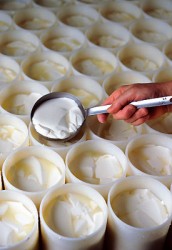
These curds are then sliced vertically and ladled into perforated cheese moulds. This manual operation is repeated four or five times over the space of 40 minutes, allowing the curds to drain off all excess water. After about 12 hours, the cheese is turned over and a stainless steel plate is placed on it, putting pressure on it so that it continues to drain overnight.
The next day, the cheese is removed from the moulds and salted. It is left for a week in a curing room with 100% humidity, where it is turned regularly. Thanks to the Pénicillium candidum in the atmosphere of the room, a natural crust is formed. (Some modern facilities spray the cheese with Pénicillium candidum to start the process.) French regulations require that it then be placed in a curing room with 50% humidity for a week.
The Camembert de Normandie A.O.C./A.O.P. is then ready for packaging. It is wrapped in plastic and then enclosed in a thin, round poplar box.
There are numerous variations on this process, depending on the manufacturer, but all makers more or less follow these steps, whether on a farm or in a larger establishment.
How to Choose a Camembert
Labeling
The first thing to look for is the origin. It will probably be Camembert de Normandie or Camembert fabriqué en Normandie. Only Camembert de Normandie is made from raw milk and and has the legal right to bear the A.O.C. or A.O.P. label. This category includes some 500 milk producers and 9 or 10 cheese makers. In any case, Camembert de Normandie is always hand-made and the dairy cattle have been let out to pasture for a minimum of 6 months. It should always be marked moulé à la louche, indicating that it is hand-made using a ladle.
This name has been protected since 1983, and only represents 4.2% of all Camembert made in France. Look for all these indications on the packaging. Labeling can often be deceptive. Study the images in this article so you’ll be able to tell whether it’s real Camembert and to get a picture of the deceptive practices used. In any case, it should bear this label:
Camembert fabriqué en Normandie simply means it’s made in Normandy. There are no regulations controlling how it is made, so it will most likely be made in a factory, but there are certainly some artisanal cheese makers who for one reason or another don’t qualify for the strict Camembert de Normandie label, but whose cheese is of a high quality.
Then there are manufacturers from other parts of the country who make what they call Camembert. This is usually made with pasteurized milk and most often in factories. We have no way of knowing whether it is made according to the rules of the trade or whether it is good except by tasting. It might even be made with milk from another country.
Appearance
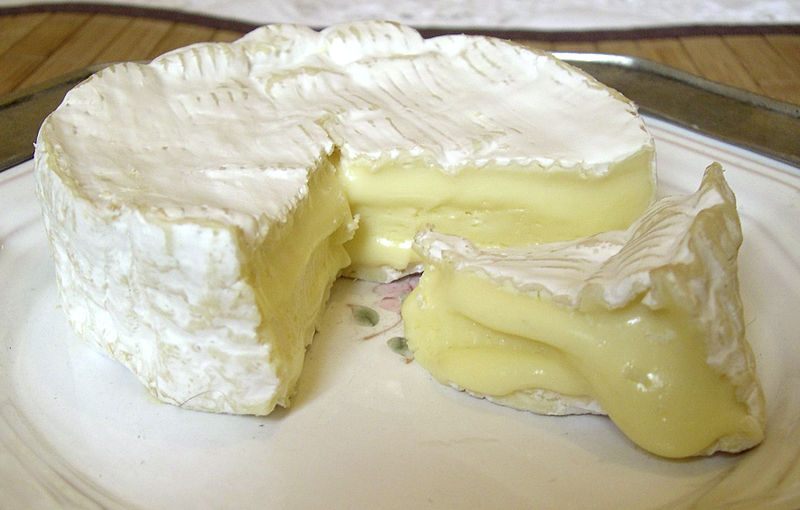
Camembert should be perfectly round and flat. The crust should be white, but slightly brownish, and should not be cracked. The brownish spotting is the result of healthy mould and ripening. The entire surface should be the smooth and even. The edges should be slightly yellow.
Smell the Camembert. Any whiff of ammonia indicates that it is too ripe. It should smell fruity and ripe like you’d like it to taste, but not overwhelming.
Touch the edges, then press the middle. It should be neither too hard nor too soft.
When you cut into the cheese, it should be light yellow in color and creamy in texture.
Note: raw milk Camembert is best in the spring and autumn.
How to Eat Camembert
The French eat their cheese after the main course, either with or after a green salad. It is eaten as is, at room temperature, with bread, and followed by dessert. Some nicer restaurants will serve dried fruit, jam or nuts with the cheese course.
Let me find what ails you, and set you to “writes”. Whether through modest adjustments or major overhauls, let’s get your prose in good health!
You are a food blogger, but your dream is to become a food writer. Writing is a craft, and like all crafts, it takes time and patience to learn. Think of it as a house. You start with a solid foundation, with a frame and a floor, but you have to finish the building so you can house your family.
Working with a writing coach is like adding a roof, insulation and siding to suit the climate you live in. The climate can be compared to the market or the type of writing you aim to do. You have to hone your writing to that market and meet the expectations of publishers and of your audience. Writing free of spelling and grammatical errors is not enough.
Here are 10 easy steps to follow to start a food (or other) blog. Food blogging can be easy if you start out right.
Keep it simple at every step, because it won’t end up being simple no matter how hard you try to make it so.
Decide on your niche and your subject. Your subject should be specific and something you know about and feel comfortable writing about. If you’ve worked at a French bakery, perhaps you know a lot about baking French pastries. For example, I studied French cuisine, so I mainly write about French cuisine. It comes easy to me; it’s within my range of knowledge. If you want your readers to be passionate, you have to be passionate yourself. If you want them to build confidence in you, you have to write with authority.
Who is your audience? Are there enough people interested in your subject to justify all the hard work? Do you have an idea of who these people might be? Go on Amazon and see how many books are published on your subject. Do a few Internet searches to see if anyone else is covering the same topic.
Define a budget. Can you afford a developer? a webmaster? I recommend both, but if you’re computer literate, it’s possible to build a website on your own.
Choose a platform. The platform you choose has a lot to do with how computer literate you are. This is not a judgment. It’s just a factor that can determine how much unnecessary frustration you risk experiencing while running your blog. If you have limited experience using computers and you want a simple, carefree site, Tumblr, Typepad and Blogger are good choices. Another advantage is that they are free, but they have their limitations. If you know Microsoft Word, know how to use a stylesheet, and feel comfortable with computers, WordPress offers more flexibility in terms of layout and functionality. It is also free. None of these platforms requires knowledge of computer coding. Wix and Medium are also free, but have limitations. None of these platforms requires knowledge of code, with the exception of a few of the cutting-edge WordPress themes. (If you don’t know code, this is a question you should ask when choosing a theme.)
If you have a hefty budget, you can make life easier by hiring a website developer and a webmaster, so you wouldn’t need the free platforms. A developer can custom build a site in code to your specifications, giving you the possibility of a beautiful, unique look, but making it necessary to have a webmaster or the developer make changes and additions, which can be costly. Think this over before starting. It will not be a one-time expense; it will be an on-going one.
If you’re building a website on a free platform, choose a theme. A theme is what you will use as the basic layout or presentation of your site (a paid web developer would do all this in code). It is what you use when you don’t have a budget for a coded website and you plan to use the free platforms. Free or low-budget themes are available for all the free platforms listed above, and allow you to browse examples before choosing. Wordpress offers free themes here.
Choose a host. The “host” is the place where your website resides. They will offer various packages at various prices. The host provides a server on which to store your blog files, as well as other necessary technical services including technical support (ask for details about this before choosing: how much time, availability, etc.), email, domain name registration, FTP access, and various other services and tools. They will offer different bandwidths (250 GB is usually the least) and disk space (5 GB is usually a minimum). How much you need depends on how many images and articles you post, of course, but a basic package usually suffices at the outset. You can always upgrade later. Ask what their average uptime and downtime are; this is what determines part of the reliability of your website. Ask how often your blog will be backed up on their servers.
Choose a name and register it as a domain name (your host may offer this service). Otherwise, you can do this directly with the free online platforms or with an online domain registration company. This reserves the name for you and you only and prevents anyone else from using it.
Take a few hours to familiarize yourself with the technical aspects of creating blog posts. If you’re using WordPress, do some research on the plugins you can use to enhance site capability. The Beginner’s Guide for WordPress is an excellent resource.
Traditionally, the French eat white asparagus. It is only recently that they have acquired a taste for the green asparagus that comes from Spain and occasionally Italy. White asparagus is grown underground so that the chlorophyll so it won’t turn green.
This label dates from the fifties, and says “asparagus in stems” (I wonder how else asparagus can be), and categorizes them as “extra fat,” which the French consider the best. This particular brand is from Belgium.
ESCOFFIER’S RECIPE FOR POT-AU-FEU OR PETITE MARMITE
Pot-au-feu and petite marmite in today’s vocabulary are the same thing. Until the nineteenth century, the term pot-au-feu simply referred to a family soup to which was added different ingredients every day, usually with beef and chicken added on Sunday. The regional variations were endless, depending on availability and season and depending on the cook.
In 1829, the French etymology dictionary defined pot-pourri as “the name our fathers gave to the pot-au-feu.” In the nineteenth century, the recipe started to take on its modern ingredients of beef, root vegetables and a veal bone, but it still included chicken, which many people, including my French butcher’s wife, leave out these days.
Escoffier, who codified French cuisine in the late nineteenth century and early twentieth century, set down the recipe in Le Guide Culinaire in 1902, still calling it petite marmite. The regional variations started to disappear, and the recipe has now been simplified by most home cooks to contain only beef, no chicken. Escoffier insisted on the importance of the chicken, but today, one rarely finds a pot-au-feu with mutton, veal, pork, chicken, duck or turkey. The other name, petite marmite, has pretty much gone out of usage.
Continue Reading…
Please choose a color:
“EATING IS AN AGRICULTURAL ACT: I begin with the proposition that eating is an agricultural act. Eating ends the annual drama of the food economy that begins with planting and birth. Most eaters, however, are no longer aware that this is true. They think of food as an agricultural product, perhaps, but they do not think of themselves as participants in agriculture. They think of themselves as ‘consumers.’ If they think beyond that, they recognize that they are passive consumers. They buy what they want — or what they have been persuaded to want — within the limits of what they can get. They pay, mostly without protest, what they are charged. And they mostly ignore certain critical questions about the quality and the cost of what they are sold: How fresh is it? How pure or clean is it, how free of dangerous chemicals? How far was it transported, and what did transportation add to the cost? How much did manufacturing or packaging or advertising add to the cost? When the food product has been manufactured or ‘processed’ or ‘precooked,’ how has that affected its quality or price or nutritional value?”