Recent Posts by Jonell Galloway

Wine and Food Pairing: Lacquered Pork Tenderloin, Roast Potatoes & Ramson Recipe

Published by Thursday, July 25, 2013 Permalink 0

Wine and Food Pairing: Lacquered Pork Tenderloin, Roast Potatoes & Ramson Recipe

by James Flewellen

Pork is a great meat to play with for wine pairing. Depending on the cut of the animal, how it is cooked and the sauce accompanying the dish you have a whole wealth of wines from which to choose.  Red wine, white wine, dry and savoury, off-dry and fruity; there are many options.


Lacquered Pork Tenderloin, Roast Potatoes & Ramson Recipe, Spontaneous Cuisine. Recipe by Jonell Galloway, editor of The Rambling Epicure.


One of my favourite choices and one I think works very well with this recipe is an Alsatian or New Zealand Pinot Gris. These are full-bodied, rich white wines with a pear and honey bouquet that is the perfect foil for pork in such a sauce. The honey and fruit notes in the wine echo the honey and vanilla flavours in the sauce; the richness of the palate counteracts the piquant mustard and coriander seeds; the body carries enough weight to handle the meatiness of the dish; and the wine brings forth enough acidity to cut through the fat in the fillet and the sauce. Try for a wine with at least 5 years age and you’ll notice truffle and mushroom notes developing to add an additional level of complexity.
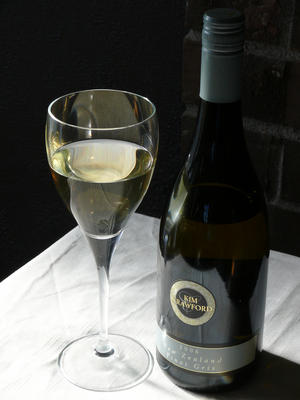
Kim Crawford 2006 Pinot Gris


About James Flewellen

Dr James Flewellen is a biophysicist at the University of Oxford. James learned his trade in taste through the Oxford Blind Wine Tasting Society, of which he was the President from 2010-2012. During his term, he represented Oxford at many international blind tasting competitions – twice winning the prestigious ‘Top Taster’ Award in the annual Varsity blind tasting match against Cambridge University and captaining winning teams in competitions throughout Europe.

One of James’s goals is to clarify the complex and hard-to-navigate world of wine for both novice and experienced tasters. He applies his scientific training to wine education, illuminating concepts of taste, tannin and terroir in an approachable, entertaining manner. James runs wine education courses in Oxford through the Oxford Wine Academy and is completing the WSET Professional Diploma in Wine and Spirits. He is the regular wine writer for The Rambling Epicure and is the founder of The Oxford Wine Blog. He is also currently co-authoring The Concise Guide to Wine and Blind Tasting – a book surveying the wine regions of the world and how to blind taste.


Never miss a post
Name: 
Your email address:*
Please enter all required fields
Correct invalid entries

Switzerland: Brasserie Lipp Geneva: The Brasserie of all Brasseries

Published by Thursday, July 25, 2013 Permalink 0


//

Switzerland: Brasserie Lipp Geneva: The Brasserie of all Brasseries

by Jonell Galloway

From the archives

The Brasserie Lipp in Geneva even tops the one in Paris. Some may say that’s not difficult to do in a sleepy, provincial town like Geneva, but it is not so simple as that.


It’s l’ensemble, the “package” with all its details, that makes it work to perfection: the top-notch French-style service, the professionalism, the decor, the reliability of the food, the atmosphere, its late opening hours, even on Sunday.

You can watch them in action on their site!

I love their site, which gives you a glimpse of all the qualities above through a short video.

Menu

The menu includes classic brasserie fare, such as choucroute, souris d’agneau confite or lamb’s shank – one of the tenderest parts of the lamb, steak with Béarnaise sauce, leeks ravigote and shellfish platters. They offer Gillardeau oysters as well as the usual selection of shellfish found in a brasserie. It is always impeccably fresh.


But unlike many brasseries, they also have a menu that changes with the seasons. It invariably offers an assortment of tartares, cold or hot soups, salads, and dishes that often have North African and Asian accents. One of my favorites that they have been doing for 3 or 4 winters, is the vegetarian couscous. It’s like no other couscous I’ve ever had, a modern, up-to-date “revision” that I never tire of.

Service

If you listen to their video, you’ll understand what I mean about the professionalism of the service. They will never get annoyed with you if you ask questions about the dishes or if you change your mind 3 times. They are old-fashioned, but in the good sense of the term. The servers are always polite and patient.

  • .
    Never miss a post
    Name: 
    Your email address:*
    Please enter all required fields
    Correct invalid entries

Food Art: Fig, Prosciutto & Gorgonzola Crostata, food photography by Meeta Khurana Wolff

Published by Wednesday, July 24, 2013 Permalink 0

See more food photo compositions at Meeta K. Wolff in our Food Art category.

Meeta K. Wolff’s Bio

Meeta Khurana Wolff is a freelance food photographer, stylist and writer, currently living in the culturally rich city of Weimar in Germany with her German husband and their 8-year-old son, where she enjoys preparing multicultural, home-cooked meals using fresh organic ingredients. When she is not styling, photographing or writing about food, Meeta loves to travel the world, exploring new cultures and capturing it all on camera. The unique mood that Meeta creates in her food photography is also found in her travel, still life and landscape photography.

Continue Reading…

Never miss a post
Name: 
Your email address:*
Please enter all required fields
Correct invalid entries

Simon Says: Daily Food Quote, July 24, 2013

Published by Wednesday, July 24, 2013 Permalink 0


//

Simon de Swaan, Simon Says, The Rambling Epicure, SwitzerlandSimon Says: Daily Food Quote, July 24, 2013

by Simon de Swaan

When our souls are happy, they talk about food.–Charles Simic

Dušan “Charles” Simić  is a Serbian-American poet and was co-poetry editor of The Paris Review. He is widely recognized as one of the most visceral and unique poets writing today, and his work has won numerous awards, including the Pulitzer Prize in 1990 for his prose poem “The World Doesn’t End:”

I am the last Napoleonic soldier. It’s almost two hundred years later and I am still retreating from Moscow. The road is lined with white birch trees and the mud comes up to my knees. The one-eyed woman wants to sell me a chicken, and I don’t even have any clothes on.

The Germans are going one way; I am going the other. The Russians are going still another way and waving good-by. I have a ceremonial saber. I use it to cut my hair, which is four feet long.

He also received the MacArthur Foundation “genius grant,” the Griffin International Poetry Prize, and, simultaneously, the Wallace Stevens Award and appointment as U.S. Poet Laureate.

___________________

Simon de Swaan is Food and Beverage Director at the Four Seasons hotel in New York City. He studied at the Culinary Institute of America and has an incredible collection of antique cookbooks and books about food and eating, from which he often posts interesting and unusual quotes. In his column Simon Says, he gives us daily food quotes from his tomes.


Never miss a post
Name: 
Your email address:*
Please enter all required fields
Correct invalid entries

Food Art: Italian Apricot Gelato, food photography by Giulia Scarpaleggia

Published by Wednesday, July 24, 2013 Permalink 0


//


We’d like to welcome Italian food photographer Guila Scarpaleggia, who runs the website Juls’ Kitchen, to The Rambling Epicure.

Guila Scarpaleggia’s Bio

My name is Giulia Scarpaleggia, I am an optimist, a dreamer, a 28 29 30 31 year old full-time herbs blogger. I am the one who appears in the reflections of the spoons in this blog’s photos and – I have to admit it – I am also responsible for the missing slices in each cake.

I live in Tuscany, in the countryside between Siena and Florence, I dream of a blooming vegetable garden, though I am content with a brick wall crammed with pots of fresh herbs and a February 2009 plant that suffers from the heat.

Continue Reading…

Never miss a post
Name: 
Your email address:*
Please enter all required fields
Correct invalid entries

Grandma’s Green Walnuts meet Nonna’s Nocino

Published by Wednesday, July 24, 2013 Permalink 0


//

Gareth Jones, food and travel writerGrandma’s Green Walnuts meet Nonna’s Nocino

by Gareth Jones

A tradition so richly experienced on the festival eve of San Giovanni, better known as “St. John’s,” in Spilamberto (near Modena – Emilia-Romagna) had me transported me back to innocent childhood days in Wales. Straying across the fields from the parental home I’d live more in my grandmother’s old cottage – hers was once an inn on a long forgotten village green and was built using the village stocks as a door lintel into her dining room. So the story goes, mature hardwood had been short for building and everything was saved – including timbers from broken ships, recognised even then by their Lloyd’s number carved or burnt into the side. Grandma had one of those too – and stirring tales of bravery at sea to go with it.

Around this time (end-June/early-July), yet knowing nothing then of the Saint’s Day, we would pick ‘green’ walnuts – green skinned and soft before their hard shells formed below the fleshy outer casing.

IMG_1083 - Copy (263x350)


These we would wash, dry and prick with a pin several times per nut. They would then be cooked in salted water, dried and let to cool before being set to cure in a vinegar sweetened with brown sugar – or perhaps it was molasses given the rich, dark colour. There are recipes going back through the ages – even Hannah Glasse in her The Art of Cookery wrote three. One each for ‘green’, ‘white’ and ‘black’ walnuts.

There would surely have been mace and nutmeg in Grandma’s recipe as there were her two favourite spices – she wore a whole nutmeg about her person, swearing it would ward off arthritis. At over 86 years when she died, arthritis was never one of her ailments.

Continue Reading…

Never miss a post
Name: 
Your email address:*
Please enter all required fields
Correct invalid entries

Bookings for Celebrate the Chartres Festival of Lights & Autumnal Equinox with a Food & Wine Tasting Masterclass

Published by Tuesday, July 23, 2013 Permalink 0

We are having technical difficulties with the booking system for the Chartres Festival of Lights & Autumnal Equinox with a Food & Wine Tasting Masterclass. If you want to reserve, simply click on the Paypal button at the top right of  the sidebar to pay by Paypal, or the  blue Contact Us button at the top right of the home page to pay by bank transfer. We’ll send you all the necessary details. Sorry for the inconvenience!


Chartres Cathedral Lighted, creative common license, photographer unknown


Never miss a post
Name: 
Your email address:*
Please enter all required fields
Correct invalid entries

Culinary Chemistry: The Truth about Soy Sauce and Gluten Content

Published by Tuesday, July 23, 2013 Permalink 0

Food writer, Culinary Chemistry, The Rambling Epicure

Culinary Chemistry: The Truth about Soy Sauce and Gluten Content

by Jenn Oliver

From the archives

Soy Sauce and Umami: Now a Staple in Western Cuisine

Soy sauce has been around as a staple condiment in Asian cuisine for thousands of years, used for flavoring all manner of dishes and foods. It’s prized for the “umami” character it gives to the overall taste of a dish, and can have a wide range of subtle notes beyond the obvious saltiness.


For example, Japanese tamari is often wheat free (I stress, not always). Still, most of the soy sauces available on store shelves contain wheat. While there is some debate as to exactly how much gluten from wheat survives the fermentation and processing, the Celiac Disease Foundation Foundation does list soy sauce as a food that may contain gluten and needs to be verified. The Mayo Clinic also states that soy sauce should be avoided unless otherwise labeled. There is also considerable anecdotal evidence of experiences of people being “glutened” by soy sauce (my husband included). Therefore, for those who must eat gluten free, soy sauce immediately becomes a food that requires attention and is a complicated topic.

Continue Reading…

Never miss a post
Name: 
Your email address:*
Please enter all required fields
Correct invalid entries

Green Leafy Foods Can be Dangerous to Your Health

Published by Saturday, July 20, 2013 Permalink 0

//

The Rambling Epicure, Editor, Jonell Galloway, food writer.

Green Leafy Foods Can be Dangerous to Your Health

From the archives

by Jonell Galloway

The Huffington Post says Americans have reason for their eternal, but ever-changing, plate fright. In the US, E. Coli, Salmonella, Norovirus and numerous other bacteria and viruses are found in food more often that we might think.

Peppery pourpier from the Lake Geneva region.

The Center for Science in the Public Interest (CSPI), a non-profit, consumer advocacy group, often referred to as the “American food police”, says the leafy greens we are encouraged to eat every day can in fact be the most dangerous of all vegetables. Over the last 20 years, there has been some 363 outbreaks and 13,568 illnesses due to green leafy foods alone.

According to Dr. Steve Swanson of the U.S. Centers for Disease Control, lettuce is only second to ground or minced beef in cases of E. Coli. Snopes gives a good explanation of how all this happens, and many suggest that we lay off pre-washed, bagged salads until more is know about exactly how greens are contaminated.

One thing is almost sure: one of the reasons salad is particularly more high risk than other vegetables is that we most often eat it raw. So wash your salad, and then wash it again. Don’t just spray it. Wash it in a basin or sink, and change the water several times.

The other high risk food is eggs, numbering 352 outbreaks in the US in the last 20 years, with 11,163 cases of illness reported.

If we want to make a “top ten” list, the other culprits, in order, are tuna, oysters, potatoes, cheese, ice cream, tomatoes, sprouts and berries.

Continue Reading…

Never miss a post
Name: 
Your email address:*
Please enter all required fields
Correct invalid entries

Elements of Wine 1: Acidity

Published by Friday, July 19, 2013 Permalink 0


James Flewellen photo, wine tasting expert, The Art of Tasting Wine: James FlewellenElements of Wine 1: Acidity

by James Flewellen

Acid in wine, photo by http://www.google.fr/imgres?client=firefox-a&sa=X&rls=org.mozilla:en-US:official&biw=1280&bih=527&tbm=isch&tbnid=0zJCNLOa8IHTHM:&imgrefurl=http://www.winesandwinemaking.com/acidity_wine.php&docid=lU-Yh-q_nn94CM&imgurl=http://www.winesandwinemaking.com/images/wine_acid.jpg&w=300&h=240&ei=la7pUYacEo7E4gSelYHYBA&zoom=1&iact=hc&vpx=768&vpy=131&dur=2051&hovh=192&hovw=240&tx=72&ty=94&page=1&tbnh=145&tbnw=178&start=0&ndsp=20&ved=1t:429,r:5,s:0,i:97 (CC)


Naturally occurring acids are present in all fruits. The major acids found in grapes are malic and tartaric. When the grape juice is fermented to become wine, these acids survive the fermentation process to end up in the bottle you’re about to open.

Acidity in wine plays a very important role in the overall structural harmony of the drink. Acid is required to balance residual sugar and alcohol. It also cuts through oils and fats present in food, providing the ideal palate cleanser between mouthfuls. An ideal wine will have a balanced acidity. Too much acid and the wine can be unpleasantly tart or sharp tasting; too little and it can taste ‘flabby’ or not as refreshing as it should.

Acids in Wine, photo by http://www.google.fr/imgres?client=firefox-a&hs=dae&sa=X&rls=org.mozilla:en-US:official&biw=1280&bih=527&tbm=isch&tbnid=m1IjwTmnK6CrlM:&imgrefurl=http://www.internationalwineguild.com/ask-iwg-acidity-and-organic-pairings&docid=foKo3uUC8dXDiM&imgurl=http://www.internationalwineguild.com/uploads/Image/AcidsinWine.jpg&w=669&h=1000&ei=f7LpUavBI-Sg4gTb9ICoBw&zoom=1&iact=hc&vpx=1057&vpy=4&dur=12309&hovh=275&hovw=184&tx=133&ty=143&page=1&tbnh=143&tbnw=103&start=0&ndsp=21&ved=1t:429,r:20,s:0,i:145 (CC)


The way in which we perceive acidity varies according to a number of factors. Different grape varieties will have different concentrations of acids, thus can taste more or less ‘acidic’. The climatic conditions throughout the growing season are also important – insufficient warmth or sunlight will mean the acids in the grapes do not ‘soften’ enough before harvest and the resulting wine may be tart and unpleasant. Other organic chemicals in the wine will also influence how we perceive acidity. Two wines may have the same pH, yet a wine with residual sugar that masks the immediate effect of the acid will come across as less acidic initially.

English: Diagram of the wine grape berry.

Diagram of the wine grape berry.


Practices in the winery can also change the acidity in the final wine from that we might expect in the initial grape juice. Malic acid can be converted to lactic acid, which comes across as a ‘softer’ acid on the palate, through a malolactic conversion by certain species of bacteria. Most red wines undergo a malolactic conversion (sometimes called a ‘fermentation’, though this is not strictly correct), which is why red wines often taste softer than whites.

In general we can register acidity by a tingling sensation on the sides of our tongue. Another approach is the ‘saliva response test’ – how quickly saliva returns to our mouth immediately after spitting or swallowing the wine. This can give us clues as to the grape variety, the growing conditions and the sorts of food the wine might pair well with.


Join James Flewellen and Jonell Galloway at “Celebrate the Chartres Festival of Lights & Autumnal Equinox with a Food & Wine Tasting Masterclass” in France from September 19 to 22, 2013.

_________________________

Dr James Flewellen is a biophysicist at the University of Oxford. James learned his trade in taste through the Oxford Blind Wine Tasting Society, of which he was the President from 2010-2012. During his term, he represented Oxford at many international blind tasting competitions – twice winning the prestigious ‘Top Taster’ Award in the annual Varsity blind tasting match against Cambridge University and captaining winning teams in competitions throughout Europe.

One of James’s goals is to clarify the complex and hard-to-navigate world of wine for both novice and experienced tasters. He applies his scientific training to wine education, illuminating concepts of taste, tannin and terroir in an approachable, entertaining manner. James runs wine education courses in Oxford through the Oxford Wine Academy and is completing the WSET Professional Diploma in Wine and Spirits. He is the regular wine writer for The Rambling Epicure and is the founder of The Oxford Wine Blog. He is also currently co-authoring The Concise Guide to Wine and Blind Tasting – a book surveying the wine regions of the world and how to blind taste.


Never miss a post
Name: 
Your email address:*
Please enter all required fields
Correct invalid entries

UA-21892701-1