Food Art: White Chocolate & Speculoos Mousse, food photography by Meeta Khurana Wolff

Published by Wednesday, June 12, 2013 Permalink 0

Food Art: White Chocolate & Speculoos Mousse, food photography by Meeta Khurana Wolff

See more food photo compositions at Meeta K. Wolff or in our Food Art category.

Bio of Meeta Khurana Wolff

Meeta, that’s my name given to me by my dad. I was born back in the summer of 1972, one beautiful day in Bombay, India. I was practically delivered in a hotel. That’s where my father has worked for most of his life and it’s what injected the hotelier’s blood into my veins. This hotel lifestyle enabled me to travel the world, get close to many cultures, learn a few languages, and experience many great adventures.

Knowing only a hotel life, I decided to follow my dad’s footsteps and studied Hotel Management, specializing in Marketing and Guest Relations. I trained in one of the finest luxury hotels of this world in Doha, Qatar. That is when a tiny spark for food was ignited in my soul.

I now have settled down in Germany, with the two men I adore, Tom, my loving partner for almost 10 years, and Soeren my adorable son of 5 6 7 years.

Hotels are not a part of my life in Germany. After graduating I came to Germany and worked in an advertising firm, an architecture and design firm and a couple of software firms. Don’t ask how that came about – it just happened. Glad it did too because along this path I bumped into and fell in love with Tom.

We are now in Weimar and you’ll laugh when I tell you this my traveling feet have begun to itch again! Let’s see where life takes us.

I love photography, always have, but it was with the start of this blog that I discovered the world of Foodography. Since then the passion for photography I developed has taken a complete new angle and opened so many exciting doors. I try to capture shots that speak a thousand words, that makes one feel as if they were a part of the scene and experience the photo with their senses. You tell me if I am succeeding!

You can see more of Meeta’s work at What’s For Lunch Honey.


Never miss a post
Name: 
Your email address:*
Please enter all required fields
Correct invalid entries

Food Quote: Nelson Mandela on Food

Published by Wednesday, June 12, 2013 Permalink 0

by Jonell Galloway

Nelson Mandela on Food

I was not born with a hunger to be free. I was born free. Free in every way that I could know. Free to run in the fields near my mother’s hut, free to swim in the clear stream that ran through my village, free to roast mealies [corn] under the stars … It was only when I learnt that my boyhood freedom was an illusion … that I began to hunger for it.–Nelson Mandela

Photo courtesy of The Guardian

has provided “the backdrop and occasionally the primary cause for momentous personal and political events in the life of Nelson Mandela.” In his autobiography, he took an innovative approach to history and showed that a great man’s life can be measured out in mouthfuls, both bitter and sweet. With this title, the reader can cook and taste Nelson Mandela’s journey from the corn grinding stone of his boyhood through wedding cakes and curries to prison hunger strikes, presidential banquets and ultimately into a dotage marked by the sweetest of just desserts. Tales told in sandwiches, sugar and samoosas speak eloquently of intellectual awakenings, emotional longings and always the struggle for racial equality. He was always motivated by hunger, either longing for food he couldn’t have, or depriving himself of food in the name of freedom.

“Only the truly food obsessed would read such a statement and consider the stomach from whence it came, but I did and the result is a gastro-political biography entitled Hunger for Freedom, the story of food in the life of Nelson Mandela,” he told Ana Trapedo of The Guardian.

When in prison, he wrote to former wife Winnie: “How I long for amasi (traditional South African fermented milk), thick and sour! You know darling there is one respect in which I dwarf all my contemporaries or at least about which I can confidently claim to be second to none – healthy appetite,” he told Trapedo.


Never miss a post
Name: 
Your email address:*
Please enter all required fields
Correct invalid entries

Outdoor Activities in English in Switzerland

Published by Monday, June 10, 2013 Permalink 0

Outdoor Activities in English in Switzerland

lavaux vineyards, bike outing with Fraiche Air, photo by Know It All at http://www.knowitall.ch/index.php?option=com_content&view=article&id=1072&catid=293&Itemid=398, Switerzland in English

Yvette Evers grew up camping, hiking and skiing in the Swiss Alps. A Canadian with Dutch roots, her career in international development allowed her to explore mountain areas around the world. Since moving to the Geneva area in 2009 with her husband and two teenage daughters, she also works as a sustainability consultant specializing in tourism. She refers to her work as “slow tourism,” says Know It All.

Yvette is the founder of fraiche air, an outdoor club that fills a gap in the market for global locals who are looking for information about outdoor recreation and tourism in English. The outings in small groups provide a wonderful opportunity to discover new outdoor activities and join an active community of like-minded athletic friends – power walks, hiking, snowshoeing, ski-touring, and family days.

Here’s a recent outing: Slow tourism along the Lavaux vineyard terraces. The first vines in Lavaux were planted in the 12th century, according to Know It All. The area between Lausanne and Vevey is now a UNESCO World Heritage site with stunning views of the Alps and Lac Léman, referred to as Lake Geneva in English.

FraicheAir is located in Geneva. For more information, look on their website at http://www.fraicheair.ch/ or call them at  (+41) 79 904 46 22. Visit their Facebook page at http://www.facebook.com/FraicheAir.


Never miss a post
Name: 
Your email address:*
Please enter all required fields
Correct invalid entries

Food Quote: The Tragedy of the Absence of Hunger, by Amélie Nothomb

Published by Sunday, June 9, 2013 Permalink 0

Food Quote: The Tragedy of the Absence of Hunger, by Amélie Nothomb

We have yet to focus on the tragedy that the absence of hunger causes.–Amélie Nothomb, The Life of Hunger, 2006

L’absence de faim est un drame sur lequel nul ne s’est penché.–Amélie Nothomb, La biographie de la faim, 2006


Amélie Nothomb was born in Japan in 1967 to Belgian diplomats. She has had long periods of anorexia, which she swears to have conquered, and truly knows the feeling of hunger.

Her eccentric, complex personality, behavior and dress have made her somewhat of an icon on the French-language literature scene. She publishes one novel every fall in September, drinks champagne while she works, always wears a tall black hat similar to a witch’s hat, and only sleeps four hours a day.


Never miss a post
Name: 
Your email address:*
Please enter all required fields
Correct invalid entries

Club Prosper Montagné’s List of Top Restaurants and Food Shops in Geneva, Switzerland

Published by Saturday, June 8, 2013 Permalink 0

Club Prosper Montagné’s List of Top Restaurants and Food Shops in Geneva, Switzerland

The Club Prosper Montagné’s list of the top restaurants and food shops in Geneva is in alphabetical order. There is no point system, so I’ll list them in the same way.


More Cookbooks than Sense describes Prosper Montagné as follows: “…Prosper Montagné, best described as the Thomas Keller of his day. Along with his (slightly older) contemporary Auguste Escoffier, he was one of the superstars of fin de siecle gastronomy. While not quite as revolutionary as the Big E (think of Escoffier as the Ferran Adria of the age), Montagne was no slouch, cooking his way around some of the biggest kitchens in France, notably the venerable Pavillon Ledoyen (currently Christian Le Squer’s three-star lair).

“Anyhow to cut a long story short, after many decades behind the range Montagne decided to kick back a little and starting writing books. This culminated in the 1938 publication of Larousse Gastronomique, co-authored with a Dr Gottschalk and published by Larousse, leading purveyors of encyclopedias and other doorstops.

“What Escoffier did for French cookery in practice, Montagne did for French cookery in print. Larousse was a staggering confection of history, dishes and recipes. The heart of the book is its coverage of French cuisine – from humble to haute. Montagne systematically went through every French region, dish, and garnish in the classic repertoire. He also provides pen-pictures of famous chefs and personalities, and added articles on history and on many notable ingredients (guess what, foie gras and truffles have some of the longest entries).”

Continue Reading…

Never miss a post
Name: 
Your email address:*
Please enter all required fields
Correct invalid entries

Food Art: The Incredible Sensuality of Lemons and Pomegranates, painting by Gerard van Honsthorst

Published by Thursday, June 6, 2013 Permalink 1


Gerard van Honsthorst was born in Utrecht in the Netherlands in 1590, the son of a textile painter and tapestry cartoonist. Like many Dutch painters of his day, he studied in Italy, where he became known as Gherardo delle Notti, or “Gerard of the Night Scenes,” because his figures often depicted dark figures in the night.

Van Honsthorst was apprenticed to Abraham Bloemaert, the most celebrated master in Utrecht, with whom he probably made the trip to Italy between 1610 and 1615. During his stay in Italy, Van Honthorst was influenced by Caravaggio, who was at his height. He copied his technique and spread it in the Netherlands. His school is referred to as the Utrecht caravaggists.

The main body of his work consists of commissions for religious paintings, many from his Italian period, such as The Beheading of St. John the Baptist (S. Maria delle Scala, Rome), Christ Before the High Priest (c. 1617, National Gallery, London), and the Supper Party (1620, Uffizi, Florence), all nocturnal scenes.

Van Honsthorst was appointed dean of the Utrecht painter’s guild in 1625 and remained in office for many years. Van Honthorst’s fame soon spread, and in 1628 he was invited to work in London at the court of King Charles I, but returned in less than a year.

He married Sophia Coopmans in 1622 and died a rich man in 1656.


Never miss a post
Name: 
Your email address:*
Please enter all required fields
Correct invalid entries

Food Art: Polpo / Octopus, food photography by Alessandro Boscolo Agostoni

Published by Wednesday, June 5, 2013 Permalink 0

This photo appears in Alessandro’s ongoing exhibit, Italian Food Rambling, on this site.


Bio of Alessandro Boscolo Agostini

Bilingual English/Italiano

My first love for photography started with a little theft: as a little boy I stole my father’s Vöiglander and I started taking pictures on my own, just using my instinct. At that time my father’s camera seemed to me the best camera possible in the whole world, until I reached junior high school and I gave it up for a Bencini all my own. But my little theft came all back to me; my girlfriend to whom I had lent my camera never gave it back to me: that can be considered petty theft, no?

Growing up, I robbed again: in high school I stole time I might have devoted to photography and dedicated myself to my other passion, music. I studied drums and played jazz music. But it was just an infatuation, because I went back to my first love and never left it again. And as a pledge of love, I gave up my history studies in college, causing great distress to many people, but not to myself.

Continue Reading…

Never miss a post
Name: 
Your email address:*
Please enter all required fields
Correct invalid entries

Switzerland: Geneva Restaurant Suggestions

Published by Sunday, June 2, 2013 Permalink 0


//


by

Jardins de Brunswick (in front of Le Richemond), rue Adémar-Fabri 7, 1201 Geneva. +41 022 731 60 16. Open 07H15 to 22H00 Mon. thru Wed, 07H15 to 24H00 Thurs. and Fri., and 10H00 to 24h00 on Saturday. Closed Sundays. info@cottagecafe.ch, www.cottagecafe.ch

When you have to meet someone near the quai du Mont-Blanc or in the Pâquis neighborhood, this is a great stopoff if you don’t have the pocketbook for the more upscale Richemond and Beau-Rivage venues right behind it. Plus, it is in a beautiful setting, right smack in the middle of the Brunswick gardens.

It’s nice in both summer and winter. The terrace is spectacular, of course, and you even get glimpses of jet d’eau from time time. Inside, it’s cozy and funky.

Breakfast includes birchermuësli, homemade jams and freshly squeezed juices. They have a daily lunch menu, serve pastries in the afternoon, and tapas starting at 18h00.

There is a selection of good quality local wines by the glass or bottle, along with some wines from other places.

Quirinale

Rue de la Rôtisserie 6, 1204 Geneva. +41 022 748 48 48

I’ve only had the truffle pizza, which is the house specialty, but I have been dreaming of it ever since.

Emmanuel de Savoie is part owner I hear.

Great central location, chic and full of jetsetters, and a little pricey if you eat a 3-course meal with wine. They do have lunch specials however, and that truffle pizza . . .

La Terrazza

Route de Florissant 51, 1206 Geneva. +41 022 345 56 00. Open for lunch and dinner. Closed Saturday and Sunday.

I discovered this almost hidden Swiss-style café-restaurant many years ago on my treks back and forth to the Beaulieu clinique.

Mr. Borella started as waiter at the Lion d’Or during its golden age. He later set out on his own and has been in this same location for about 25 years. Mrs. Borella cooks and Mr. Borella serves. They are from the Dolomites, so they cook hardy, traditional dishes, as well as some well turned-out Swiss classics.

The price is about as right as you can get, and they buy all their ingredients from local producers. The tomatoes taste like tomatoes and the salads, well they come straight from Chapuis.

Nologo Restaurant

Rue de Fribourg 11, 1201 Geneva. +41 022 901 03 33. Open Mon. thru Fri. lunch and dinner, Sat. dinner only. Closed Sundays. resto@nologo.ch, www.nologo.ch

This is Japanese food like you eat in Japan, not adapted for Western tastes. Wonderful mixtures of unusual flavors and ingredients like you’d never find in your regular, standardized-menu sushi bars.

Don’t count on them being friendly, just think about what’s on your plate. Tiny space so reserve well ahead.

Never miss a post
Name: 
Your email address:*
Please enter all required fields
Correct invalid entries

Apollonia Poilâne and the Making of the Paris Poilâne Bread “Empire”

Published by Saturday, June 1, 2013 Permalink 0

by Jonell Galloway

Did the French Bread Revolution start with Poilâne Bread?

The familiar French word for friend, “copain,” means “to share bread with each other.”–Apollonia Poilâne, now head of the Poilâne bread “empire”

A humble baker called Pierre Poilâne started a bakery on the rue du Cherche-Midi in Paris in 1932. The 6th arrondissement was not a chic neighborhood at the time; penniless artists lived there, and often paid Poilâne in paintings. We might ask, did the French Bread Revolution start here at 8 rue du Cherche-Midi?

Poilâne used stoneground, unprocessed, whole-grain flour and sourdough starter, baking his bread in a wood oven — then unheard of in Paris, the capital of the baguette. It was unfashionable to eat anything other than white bread. This way of thinking was further reinforced by WWII, during which the French had no choice but to eat heavy, dark bread. He continued making it nonetheless, says France Today, and today, Apollonia Poilâne, Pierre’s granddaughter, runs the bakery.

Until 2007, she studied at Harvard and ran the bakery at the same time, having her personal supply of bread sent to her every week in Boston.

Note the elegant “P” carved into the top of each loaf.


This now-classic Poilâne loaf has a hard, crusty outside and a firm, dense crumb on the inside. It can keep be eaten fresh for up to 5 days after baking, after which it can be toasted.
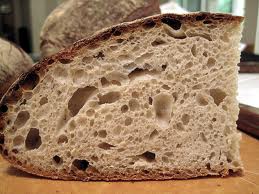
Inside Pain Poilane bread creative common license http://www.thefreshloaf.com/keyword/pointeacalliere


Pain Poilâne or miche, meaning “round loaf,” weighs in at around 2 kg / 4.4 lb. The recipe is secret, and it is not a whole-grain bread in the traditional sense of the word. Environmentally correct, pesticide-free varieties of wheat are grown and stored. They are then stone-ground, thus preserving the wheat germ. Stone grinding makes it possible to eliminate any coarse bran that might contain impurities.

Poilâne flour is what is called in French farine biseor wheatmeal — a brown flour intermediate between white flour and wholemeal flour — which maintains a higher nutritional value than white flour. Levain or sourdough starter and salt from the salterns of Guérande, a swamp of salt water in Brittany.

Pierre brought this type of bread with him from his native Normandy, where loaves were large and round, in the style of what the French now call “country bread.” Today, it is distributed all over the world.
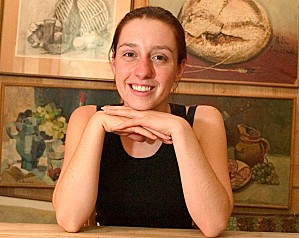
Apollonia Poilâne, current owner of Poilâne bread bakeries


Pierre’s sons Lionel and Max took over the bakery in 1970. Just like Apollonia, they had learned bread baking by working right alongside their father, and continued the tradition of the original round loaf marked with the signature “P.” They eventually took separate paths, with Lionel keeping the original bakery started by his father, and Max going off on his own to start a bakery under his own name, Max Poilâne. In Paris, people have long discussions over which of the brothers makes/made the better bread, since both have continued to bake their father’s signature recipe.

Lionel Poilâne is better known outside France, since he grew the original family business, making it into an international name. This growth was made possible by his excellent teaching skills and his embracing of modern developments in the industry, such as the use of machine kneading, while at the same time maintaining his father’s philosophy of each baker following and taking responsibility for his or her loaves from start to finish. He referred to his concept as “retro-innovation.”

Lionel and his wife died when their helicopter, piloted by Lionel, crashed in 2002, leaving behind daughters Athena and Apollonia, the latter who is now following in her father’s footsteps. She started running the bakery on graduation from high school.

In this video, Martha Stewart visits the Poilâne bakery in Paris and learns about the bread making process in an interview with 22-year-old Apollonia Poilâne when she was still at Harvard. Click here to watch the video interview of Apollonia by Martha Stewart herself.


Martha Stewart

The offiical Poilâne site lists a number of recipes, for making and using some of the Poilâne bread and pastries.


Poilâne Bakeries

8 rue du Cherche-Midi, Paris 6th arrondissement
Tel. +33 (0) 1 45 48 42 59
 
49 bld de Grenelle, Paris 15th arrondissement
Tel. +33 (0) 1 45 79 11 49
Open on Sundays
 
38 rue Debelleyme, Paris 3rd arrondissement
Tel. +33 (0) 1 44 61 83 39
Open on Sundays
 
46 Elizabeth Street, London SW1W
Tel. +44 (0) 207 808 4910


To read more about the French Bread Revolution, see also (bilingual in French and English):

The Revolution of French Bread Baking (part 1), by Jean-Philippe de Tonnac

The Revolution of French Bread Baking (part 2), by Jean-Philippe de Tonnac

Book Review: Jean-Philippe de Tonnac’s “Dictionnaire Universel du Pain” or Universal Dictionary of Bread, by Jean-Philippe de Tonnac

The 7 Lives of Bread: Pascal Auriac, master bread baker in Laguiole, a hidden corner of France, by Jean-Philippe de Tonnac

Never miss a post
Name: 
Your email address:*
Please enter all required fields
Correct invalid entries

Daily Food Quote: Mahatma Gandhi on Food and God

Published by Friday, May 31, 2013 Permalink 0

by Jonell Galloway

To a man with an empty stomach food is God.–Mahatma Gandhi

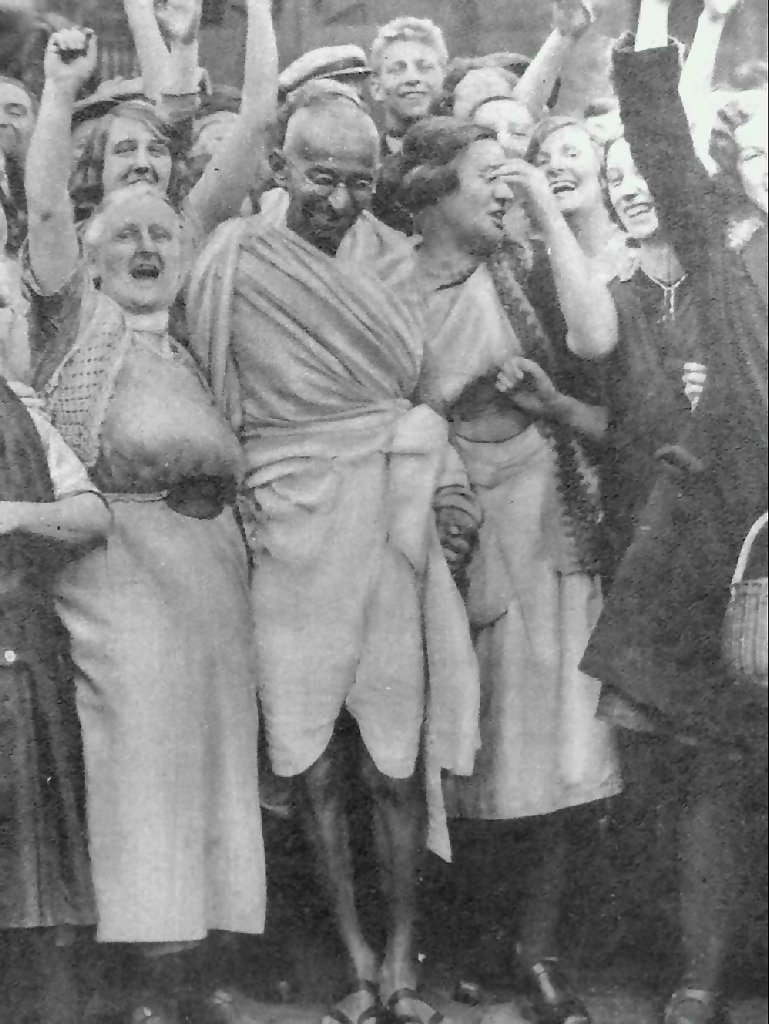
Mahatma Gandhi with textile workers at Darwen,...

Mahatma Gandhi with textile workers at Darwen, Lancashire, England, September 26, 1931.


Mohandas Karamchand Gandhi, more commonly known as “Mahatma Gandhi,” was born on October 2, 1869, in Porbandar, India. He studied law and became a defender of Indian rights both in India and South Africa, where he lived and worked for some 20 years. His method of opposing British rule and treatment was through mass non-violent civil disobedience, which has made him a model for peaceful revolution around the world.

Gandhi believed in living a simple life. He wove and made his own clothes, was a vegetarian and used traditional Indian fasts both for self-purification and protests against British discriminatory legislation against Indians. His philosophy of life and political “action” remain a beacon of hope for oppressed people around the world.


Never miss a post
Name: 
Your email address:*
Please enter all required fields
Correct invalid entries

UA-21892701-1