Related articles
|
|

A Literary Culinary Journal
 by Jonell Galloway
Native Kentuckian from Maysville, Bill Sanders has spent a lifetime training his taste buds and nose. A graduate of the University of Kentucky, Sanders went on to study law at Salmon P. Chase College of Law in Cincinnati, Ohio, embellishing his résumé with other studies of quite a different nature: sensory evaluation of olive oil and professional wine studies at Culinary Institute of America.

Sanders started Crush and Press in January 2009, financing it through a Kickstarter campaign to which I gladly donated. The olive oil quickly took off, and has already received mention as “one of the best olive oils in the world.” This olive oil, Sanders Fresh Press, received the mention.
Congratulations, fellow Kentuckian!
|
|

by Leonor White
I discovered Tocqueville last New Year’s Eve, and it’s been my go-to place ever since when special people come to town. My latest visit to this understated yet elegant Union Square New American-French restaurant with a French flare and amiable, well-trained servers brought rave “reviews” from the entire table.

Seven days a week, the restaurant offers an excellent value prix fixe menu ($29). The menu consists of three courses — appetizer, main course and dessert — as well as an amuse-bouche and interesting housemade bread à go-go. In the evening, Tocqueville offers a pre-theatre menu at $44, as well as a full à la carte menu. We went for Saturday lunch, when the restaurant was unusually uncrowded, so we sat on the ground floor from where we could enjoy a view of the restaurant’s refined décor. The dining room was pleasantly quiet with tables set widely apart and well-designed acoustics, allowing us to concentrate on the marvelous food and have good conversation too.
As mentioned, the prix fixe offers three courses, with two choices per course. From the appetizers, everyone tried both offerings, the “creamless sunchoke soup” and the “salad with mushroom terrine”; both dishes were flawless, the flavors bold but balanced. Prior to our appetizer arriving, we were served an excellent “roasted asparagus and beets” amuse-bouche, a great start to our culinary adventure. Throughout the lunch we were also able to enjoy an assortment of homemade bread, namely, brioche, focaccia filled with olive chunks, and crusty, white sourdough with homemade butter (you heard me right, homemade).
|
|
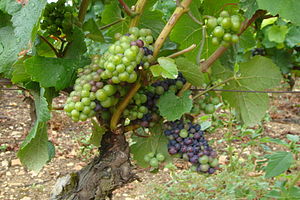
Pinot Noir is a light-skinned red grape originating from Burgundy in its modern form. Although, the Burgundians have been working with Pinot for around a thousand years, so the term ‘modern’ should be taken with a grain of salt!
The grape typically produces light-bodied wines with aromas ranging from fresh red fruit (raspberry, strawberry, cherry) to black (blackberry, mulberry) depending on the local climate of the vineyard. Warmer sites tend to produce wines with ‘blacker’ and riper fruit flavours. Alongside the fruit, good Pinot exhibits a fresh minerally, or even pleasantly ‘grassy’ character – complemented by the grape’s naturally high acidity on the palate. With bottle maturation, the wine develops notes of mushroom and decaying autumnal leaves — expressed evocatively by the French term sous-bois — which translates as ‘forest floor’. The thin skins of the grapes mean that the wines are generally low in tannin, though tannins are usually very fine-grained and punctuate the wine sufficiently so it can be enjoyed with food.
Pinot Noir is a notoriously fickle grape and is very difficult to handle. Burgundy’s millennium of association with Pinot Noir means that it produces the best in the world — and that the Burgundian clones of the grape are ideally suited to Burgundy’s continental climate. Explaining Burgundy’s appellation system would take an entire post of its own, but there are two main subregions for Pinot Noir there: Côte de Beaune and Côte de Nuits. These are further divided into villages, which may be further identified by vineyard — and these can be classified as either Premier Cru or Grand Cru indicating the quality level of the grapes.
|
|

1. Do you remember the moment when you became interested in food?
I was just five years old and my grandma finally trusted me to help make the bread. Each grain was so precious and I was as focused in the kitchen then as I am now!
I remember making bread with my mother and the respect she taught me for the whole process of growing and cooking nutritious food for the family. Simple, natural food was the standard at home. We were so poor that a small piece of hard, crusty bread with a bowl of lentil soup was a luxury. We grew almost all of our food on our property and only went into town to buy flour.
2. Who influenced you most and did they teach you about cooking and food?
Ferran Adria taught me to give my brain and my hands the freedom to create magical dishes. At el Bulli, we practiced the “art of doing” and everything Ferran has achieved came from hard work; none of his innovations was accomplished by accident.
3. Do you think with your taste buds?
I feel with them…my hands, eyes, heart and soul all have taste buds!
4. Where did you start your culinary studies (a little history)?
My first technical training was at Culinary School in Rotterdam, but I’d been butchering, foraging, harvesting, processing and cooking daily since early childhood. Food has always been my way of life.
5. At what point did you become interested in molecular cuisine?
I was working in Rotterdam when I started reading about Grant Achatz and Ferran Adria. I set my intention to do my next training with them, and although I knew it would be next to impossible, I worked every day to make it happen. I dreamed of making crazy sexy food and these two chefs introduced me to a new paradigm of creativity, using science and technology in the kitchen.
6. There are those who say molecular cuisine is unhealthy. What are your thoughts on this?
Food can be prepared in so many ways. For me, it’s unhealthy to eat packaged and processed foods without regard for where they originate or what additives they contain. Molecular gastronomy is an experimental way of cooking, but master chefs use only the highest quality organic ingredients and utilize technology just to present the best of each product to the guest. This modern style of cooking really boils down to a measure of creativity, not health. The so-called “chemicals” used are very common, benign food-safe chemicals and only trace amounts are used. What worries me are all the “natural” blueberry products that contain absolutely no blueberries, just Modified Corn Starch, High Fructose Corn Syrup, Partially Hydrogenated Soybean Oil, Red #40, Blue #1 and Blue #2!
7. You often talk about your dreams and how you are in the process of making them into reality. You seem to have already realized many of your dreams. Which ones do you still have left to fulfill?
I haven’t even started, but I have just a few humble dreams. I would love to be able to offer a perfectly ripe heirloom tomato to every child in the world who’s never had the chance to taste something so vital and naturally delicious. I would also love to stop big multinational companies from mass-producing horrible GMO foods.
I dream of making “clean” food available for everyone, but for that to happen people have to take an active interest and demand to know how their food is made. People will pay so much for a pair of shoes, a car or a handbag, and then they give so little thought and attention to the most important thing in their life, which actually becomes a part of their body, FOOD !!
8. You once told me you’d always been a nomad, even with your parents. Can you talk to us a little about that?
My soul was born free and I remain a free spirit, home for me is everywhere. I live simply and make my home anywhere I am. I learn from people and I always need new people around me. I need to see, feel and experience in order to understand the world in which I live. I’m from the Atlas in Morocco and I grew up between there and San Sebastian. I feel so fortunate for the unique mix of cultures I was exposed to throughout my life; it was just amazing.
9. You’ve done internships with many famous chefs I believe? Can you tell us about your adventures?
Each of them gave me all I needed to become the best chef I could be. Grant Achatz made me believe that I was not crazy with my focus and intensity in the kitchen. Rene Redzepi made me believe that yes, I can create elegant, interesting dishes with just the products I had around in nature. I already knew that deep inside, but it was great to see it in the context of a three-star Michelin setting. Thomas Keller taught me that I was correct in having an insane sense of urgency, and being determined to execute perfection for each guest. And Ferran Adria gave me the chance to free my mind. I don’t have rules and regulations in my brain, only freedom. Everything I can visualize in my brain I can bring to life with my food. Once I’ve seen it in my brain, I just need to find the way to make it happen! That is the magic of creativity, freedom and hard work.
Another thing I achieved with Ferran Adria was to completely kill my ego. That’s perhaps the most special lesson he imparts on his chefs (we call them Los Chicos del Bulli – The Boys of el Bulli, most of whom started very young and spent over 20 years working side-by-side with him). These boys, now men, create magic with food and carry the “World’s Best” title, but they have absolutely no ego and nothing to prove; they simply are who they are…chefs.
Najat Kaanache
http://www.najatkaanache.com
The Pilgrim Chef at http://elbulli-arco.blogspot.com
Facebook: http://www.facebook.com/NajatKaanache%20″
Twitter: @ThePilgrimChef http://twitter.com/#%21/ThePilgrimChef
|
|

|
|

“What is of note, is the survival of the arts within the walled ghetto. John Hersey’s masterpiece novel, The Wall, based on actual diaries (Emanuel Ringelblum), show the arts being practiced; theatre and music and fine art within a ghetto atmosphere mortified by repetitive eve of destruction. The record left by ghetto dwellers, camp internees, and displaced persons create snapshots of life and death under Hitler. Inmate drawings and paintings were legitimate articulations of man’s inhumanity and cruelty,” says Dave in Art of Insurrection and Resurrection.
|
|
par Julien Darmon
Click here for English.
Extrait du Dictionnaire Universel du Pain, publié par Bouquins, Robert Laffont

L’obligation de s’abstenir de hamets (pâte levée) durant la fête de Pessah, et donc de consommer uniquement de la matsah (azymes), trouve son explication dans Deutéronome xvi, 3 : « Un pain de pauvreté [‘oni] car tu es sorti en hâte d’Égypte », qu’on interprète généralement comme « la pâte n’a pas eu le temps de lever ». Quelle est cette « hâte » dont il est fait mention ici ? En effet, en Exode xii, 11, cette hâte fait l’objet d’un ordre : « Vous mangerez [le sacrifice pascal] en hâte », tandis qu’en Deutéronome xvi, 3, il s’agit d’une justification : « Tu ne mangeras pas [ce sacrifice pascal] avec du hamets, pendant sept jours tu mangeras des matsot, pain de pauvreté, car tu es sorti en hâte de la terre d’Égypte… » Or, en fait de hâte, voici comment les choses se sont déroulées au moment de la Sortie d’Égypte (xii). Le premier jour du mois de Nissan, Dieu dit à Moïse et à Aaron : « Ce mois sera pour eux le premier des mois […] Les Hébreux feront le sacrifice pascal et mangeront des azymes […] Dès le 10 du mois, ils réserveront un agneau, qu’ils sacrifieront le 14… Durant la nuit suivante, au milieu de la nuit, Dieu frappera tous les premiers-nés […] Alors les Hébreux sortiront d’Égypte. » Donc, depuis au moins le 10 du mois, si ce n’est depuis le 1er ou le 2, tous les Hébreux sont au courant qu’il va falloir manger des azymes dans la nuit du 14 au 15 (qu’on appelle la « nuit du 15 »), et durant les sept jours qui suivent. Donc, les premiers azymes de Pâque ne sont pas des pains qui, à cause du manque de temps, n’ont pas eu le temps de lever, mais des pains qu’on n’a pas laissé lever, délibérément.
|
|
“The 1914 Faberge Mosaic Egg is one of four Faberge eggs among the Tsar Nicholas II of Britain’s Queen Elizabeth ll. Four jewel-encrusted Easter eggs dominate a lavish display of works by Russian Imperial jeweler Carl Faberge that went on public show in Buckingham Palace on Friday. The four eggs, three of which were commissioned by Tsar Nicholas II and are among only 50 Imperial Eggs ever made, are included in 300 Faberge works from the Royal Collection” in London. Click here to read more.

Photo by POOL/KIRSTY WIGGLESWORTH ALL RIGHTS RESERVED (C)
|
|
 Meet Jonell Galloway, a freelance writer and editor specialized in French cuisine.