Simon Says: February 3, 2011

Published by Thursday, February 3, 2011 Permalink 0

by Simon de Swaan and Argentine Cookery

Half of all Argentine desserts would disappear if dulce de leche [caramel spread] did not exist.  When abroad, Argentine people who have no dulce de leche, suffer the syndrome of abstinence and all those who go abroad, take dulce de leche in their luggage. Dulce de leche is the national obsession.–Argentine Cookery, Monica Hoss de le Comte, 2000

Never miss a post
Name: 
Your email address:*
Please enter all required fields
Correct invalid entries

On the Chocolate Trail: Yes, there are chocolate spies, but I am not one of them

Published by Thursday, February 3, 2011 Permalink 0

by Christina Daub


I am seventeen, in Zurich waiting for a train to Kilchberg, a welcome break from the grinding German language drills that march me through my summer mornings. Kilchberg, literal translation: mountain of freshwater whitefish and the site of Thomas Mann’s grave, but these could be not be further from my mind.

I am going on my first chocolate factory tour, the Lindt Swiss chocolate factory, where you can sample the goods and I can hardly breathe.

Continue Reading…

Never miss a post
Name: 
Your email address:*
Please enter all required fields
Correct invalid entries

A Video: Why Meryl Streep Was Inspired to Play Julia Child

Published by Thursday, February 3, 2011 Permalink 0

by Jonell Galloway

“Julie and Julia” was by no means one of my favorite food movies. Julie was of such a banality, lost in life with no purpose that made any sense, compared to Julia Child, who when she lacked something to do in Paris, set off on a mission that was to last the rest of her life. In this short video, Meryl Streep describes why she was inspired to make the movie. She really was the perfect choice, and I listen to excerpts of Streep’s performance over and over for inspiration.

Meryl Streep’s Julia Child Inspiration

Never miss a post
Name: 
Your email address:*
Please enter all required fields
Correct invalid entries

Simon Says: February 2, 2011

Published by Wednesday, February 2, 2011 Permalink 0

by Simon de Swaan and Jonell Galloway

To gulp a mouthful of soft, warm red wine, and then to lean forward and slice a fragrant chip of meat from the brown, bubbling carcass in front of you, dunk it in the fierce sauce of vinegar, garlic, and red pepper, and then stuff it, nut-sweet and juicy, into your mouth, seemed one of the most satisfying actions of my life.–Gerald Durrell, The Whispering Land, 1961

Gerald Durrell, brother of the noted author Lawrence Durrell, was foremost a zoologist interested in protecting wildlife. His brother Lawrence once suggested that he write books in order to earn money to support his numerous wildlife causes, which motivated him to write The Overloaded Ark, followed by The Bafut Beagles and Three Singles to Adventure. All were successful enough to allow him to continue writing up until his death in 1995, all for the sole means of supporting his animal protection causes, chiefly through the Durrell Wildlife Conservation Trust.

Continue Reading…

Never miss a post
Name: 
Your email address:*
Please enter all required fields
Correct invalid entries

David Downie: World’s Best Tortellini in Paris?

Published by Wednesday, February 2, 2011 Permalink 0

by Pellegrino Artusi’

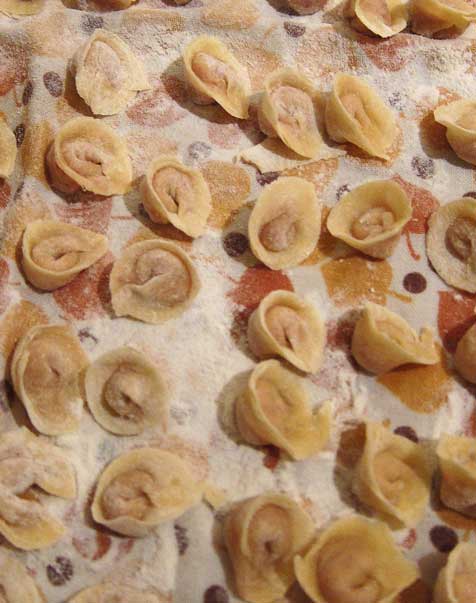
The other night, for our collective birthdays – three of us – our dear friend Daniela X (she is modest and does not wish to be identified) made classic tortellini alla bolognese in brodo. Anyone who has been to Bologna, Parma, Modena or the other great-eating-cities in the Emilia region, will know the authentic item.

Tortellini are a variety of navel-sized (and shaped) filled pasta — see the photo of Daniela’s tortellini, courtesy Kimmo Pasanen. They’re cooked in a sumptuous broth made from several types of meat (usually chicken or capon, veal, and, optionally, cotechino), and served in the broth, period. Purists don’t even sprinkle them with grated Parmigiano. But that may be going too far.

Continue Reading…

Never miss a post
Name: 
Your email address:*
Please enter all required fields
Correct invalid entries

The 7 Lives of Bread: Recipe for Bread by the Sweat of Their Brow

Published by Wednesday, February 2, 2011 Permalink 0

by Jean-Philippe de Tonnac

Translated and adapted by Diane Castiglioni

Discriminating bread lovers and sensitive natures, please abstain.

Photo: A Crow sweat lodge, photo from Museum of the American Indian.

The activity of kneading several pounds of bread dough, before the introduction of mixing machines, brought about a condition not unlike what the Lakota Sioux undergo in their I-ni-pi ceremonies, what is commonly called a “sweat lodge.” Theirs is an act of ceremony honoring the link with the Great Creator, and inside this veritable oven, the participant performs his metanoia (μετάνοια) by ritually “crying the tears of the body.” One offers this water in a manner to allow that which is within to be given back to Mother Earth.

Continue Reading…

Never miss a post
Name: 
Your email address:*
Please enter all required fields
Correct invalid entries

Germy Stuff Cooks and Diners Should be Aware Of

Published by Wednesday, February 2, 2011 Permalink 0

contributed by Louise McGee Cook

This article appeared on Shine from Yahoo, and is from the Editors of Prevention. This material is not original material belonging to The Rambling Epicure and we do not take credit for it. We are passing it along as information for the good of the public.


You touch germy stuff all day. In fact, the average adult comes in contact with as many as 30 objects within a minute, including germ-harboring, high-traffic surfaces such as light switches, doorknobs, phone receivers, and the remote control. While most of us are aware that these surfaces aren’t bastions of sanitation (and why we wash our hands accordingly) there are, unfortunately, places many of us visit regularly where germs abound. Here, 7 of the most common, and how you can stay (mostly) germ-free.

Continue Reading…

Never miss a post
Name: 
Your email address:*
Please enter all required fields
Correct invalid entries

Recipes: Wild Woman on Feral Acres: Pantry Meals: Bounty from a Dormant Garden

Published by Wednesday, February 2, 2011 Permalink 0

by Esmaa Self

We often think of fall as a good time to prepare meals from the garden, but those with a pantry filled with last season’s bounty will recognize the bitter days of a northern hemisphere February as a great time to dish up homemade soup.

As I write this, much of America is experiencing extreme winter weather. Our local forecast calls for a low of -21° F. So you may well imagine how hunkered down is the farm today. But isn’t this the sort of weather we plan for when we plant, tend, harvest and preserve the bounty from our gardens? Indeed, a pantry filled with homegrown goodness can assuage the sting of an ice storm.

Here are a couple of bone-warming recipes that make good use of a pantry stocked with home-grown foods. If you have no such thing, consider this an invitation to get into the gardening game.

Continue Reading…

Never miss a post
Name: 
Your email address:*
Please enter all required fields
Correct invalid entries

Switzerland: Art of Writing Afternoon Tea Workshops at Le Richmond hotel, Geneva

Published by Tuesday, February 1, 2011 Permalink 0

by Jonell Galloway

Happening/Event: Geneva, Switzerland

ART OF WRITING AFTERNOON TEA WORKSHOP

Starting Saturday, 12 February 2011, from 3 p.m. to 6 p.m.

Discover and develop your creativity with words and enjoy an afternoon’s revelry of easy refinement with a delightful Afternoon High Tea at The Lounge at Le Richemond.  The legendary Le Richemond introduces a series of The Art of Writing workshops inspired by the French author Colette who penned the Blue Lantern at the hotel from 1946-1947.

The workshops are taught by Susan Tiberghien, an American writer living in Switzerland who has published three memoirs and most recently a handbook on writing. The Art of Writing workshops are open to everyone who is looking to awaken their creative voice and sharpen their writing skills.

The workshops will be conducted in English, with French translation as necessary. Guests of all ages from teens to adults are invited to attend and enjoy a traditional afternoon high tea complete with finger sandwiches, scones, homemade pastries and a selection of tea, coffee or hot chocolate.

Continue Reading…

Never miss a post
Name: 
Your email address:*
Please enter all required fields
Correct invalid entries

Simon Says: Daily Food Quote, February 1, 2011

Published by Tuesday, February 1, 2011 Permalink 0

by Jonell Galloway and Simon de Swaan

There is no love sincerer than the love of food.–George Bernard Shaw

George Bernard Shaw was born in Dublin, Ireland, on July 26, 1856, and died on November 2, 1950. Although of the landed Irish gentry, his father failed at both being a civil servant and working as a grain merchant. The family lived in genteel poverty, and Shaw’s education was irregular, also due to his dislike of any organized training, and ended at the age of 16. Shaw did however develop a broad knowledge of music, art, and literature, thanks to his mother’s strong cultural influence and many visits to the National Gallery of Ireland.

Continue Reading…

Never miss a post
Name: 
Your email address:*
Please enter all required fields
Correct invalid entries

UA-21892701-1