Based in Switzerland and France
Skype telephone number: 1-270-859-1112
Skype name: jonell.galloway.white
E-mail: jonell@theramblingepicure.com
Professional History and Experience
I started my culinary career in Paris in the early 80s. At the Sorbonne, where I studied French, I asked for special authorization to write my thesis on the history of French cuisine, which was, exceptionally, granted. I later studied at both the Cordon Bleu and La Varenne, and studied wine in various locations all over France, including Steven Spurrier’s Académie du Vin, often associated with the 1976 Judgment of Paris, and at CAVE S.A. in Switzerland. While in France, I developed and taught a method, Spontaneous Cuisine, a market-based derivation of classic French cuisine; was a contributing editor for the English version of GaultMillau for France, wrote freelance for Paris Voice, and worked as a food translator and interpreter. My articles are available on TheRamblingEpicure.com, 10Best.com/USAToday, GenevaLunch.com, Travora.com, TheRamblingEpicure.tumblr.com, in the Paris Voice archives, as well as those of CityGuide Paris and Gayot Publications for France.
I recently collaborated with Jean-Philippe de Tonnac on Le tour du monde en 80 pains / Around the World with 80 Breads, a bilingual French-English book published by Orphie in Paris. I also collaborated on a review of the life work of contemporary Swiss sculptor André Raboud for Edipresse in Lausanne. I am currently producing an American-adapted version of Christophe Certain’s book Ma Cuisine Méditerranéenne, which I will call Small Plates of the Mediterranean in English.
After moving to Switzerland in 2003, I didn’t work for 7 years. I have recently dedicated myself to a “literary” food website. The Rambling Epicure joins the voices and visions of professional writers and photographers from around the world who promote a mindful, responsible approach to real food shopping, cooking, and eating, as well as wine tasting and pairing, food politics, safety, history, art, literature and philosophy. I invite you to browse the site to see the depth and professionalism of the coverage. http://theramblingepicure.com/
A few years ago, I opened a farm-to-table with my sisters in my hometown of Hardinsburg, Kentucky, where we used local agricultural products and organic ingredients.
I am fluent in English (native tongue), French and Spanish, with rudimentary Italian and Portuguese. Having a scientific background, I thrive on investigative journalism and writing that requires in-depth research and documentation.
I currently divide my time between Switzerland and France, where I have a 1,000-year-old house in Chartres.
“I dislike the thought that some animal has been made miserable to feed me. If I am going to eat meat, I want it to be from an animal that has lived a pleasant, uncrowded life outdoors, on bountiful pasture, with good water nearby and trees for shade.” (What Are People For?)
“Eating is an agricultural act.” (What Are People for Essays By Wendell Berry)
The passive American consumer, sitting down to a meal of pre-prepared food, confronts inert, anonymous substances that have been processed, dyed, breaded, sauced, gravied, ground, pulped, strained, blended, prettified, and sanitized beyond resemblance to any part of any creature that ever lived. The products of nature and agriculture have been made, to all appearances, the products of industry. Both eater and eaten are thus in exile from biological reality.
Eating with the fullest pleasure – pleasure, that is, that does not depend on ignorance – is perhaps the profoundest enactment of our connection with the world. In this pleasure we experience our dependence and our gratitude, for we are living in a mystery, from creatures we did not make and powers we cannot comprehend.” “A person who undertakes to grow a garden at home, by practices that will preserve rather than exploit the economy of the soil, has his mind precisely against what is wrong with us… What I am saying is that if we apply our minds directly and competently to the needs of the earth, then we will have begun to make fundamental and necessary changes in our minds. We will begin to understand and to mistrust and to change our wasteful economy, which markets not just the produce of earth, but also the earth’s ability to produce.
But even in the much-publicized rebellion of the young against the materialism of the affluent society, the consumer mentality is too often still intact: the standards of behavior are still those of kind and quantity, the security sought is still the security of numbers, and the chief motive is still the consumer’s anxiety that he is missing out on what is “in.” In this state of total consumerism – which is to say a state of helpless dependence on things and services and ideas and motives that we have forgotten how to provide ourselves – all meaningful contact between ourselves and the earth is broken. We do not understand the earth in terms either of what it offers us or of what it requires of us, and I think it is the rule that people inevitably destroy what they do not understand.” (pg. 85, “Think Little“) (The Art of the Commonplace: The Agrarian Essays of Wendell Berry)
Eduardo Amorim / Foter / CC BY-NC-SA
“Odd as I am sure it will appear to some, I can think of no better form of personal involvement in the cure of the environment than that of gardening. A person who is growing a garden, if he is growing it organically, is improving a piece of the world. He is producing something to eat, which makes him somewhat independent of the grocery business, but he is also enlarging, for himself, the meaning of food and the pleasure of eating. (pg. 88, “Think Little”) (The Art of the Commonplace: The Agrarian Essays of Wendell Berry)
“…the care of the earth is our most ancient and most worthy and, after all, our most pleasing responsibility. To cherish what remains of it, and to foster its renewal, is our only legitimate hope.” (The Art of the Commonplace: The Agrarian Essays of Wendell Berry)
“The Satisfactions of the Mad Farmer…the quiet in the woods of a summer morning, the voice of a pewee passing through it like a tight silver wire; …” (The Collected Poems of Wendell Berry, 1957-1982)
“If we apply our minds directly and competently to the needs of the earth, then we will have begun to make fundamental and necessary changes in our minds. We will begin to understand and to mistrust and to change our wasteful economy, which markets not just the produce of the earth, but also the earth’s ability to produce. We will see that beauty and utility are alike dependent upon the health of the world. But we will also see through the fads and the fashions of protest. We will see that war and oppression and pollution are not separate issues, but are aspects of the same issue. Amid the outcries for the liberation of this group or that, we will know that no person is free except in the freedom of other persons, and that man’s only real freedom is to know and faithfully occupy his place – a much humbler place than we have been taught to think – in the order of creation. (pg.89, “Think Little”)” (The Art of the Commonplace: The Agrarian Essays of Wendell Berry)
“He imagines a necessary joy in things that must fly to eat.”
“Until we understand what the land is, we are at odds with everything we touch. And to come to that understanding it is necessary, even now, to leave the regions of our conquest – the cleared fields, the towns and cities, the highways – and re-enter the woods. For only there can a man encounter the silence and the darkness of his own absence. Only in this silence and darkness can he recover the sense of the world’s longevity, of its ability to thrive without him, of his inferiority to it and his dependence on it. Perhaps then, having heard that silence and seen that darkness, he will grow humble before the place and begin to take it in – to learn from it what it is. As its sounds come into his hearing, and its lights and colors come into his vision, and its odors come into his nostrils, then he may come into its presence as he never has before, and he will arrive in his place and will want to remain. His life will grow out of the ground like the other lives of the place, and take its place among them. He will be with them – neither ignorant of them, nor indifferent to them, nor against them – and so at last he will grow to be native-born. That is, he must reenter the silence and the darkness, and be born again. (pg. 27, “A Native Hill”)” (The Art of the Commonplace: The Agrarian Essays of Wendell Berry)
Please choose a color:
About Jonell Galloway
Jonell Galloway grew up on Wendell Berry and food straight from a backyard Kentucky garden. She is a freelance writer. She attended Le Cordon Bleu and La Varenne cooking schools in Paris and the Académie du Vin, worked for the GaultMillau restaurant guide and CityGuides in France and Paris and for Gannett Company in the U.S., and collaborated on Le tour du monde en 80 pains / Around the World with 80 Breads with Jean-Philippe de Tonnac in France; André Raboud, Sculptures 2002-2009 in Switzerland; Ma Cuisine Méditerranéenne with Christophe Certain in France, At the Table: Food and Family around the World with Ken Albala, and a biography of French chef Pierre Gagnaire. She ran a cooking school in France, and owned a farm-to-table restaurant, The Three Sisters’ Café, with her two sisters in the U.S. She organizes the Taste Unlocked bespoke food and wine tasting awareness workshops with James Flewellen, is an active member of Slow Food, and runs the food writing website The Rambling Epicure. Her work has been published in numerous international publications and she has been interviewed on international public radio in France, Switzerland, and the U.S. She has just signed on at In Search of Taste, a British print publication, and is now working on a book, What to Eat in Venice
Related articles
Wendell Berry: No technological fix to climate change
SandeeA is our latest food photography discovery. A woman of many talents, she is also author of the Food Play column. She writes in both English and Spanish. SandeeA runs a popular food blog in Spain, La Receta de la Felicidad.
Sandeea is our latest food photography discovery. A woman of many talents, she is also author of the Food Play column. She writes in both English and Spanish. She develops playful recipes, and is an excellent food stylist and photographer. She runs the site La Receta de la Felicitad. She writes in Spanish and English.
For the second post in this mini series on fermentation, let’s get into the “why” of fermentation.
Cultures from all over the world have fermented a food or drink. The principle reason has been to preserve their harvest. Over the winter months, fermented vegetables last and provide a source of calories, nutrients, and an accompaniment to the endless plates of what I imagine were sausage, jerky, smoked meat, and potatoes.
A 3 -litre jar of salsa, ready to start fermenting.
I like to imagine what the first aspiring fermenters thought when they heaped their extra produce into a large mound in a dark, warm, covered area, poured brine over top (or not), and – fully aware that vegetables rot – left it to stew before digging in with their hands. “Let’s see what this tastes like! Sort of sour but…”
I have found in my world travels that one of the highlights for revealing the secrets of the local culture when in a new destination is to go to the neighborhood supermarket. Even if you don’t need anything, this visit is a must everywhere. It’s fascinating.
Even if you don’t know what some things are, it’s amazing to observe the different presentation of goods as well as the packaging, transaction techniques and social behaviors in the store. Switzerland is particularly interesting because the country has four national languages (German, French, Italian and Romansch, which is an ancient Latin language). With various cultural backgrounds in different regions, you will find different food items available, but many products are, by law, labeled in at least 3 languages. The Swiss German supermarkets’ food items are quite different from those you find in the French speaking region (called “Suisse Romande” or “Romandie” in French), even if it’s the same store chain.
Swiss sweets: photo courtesy of Ivan Mlinaric
Feeling the need for a quick snack after walking around (or mostly up and down) in the clean Swiss Alpine air? Can’t wait for the later-than-you’re-used-to Swiss dinner hour? Then head for the nearest supermarket where you will find the locals snacking away. Sometimes there are benches inside and outside the supermarket door just for this purpose! This is not to say that there is not a wonderful choice of restaurants in Switzerland. Au contraire! But as a business traveler like me, you may find yourself hungry at odd times and lunch service is usually over at 2:00 p.m. Dinner does not usualy start until 7:00 p.m. in French-speaking Switzerland and 5 p.m. in German-speaking Switzerland, or later if your Swiss friends live on Lake Geneva and are très chic. There are exceptions. The reason behind this afternoon restaurant closure is that most waiters, chefs and owners work split shifts and need a break before dinner service.
Mediterranean Food Connection: Frita, or Sweet Pepper & Tomato Compote
Recipe translated from the French and adapted by Jonell Galloway (from the archives)
Original recipe by Christophe Certain
Cliquez ici pour la version française
Mediterranean countries each have their own version of sweet pepper and tomato compote. In France, they call it piperade. The Pieds-Noirs — French colonials born in Algeria — call their version of this Mediterranean classic “frita”. Unlike piperade, frita contains no garlic.
Frita is a wonderful thing to have in the fridge, because it can be used in many ways. You can eat it warm as a starter, or cold as a starter. It’s a perfect dish to make ahead for those dinner parties where you’re short on time.
You can also use frita to make bruschetta, or use it as a pizza topping or to make empanadas. If it’s still warm in the pan, you can put eggs on it, cover it and cook over low heat until the eggs are poached.
Algerians often eat frita as a side dish with merguez sausage or grilled meat and fish, such as grilled meat on a skewer or tuna à la plancha.
To make a pizza: Put a layer of frita on a pizza crust. Sprinkle with grated cheese, anchovies in oil and black olives. Bake at 450° to 500° F / 250° C until crust is cooked and well browned.
Recipe
Click here for metric-Imperial recipe conversions.
Ingredients
400 g crushed tomatoes (fresh or canned) 3 red and green bell peppers 3 onions 1 lump of sugar 2 to 3 tablespoons olive oil Salt and pepper to taste
Instructions
Cut onions and peppers into think slices.
Heat olive oil in heavy frying pan. Add onions and peppers.
Cook over low heat until onions start to brown.
Add tomatoes and sugar. Salt and pepper to taste.
Simmer over low heat for about 30 minutes, or until all the vegetables are soft and form a jam-like substance.
As mentioned in my previous post on alcohol in wine, sugars accumulate in grapes as they ripen. At harvest time, grapes have a level of what is termed ‘potential alcohol’, that is the alcoholic strength of the future wine should all sugar in it be fermented to alcohol by the action of yeast cells. However, in some cases not all the sugar is fermented, leaving what is termed ‘residual sugar’ in the wine and a noticeable sweetness on the palate.
There are a number of ways to obtain sweetness in wine. The fermentation may be stopped deliberately, perhaps through addition of sulphur dioxide, which kills yeast, or through passing the wine through a membrane filter to remove the yeasts. This results in a wine of lower alcoholic strength and some residual sugar. A classic example is Riesling from the Mosel in Germany, which typically has 7-9% abv (Alcohol By Volume) and varying levels of sweetness depending on the initial level of ripeness of the grapes.
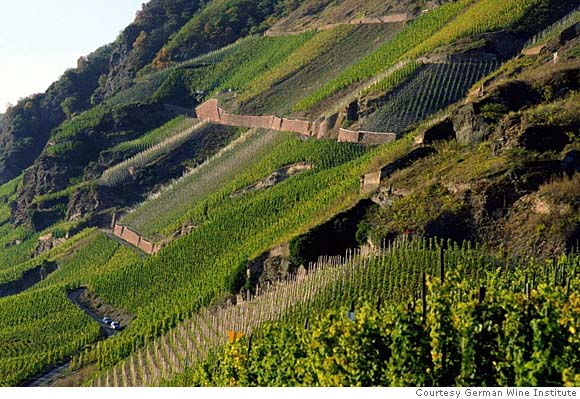
Steep vineyards of the Mosel vineyards in Germany
In other cases, there may be too much sugar for the yeast to convert it all to alcohol. Somewhere around 13-15% abv yeast stops being able to effectively ferment sugar to alcohol and naturally dies off. Super-ripe grapes will thus result in a wine with relatively high levels of alcohol and some residual sweetness. This sweetness can be quite subtle, or it can be syrupy and luscious – as found in dessert wines, which have very high concentrations of sugar in the harvested fruit.
Tasting sugar in wine is a difficult process. We can usually tell if something is ‘moderately sweet’; however it’s very hard to estimate the sweetness level in full-blown dessert wines. Wines with a little bit of residual sugar often have their sweetness masked by acidity and flavour compounds.
Sweetness in wine should be matched by a refreshing acidity for balance. This is especially true for dessert wines, which can come across as cloying without sufficient acidity. On the other hand, a touch of residual sugar, while not tasteable to most people, can give a welcome sense of roundness to a sharply acidic wine.
Dr James Flewellen is a biophysicist at the University of Oxford. James learned his trade in taste through the Oxford Blind Wine Tasting Society, of which he was the President from 2010-2012. During his term, he represented Oxford at many international blind tasting competitions – twice winning the prestigious ‘Top Taster’ Award in the annual Varsity blind tasting match against Cambridge University and captaining winning teams in competitions throughout Europe.
One of James’s goals is to clarify the complex and hard-to-navigate world of wine for both novice and experienced tasters. He applies his scientific training to wine education, illuminating concepts of taste, tannin and terroir in an approachable, entertaining manner. James runs wine education courses in Oxford through the The Oxford Wine Blog and is completing the WSET Professional Diploma in Wine and Spirits. He is the regular wine writer for The Rambling Epicure and is the founder of The Oxford Wine Blog. He is also currently co-authoring The Concise Guide to Wine and Blind Tasting – a book surveying the wine regions of the world and how to blind taste.
France: How Reducing Food Waste is Part of Fighting Hunger
An initiative on the part of the French Ministry of Agriculture creates a link between professionals from the agrifood sector and public charities with the aim of reducing food waste and fighting hunger. It is referred to as the French National Pact against Food Waste.
A practical example: the “donation market”
The “donation market” is an initiative from the French Ministry of Agriculture to create a link between professionals from the agrifood sector and public charities. This idea arose out of the fact that professionals and charitable associations both have difficulty finding contacts, and don’t have time to give away food for free or find donors, says the French government. This public Internet platform responds to these difficulties and is easy to implement. Donors propose the kind of donation they want to make as well as its conditions of use and its transportation on the platform itself. As soon as it is posted on the Internet, all potential “receivers” are alerted by e-mail and can accept it. Donors can propose either food, equipment, transportation or knowledge on the platform.
As well as helping connect people and fighting hunger, this platform is also a way of reducing food waste, as it encourages people to give food rather than to throw it away and to offer extra room in transportation, for example.
Origin of Food Waste and Means of Action
In their Agrimonde and Dualine projects, French researchers from CIRAD, the French Agricultural Research for Development, and INRA, the French National Institute for Agricultural Research, examined possible systems of production and supply to feed the world in 2050. According to them, feeding 9 billion people by 2050 is possible so long as we:
increase yield in a sustainable way
reduce waste from field to fork
manage to change our food habits
They insist on the fact that wasting food also means wasting the energy, soil and water used to produce it, and will in turn be used to destroy the waste. Researchers also make a distinction between food loss, which occurs during the early stage of production (just after the harvest, during the first storage, transport, and first transformation) and which mostly concerns poor countries, and food waste, which is due to consumption habits (at home, in restaurants) or mismanagement of storage in the retail sector. Food waste mostly concerns rich countries. Food waste and food loss of course require different solutions.
To reduce food waste by 50% before 2025, the European Commission has proposed guidelines to Member States:
to educate people
to encourage better labeling and packaging
to ask Member States to favor partnership with responsible catering companies
Examples are also provided, such as:
to produce a new “sell-by date” label
to encourage new sizes of packaging for better preservation of products
to teach children good practices for proper use of food
Key Data
In the European Union, food waste comes from:
42% from domestic use
39% from the food-industry
5% from retailers
14% from the catering sector
every individual wastes 394 lbs. per year
89 million metric tons of food are wasted each year in the 27 countries of the EU
To learn more about this subject, here is the French National Pact against Food Waste.
Based on press release from the French Ministry of Agriculture


 Jonell Galloway