Click here to keep up with the latest in world food and wine news.

Related articles
|
|

A Literary Culinary Journal
 by Jonell Galloway
Click to see the Tasting Week program for the entire country. Tasting week runs from 13 to 23 September 2012.
This year many of the events are sponsored by Savoring a week of ‘slow food’ across the country.

|
|
 by Rosa Mayland
INCREASE YOUR GASTRONOMIC EXPERIENCE BY EATING IN SYNC WITH THE SEASONS

With the arrival of hotter weather, I am thrilled that some of my favorite fruits are starting to grace (super)market stalls. They are so fabulous that I can never get enough of them. Not one week goes by without me making either pies, pastries, cakes, trifles, crumbles, clafoutis or cobblers in my itsy-bitsy apartment kitchen.
|
|
//

 by Renu Chhabra
Remember the tea kettle — it is always up to its neck in hot water, yet it still sings! ~Author Unknown

Last Saturday, I was invited to a fundraiser over Chat and Chai. A room full of lovely women, some dressed in Indian attire, were there to raise money for this noble cause in southern India. Colorful sarees and scarves were the stars of the show. They were displayed elegantly on a table for silent auction, creating a very exotic ambiance. A few guests were somewhat familiar with the Indian culture; whereas, others were inquisitive to learn about it. From food to draping of a saree, it was an enriching experience for many.
After viewing a short film about the cause, it was time to indulge in some Indian-inspired food — curried deviled eggs, lentil salad, tea sandwiches, and a variety of sweets and snacks. The table was full of mouth-watering choices, making it difficult to resist the temptation. Finding my way through this delicious spread was one big challenge. And I knew I wasn’t the only one facing this dilemma. Finally, a warm cup of fragrant chai completed the feast.
On my way back I kept thinking about mathri or mathi, a savory Indian snack. This salty and flaky cracker is laced with herbs and spices. Carom or nigella seeds add a flavorful punch, and black peppercorns give it a spicy bite. Traditionally, it is deep fried. The size and thickness can vary — large discs or bite size. It is a perfect tea-time snack paired with a cup of sweetened chai.

I have fond memories of making mathri with my great grandma. Sitting at the kitchen table, she used to flatten the dough balls with the heel of her palm. She did not use measurements, rolling pins, or fancy cutters. Just a pinch of this and a handful of that was the way to go for her. Her best tools were her hands to measure, knead, and flatten the dough — quite amazing. At the same time, the wisdom and stories that she shared while making this snack made the experience even more special. These are the moments most of us remember for years to come — rustic and soulful. And they linger in my memories as well, even decades later.
Inspired by my memories, I decided to make mathri today with a few of my own twists. Keeping them healthy, I used whole wheat pastry flour instead of regular white flour. Another detour from the original method was to bake them instead of frying – -a guilt-free indulgence. And they turned out quite delicious!
Click here for metric converter.
1. In a stand mixer with paddle attachment, add flour, baking powder, salt, nigella seeds, carom seeds, black pepper, and oil. Mix on low speed. Slowly add water to make firm dough.
2. If needed, bring the dough together with hands and knead to form a smooth ball. Cover with plastic wrap and set aside for 30 minutes. You can also make the dough in a food processor or by hand.


3. Line two baking sheets with parchment paper.
4. Roll the dough to 1/8 -inch thickness.
5. Cut the rolled dough into desired shapes.
6. Transfer them to the baking sheets, and prick with a fork.
7. Bake at 325° F for 20-25 minutes or until bottom is golden brown.
8. Re-roll the leftover dough and cut into shapes.
. 

9. Cool completely on a wire rack. Store in an airtight container.
10. Serve with a hot cup of chai.

Makes approximately 3-3 1/ 2 dozen small crackers.
Please follow my next post about chai.
|
|
Over more dinners with friends than I can remember, chocolate chip cookies have become synonymous with coming to my house. While my dorm neighbors were making tartiflettes and curries to plant little seeds of home in campus life, I was either making apple crumbles in a roasting pan, or trying to beat butter and sugar until fluffy with a wooden spoon. This is really not as sophisticated or even as homey as it sounds, considering that our 50-year-old kitchens had a decorating scheme typical of a detention centre, and faulty wiring that’s led the university to demolish the buildings. Still, the sentiment was there.

Neglecting the brownie, the chocolate chip cookie might be the greatest American delicacy that is almost untraceable on this side of the ocean — apart from some pretty pathetic, grey-looking supermarket things and the greasy mondo version from Millie’s Cookies branches in shopping centres. No matter which recipe I use, the chocolate chip cookie is one I’m asked for more than anything else by friends from all over the place (and is the main reason some called me “Monica” for being anal enough to write “226 grams of butter”).
In those beginning days in university halls, the oven was so temperamental that it was okay to make sweeping substitutions with whatever you had on hand, because you never knew what would come of it. (Seriously – there was always a poor and hungry Frenchie willing to vacuum up the disasters.) It wasn’t until I moved kitchens that I realized my “randomize” approach just wasn’t cutting it. I needed to test several recipes, and I needed to know which one was the best…and so began the Great Chocolate Chip Cookie Quest!

A chocolate-chip cookie.
One thing that stood out immediately was the small but obvious difference in taste and texture between the light brown sugars found in North America and the UK — an ingredient essential to the success of a good chocolate chip cookie recipe. Inspired by fellow expat David Lebovitz, I set about finding out the difference, and here’s what I found.
Disclaimer: I researched general processes — not those of specific companies — and I am no food scientist. The further I dug into the subject, the more I wanted to learn (and I’d heartily welcome any corrections).
3 TYPES OF COMMONLY USED BROWN SUGAR
To figure out what kind of product I’m actually trying to reproduce, I looked at light, dark, and muscovado (or “regular”) brown sugars. Light brown sugar consists of a small proportion of molasses at 3.5%; dark brown sugar at 6.5%; and muscovado sugar at nearer 10%.

Brown sugar examples: Muscovado (top), dark brown (left), golden brown (right).
SUGAR CANE vs. SUGAR BEETS
Sugar is made from a variety of plants, but most of the sugar that we reach for in the baking aisle comes from either sugarcane or sugar beets; which one you use is all about climate. Sugar cane grows exclusively in tropical climates like in Hawaii. Brazil and Indonesia, making it the main import in the US market. Sugar beet grows exclusively in “temperate” climates like parts of Russia, the American Midwest, and East Anglia in the UK, making it the standard in Britain and the surrounding European countries.
It seems that sugar beet in the UK has a greater consumer loyalty (than the non-loyalty of North Americans to a specific plant), due to sugar beet being viewed as a more “green, local, British” product. This is also true for the parts of the States that grow sugar beet, but because we’re a huge country with such varied climates, branding a ‘national’ sugar source presents some problems.

English: Sugar beet Sugar beet at Blue Barn Farm
Fun fact: it takes about 6-9 kg (or 4-6 bulbs) of sugar beet to produce a kilogram of refined white sugar, and about 8 kg (or 5-6 stalks) of sugar cane to produce a kilogram of brown sugar. (Brown and refined white sugars have surprisingly similar densities.)
Cane sugar is often touted as being more beneficial for health, due to its roots reaching further into the ground beyond topsoil that may have had many of its nutrients washed away. But this appears to be true only of unrefined — and not refined white — sugars. White sugars are refined by stripping all flavorful minerals and “impurities” from plant juice by centrifuging out the syrup by-products from the crystallized sugar, the only slight and indiscernible difference between cane and beet sugars being that during the treating and whitening of beet juice, a few more natural agents are used due to its different chemical composition. This difference in processing has absolutely no effect on the flavor and little effect on the natural composition of the final product in white sugars. (Recent studies have shown that it is possible to ‘fingerprint’ a beet or cane sugar particle and reveal trace elements leeched from the soil where it was produced, and lock down regional connections, but any elements found are in such small quantities that differences are pretty negligible to nutrition. Pretty cool, eh?)

Venezuelan sugar cane (Saccharum) harvested for processing.
But I’m getting sidetracked: the principal difference between cane and beet brown sugars is in the nature of the syrupy by-products from each plant.

English: Ox-wagons transporting harvested sugar cane to the sugar factory in the Netherlands.
In sugarcane processing, the molasses syrup that results from removing sugar after each stage of boiling can be categorized as either sulphured or unsulphured. Sulphur dioxide is added in the first case to preserve sugarcane which has been picked ‘young’, and unsulphured molasses is derived from fully mature stalks which have sun-ripened over 12-15 months. Regardless of whether sulphur dioxide has been added or not, the first boiling of juice yields ‘mild’ molasses and the second yields ‘dark’. ‘Blackstrap’ molasses is obtained from the third and final round of boiling, after which the proportion of sugar in the syrup is too small to be extracted economically. This makes blackstrap molasses the lowest in sugar content and the most rich in “impurities” (like B6, calcium, magnesium, potassium and iron). That’s why it’s promoted for good health, providing the most concentrated dosage of all of those minerals and accounting for up to 20% of their recommended daily amounts!
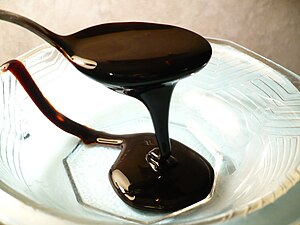
Refiners’ syrup, used widely in the commonwealth countries under the name golden syrup, is made by refining and filtering the pre-boil, concentrated cane juice through bone charcoal. It’s similar to molasses, but consists of only certain sugars and moisture – and does not include any of the minerals and other “impurities” in molasses that cause its distinct flavors.
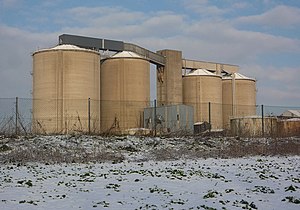
English: Old sugar beet factory A landmark on this side of Ipswich, in view from the A14 but seen here at close hand from the Gipping footpath.
On the other hand, sugar beet processing yields different results. Molasses can be produced from beet sugar, but it only appears after the second round of boiling (because of this, the first and second boils are called the ‘high’ and ‘low’ greens, or raws). Sugar beet molasses, obtained from the second or third boil, contains a lot of salts and compounds which don’t make it very tasty for humans, so it’s used predominantly in the production of cattle feed. In the Low Countries, sugar beet molasses is sold as “sirop de candi“, in a normal version branded as ‘sweet’ — due to a higher proportion of remaining sugars — and also the third boil, very dark version. Sirop de candi is used as an ingredient in traditional treats like speculoos biscuits (cookies), or as a topping for toast or waffles. Beet molasses is also used as a coating for road salt, due to its low melting point and de-icing properties (which actually ends up attracting deer to road networks in cold weather, but that’s a tangent for the transportation engineer in me!). Refiners’ syrup can also be made from beet sugars by a different process than that used to obtain it from cane.
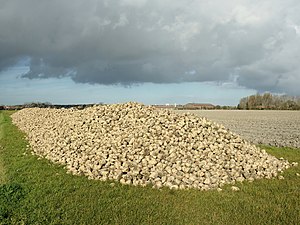
Sugar beet farm at Vlissegem, Belgium.
It’s important to note here that some of the products we know as molasses in North America (such as Grandma’s Own Original Molasses) are, in fact, reduced cane syrup: molasses which has been gently heated, but not boiled, and had none of its sugars removed. This is sometimes referred to as ‘high-test’ molasses, and is not a by-product of sugar production. As a result, what most people recognize as normal pantry molasses is much less bitter than black treacle here in the UK, which is a 50/50 mixture of blackstrap molasses and golden syrup. Bottom line: unless your North American recipe calls for ‘dark’ molasses, don’t use black treacle as a substitute and expect exact results!
THE BIG DIFFERENCE ACROSS THE POND
Essentially, all of this means that most standard brown sugars in the UK have to have the less palatable beet molasses completely extracted, and then add in ‘dark’ sugar cane molasses to the refined white beet sugars. (So that package of “British” brown sugar actually has a pretty large carbon footprint!) This alone doesn’t cause any variations — even most brown cane sugar producers totally refine their sugar and then re-add the extracted molasses, in order to control variations in the harvest and make a uniform product with a standard molasses content. It’s the processes commonly used for re-adding the cane molasses to either kind of white sugar which makes a difference. While the molasses added to the cane sugar is combined via a stage of re-boiling, the molasses added to beet sugar is always sprayed over the granules. This coating of the white sugar creates coarser and less saturated particles, and totally explains why North American light brown sugars are softer and more compactable than the relatively free-flowing light brown sugars in the UK — like the difference between slightly moist and just-drying sand.
So after all of that technical mumbo jumbo — now what? To make your own brown sugar at home, molasses can be re-added to white sugar at a recommended proportion of 1 tablespoon to 200 grams. But which grade of molasses to add is never mentioned! This is because the syrup that is said to be re-added into white sugars at the factory is always a blend of molasses and/or treacle varieties produced and sold differently to companies in different parts of the world. Whichever blend is used contributes to the different flavors found in every country.
Now that I’m itching for a factory tour, I want to reproduce this in my own kitchen. The homemade method means that the molasses content is roughly 7.5% if using the ‘blackstrap’ variety. Using my highly developed engineering skills, I calculated that in order to get a 3.5% molasses content, one tablespoon of molasses must be at around 60% sucrose content; dark second-boil molasses contains about 55% sucrose, as does black treacle. Like most things worth doing in baking, I might play mad scientist, go try some British-made cane sugars, or even make my own, and see what happens. All in the name of chocolate chip glory!
This post has previously appeared on Rowth an’ Scowth, where Melissa writes about baking and expatriation from Edinburgh, Scotland.
|
|

These photos are by SandeeA, author of the column Food Play, and who runs a site called La Receta de la Felicidad. SandeeA is never lacking ideas when it comes to playful, fun recipes. Click here to find the recipe for this Giant Oreo Cake. It would be a great recipe to get your kids in the kitchen!
|
|
by Jonell Galloway
Here’s a quick, unfiltered overview of the photos I took at the first Salon du Chocolat Zurich.


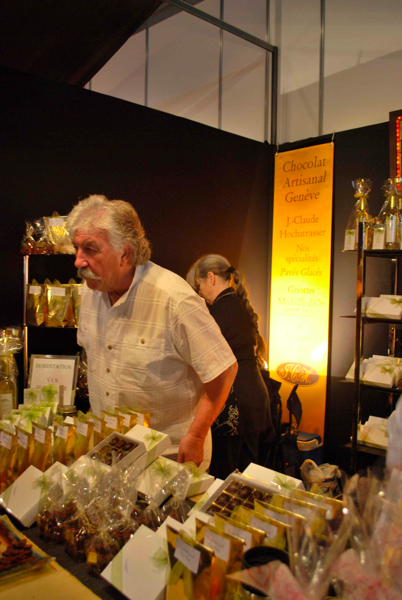


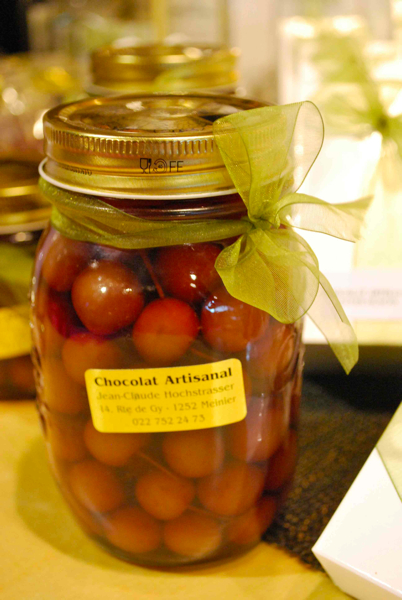












These are here to help you get an idea of what was on offer at the show. They are not professional photos, yet they are mine. If you want to use them commercially or copy them, please be so kind as to contact me beforehand by clicking on the blue Contact Us button at the top right of our home page.
I’ll be adding more tonight or tomorrow morning, so stay in touch!
|
|

Our ongoing series of tapas photos from our latest food artist discovery: food photographer Steve Homer of Sabor de Almería in the southeast of Spain.
|
|
 Meet Jonell Galloway, a freelance writer and editor specialized in French cuisine.


