French Food Quote: Daily Food Quote, August 18, 2011

Published by Thursday, August 18, 2011 Permalink 0

by Jonell Galloway

You don’t have to cook fancy or complicated masterpieces – just good food from fresh ingredients.–Julia Child (1912 – 2004)

Julia Child, (1912 – 2004), American cookbook writer, TV personality and tremendous contributor to the food world, introduced Americans to the techniques of French cooking with her classic book, Mastering the Art of French Cooking, Volumes I and II.

Julia Child brought French food to post-war America. When her husband Paul was posted to Paris, she studied at L’Ecole du Cordon Bleu, and went on to form her own cooking school with fellow students Simone Beck and Louisette Bertholle. The threesome went on to write the 2-volume classic Mastering the Art of French Cooking, which covered all the basic techniques and dishes of classic French cuisine.

Related articles
Never miss a post
Name: 
Your email address:*
Please enter all required fields
Correct invalid entries

Simon Says: Daily Food Quote, August 18, 2011

Published by Thursday, August 18, 2011 Permalink 0

by Simón de Swaan


We didn’t starve, but we didn’t eat chicken unless we were sick, or the chicken was.–Bernard Malamud (1914-1986)

_____________________

Bernard Malamud is considered one of the most prominent figures in Jewish-American literature, a movement that originated in the 1930s and is known for its tragicomic elements. Malamud’s stories and novels, in which reality and fantasy are frequently interlaced, have been compared to parables, myths, and allegories, and often illustrate the importance of moral obligation. Along with Saul Bellow and Philip Roth, he was one of the great American Jewish authors of the 20th century. His 1966 novel The Fixer, about anti-Semitism in Tsarist Russia, won both the National Book Award and the Pulitzer Prize for Fiction.

Never miss a post
Name: 
Your email address:*
Please enter all required fields
Correct invalid entries

Food Art: Brocade Swiss roll, food photography by SandeeA

Published by Thursday, August 18, 2011 Permalink 0

These photos are by SandeeA, author of the column Food Play, and who runs a site called La Receta de la Felicidad. SandeeA is never lacking ideas when it comes to playful, fun recipes. Click here to find the recipe for this Brocade Swiss Roll. It would be a great recipe for having some fun with your kids in the kitchen!


Never miss a post
Name: 
Your email address:*
Please enter all required fields
Correct invalid entries

Food News Daily: August 17, 2011

Published by Wednesday, August 17, 2011 Permalink 0

Mainstream Press

School Districts Rediscover Value of From-Scratch Meals, The New York Times
Why the Swiss Don’t Buy Swiss Cheese, Moneyland, Time
Consider chocolate, The Guardian
India Sues Monsanto Over Genetically-Modified Eggplant, Forbes
Why the Government Is Regulating Gluten-Free Foods, The Atlantic
One Man’s Blurry Quest to Cook Every Meal with Beer, BA Daily
Sex on a plate: in Paris, food and seduction are one and the same, The Telegraph

Best of the Anglo Food Blogs and Sites

Mexican Chocolate Pops Recipe, Leite’s Culinaria
{For Jennie & Mikey} Chocolate Peanut Butter Pie, Healthy-Delicious
Search – LocalHarvest, find local produce in your area by in U.S. by clicking on map
Yogurt Ice Pops with Berries Recipe, Leite’s Culinaria
Deliciously Rich Salted Caramel Ice Cream Recipe, Simply Stated

Alternative Press/Sites

2011 James Beard Foundation Leadership Awards – Sustainable Food Awards, The Daily Green
Best Farmers Markets – Big U.S. Farmers Markets, The Daily Green
The 10 (U.S.) Colleges With The Best Campus Food, Huffington Post

World

Masterchef India, playful Bollywood style
Sticky Date Pudding With Toffee Sauce, a Dubai take on a British classic, Sips and Spoonfuls
Ancient Rice Offering Is the Heart of India’s Jewish Community – Jew and the Carrot, Forward
The 7 Most Annoying Ways To Order At A Restaurant, Zagat
Flavors of Brazil: Attn Chocoholics: The World’s Largest Chocolate Fair Is Coming to Brazil, Flavors of Brazil
Keeping Food True: Embrace Pickles, Danish bread and butter pickles
The okra renaissance, the outcast vegetable is back in style, Food Bridge
Japanese Farm Food, Indigo Days
What food cravings say about your health?, IOL Lifestyle
Buttermilk ice cream with basil & Vanilla – Summer, come back!, Munich-based Delicious Days
Homemade Peanut Butter, Indian Country Today Media Network


Never miss a post
Name: 
Your email address:*
Please enter all required fields
Correct invalid entries

Switzerland: Tomatoes and Swiss Chard, and it’s in Season!

Published by Tuesday, August 16, 2011 Permalink 0

by Jonell Galloway

Swiss chard, along with kale, mustard greens and collard greens, is one of several leafy green vegetables often referred to as “greens”. It is a tall leafy green vegetable with a thick, crunchy stalk that comes in white, red or yellow with wide fan-like green leaves.

The Swiss variety tends to have whitish stems not dissimilar to green celery but wider and somewhat fan-shaped, while the varieties found in North America can be red, purpose or yellow. Some say chard is second only to spinach in terms of nutrients, and it is certainly full of fiber and phytonutrients.

When choosing chard, make sure the leaves are not wilted and the stems look fresh and crisp. If it looks limp in any way, pass it up.

It is one of the few vegetables that probably shouldn’t be eaten raw, due to its high acid content.

Although it is referred to as “Swiss” chard, it isn’t actually native to Switzerland. It is a Mediterranean vegetable. Already in the fourth century B.C., Aristotle wrote about “chard”, the common name used in the Mediterranean region. It probably got its name from a vegetable that it resembles, the cardoon. It is thought that the French confused the two and ended up calling them both “charde”.

In modern times, the French call Swiss chard blettes, the Swiss call them côtes de bettes, and, funnily enough, the English-speaking world has kept the name closest to the original used in ancient times: chard.


Swiss chard (Beta vulgaris) with variously col...


Its actual homeland lies farther south, in the Mediterranean region; in fact, the Greek philosopher Aristotle wrote about chard in the fourth century B.C. This is not surprising given the fact that the ancient Greeks, and later the Romans, honored chard for its medicinal properties. Chard got its common name from another Mediterranean vegetable, cardoon, a celery-like plant with thick stalks that resemble those of chard. The French got the two confused and called them both “carde.”

Swiss chard is in season for a good deal of the year in Switzerland, but this recipe takes advantage of summer to use some of those divine tomatoes that embellish the farmers markets.

In winter, it can be mixed with potatoes to make a lovely purée or soup.

Recipe

Tomatoes and Swiss Chard

Ingredients

Click here for recipe measurement converter

1 Tbsp. cooking oil

1 kg Swiss chard

500 g ripe tomatoes

1 tsp. sea salt
Pepper to taste
  1. Heat oil to medium low in a Dutch oven.
  2. In the meantime, bring a large soup pan of water to boil.
  3. Scrape any mud or black spots off Swiss chard. Wash carefully.
  4. Cut stems into 2 cm long chunks.
  5. Add Swiss chard to warm oil.
  6. Sautée for 2 minutes, stirring all the time.
  7. Wash tomatoes.
  8. Drop tomatoes into boiling water for 30 seconds or until skin starts to crack.
  9. Remove tomatoes from boiling water, and run under cold water, carefully removing the skins with fingers.
  10. Squeeze to remove seeds or scrape out seeds with end of a knife.
  11. Chop finely.
  12. Add tomatoes to Swiss chard. Mix well.
  13. Add sea salt and pepper to taste. Continue mixing.
  14. Turn heat down to low and cover Dutch oven. Cook slowly for 20 to 40 minutes, depending on whether you prefer it crunchy or less crunchy.
  15. Serve hot.

Suggestion: For a livelier version, add garlic and garam masala.

Suggestion: To make this in to a vegetarian meal, add borlotti, cannellini beans  or garbanzo beans and sprinkle with grated cheese.

Related articles

French Food Quote: Daily Food Quote, August 16, 2011

Published by Tuesday, August 16, 2011 Permalink 0

by Jonell Galloway

Noncooks think it’s silly to invest two hours’ work in two minutes’ enjoyment; but if cooking is evanescent, so is the ballet.–Julia Child

Julia Child, (1912 – 2004), American cookbook writer, TV personality and tremendous contributor to the food world, introduced Americans to the techniques of French cooking with her classic book, Mastering the Art of French Cooking, Volumes I and II.

Julia Child brought French food to post-war America. When her husband Paul was posted to Paris, she studied at L’Ecole du Cordon Bleu, and went on to form her own cooking school with fellow students Simone Beck and Louisette Bertholle. The threesome went on to write the 2-volume classic Mastering the Art of French Cooking, which covered all the basic techniques and dishes of classic French cuisine.

Julia Child, Miami Book Fair International, 1989

Image via Wikipedi

Never miss a post
Name: 
Your email address:*
Please enter all required fields
Correct invalid entries

Simon Says: Daily Food Quote, August 16, 2011

Published by Tuesday, August 16, 2011 Permalink 0

by Simón de Swaan

[Breadbaking is] one of those almost hypnotic businesses, like a dance from some ancient ceremony. It leaves you filled with one of the world’s sweetest smells…there is no chiropractic treatment, no Yoga exercise, no hour of meditation in a music-throbbing chapel that will leave you emptier of bad thoughts than this homely ceremony of making bread.-M.F.K. Fisher, The Art of Eating

Mary Francis Kenney Fisher (July 3, 1908 – June 22, 1992). a Californian by birth, was a prolific and well-respected author of 20 books, many of which dealt with the preparation, history and culture of food. She spent the first three years of her marriage in France, where she learned how to live and eat economically and was introduced to various wines, pastries and cheeses. This was to determine the path of her life.

DSC_2145
Never miss a post
Name: 
Your email address:*
Please enter all required fields
Correct invalid entries

Happy 99th Birthday, Julia Child!

Published by Monday, August 15, 2011 Permalink 0

by Julia Child

Julia Child would have turned 99 today.

Julia Child brought French food to post-war America. When her husband Paul was posted to Paris, she studied at L’Ecole du Cordon Bleu, and went on to form her own cooking school with fellow students Mastering the Art of French Cooking and Louisette Bertholle. The threesome went on to write the 2-volume classic Coq au Vin , which covered all the basic techniques and dishes of classic French cuisine.


And indeed she proved to be right. It is only now, 60 years later, that cooking has established itself as gastronomy, and only when referring to a few great American chefs.

This is Foodista’s list of their favorite Julia recipes.

Coq au Vin

Rooster cooked in red wine is a classic Burgundian dish made with red wine, mushrooms, onions, bacon and herbs.

Duck a l’Orange

Vichyssoise is actually the base of almost all French soups. This simple base — made of potatoes, leeks, and salt — is elaborated on in countless ways to make an endless variety of soup. When served cold in summer and cream is added, it is referred to as Vichyssoise.

Boeuf Bourguignon

Ratatouille brings all the flavors of the Southern sun together: red ripe tomatoes, eggplant, zucchini, bell peppers, garlic, onions and Provençal herbs. Today there are many other versions, many of them even in the oven, but this is the classic recipe.

Upside-Down Martini

The problem with duck is always the same: the fat spews all over the place and it is difficult to digest. The acid of the orange in this classic French dish helps digest the fat, and makes it tasty too. This is a favorite Julia Child recipe.

Custard Apple Tart

Boeuf Bourguignon is a fancy version of our classic beef stew. What makes it different is that it is cooked in red wine, and pearl onions and mushroom caps are added to it.

Plum Clafoutis

Not surprising that Julia loved Martinis. She added vermouth to just about any sauce she could work it in to.

Sabayon

Not all French pies are made with custard, but you often find this version in Normandy, the land of cream and butter. It can be served either cold or warm.

Lessons from Julia Child

Clafoutis can be made with many different fruits, but plus and cherries are all-time French favorites. This tart has a custard-like consistency, but also contains ground almonds, giving it a salty edge.

Sabayon is a a cousin of the light, egg-based Italian dessert zabaglione. It is light and custard-like, and a standard in French as well as British cuisine.

Never miss a post
Name: 
Your email address:*
Please enter all required fields
Correct invalid entries

French Food Quote: Daily Food Quote, August 15, 2011

Published by Monday, August 15, 2011 Permalink 0

by Jonell Galloway

Nouvelle cuisine was so specifically French that it was, and still is, misunderstood in the rest of the world. You have to be dominated by Escoffier before rejecting him becomes meaningful.–Mark Kurlansky, Choice Cuts (2002)

Mark Kurlansky’s Choice Cuts features more than 200 essays on what great thinkers, writers, musicians and sometimes even foodies thought about food in all its forms throughout time. It is essential to any cookbook collection and serves as an amusing read at any time of the day.

Cover of
Related articles
Never miss a post
Name: 
Your email address:*
Please enter all required fields
Correct invalid entries

Food Play: How to make Homemade Butter

Published by Monday, August 15, 2011 Permalink 0

por SandeeA

Versión origínale en español

Kids in the Kitchen

Nowadays we’ve forgotten where food actually comes from. Some people find it difficult to believe olives were “born” with pits, because they’ve only eaten the pitted ones out of cans, and others have never known fresh milk or milk straight from the cow; they’ve only had milk from a U.H.T. Tetra Brik carton.

So what about pulling some magic in the kitchen and showing your kids how cream becomes butter? You will get a delicious homemade butter, full of flavour, with 65%  fat, as compared to commercial butters, which commonly have up to 80% fat and zero flavour to boot.

So switch on the music on, and let’s shake it! Who said you cannot play with food?


Mantequilla casera 4

Recipe

Homemade Butter

Click here for recipe converter

Preparation time: 4-5 min
Cooking time: 0 min
Total: 4-5 min
Yield: 40 gr butter (2 portions)

Difficulty: My 3-year-old son can do it

Ingredients

100 ml heavy cream, very cold (minimum 35% fat)
A small jar with lid

Preparation

1. Put cream in the jar and close lid.

Mantequilla casera 2

2. Turn the music on.

3. Shake it, shake it. About two minutes later, you will notice that the cream is starting to thicken. Take a rest.

Mantequilla casera 2

4. Keep shaking shaking (it will take a couple more minutes). Suddenly, the cream will start to divide into a solid part (butter) and a liquid part (buttermilk) You did it! Press butter and knead it a litte bit to eliminate exceeding buttermilk, and clean it under clean water. You can keep both buttermilk and butter in the refrigerator for a few days.

Mantequilla casera 3

Note 1: You can do the same thing using a food processor, but it won’t be as much fun! Click here to watch a video showing how to make homemade butter using a food processor.

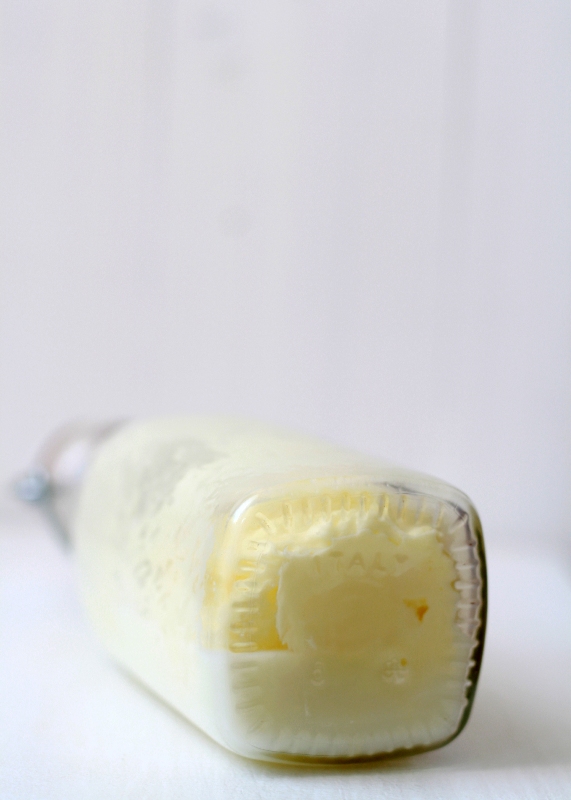
Note 2: The bottle shown in the pics is not the ideal recipient for making butter…when butter becomes solid, it is really hard to get the butter out of it.

Note 3:  The time indicated on the recipe is for an adult. Kids have less strengh and cannot mantain constant movement, so it will take them longer to actually get butter.


As seen at Cultured Butter


Related articles
Never miss a post
Name: 
Your email address:*
Please enter all required fields
Correct invalid entries

UA-21892701-1