

by Leo Racicot
Along with an uncanny mastery of seven languages perfected while she was a scholarship student at L’Université de Paris plus a crystalline singing voice that gained her entrée to the finest church choirs in Europe, my Nana brought with her to, of all places, Lowell, Massachusetts, the Egyptian/Syrian cooking she learned as a girl in her native Alexandria. Sudden love for a fellow Egyptian émigré, Ralph, a barber, took Adele away from her academic and musical aspirations.
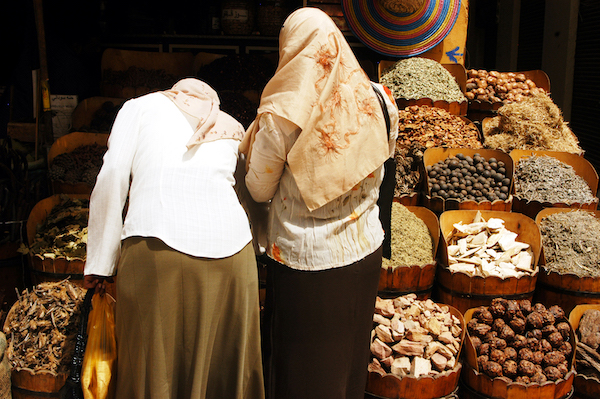
Muslim women in Aswan market, Egypt.
Ralph had an idea that opening his own shop in America, the land of opportunity, would put him and his new bride on roads paved in silver and gold. Before she knew what hit her, Adele (called by everyone Lena) found herself transplanted to a blue-collar town with a blue-collar man. The pair had four children in quick succession, each born two years apart: Mariam (Marie), Helen, George and my mother, Edna, nicknamed “Topsy.” Life and the barbershop landed them if not on Easy Street at least on This is Okay Way until Ralph died suddenly and young of a massive heart attack. My mother was six months old. Nana, unable to work full-time and raise four, small children alone (Lowell, after all, wasn’t Paris), took a job doing piecework in Hub Hosiery, one of the city’s many sweatshops and reluctantly put the kids in Franco American Orphanage where they would remain until they came of age.

Middle Eastern pistachio baklawa or baklava.
By the time I knew her, Nana had left her dashed aspirations and heartbreak on the curb and gone about the business of “getting on with it.” Perhaps to make a second stab at rearing the children she, herself, had been unable to raise, she and Marie, who stayed single and made a home for her mother and herself, became co-parents to my sister, Diane, and me. We, too, had been orphaned at a very young age, leaving our mother in the same mess her mother had known. I grew up then with all women: my mother, my sister, my aunt, my Nana, the nuns at school. I witnessed firsthand the power of the female ethos, the banding together of women when Fate has removed all men from the picture, to step in and nurture, as individuals and as a group. I loved my women, but Nana I adored. The love life denied her giving to her own children she heaped on Diane and me. A more caring, hospitable, convivial spirit I have never known. And so, this is how, among other facets and aspects of my growing up years, I was exposed to the Syrian/Egyptian kitchen.

Assorted mezze.
I loved being with Nana in her kitchen, watching her cook. We learn so much from watching. An almost pastoral calm would come over her as the small, old bones of her hands deftly tucked the Mahshi (Malfouf) mixture into the cabbage. In a flash, the stuffed wonders would layer up to the brim of the kettle (Nana pronounced it “cuttle”) to be doused with ripe, good garden tomatoes, homemade tomato sauce, and some water. Even more fun to watch was the way she would fashion a design, using only two turkey needles, into the top of a baked Kibbeh loaf. With the greatest care, too, she placed pine nuts (Snooba) strategically throughout the neat cake (not too many, not too few!). Kibbeh Nayyeh (raw hamburger or lamb) was also a staple of our family table.
People cringe now hearing that we ate raw meat (chased with raw onion). “Cannibals!,” they cry. I don’t know how I, so picky an eater I wouldn’t put a plain slice of American cheese in my mouth, got to love uncooked meat, but I could never get enough of the stuff – one of the treats of going over to my best friend, Anthony Kalil’s house, was the always-waiting Nayyeh on the table – Anthony’s father was a butcher so the house was well-stocked with the very best cuts. I loved the hurry-scurry of Anthony’s three brothers — his poor mom, outnumbered — racing in-and-out of the kitchen on their way to a date, a ballgame, a concert, tearing a piece of Syrian bread (the term, “pita” came into use much, much later on), scooping up a clump of Nayyeh, a bite of onion and chowing down. What with today’s heavy chemical treatment of meats and other No-No’s in meat products, I’m not so sure I would “go raw” now but I can still taste the sting of onion, the salted, peppered meat on my tongue and in my tummy. Good nourishing food.
Never-ending were the delights to be had in Nana’s kitchen. There was Gusa (stuffed zucchini though any squash could be used) with its aromatic garden flavors, bitter to the taste in a good way. Baba Ganoush, a tangy yogurt/eggplant spread, perfect for dipping or eating plain. Nana was never 100% satisfied with her own yogurt. “Is it too tart? A little bit, huh?” There was Makdous, tiny, marinated eggplants sprinkled with walnuts, Fatoush, a fresh lettuce and tomato salad splashed with lemon juice and sumac – a regular visitor to Nana’s table, it made my cheeks pucker. Halami, Halwah (pronounced ‘Ha-lay-wee’), Baklawa, Hummus, Tabouleh, M’jadara (lentil porridge), Za’atar (the best!). How could anyone not leave the table fat and happy?
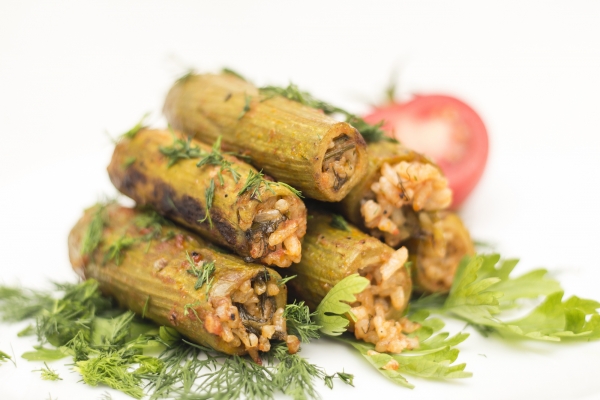
Egyptian-style stuffed zucchini.
Special Sunday trips were to nearby Lawrence and Bishop’s (Aunt Marie at the wheel) where, if the Arabic food wasn’t quite as good as Nana’s, well, “Hey, I’ll take it!” Our friend, Al, the waiter, would bring us extra olive oil, extra mint, extra bread. Al had a genial face. He looked like Abe Burrows and Sam Levenson, popular humorists of the day, and was funny the way they were funny. After feasting, we would go tramping unsavory neighborhoods in search of Melia A’asi, a girlhood friend of Nana’s in Alexandria. Nana knew Melia lived “somewhere in Lawrence.” Melia became somewhat of a legend in family lore. We never did find her. (Interesting aside: years later, after I told M.F.K. Fisher this story, she thought it would be fun to co-write a mystery novel with me, The Case of Missing Melia A’asi. My pseudonym, she decided, would be “Ricochet Raincoat.” Like Melia, though, the book never materialized.) At least Aggie Michael, Nana’s Lowell friend, existed. Nana and I would regularly visit her home peopled with life-sized statues of every saint in the canon. Aggie was a funny, fat, little Buddha with Orphan Annie hair. I liked her, but Nana and I always heeded Marie’s warning, “Don’t ever eat anything there; she cooks spaghetti in the same pan she washes her feet in.”
Nana’s desserts were my favorite. I could eat Ma’moul, the anise-and-date-scented pastries ‘til they came out of my ears. When Anthony and I brought along a paper bag full of them on our choirboys’ field trip to Boston’s Museum of Science, the other kids made throwing up sounds ‘til we passed the tantalizing cookie-cake-y wonders around. Everybody was our friend that day.
My most-loved sweets were Ka’ak, Proustian in its fragrance and its tastes, Turkish Delights, plump with pistachios, homemade Marzipan (not as hard to make as you’d think) and – heaven in a cup – the Egyptian delicacy, Umm Ali, its circus-y colors beckoning you to become a professional glutton.
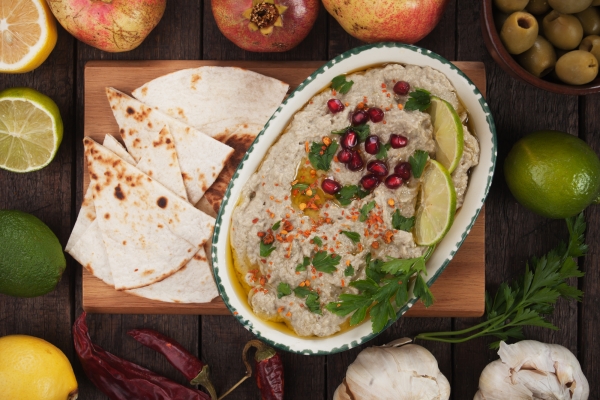
Baba Ganoush or eggplant purée.
I liked few things better than being with my Nana, sitting beside her in her kitchen waiting for everything to cook. I can still hear the good heat bubbling up from oven cups of custard, cinnamon-laced, rice and grape-nut puddings, too, and Knefe and Atayef. My whole boyhood early on was exoticized by almonds, the scent of sesame, strong licorice, black and running out of the corners of my mouth. Nana is teaching me how to make tissue paper carnations, pink. I’m not a very good student. Her chatter is punctuated by delightful Malapropisms, mangling the names of favorite entertainers: Florence Welch (Lawrence Welk), Furry Como (Perry Como), Pranky Pontaine (for Frank Fontaine), Ed Solomont (Ed Sullivan) and the funniest – Alfred Pitchfork (He was a bit of a devil!). We crack each other up; she, correcting my Arabic, I, correcting her English. Nana was petite, her white hair pulled up into a donut at the top of her head (very Marseille market). Nana was an anomaly; raised as an Ottoman Jew in Alexandria, schooled in Paris, she came to the new country equipped with a repertory of Baptist hymns (go figure!). Diane and I, per order of our very Catholic dad, were raised in his faith. So Nana and I would alternate dueling music genres: myself trilling The Angelus, The Kyrie and she, in her sweet, clear soprano intoning the old hymns: In the Garden, The Old, Rugged Cross, Abide with Me. Our songs and our laughter lifted the kitchen curtains high while the food cooked and heaven hovered quiet just over in a corner. I never heard her put on airs. She was plain, without make-up or pretensions. I never heard her speak an unkind word against anyone. She did like to thumb her nose behind Marie’s back whenever Marie criticized her about spoiling Diane and me. “Next thing, they’ll want we should build them their own Taj Mahal.”
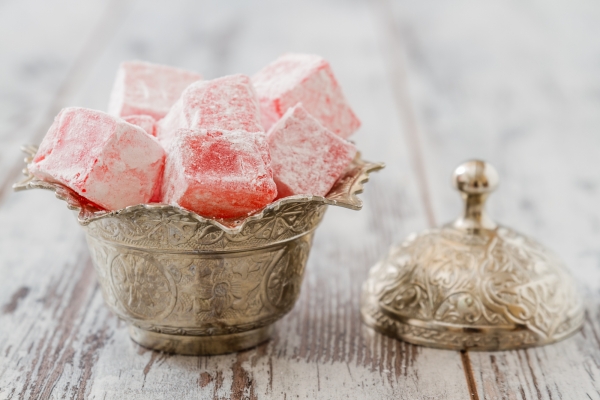
Turkish delight or lokum.
If there were times whole oceans rose up in her old eyes, well, we knew why; thoughts about a life that might have been. But she never let tears wet her bosom for long – she moved on – in acceptance, in grace, loving her life, her family, her kitchen.
The kitchen and her heart went dark in the year of The Bicentennial. So broken by grief was I, I ran away to avoid the wake. I couldn’t bear to say goodbye. I keep every day for saying goodbye by firing up the stove for cooking up a cauldron of Koshari, frying up a mess of onions in good olive oil for M’jadara, closing my eyes and conjuring up Nana in her kitchen, persimmons in ceramic bowls, hard candies and oranges and apples for anyone who might drop by. We learn so much from watching. We celebrate the nurturing women in our lives by nurturing ourselves and others. We nourish ourselves. We eat.
|
|


 Apricot Rosemary Pork Tenderloin with Grilled Apricots


