Gluten-Free Recipe Conversions – Strategies for Substitutions
Published by Friday, August 9, 2013 Permalink 0

Jenn Oliver, Culinary Chemist, The Rambling EpicureCulinary Chemistry: Gluten-Free Recipe Conversions – Strategies for Substitutions

by Jenn Oliver

From the archives

When my husband and I first started cooking gluten-free in our kitchen, we mainly focused on one type of meal — those that were naturally gluten-free.

The naturally gluten-free foods were the easiest to cook from scratch because they required no substitutions at all — risottos, fresh fruit, vegetables, custards & puddings, stir fry, roasted potatoes, homemade “chips”, salads, fresh steamed fish, bean stews, meringues, and even a macaron attempt or two. As a beginner to the gluten-free world nearly five years ago, I was thrilled with how many foods we could make without ever having to worry about an ingredient on a package label that could be harmful to my husband’s health.  As long as we cooked from entirely fresh ingredients and avoided anything that came in a package or required flour, we were fine — and what a great variety we had to choose from!

But it didn’t take long before my husband would say, “You know, I really miss pizza,” or “Wouldn’t it be nice to have a thick creamy gravy to go on mashed potatoes sometime?” It was inevitable, really, that shunning all things flour-related was bound to cause waxing nostalgia for the meals we no longer ate. While it was great to get our feet wet by starting with the easy gluten-free meals that didn’t require any substitutions or extra thought, it seemed wrong to deprive ourselves completely of other foods that we enjoyed.

I set out on a mission of sorts to figure out how to convert our favorite foods to gluten free, where I found a veritable “Wild West” frontier land when it came to recipes — myriad flour blends and formulas either in packages on grocery store shelves or listed in books, none of which explained how they came to be or why they worked, often calling for expensive and elusive ingredients. It all seemed like some esoteric recipe voodoo.


I decided instead to create my own blends, first categorizing the various alternative flours and ingredients by texture and coarseness, and then quickly realizing that while those aspects do play a role in the end product, the key factor was in fact not the texture, but the starch, protein, and fat content, as these are the things that determine most how a flour will behave in a recipe. I can’t say I get a perfect product every single time on the first try, but the turning point in my success was when I started looking into exactly what I was replacing with my gluten-free flour blends.

Sometimes it really is the gluten that needs to be emulated, such as in a bread recipe, where the developed network of gluten in conventional breads actively works to trap the air pockets made by the yeast, allowing the bread to rise. Techniques for mimicking this include adding other leavening agents to help account for the fact that some of the air will indeed escape before the bread is done, or adding binding agents to help trap the air that is formed — and maybe even a combination of both of these techniques.

Often this is why one sees gluten-free recipes that include extra eggs, or gelling agents like ground flax or chia seeds, manufactured gums, or incorporation of starches into the GF blend, such as tapioca or arrowroot. Once we understand why these ingredients exist in a gluten-free recipe, we can better judge how to make substitutions to fit our needs – for example, don’t have ground chia seeds? Maybe adding an egg in its place will do the trick. The bread fell flat a bit and was too dense? We now have options. We consider the properties of the ingredients we are using, and this information can be used as tools for determining how to logically go about changing our recipes to improve them.

Other recipes that conventionally use flour don’t actually care about the gluten at all. Take, for example, a roux, essentially made up of a flour and a fat that are cooked together and then used as a thickening agent in soups and stews, such as gumbo. In the case of roux, there’s no elasticity needed, and no air to be trapped – all we are looking for is thickening, which occurs thanks to the starch components within wheat flour. This is great news for gluten-free cooks; there are lots of starchy gluten-free ingredients at our disposal that we can use to replace conventional wheat flour!

All-purpose wheat flour contains, along with gluten, a fair amount of starch. So to create a 1:1 substitution (by weight of course), one would just need to come up with a gluten-free flour blend that is also mostly (but not all) starch. This can be done either by using flours with similar starch content to wheat flour, or by supplementing the GF blend with a pure starch (cornstarch, tapioca, arrowroot, potato, glutinous rice flour, etc.). Each type of starch differs slightly in its chemistry, but for the most part they all have gelling and viscosity properties – i.e. they help food thicken and stick together. In something like our roux example, it’s not going to matter a whole lot what kind of starches we use, because the only aspect of the starch we are calling upon in this case is its thickening power.

Obviously, for baking, things get a little more complicated, but I’m convinced the overall strategy remains the same. The first thing I ask myself when converting a recipe is, “what in conventional wheat flour is doing the work? What traits do I need to make sure I replace with my gluten-free mix?” And then we can use our knowledge about the various gluten-free ingredients available to reproduce those properties. Actually, I think once one gets a bit more comfortable with gluten-free substitutions, there is even more freedom and more possibilities for “customizing” than when working with conventional all-purpose wheat flour. This is because one has the ability to pick and choose from amongst so many great ingredients — not just for certain properties, but also for flavors. For example, I often incorporate chestnut flour, because I just love the earthy rustic qualities it lends to baked goods.

Gluten-free substitutions don’t have to involve some mysterious wizardry in order to have success. Sometimes it’s just a bit of recipe tweaking, and other times, a little knowledge about the science behind why a recipe works goes a long way.


Never miss a post
Name: 
Your email address:*
Please enter all required fields
Correct invalid entries

Recipes: Dairy-Free Switzerland

Published by Saturday, July 27, 2013 Permalink 0

Recipes: Dairy-Free Switzerland

I’ve just discovered , dedicated to making traditional Swiss and other recipes dairy-free.

Dairy Free Symbol, image by http://www.americaseatingstrategist.com/2013/04/10/gone-dairy-free-here-are-some-ways-to-optimize-your-diet/


Heddi started her site in 2012 to face up to the daily task of cooking for her son, who has multiple allergies, including milk allergies.

A dairy-free version of many traditional Swiss recipes for lactose-intolerant people. Switzerland is a land of milk and cheese, so this is a difficult task. Bravo for her efforts.


Never miss a post
Name: 
Your email address:*
Please enter all required fields
Correct invalid entries

Introducing our new “TRE Quality Label”

Published by Thursday, July 25, 2013 Permalink 0


//

Introducing our new “TRE Quality Label”: Healthy, Homemade Meals Delivered to Your Door, Geneva

The TRE Quality Label

The TRE Quality Label

Introducing our new “TRE Quality Label”

In this complex world of industrial food, where even organic food is sold by agro food conglomerates, it is important to know the quality and origin of what we eat. Thus the importance of a quality label that has been tested by people like us who are experienced in the real-food business. When we give the TRE Quality Label, we know where the ingredients came from, we know how the food was processed and treated — and most of it is entirely local,  allowing you too to eat locally. We also know how it tastes, because we’ve tasted it all.

All the important criteria make up part of the TRE Quality Label: quality, origin, and taste. You can be sure of what you’re buying if it has a TRE Quality Label.

Today, we’d like to introduce the first product to which we’re giving our label: panbeh, a Geneva grassroots operation that makes every attempt to meet all these criteria, and to put something healthy, natural and tasty on your plate.

panbeh‘s meals are delivered straight to your door in Geneva. Most of the ingredients are from Geneva or nearby in the countryside.

It is the perfect solution for those who are home bound and for the elderly, as well as for those who simply don’t have the time to do the shopping required to cook a healthy, well-balanced meal. It’s great for those weeks when your work schedule is heavy, and ensures that you’ll get a home-cooked, healthy meal every day, delivered straight to your door.

Geneva: Healthy, Homemade Meals Delivered to Your Door by panbeh

panbeh describes itself:

panbeh means “pure cotton” in Farsi: the purity of a healthy, home-cooked meal

Panbeh's very own cotton plant in Geneva, Switzerland

Panbeh’s very own cotton plant in Geneva, Switzerland

As we all know, what we eat is important for our daily activity and well-being, so we are introducing our new concept: the pleasure of eating healthy, natural, homemade food while fully enjoying the taste of what you eat, delivered right to your door.

No additives and no pesticides, no hormones and no chemicals — only the real, natural flavor of top quality, artisanal ingredients, the origin of which we systematically list. And you benefit from the real taste of the whole, untreated, unprocessed food, prepared fresh every day in a high-fiber, low-fat manner.

Whenever possible, we use only organic ingredients.

We propose a daily lunch menu and will deliver it to you at your home or your office, free of charge. Please find below are our daily menus for the month of July.

Delivery to your home or office
Order the night before (before 6 pm) for next day’s lunch, or order for the whole week
Orders are delivered between 12 and 1 pm

Order by email:
panbeh@servge.ch
or by phone:
076 630 79 56

 
Free delivery for Petit-Saconnex, Grand-Saconnex, Grand-Pré and Nations.
 

It is our right to know where our food comes from:

Bread: Eric Emery bakery, Geneva.
Vegetables, fruits and mountain herbs (organic): Marché à la Ferme de Budé, Geneva.
Cheese (organic) : Casa Mozzarella, Geneva.
Salmon: Wild from Alaska or Scotland, sold by Francesco Drago, Halle de Rive covered market, Geneva.
Tomato sauce (organic): Marché a la Ferme de Budé, Geneva.
Spaghetti (organic): Marché à la Ferme de Budé, Geneva.
Rice & Quinoa (organic): Marché de Vie, Geneva
Olive oil: Greece, sold by Marché à la Ferme de Budé, Geneva
Eggs (organic): Marché à la Ferme de Budé, Geneva.
Chicken (organic) : Swiss origin
Wheat (organic) : Swiss origin


Bon appétit!


MENU for July 2013 (24.00 CHF)

Monday
Mixed salad
Quinoa balls, oven-baked Homemade
panbeh cake

Tuesday
Shirazi salad (tomato, cucumbers, onion, fresh mint)
Indian Tilda rice with safran, berberis (barberries) and chicken, or wild rice with chicken and vegetables
Fresh fruit salad

Wednesday
Potato salad, onion, eggs
Eggplant and tomato sandwich
panbeh homemade crème caramel

Thursday
Tomato & mozzarella & fresh basil
Spaghetti, tomato sauce & mushrooms
Watermelon or melon

Friday
Salad (ricotta & tomato covered with aromatic herbs)
Wild smoked salmon sandwich
Homemade panbeh cake

Large portion of mixed salad: 12.00 CHF

Drinks: kefir, mineral water, or fruit juice.


Order by email:
panbeh@servge.ch
or by phone:
076 630 79 56


Never miss a post
Name: 
Your email address:*
Please enter all required fields
Correct invalid entries

Switzerland: Valais Apricots and 10 Things You Can Do with Them

Published by Friday, July 19, 2013 Permalink 0

Switzerland: Valais Apricots and 10 Things You Can Do with ThemJonell Galloway, Spontaneous Cuisine, Mindful Eating, Slow Food, Editor of The Rambling Epicure

by Jonell Galloway

Height of season for Valais apricots, considered best in Switzerland

It is the height of the Valais apricot season, I thought it timely to offer you a few ideas for using them while they’re ripe and ready.

Choosing your apricots

apricots_valais_tree_switzerland_suisse_geneva
Photo courtesy of Ellen Wallace.

The first and most important thing is to buy tree-ripened apricots. By definition, this means local ones, since ripe apricots are soft to the touch and do not travel well.

If you plan to eat them fresh, they should be soft, but not blemished or bruised. The riper they are, the more flavorful they are.

If you are using them for cooking, the riper the better, and you can even get by with blemishes as long as they are not rotten-looking. As a general rule, the softer the sweeter.

You will often see crates of extra-ripe apricots discounted in farmers markets. Look them over, and if there are not too many black or rotting ones, they are actually the best for cooking purposes, especially for jams, cakes and sauces.

Recipe ideas for apricots

Note: With all apricot recipes, the amount of sugar used depends on the acidity of the apricots. The acidity depends on the ripeness, origin and variety. With so many factors coming into play, taste tests are indispensable and the quantity of sugar should be determined by taste, using the quantities given here as a guideline.

Continue Reading…

Never miss a post
Name: 
Your email address:*
Please enter all required fields
Correct invalid entries

10 Things You Need to Know before You Start Gourmet Cooking

Published by Wednesday, July 17, 2013 Permalink 0


The Rambling Epicure, Editor, Jonell Galloway, food writer.

10 Things You Need to Know before You Start Gourmet Cooking

by Jonell Galloway

From the archives

Cooking is just applied physics and chemistry, with a little creativity thrown in.

1. Heat and temperature

Heat and temperature are important at every stage in cooking.

When browning or grilling meat or fish, oil should be very hot before adding it. This seizes it, thus preserving all its natural juices, which are where the flavor resides.

Slow cooking at low temperatures is best for tough, sinewy or fatty pieces of meat, while high temperatures are best for lean meats such as filet, where it is necessary to seize it, since it has no fat to keep it from drying out.

2. Juices

http://www.yumsugar.com/Deglaze-592880


No matter what the ingredient, the flavor resides in its natural juices. That’s why fresh is always better than frozen. When you thaw food, part of its natural juices are lost.

There is an appropriate way to cook every ingredient, depending on its nature.

Continue Reading…

Never miss a post
Name: 
Your email address:*
Please enter all required fields
Correct invalid entries

Eating Like the Ancient Romans in Switzerland – Opera Festival in Avenches

Published by Thursday, July 4, 2013 Permalink 0

Amy Eber of World Radio Switzerland did a very good podcast about the Roman ruins in Avenches in the canton of Vaud. She even talked about how the Helvetii‘s and Romans’ food was influenced by the trade routes. Click here to listen.

Roman Feast, creative common photo by http://news.richarddenning.co.uk/?cat=24

Ancient Roman Feast

The Aventicum Roman museum is located on the site of the ruins. Both the museum and the site are open to the public. Click here for more details. The ampitheatre is still used for large events, including operas and concerts.

Avenches Ancient Roman amphitheatre, common license photo by http://www.myswitzerland.com/fr/aventicum-ruines-romaines-musee.html

The 19th edition of the Avenches Opera Festival featuring Giuseppe Verdi’s famous “Nabucco” starts tomorrow night and runs through the 13th. “This immensely successful opera festival has become a unique platform for renowned international artists performing in high-quality productions with superb sets that attract thousands of opera lovers each year,” says the Avenches Tourisme site.
Schedule:

Friday, 5 July 13 / 21:30 CET – Tuesday, 9 July 13


Never miss a post
Name: 
Your email address:*
Please enter all required fields
Correct invalid entries

What to Eat in Switzerland: A Geneva Christmas: Longeole Sausage

Published by Friday, December 21, 2012 Permalink 0

by Jonell Galloway

From the archives

Christmas traditions in Switzerland

One should never think that everybody in Switzerland eats the same thing for Christmas dinner. With four languages and a multitude of “mini-cultures” tucked away its various mountain niches, and with a huge international population, Switzerland may well have more Christmas menus than any other country in the world.

In the French-speaking part of Switzerland, Geneva’s traditions are quite apart from the Vaud, for example, due to the late date Geneva finally decided to become part of Switzerland. Geneva traditions are often more influenced by their Savoyard and French neighbors, since they share about 100 km of border with them and only 5 km with canton Vaud.

What’s so special about a Longeole?

Many Genevois eat a sausage specific to Geneva called longeole. Every region and many villages have their own sausage recipes, but the longeole is quite apart from the others for several reasons.


Longeole sausage and potatoes cooked in
white wine, a Geneva Christmas specialty.


For one thing, it contains not only ground pork but also ground pork rind. This keeps it from drying out and gives it fuller flavor. The other, and quite major, difference is that that it is speckled with fennel seeds, probably a Savoyard influence.

Any good local butcher makes his own longeole. If not, it is advisable to find one who does. It’s Christmas, so you want to be certain it’s of good quality.

Cooking Longeole

Longeole is easy to cook, but you must allow yourself enough time. It takes longer to cook than other cooking sausages because of the addition of the pork rind, which is harder than simple ground pork.

Use a soup pot tall enough to hold your sausage. Fill with water and bring water to boil. Add a touch of salt. Drop in sausage, lower heat, and let it simmer for 2 hours 45 minutes or 3 hours. The water should be just on the verge of boiling during the whole cooking time. It is then ready to slice and eat.

Some cooks prick the Longeole with a fork before cooking, but purist that I am, I think you risk losing some of the juices, which would take away from the flavor and make the sausage less succulent in the mouth. It is also important not to let it boil, because this too will dry it out.

What do Genevois eat with Longeole?

Like everywhere, different families have different traditions, different favorites, but the most common accompaniments are potatoes cooked in white wine, lentil stew and cardoon gratin, all Geneva specialties as well.

Continue Reading…

Never miss a post
Name: 
Your email address:*
Please enter all required fields
Correct invalid entries

Culinary Chemistry: On the Technique of Brining

Published by Tuesday, November 13, 2012 Permalink 0

Culinary Chemistry: On the Technique of Brining

by Jenn Oliver

Hello and welcome to the first post of Culinary Chemistry with Jenn! I am Jenn, your resident scientist with a gluten-free husband who is curious about all things related to the how and why of cooking.  Today, we’re going to talk about brining, but each post will explore a different technique or phenomenon related to cooking/baking in the kitchen. Do you have questions or are curious about a particular aspect in the kitchen? Feel free to send me an email at jennoliver@theramblingepicure.com or on our online chat to the right of the screen, or join our Community and follow the Culinary Chemistry group and forum.

This past holiday season, families and friends gathered to share in their holiday traditions of a meal together — many of which surely included an oven-baked roast. Mine certainly did, as my husband and I celebrated our first Christmas abroad, a cozy romantic weekend together, marking our one-year anniversary since arriving to Switzerland, our current home. But just because the holidays are over doesn’t mean you have to swear off making roasts until next winter’s festivities roll around.

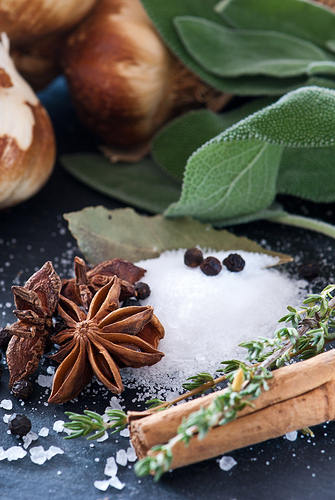
Spices for pork roast brine.


Continue Reading…

Never miss a post
Name: 
Your email address:*
Please enter all required fields
Correct invalid entries

Switzerland: Raphael of Fribourg making Fribourg-style Swiss fondue using cheese he makes

Published by Friday, November 2, 2012 Permalink 0

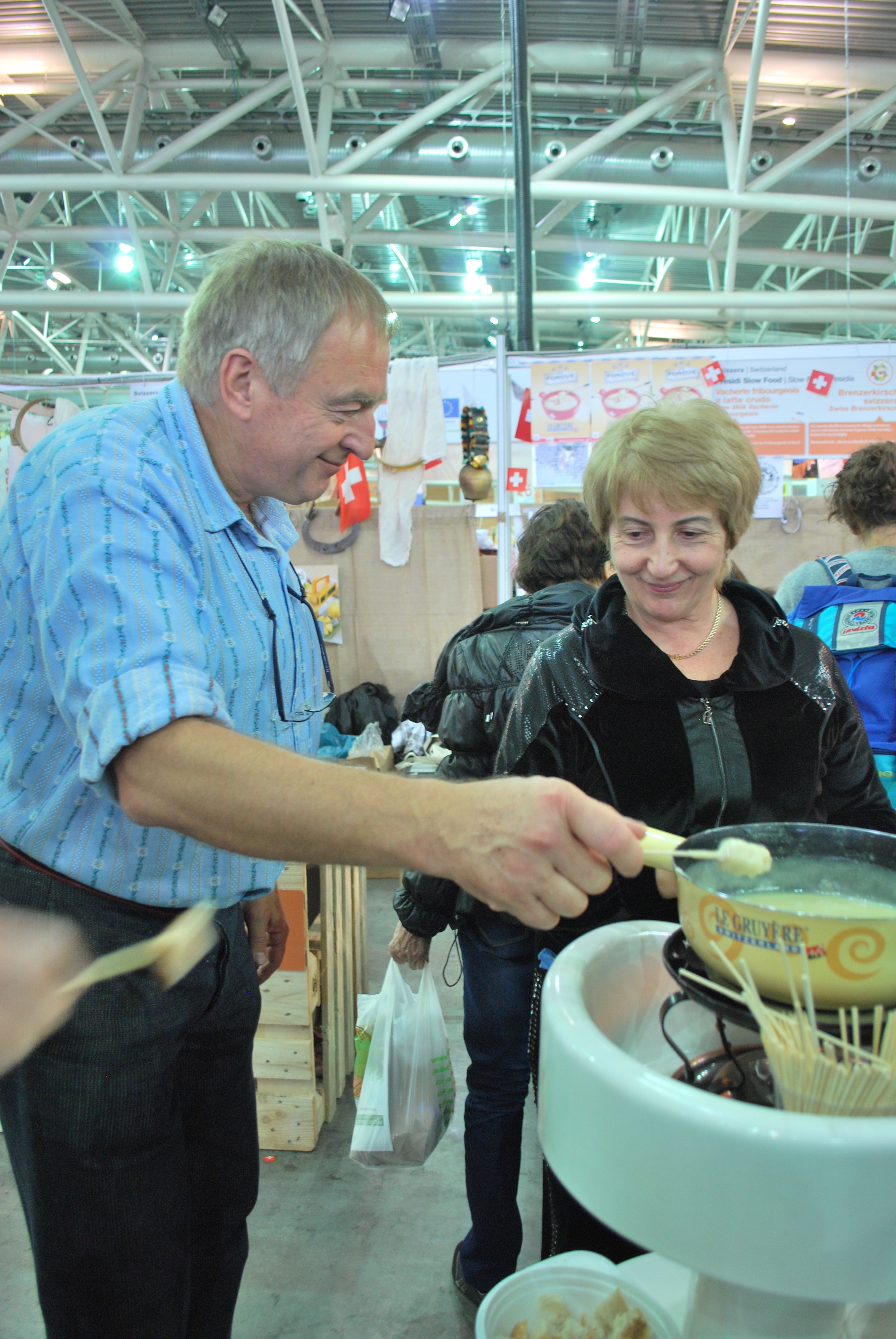
Fribourg-style Swiss fondue is referred to as moitié-moitié. Unlike fondues from other regions, it is made with a hard, cooked cheese native to Fribourg, known as Vacherin Fribourgeois (not to be confused with Vacherin or Mont d’Or). The recipe calls for half Vacherin Fribourgeois and half Swiss Gruyère.

In this photo, Raphael is making fondue using the handmade cheeses he makes himself, at the Slow Food Switzerland stand at the Salone del Gusto in Turin, Italy last week. The visitors ran to his stand every time he put a new pot of fondue out. Obviously, it was very good!


Never miss a post
Name: 
Your email address:*
Please enter all required fields
Correct invalid entries

What we’re reading: healthy food, happy cows; history of chocolate chip cookies; Russian organic food, etc.

Published by Monday, October 22, 2012 Permalink 0

What we’re reading: healthy food, happy cows; history of chocolate chip cookies; Russian organic food, etc.

by Jonell Galloway

Click here to keep up with the latest in world food and wine news.

Mindful Eating: Farmers, the Land, and Local Economy, by Jonell Galloway, Editor of The Rambling Epicure, Switzerland. Mindful Eating / Slow Food, real food.


Never miss a post
Name: 
Your email address:*
Please enter all required fields
Correct invalid entries

UA-21892701-1