The Kitchen at the Center of History: An Interview with Rachel Laudan

Published by Tuesday, July 23, 2013 Permalink 0


Rachel Lauden, author of Cusine & Empire

Rachel Laudan, author of Cuisine & Empire

by Elatia Harris

All photos courtesy of Rachel Laudan

Rachel Laudan is the prize-winning author of The Food of Paradise: Exploring Hawaii’s Culinary Heritage and a co-editor of the Oxford Companion to the History of Modern Science. In this wide-ranging interview, Rachel and I talk about her long-awaited book, Cuisine and Empire: Cooking in World History. Paul Freedman remarks that  the book is a riveting and unique combination of culinary ideas and exposition on the materiality of eating.” Other delighted early readers include Anne Willan, Naomi Duguid and Dan Headrick. As a food lover, a cook, a world traveler or a student of cultural history, you might have asked yourself: What is this thing called food? If so, this is the book for you. 

Laudan_Cuisine-001

ELATIA HARRIS: To begin, I would love to know what was involved in the transition from historian of science to historian of food. I can remember when there was no such academic discipline as food history, and I’ll warrant so can many readers.

RACHEL LAUDAN: I can remember when there was no such discipline as science history! I think history is the thread through my life. Growing up in history-heavy Wiltshire, I felt I had to escape the weight of the past. I studied the key historical science, geology, at university, although this was almost unheard of for a woman. I then changed to history and philosophy of science and technology. Then to history of food. History is my way of understanding things.

A lot of food writing is about how we feel about food, particularly about the good feelings that food induces. I’m more interested in how we think about food. In fact, I put culinary philosophy at the center of my book. Our culinary philosophy is the bridge between food and culture, between what we eat and how we relate to the natural world, including our bodies, to the social world, and to the gods or morality.

EH: Your earlier book, The Food of Paradise, necessarily dealt with food politics and food history. So many cultures were blended into local food in Hawaii. I treasure that book — almost a miniature of what you’re doing in Cuisine and Empire.

RL: Well, thank you. It came as a surprise to me that I had a subject for a book-length treatment of something to do with food or cooking — as interested in the subject as I certainly was. The only genre I knew was the cookbook, and I am not cut out to write recipes.  

It was prompted by a move to teach at the University of Hawaii in the mid-1980s. I went reluctantly, convinced by the tourist propaganda that the resources of the islands consisted of little more than sandy beaches and grass-skirted dancers doing the hula.

I couldn’t have been more wrong. These tiny islands, the most remote inhabited land on earth, have extraordinarily various peoples and environments. And as to the food, I was humiliatingly lost. The first morning in the office, Barbara Hoshida, the department secretary, held out a plate of golf-ball sized fried, well, fried whats? “These are Okinawan andagi,” she explained, “They’re just like Portuguese malasadas.”  I didn’t dare ask what Portuguese malasadas were. 

Before I knew it I had a stack of essays on the foods of the three diasporas that had ended up in the islands: the taro-based cuisine of the peoples from the South Pacific (the Hawaiians); the rice-based cuisine of the Asians (Koreans, Han and Hakka Chinese, Japanese, Okinawans, and Ilocanos and Tagalogs from the Philippines); and the bread-based cuisine of the Anglos (British and Americans).

Continue Reading…

Never miss a post
Name: 
Your email address:*
Please enter all required fields
Correct invalid entries

Food Quote: Nelson Mandela on Food

Published by Wednesday, June 12, 2013 Permalink 0

by Jonell Galloway

Nelson Mandela on Food

I was not born with a hunger to be free. I was born free. Free in every way that I could know. Free to run in the fields near my mother’s hut, free to swim in the clear stream that ran through my village, free to roast mealies [corn] under the stars … It was only when I learnt that my boyhood freedom was an illusion … that I began to hunger for it.–Nelson Mandela

Photo courtesy of The Guardian

has provided “the backdrop and occasionally the primary cause for momentous personal and political events in the life of Nelson Mandela.” In his autobiography, he took an innovative approach to history and showed that a great man’s life can be measured out in mouthfuls, both bitter and sweet. With this title, the reader can cook and taste Nelson Mandela’s journey from the corn grinding stone of his boyhood through wedding cakes and curries to prison hunger strikes, presidential banquets and ultimately into a dotage marked by the sweetest of just desserts. Tales told in sandwiches, sugar and samoosas speak eloquently of intellectual awakenings, emotional longings and always the struggle for racial equality. He was always motivated by hunger, either longing for food he couldn’t have, or depriving himself of food in the name of freedom.

“Only the truly food obsessed would read such a statement and consider the stomach from whence it came, but I did and the result is a gastro-political biography entitled Hunger for Freedom, the story of food in the life of Nelson Mandela,” he told Ana Trapedo of The Guardian.

When in prison, he wrote to former wife Winnie: “How I long for amasi (traditional South African fermented milk), thick and sour! You know darling there is one respect in which I dwarf all my contemporaries or at least about which I can confidently claim to be second to none – healthy appetite,” he told Trapedo.


Never miss a post
Name: 
Your email address:*
Please enter all required fields
Correct invalid entries

Indian Curry Through Foreign Eyes, Part 1: Hannah Glasse’s 18th-century Curry Recipe

Published by Sunday, June 9, 2013 Permalink 0

Indian Curry Through Foreign Eyes, Part 1: Hannah Glasse’s 18th-century Curry Recipe

by Laura Kelley

I have long been fascinated by concepts of “I and other”, or the many ways we separate what is familiar (self) from what is not familiar (non-self). By defining what is not self, we are in fact defining self. One can hear small children do this when misclassified by gender; most adamantly declare that they are not members of the opposite sex. “I and other” are also evident in beautiful symbolic ways when considering the movement of ideas and beliefs through societies. The newly introduced idea is at first foreign, complete with unfamiliar trappings. As the idea flows through society and is adopted, the foreign elements are shed and replaced by the familiar.

Depictions of Buddha: Caucasian and Asian, by Laura Kelley at //www.silkroadgourmet.com/hannah-glasse-curry/

Depictions of Buddha: Caucasian and Asian

One place to see this is operation is at the Boston Museum of Fine Arts, which houses an expansive collection of Asian art. As Buddhism moves out of India and across Asia, first to the west and then the east, early iconography clearly depicts Buddha as Caucasian (Gandahara style), even when the work is from the Himalayas, Burma or Western China. As time passes, and Buddhist ideas are adopted across the east, however, religious iconography begins to depict a wide variety of races and ethnicities. Noses become smaller, epicanthic lids are added as the face changes from Caucasian to Asian. Expressions usually remain contemplative and serene, but the varying shapes of the faces are evidence of the triumph of the ideas across space and time.

The “I and other” concept is also of interest in historical cookery, especially when one group is attempting to recreate the cuisine of another. I’ve been looking at early recipes for Indian curry written by non-Indians. So far, I have a small collection of English and American recipes from the 18th and 19th centuries that show curry powders and recipes developing from recipes that merely reminiscent as Indian in the eighteenth century to those that are nearly indistinguishable from modern recipes broken out by geographical region by the end of the nineteenth. The earliest amongst them (so far) is a recipe from Hannah Glasse’s The Art of Cookery made Plain and Easy, first published in 1747.

The Art of Cookery, 1774, photo by Laura Kelley

The Art of Cookery, 1774

Continue Reading…

Never miss a post
Name: 
Your email address:*
Please enter all required fields
Correct invalid entries

A Mesolithic Dinner: Food, Wine and Art by Jane Le Besque

Published by Tuesday, June 4, 2013 Permalink 0

by Jonell Galloway

A Mesolithic Dinner: Food, Wine and Art by Jane Le Besque


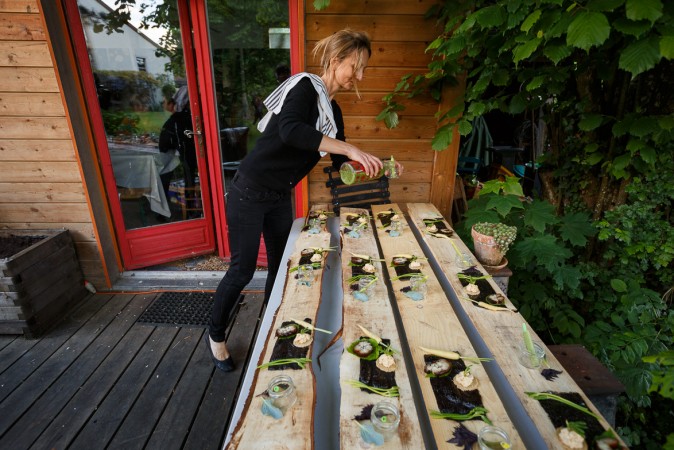
Jane Le Besque hosted a “mesolithic dinner” on June 30, 2013, in her home in the Pays de Gex just over the border in France, an event sponsored by Slow Food Geneva. The dinner was cooked using ancient flavor combinations and techniques, and served on split logs onto which slate plates were placed and used as plates.

What Food Did Jane Le Besque Serve at Her Mesolithic Dinner?

Although Jane’s dinner was labeled “Mesolithic”, it was indeed much more than that. She covered the evolution of food from the post-glacial hunter-gather periods, through the Mesolithic and Neolithic, and going on to the Ancient Greeks and Romans, centering on Europe.

It started with the Mesolithic era, with an assortment of coastal and lake fish, eel, root vegetables and wild greens. The meal then slipped in to the Neolithic era with galettes made from ground lentils, peas and barley, served with spit-roasted boar. The menu ended with an Iron-Age “travelers pack” of dried fruits and dried-porridge slices fried in cumin and butter. The Bronze Age brought blue cheese and butter.

Drinks consisted of mead, more often referred to as “honey wine,” more in the style of the ancient Greeks and Romans than of more ancient peoples, and beer.

What is the Mesolithic?

As a reminder, the Mesolithic Age refers to the pre-agricultural period between 10,000 and 5,000 BCE in Europe, and variations of this period in other parts of the world. The term “pre-agricultural” is key in understanding what ingredients were available. The three terms paleolithic, mesolithic and mesolithic refer to what is generally called the “Stone Age,” i.e. the post-glacial hunter-gatherer period, when humans started to use stone tools and food was gathered rather than farmed.


During the early Stone Ages or paleolithic (2.6 million years ago to around 10,000 BP), humans used some stone tools and utensils, but many tools were made from organic matter such as bone, fibers, and wood. Hunting and gathering were the chief ways of providing food. During the neolithic, starting around 10,200 BCE and ending between 4,500 to 2,000 BCE, depending on the location, we saw the beginning of farming. The mesolithic overlapped the other two ages, once again, at different times in different places. Metal tools brought these three Stone Ages to an end.

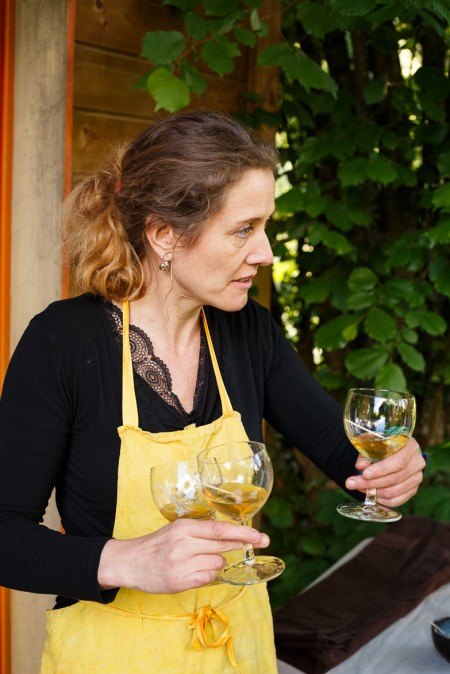
Jane Le Besque, artist and Mesolithic chef, serving mead


Early Stone Age cooking was generally on leaves or directly over the embers, although clay cookware has recently been found in China dating from 19,2000–20,000 years ago, during the ice age. Stone Age plates usually consisted of a rock or other flattish surface found in nature, such as the flattened split logs Jane used in the same manner as we use wooden tables today. Earthenware did not appear on the dinner table until much later.

What Did You Usually Eat at Mesolithic Dinners?

What did they eat? Pretty much whatever they found and killed that was edible: meat, fish, wild plants. The specifics of this depended on the location, climate and season. Meals included the day’s finds. This might consist of berries, wild greens and other wild vegetables and plants.

Meat and later fish were not an everyday affair. They were difficult to come by and difficult to preserve, depending on the location (salt was found in Romania as early as 10,000 years ago). Stone  Age people ate very little grain, since agriculture didn’t exist yet. Hazelnuts and other nuts were often roasted, and stored for winter. Wild boar was common; dairy products and cheese were on the menu, although a limited variety.

About Jane Le Besque

Jane Le Besque lives and works with her family at the foot of the French Jura, a few minutes from Geneva, in the foothills of the Jura mountains.

She was born in England and has a Breton grandfather, hence the name. Since graduating from Birmingham Art College in 1986, she continued her studies at l’Ecole des Beaux Arts in Paris. She afterwards lived and worked in Toulouse, London, and now outside Geneva.


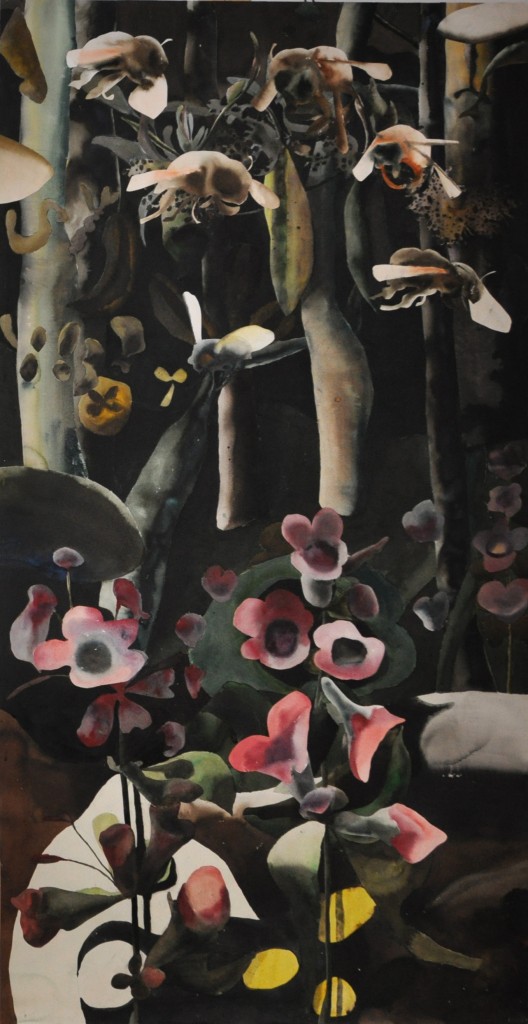
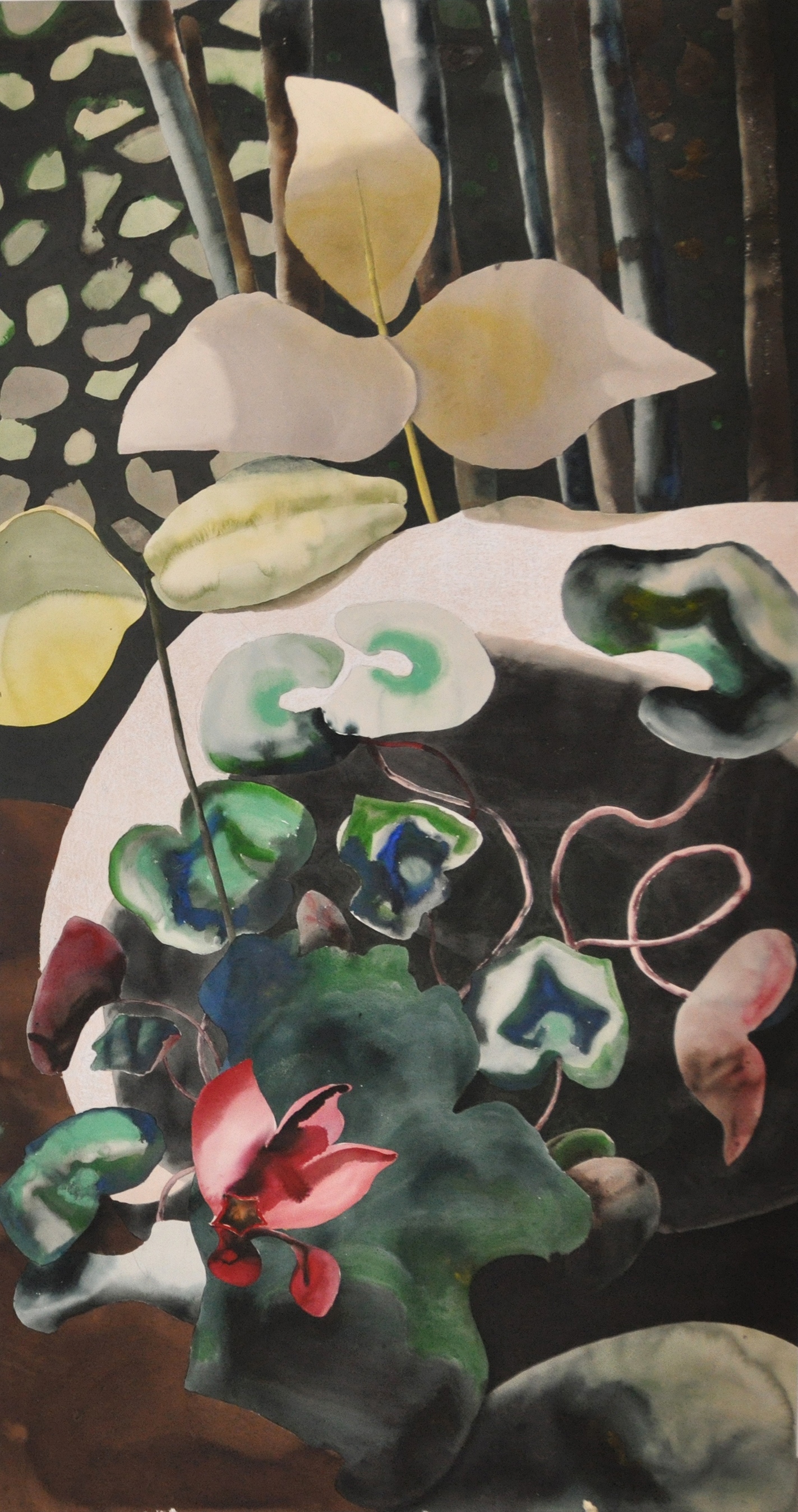
Jane has always painted. She is her happiest walking through the woods and gathering berries, mushrooms, acorns, flowers and leaves to use in her cooking and painting.

One might say Jane has been interested in mesolithic cooking even before she learned the word. As a child, she spent her time gathering the wild things she now uses in her paintings,  making dresses out of them.

Her paintings are an intense reflection of her “gatherer” spirit. The Mesolithic dinner was held in her studio, lined with her paintings of flora of all types.


Never miss a post
Name: 
Your email address:*
Please enter all required fields
Correct invalid entries

Food Art: The Food of the Dead for the Living, painting by David Olere

Published by Saturday, March 30, 2013 Permalink 0


“What is of note, is the survival of the arts within the walled ghetto. John Hersey’s masterpiece novel, The Wall, based on actual diaries (Emanuel Ringelblum), show the arts being practiced; theatre and music and fine art within a ghetto atmosphere mortified by repetitive eve of destruction. The record left by ghetto dwellers, camp internees, and displaced persons create snapshots of life and death under Hitler. Inmate drawings and paintings were legitimate articulations of man’s inhumanity and cruelty,” says Dave in Art of Insurrection and Resurrection.


Never miss a post
Name: 
Your email address:*
Please enter all required fields
Correct invalid entries

Pessah ou la fête des Azymes

Published by Saturday, March 30, 2013 Permalink 0

par Julien Darmon

Click here for English.

Extrait du Dictionnaire Universel du Pain, publié par Bouquins, Robert Laffont

L’obligation de s’abstenir de hamets (pâte levée) durant la fête de Pessah, et donc de consommer uniquement de la matsah (azymes), trouve son explication dans Deutéronome xvi, 3 : « Un pain de pauvreté [‘oni] car tu es sorti en hâte d’Égypte », qu’on interprète généralement comme « la pâte n’a pas eu le temps de lever ». Quelle est cette « hâte » dont il est fait mention ici ? En effet, en Exode xii, 11, cette hâte fait l’objet d’un ordre : « Vous mangerez [le sacrifice pascal] en hâte », tandis qu’en Deutéronome xvi, 3, il s’agit d’une justification : « Tu ne mangeras pas [ce sacrifice pascal] avec du hamets, pendant sept jours tu mangeras des matsot, pain de pauvreté, car tu es sorti en hâte de la terre d’Égypte… » Or, en fait de hâte, voici comment les choses se sont déroulées au moment de la Sortie d’Égypte (xii). Le premier jour du mois de Nissan, Dieu dit à Moïse et à Aaron : « Ce mois sera pour eux le premier des mois […] Les Hébreux feront le sacrifice pascal et mangeront des azymes […] Dès le 10 du mois, ils réserveront un agneau, qu’ils sacrifieront le 14… Durant la nuit suivante, au milieu de la nuit, Dieu frappera tous les premiers-nés […] Alors les Hébreux sortiront d’Égypte. » Donc, depuis au moins le 10 du mois, si ce n’est depuis le 1er ou le 2, tous les Hébreux sont au courant qu’il va falloir manger des azymes dans la nuit du 14 au 15 (qu’on appelle la « nuit du 15 »), et durant les sept jours qui suivent. Donc, les premiers azymes de Pâque ne sont pas des pains qui, à cause du manque de temps, n’ont pas eu le temps de lever, mais des pains qu’on n’a pas laissé lever, délibérément.

Continue Reading…

Never miss a post
Name: 
Your email address:*
Please enter all required fields
Correct invalid entries

What we’re reading: bread pots, bad cooking myths, how the French Revolution changed food history, gourmet vegetarian

Published by Thursday, December 20, 2012 Permalink 0

by Jonell Galloway

Click here to find the best in current food news and trends in the world of real food, Slow Food and mindful eating.


Never miss a post
Name: 
Your email address:*
Please enter all required fields
Correct invalid entries

What to Eat in Switzerland: A Geneva Christmas: Cardoon Gratin Recipe

Published by Wednesday, December 19, 2012 Permalink 0

by Jonell Galloway

From the archives


Cardoon gratin is a classic Geneva Christmas dish, but only brave souls should try to prepare them because they are prickly, and the preparation can be long and tedious. Many farmers markets in Switzerland now sell them prepared sous vide, in plastic vacuum-packed packages, which is probably the best option for those who don’t get a thrill out of getting a few pricks. In any case, it is important to schedule it carefully into your meal preparations, because it is time-consuming any way you go about it.

Cardoon Gratin Recipe

Preparation of Cardoons for Gratin

  1. Throw out any hard stems and any that are wilted.
  2. Peel the cardoons by removing leaves, spines and stringy parts. The exterior will then be covered with a fuzzy layer. Use a cloth to rub stalks gently to remove fuzz.
  3. Cut stems into 8 cm (3 cm) slices. Rub with lemon, or if you intend to use them later, put slices into lemon water so they won’t turn dark.
  4. You now have two choices: you can either cook them in a white vegetable broth you’ve made ahead of time, or you can cook them in the lemon water you soaked them in.
  5. Bring to a boil and boil until tender. It should take about 30 minutes for them to become tender, but if they are larger in diameter it can take up to 2 hours, so allow plenty of time.

Recipe


All these steps can be carried out while the cardoons are cooking. There are actually several ways of doing this. You can either make a Béchamel (white) sauce and sprinkle cheese on the cardoons before you put them in the oven, or you can make a Mornay (cheese) sauce and pour it on the cooked cardoons before putting in the oven to brown. I think it’s tastier to make a Mornay sauce, and then sprinkle a bit of cheese on the top before putting it in the oven. Here’s my recipe.

Ingredients

Click here for British/American/metric recipe converter

Approximately 1 kg of cardoons
30 g of butter
1 tablespoon of flour
2.5 dl of whole milk
1 dl of cream
50 g of cheese, type Gruyère or Swiss (see photo below), grated
Lemon juice, freshly squeezed
Salt and pepper to taste
 

Emmentaler (also known as Swiss Cheese), while...


DIRECTIONS

  1. Make a Béchamel sauce, using the proportions of ingredients above.
  2. When finished and seasoned, add cream and cheese, setting aside a tablespoon of cheese. Set aside.
  3. Preheat oven to 250° C.
  4. Once cardoons are tender, drain, making sure all water is drained off.
  5. In a large bowl, mix cooked cardoons and Mornay sauce.
  6. Pour into a baking dish of the appropriate size, so that there is a layer of about 3 cm high.
  7. Sprinkle evenly with remaining grated cheese and a few knobs of butter.
  8. Put in hot oven for 15 to 20 minutes, or until golden brown.

Notes: It is important to use a hard, Swiss-type cheese. Cheddar cheese would have too strong of a taste. If you can’t find cardoons, the same recipe can be made with Swiss chard, thus eliminating the long, meticulous preparation. Simply cut them as for the cardoons and cook in chicken broth until tender, then follow the other steps in the recipe for making the gratin. Its texture is quite similar to that of cardoons.

Related articles


Never miss a post
Name: 
Your email address:*
Please enter all required fields
Correct invalid entries

The Low Hanging Fruit

Published by Wednesday, December 12, 2012 Permalink 0

by Alice DeLuca

As the Mayan-predicted end of the world is upon us, I am sitting on the precipice of civilization, looking at seemingly the last remaining pay phone in the world.  Pay phones used to be easy to find. They weren’t perfect. Some coin-operated telephones had broken cords, no handset, no phone book. Many phone booths had been used for unspeakable activities. Others were like a dream, with all parts intact, clean and working, the kind of place that Superman and Dr. Who might step in to, in an emergency.

When pay phones ruled the sidewalks, anyone with a dime could make a call, and if you had a pocketful of change you could talk for minutes, clanging in additional coin-of-the-realm whenever the operator “horned in” and threatened to disconnect the call.  College students shared the one pay phone on their dormitory hall to phone home. Women walking alone could seek assistance at any functioning pay phone. We knew where the pay phones were, even if we were a bit afraid of the voice of the operator, interrupting, in that all-powerful voice like Lily Tomlin’s Ernestine.

You could game the system if you were short of cash. If you called “collect” and hung up quickly after saying your name (“Will you accept a collect call from Fred?”), your friend could call you back “on their nickel.” Expats living in Paris knew that a long line of waiting immigrants standing in line by a phone signaled a phone that had been broken (now we would say “hacked”) so this special pay phone could be used for free to call home in some faraway country.

Today, the American pay phone industry claims there are just a one and a half million pay phones in existence. One hundred and forty million Americans have no cell phone, and fourteen million have no home phone either. That’s a lot of people who must still know where the pay phones are.

The pay phone was the automat of communication, but instead of opening a little door to pull out a piece of pie, as was possible at the Horn and Hardart automats in New York City, you put in your dime and presto! there was a person talking at the other end of a line. The automat, that magical drive-up window for pedestrians, is a thing of the past. So is the omnipotent “phone company,” and so is the shared experience of the pay phone.

The IPhone 5 is available now, and who doesn’t lust after its shiny, sleek profile holding a box of mysteries and enchantments? It will only cost you  $1,000 a year, all told, or ten thousand dimes. These phones work, their phone books don’t have pages missing, and they are personal and clean. But where do recent immigrants go to make a call at low cost?

And, where is the common experience that binds us all together in today’s America?

I find hope for the common experience at the increasing number of local diners run by recent immigrants, often from Central America and Brazil. At these local diners the coffee is hot, the plates are mismatched because there are no matching plates, not by design, and the prices are reasonable. The waitress prices your meal as “sides” to save any diner a few bucks.

You can tell you are in the right place because the menu includes an option of a large bowl of fruit.  Rich and poor, we all come in for the fruit. The fruit is uniformly fresh and juicy, never defrosted from a bag of institutional frozen fruit salad. Frozen melon has a squishy, spongy consistency because all the cell walls have been compromised by freezing. Frozen melon is not good, and there is nothing more to say about it. The local diner fruit bowl is truly the “low-hanging fruit”, to use a horrible term from business-speak, and I am picking it now, just before the end of the world.

To be continued…..

Never miss a post
Name: 
Your email address:*
Please enter all required fields
Correct invalid entries

My Favorite Hanukkah Foods: Grandma’s Latke Recipe

Published by Saturday, December 8, 2012 Permalink 0

by Warren Bobrow

From the archives

Hanukkah recipes are passed down from generation to generation. There are hundreds of recipes floating around on the Internet, but I thought it best to consult a friend with trained taste buds. Here is what Warren Bobrow has to say.–Jonell Galloway, Editor

My Favorite Hanukkah Foods

Of all the holiday foods I look forward to, there are two dishes that clearly connect my stomach to the past. The first is a rousing bowl of matzo ball soup. The other, specifically a Hanukkah dish, is a plate of crispy potato latkes, cooked in a heavy cast iron pan.

Ur-Bubby’s Latkes

I forewarn you. This is a Jewish story, so it is repetitive and sometimes fahklumpt (a confused story, for those who are not in the know), told by a kvetch (a complainer) who secretly loves life and food and words and work, and tells a story full of fond memories.

My great-grandmother Yetta made excellent latkes. During these eight days of Hanukkah (eight chances to get it right . . . to be exact), we celebrate the past by reliving these flavors and the stories that go with them each time we bite into a steaming morsel of grated potato, egg, onion and a bit of vegetable oil, made straight from her recipe.

Generations of cooks have grated potatoes for latkes in celebration of Hanukkah. You will not be the first or the last. And every family has their own special recipe, their own special stories.

Bubby Yetta was particularly interested in not scraping her knuckles. Even so, she used to say that if you don’t catch your knuckle on the potato grater, the latkes couldn’t possibly taste good. Something about the physical act of grating potatoes already connects me to the old days when Bubby made the latkes every evening during Hanukkah.

Onions also resonate in my memory:  the tears that ran down her cheeks as she grated the onions were not tears of joy. We heard the same kvetching every year, and carry on as we make our own history.

Every day of Hanukkah, Ur-Bubby Yetta would scrape and grate until the job was done. Much hushed conversation would follow. Were the latkes going to be good?  If not, what would we do, there was no place in those days to buy frozen latkes in the supermarket!

And with each potato and onion grated, each tear fallen, each latke fried, another memory was made. Years of latke conversation would follow . . . How about the ones we made twenty years ago? Did potatoes taste differently then, or was it a specific taste that stuck in our memories?

So careful with the grater, and accept that you’ll invariably catch your knuckle at least once, and that you may well have the battle scars to prove that you made them from scratch. And stories to tell.

Recipe

Continue Reading…

Never miss a post
Name: 
Your email address:*
Please enter all required fields
Correct invalid entries

UA-21892701-1