

|
|

A Literary Culinary Journal

Gerard van Honsthorst was born in Utrecht in the Netherlands in 1590, the son of a textile painter and tapestry cartoonist. Like many Dutch painters of his day, he studied in Italy, where he became known as Gherardo delle Notti, or “Gerard of the Night Scenes,” because his figures often depicted dark figures in the night.
Van Honsthorst was apprenticed to Abraham Bloemaert, the most celebrated master in Utrecht, with whom he probably made the trip to Italy between 1610 and 1615. During his stay in Italy, Van Honthorst was influenced by Caravaggio, who was at his height. He copied his technique and spread it in the Netherlands. His school is referred to as the Utrecht caravaggists.
The main body of his work consists of commissions for religious paintings, many from his Italian period, such as The Beheading of St. John the Baptist (S. Maria delle Scala, Rome), Christ Before the High Priest (c. 1617, National Gallery, London), and the Supper Party (1620, Uffizi, Florence), all nocturnal scenes.
Van Honsthorst was appointed dean of the Utrecht painter’s guild in 1625 and remained in office for many years. Van Honthorst’s fame soon spread, and in 1628 he was invited to work in London at the court of King Charles I, but returned in less than a year.
He married Sophia Coopmans in 1622 and died a rich man in 1656.
|
|

Ralf Heynen is a contemporary still life and portrait painter from the Netherlands.
The incredible twists of the lemon peel bring a particular energy to this painting. Although it appears to be simple, the lemon peel is hanging on to the pulp of the lemon itself for dear life, just by a string. Meanwhile, the lemon is staid, still, unflinching in its almost perfect roundness. It looks heavy and sure of itself as compared to the peel, which is thick and rough and “struggling” to wrench itself from the body of the fruit or “mother”.
Click here to see more of Ralf’s work.
|
|

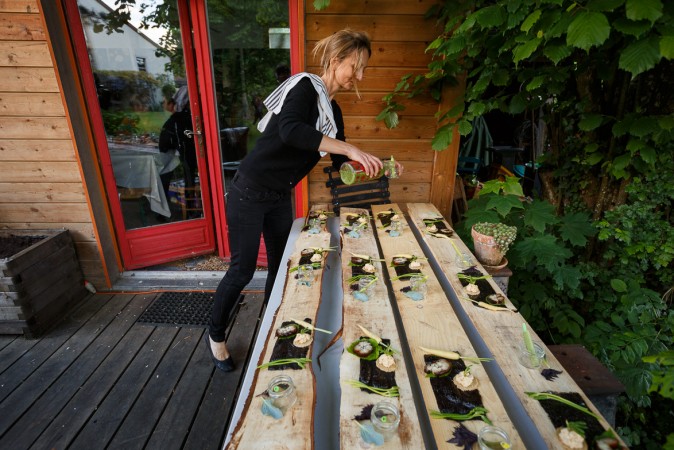
Jane Le Besque hosted a “mesolithic dinner” on June 30, 2013, in her home in the Pays de Gex just over the border in France, an event sponsored by Slow Food Geneva. The dinner was cooked using ancient flavor combinations and techniques, and served on split logs onto which slate plates were placed and used as plates.
Although Jane’s dinner was labeled “Mesolithic”, it was indeed much more than that. She covered the evolution of food from the post-glacial hunter-gather periods, through the Mesolithic and Neolithic, and going on to the Ancient Greeks and Romans, centering on Europe.
It started with the Mesolithic era, with an assortment of coastal and lake fish, eel, root vegetables and wild greens. The meal then slipped in to the Neolithic era with galettes made from ground lentils, peas and barley, served with spit-roasted boar. The menu ended with an Iron-Age “travelers pack” of dried fruits and dried-porridge slices fried in cumin and butter. The Bronze Age brought blue cheese and butter.
Drinks consisted of mead, more often referred to as “honey wine,” more in the style of the ancient Greeks and Romans than of more ancient peoples, and beer.
As a reminder, the Mesolithic Age refers to the pre-agricultural period between 10,000 and 5,000 BCE in Europe, and variations of this period in other parts of the world. The term “pre-agricultural” is key in understanding what ingredients were available. The three terms paleolithic, mesolithic and mesolithic refer to what is generally called the “Stone Age,” i.e. the post-glacial hunter-gatherer period, when humans started to use stone tools and food was gathered rather than farmed.
During the early Stone Ages or paleolithic (2.6 million years ago to around 10,000 BP), humans used some stone tools and utensils, but many tools were made from organic matter such as bone, fibers, and wood. Hunting and gathering were the chief ways of providing food. During the neolithic, starting around 10,200 BCE and ending between 4,500 to 2,000 BCE, depending on the location, we saw the beginning of farming. The mesolithic overlapped the other two ages, once again, at different times in different places. Metal tools brought these three Stone Ages to an end.
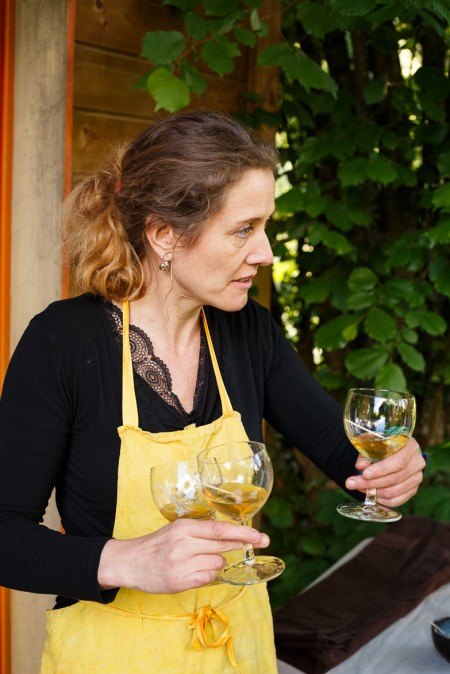
Jane Le Besque, artist and Mesolithic chef, serving mead
Early Stone Age cooking was generally on leaves or directly over the embers, although clay cookware has recently been found in China dating from 19,2000–20,000 years ago, during the ice age. Stone Age plates usually consisted of a rock or other flattish surface found in nature, such as the flattened split logs Jane used in the same manner as we use wooden tables today. Earthenware did not appear on the dinner table until much later.
What did they eat? Pretty much whatever they found and killed that was edible: meat, fish, wild plants. The specifics of this depended on the location, climate and season. Meals included the day’s finds. This might consist of berries, wild greens and other wild vegetables and plants.
Meat and later fish were not an everyday affair. They were difficult to come by and difficult to preserve, depending on the location (salt was found in Romania as early as 10,000 years ago). Stone Age people ate very little grain, since agriculture didn’t exist yet. Hazelnuts and other nuts were often roasted, and stored for winter. Wild boar was common; dairy products and cheese were on the menu, although a limited variety.
Jane Le Besque lives and works with her family at the foot of the French Jura, a few minutes from Geneva, in the foothills of the Jura mountains.
She was born in England and has a Breton grandfather, hence the name. Since graduating from Birmingham Art College in 1986, she continued her studies at l’Ecole des Beaux Arts in Paris. She afterwards lived and worked in Toulouse, London, and now outside Geneva.
Jane has always painted. She is her happiest walking through the woods and gathering berries, mushrooms, acorns, flowers and leaves to use in her cooking and painting.
One might say Jane has been interested in mesolithic cooking even before she learned the word. As a child, she spent her time gathering the wild things she now uses in her paintings, making dresses out of them.
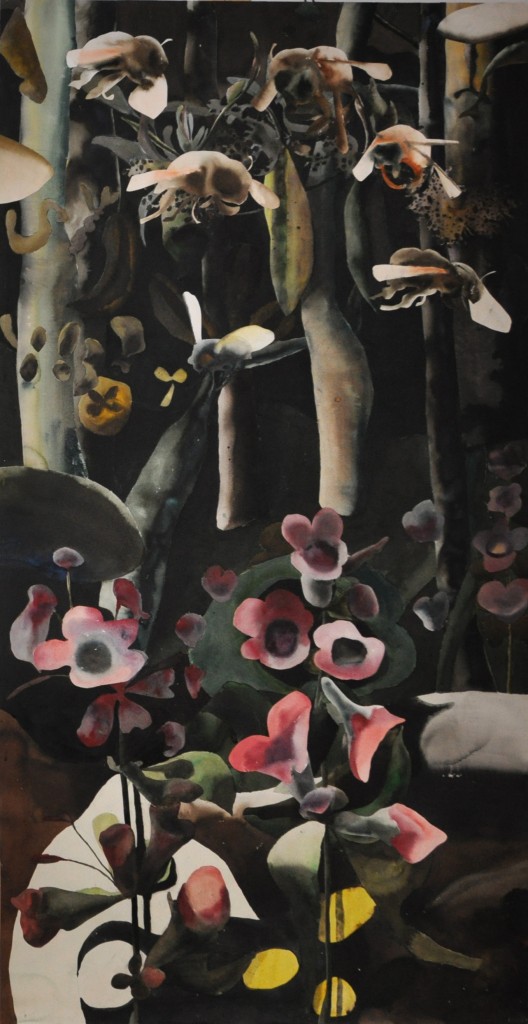
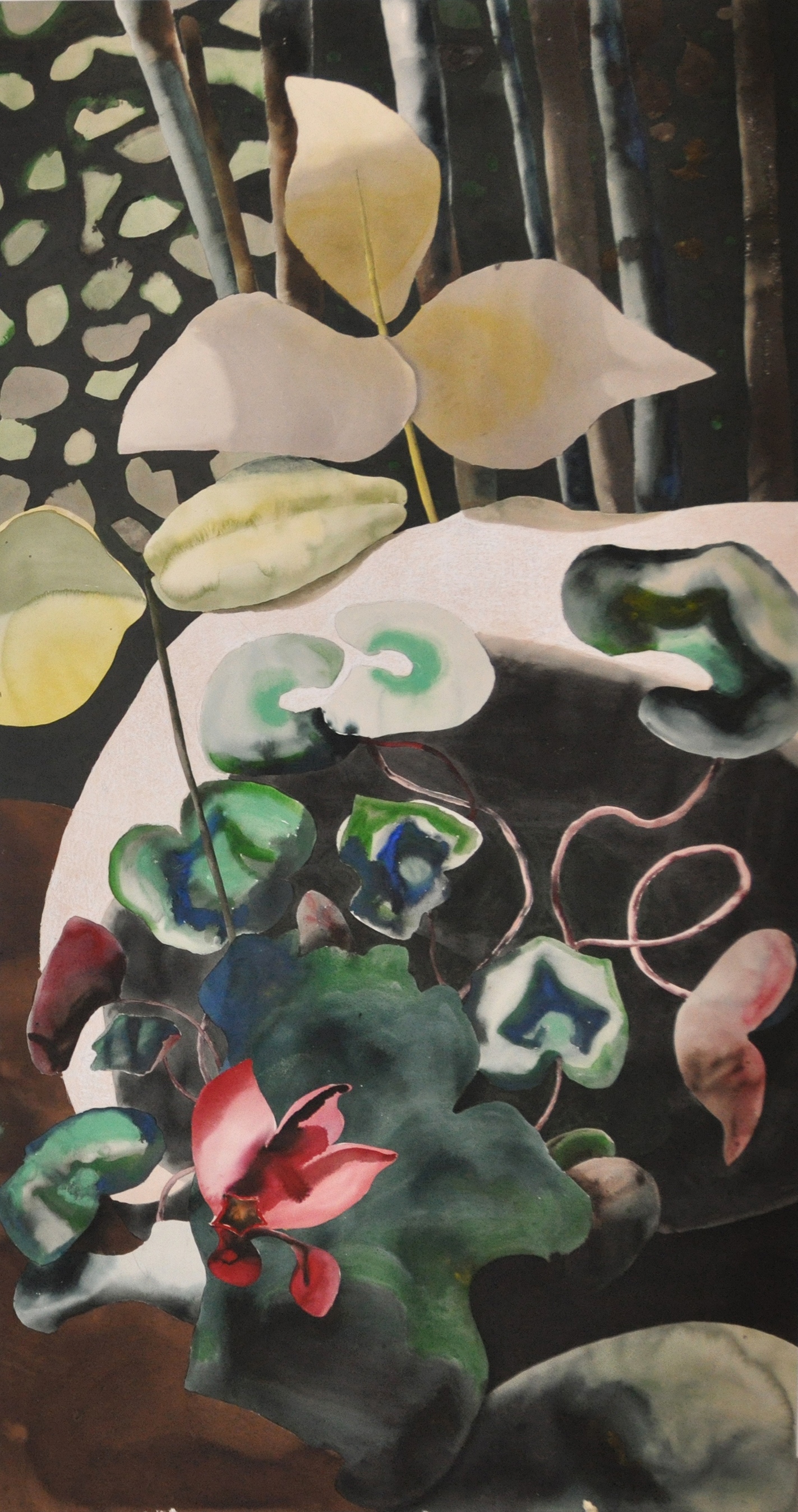
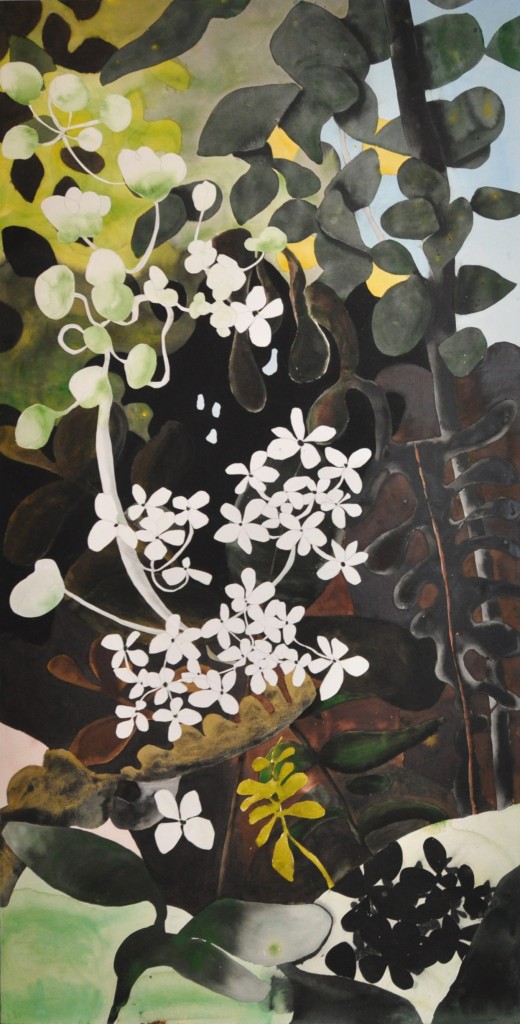
Her paintings are an intense reflection of her “gatherer” spirit. The Mesolithic dinner was held in her studio, lined with her paintings of flora of all types.
|
|

Click here to read more about Thomas Needham’s contemporary paintings and biography, for sale on his website.
|
|

|
|

“What is of note, is the survival of the arts within the walled ghetto. John Hersey’s masterpiece novel, The Wall, based on actual diaries (Emanuel Ringelblum), show the arts being practiced; theatre and music and fine art within a ghetto atmosphere mortified by repetitive eve of destruction. The record left by ghetto dwellers, camp internees, and displaced persons create snapshots of life and death under Hitler. Inmate drawings and paintings were legitimate articulations of man’s inhumanity and cruelty,” says Dave in Art of Insurrection and Resurrection.
|
|

See more of Clinton T. Hobart’s work on this site.
|
|

Maria Vos was a Dutch still life and landscape painter who lived from 1824 to 1906.
|
|
 Meet Jonell Galloway, a freelance writer and editor specialized in French cuisine.


