In this brief history of the sandwich, you’ll learn that a sandwich is an extremely versatile and universal food item consisting of two slices of bread in the middle of which is encased a filling, or of a single slice of bread garnished with a topping (tartines/bruschetta, smørrebrød, canapés, etc.). In both cases they come in an infinite number of varieties that differ in flavour, style, texture and size.
The origin of the term dates back to 1762 and saw the light of day in East Kent, England. According to legend, John Montagu aka the Fourth Earl of Sandwich was so busy gambling that he did not want to stop his activities in order to dine, so he ordered the waiter to bring him slices of roast beef enclosed in two wedges of bread. In this way, he could continue playing while eating and would in no manner dirty his fingers. That is how this quick and improvised snack became known as “sandwich”.
Even if the Earl gave his name to this popular “speciality,” it is to be said that bread has been served with meat and/or vegetables for centuries before this “invention” and that its forefather probably already existed in Neolithic times with the advent of the domestication of wheat. The first form of sandwich is attributed to the ancient Jewish wise man Hillel the Elder (~1st century B.C.) from Babylon who apparently put meat from the lamb sacrificed for Passover and bitter herbs (horseradish, chicory, sow thistle, eryngo, and lettuce) between pieces of matzo (kosher cracker-like, unleavened bread). Another genre of sandwich was common during the Middle Ages: thick slabs of stale bread called “trenchers” were used as plates and can be regarded as the precursors to the open-faced sandwich.
At the beginning, sandwiches represented a humble and simple lower-class meal, but by the middle of the 18th century, the aristocracy started serving them as a late-night collation, and they were considered very chic. Then with the breakthrough of the Industrial Revolution in the 19th century and its hordes of restless workers slaving away in factories, sandwiches became a working-class luncheon, since they were practical, easily accessible, nourishing (calorific), inexpensive, portable and could be eaten in a rush.
After having first appeared in England as well as Spain, the sandwich rapidly spread through the rest of Europe and the United States, where it was first promoted as an elaborate main dish. The 20th century saw the rise of the sandwich in the U.S. and the Mediterranean when bread became an indispensable component of people’s diet and started being consumed in much larger quantities than in the past.
We think of taste as something universal that we have in common with all (or most) human beings, as a mechanical and chemical process that requires no thought. If we could measure the data that goes into our final judgment about the taste of a food, we’d likely be in for a shock. Perhaps surprisingly, our subconscious also plays a major role in what we like or dislike, and we use all our senses to determine this.
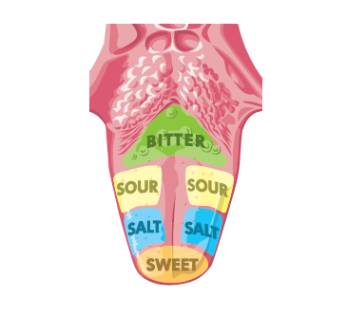
Traditionally, when we study the four elements of taste, they are presented as follows:
There is no need to explain these. We are all familiar with them.
Today, taste specialists have added a fifth to that list: umami. Taking its name from Japanese, umami is a pleasant savory taste occurring naturally in many foods, including meat, fish, vegetables and dairy products. It is subtle and blends well with other tastes to expand and round them out. Some researchers, such as Adam Hadhazi, think there are even more tastes to be added.
But in reality, taste or flavor involves all five senses. Yes: sight, hearing, touch, taste and smell.
Some researchers, such as Gordon M. Shepherd, would have it that what we most often refer to as “taste” is in fact flavor, and that flavor is largely made up of what he calls “retrosmell”. It is true that in the past we were taught that primates lost touch with their sense of smell when they started holding their heads upright, far from the ground, and standing on two legs instead of four, but today, that is called into question. Shepherd is the one who challenged this long-held premise back in 1974.
Retronasal smell, also known as “retrosmell” or “mouth-smell”, is an addition to the conventional teaching about taste; it is an integral part of flavor. Retrosmell takes place while you’re chewing and swallowing, as well as while you’re breathing. When you exhale, you draw “chemicals released by the food into the nasal cavity, where they are sensed and transmitted to the brain,” says Medical Discovery News. It is what defines the aftertaste that stays in your mouth after sipping a good wine, for example.
I have lived much of my life through what I like to call “full-sensory taste.” Of course, I consider sour, sweet, bitter and salty, but the other senses also come into play. When I read a good restaurant menu, I focus on individual ingredients and can quite easily conjure up the final combination of flavors, i.e. taste, a dish will have. Just as when I shop, I first see the ingredient, then I might imagine how it sounds in my mouth (yes, I really do that). This is usually a function of whether it is crunchy, in which case it makes quite a lot of noise, or whether it is creamy, and spreads over the tongue and goes down smoothly (umami comes in here). I even like to touch certain ingredients, such as tomatoes, to see whether they are firm or mushy, or cereals, to make sure they’re still crisp.
On principle, I always smell vegetables and fruit before buying. Though today’s strict standards and expectations on the part of customers are largely visual, looks do not tell the entire story. A tomato might well be perfectly red, round and standard in size, but I know from experience that real tomatoes that you pick from the garden are not perfect to look at, and it is not this so-called “perfection” that determines the taste. As my best friend’s mother used to say, “Art is never perfect, and don’t forget that.” And thus is nature.
From my grandfather’s garden I bring in another element of taste: nostalgia. I will forever associate the chlorophyll-filled smells of the fresh vegetables and fruits from his garden with a sense of well being. I remember getting on my knees to smell the tomatoes before I picked them, like an animal with my nose close to the vines. After we’d finished harvesting for the day, with sweat on our brows, I’d sit on his lap under the shade of trees and drink ice water, his blue eyes sparkling in the sun as he laughed. I’d often hear my horse neighing in the field next door, see the horse barn in the distance. The stifling heat of the Kentucky sun would from time to time be broken up by a breeze that came suddenly out of nowhere, lasting only a few seconds, just enough to help evaporate our perspiration and bring with it a waft of horse sweat. When we finally carried our harvest into the house, my grandmother would start preparing dinner, changing those fresh scents of chlorophyll into seasoned scents of the traditional Kentucky dishes she mastered. The ensemble — all the sensory input and all the partly subconscious thoughts and feelings from these days gone by — is my definition of a perfect time and place and world, as simple as that may seem. It was a full-sensory experience, existing now in the form of subconscious associations that are totally my own, associations that form my likes and dislikes.
When I walk through the farmers market, I use all my senses and some nostalgia too. First I look, filtering out what experience tells me is not fresh or of good quality. I “create” dishes in my mind, “using” the ingredients that seem freshest and imagining the flavor of those ingredients together. It is a full-sensory experience. I imagine the crunchiness, unctuousness, aroma, the acidity, saltiness, bitterness, sweetness, umami. Associations from the past often rush in without me being conscious of them. It’s like a sentence from Proust. In one very long sentence, Proust takes you through all the senses and sometimes back again, and time is suspended, letting them all blend together to make an astonishing whole that is forever your own. This passage, quoted often, is just one example:
And soon, mechanically, weary after a dull day with the prospect of a depressing morrow, I raised to my lips a spoonful of the tea in which I had soaked a morsel of the cake. No sooner had the warm liquid, and the crumbs with it, touched my palate than a shudder ran through my whole body, and I stopped, intent upon the extraordinary changes that were taking place. . . . I was conscious that it was connected with the taste of tea and cake, but that it infinitely transcended those savors, could not, indeed, be of the same nature as theirs.
Proust is, of course, referring to the conscious pleasure that comes through the senses, to which is inevitably added subconscious associations.
To sum it up, when you bite into a potato chip, you start by looking at it to see if it looks appetizing. When you put it in your mouth, you feel the crunch with your teeth (touch) and you hear it. You taste the salt; you taste and smell the flavoring, and it may well have a retrosmell, a taste/smell that lingers in the back of your mouth, even after you’ve swallowed it. All this gives you an idea, often formed from the past, of what it should be like in your mouth. If that “historical” expectation is not met, you probably won’t like the chip.
From this perspective, flavor in the traditional sense of the word takes on a whole new complexity. The traditional elements of flavor are combined with signals and messages from the other senses and with nostalgia and other subconscious associations. Our likes and dislikes become, like Proust’s description, a rich, unique blend of all these elements. There are indeed objective elements, but these cannot stand alone in producing the astonishing whole that is your own, which no one in the world has perceived exactly in the same way. Tasting becomes a moment suspended in time, a moment that is yours and yours only.
In this series of articles, we will explore these elements of full-sensory taste.
Don’t take any recipe on faith. There are some hostile recipes in this world.–Peg Bracken
One might say Ruth Eleanor “Peg” Bracken was an “anti-housewife”. She did what was necessary to take care of her family, who she loved very much, but did her chores “as seldom as possible.” Bracken wrote a series of humorous books on cooking, housekeeping, etiquette and travel, always conveying her point of view in a witty manner, which many housewives of the 60s related to. Her most well-known book out of the nine she wrote is the 1960 The I Hate to Cook Book. Bracken is quoted often.
You are the soup and the fish,
the buttered crumpet and the tea.
You are the cook at the brothel’s stove
and the bubbling beans in the pot.
You are the great eater of the beef,
and the lobster trembling for life.
However, you are not the cheese of the poet,
the hell of the spinach,
or the apples of Eve.
And you are certainly not the Quangle Wangle’s tree.
There is just no way that you are the Quangle Wangle’s tree.
It is possible that you are the sauce to dress the goose,
maybe even the restaurant in Baudelaire’s head,
but you are not even close
to being the grape of Beulah at dusk.
And a quick look in the mirror will show
that you are neither the fat of the child-pig
nor the past alive as madeleine.
It might interest you to know,
speaking of the plentiful imagery of the world,
that I am the corn who’s better than sex.
I also happen to be the hencod’s roe,
the small green face of the freshly shelled green pea,
and the hunger for fried fish in the open air.
I am also the parsley that is gharsley
and the goblin’s cry of fruits.
But don’t worry, I’m not the soup and the fish.
You are still the soup and the fish.
*Lines from Sydney Smith, J.C. Masterman, Polly Adler, Martial’s Epigrams, William Shakespeare, Samuel Beckett, G.K. Chesterton, E.B. White, Lord Byron, Edward Lear, Alice B.Toklas, Baudelaire, Mae West, Charles Lamb, Proust, E.S. Gaskell, Garson Keillor, James Joyce, William Wallace Irwin, Mark Twain, Ogden Nash, Rosetti.
This poem was previously published in Best American Poetry.
_________________________
Karen Resta has had an interesting career history, one part as Executive Chef for Partners Dining at Goldman Sachs in NYC, and another as VP for Goldman Sachs NYC. Her writing can be found at eGullet, The Culinary Media Network, Serious Eats, Book of Rai, Christian Science Monitor, One Million Stories and Rose Red Review.
Cookery is naturally the most ancient of the arts, as of all arts it is the most important.–George Ellwanger, Pleasures of the Table, 1903
George Ellwanger was a prominent horticulture scientist, born in Württemberg, Germany. Ellwanger immigrated to the United States, settling in Rochester, New York, where he and Patrick Barry formed the Mount Hope Nursery (also known as the Ellwanger and Barry Nursery) in 1840. In 1843, the nursery began publishing catalogs to increase sales.
Translated from the French and adapted by Jonell Galloway. Cliquez ici pour la version française.
If you ask an artisan bread baker who is passionate about his work from where he derived his passion, he or she will almost invariably reply, with no hesitation, that it arose out of the “mystery of the fermentation.” Did you know that bread is the result of an alcoholic fermentation, and the baker therefore actually manufactures alcohol? Now how does that come about, you might ask?* (If you’re interested, read the very technical footnote below.)
It’s not really surprising that a bread baker shares the wine maker’s penchant for the processes of “alteration,” “deterioration,” and “transformation,” which make them both somewhat sorcerers, metaphorically speaking. While a baker talks about bread fermentation, the wine maker continually refers to “maceration,” and the cheese maker to “maturation.” But whether it consists of alcoholic or lactic fermentation, we are still talking about transubstantiation, a sort of “sacrament,” which creates an aura without parallel around these “artists”. They are aware of this, and they know it is at the very heart of their art. Bread baker, cheese maker, wine maker: they all fight the same battle, that of transformation of food, of true metamorphosis.
When does dough become bread?
At the same time, at what point in this long sequence of processes does the product we actually consume merit the name “bread”? This is not an easy question.
In most of our minds, bread is a loaf or a baguette; it is ciabatta in Italy and pumpernickel in Germany. In Iran, they call it sangak, in Denmark, rugbrød, in Jamaica, bammy, eaten straight out of the oven.
Can we call the fat roll of dough after kneading and shaping or left to rise “bread”? Is the dough left to ferment in the dough trough not already bread?
The large sacks of flour that the miller delivers every morning, are they not, in some ways, already bread? Is a grain that we mill, or even a seed that we plant, not bread? Is leftover bread, bread we let dry, whether on purpose or not, and that we use to make croutons for a thick winter’s soup that we lap up like a Jacques Brel song, not also bread?
This 7 Lives of Bread column will explore every facet of bread, walking you through all the phases of transformation, from seed and grain to the end product you savor.
The 7 Lives of Bread will trace the life of a loaf of bread, from its “birth” to its “death”. Bread is therefore:
The grain prepared for milling.
The flour that results from milling.
The dough that seals the coming together of flour and water, a meeting that starts the fermentation process.
The dough roll that is detached from this initial bulk of dough, and then starts down its own individual path.
The dough roll when it is baked in the oven.
The bread we choose at the bread bakery, or the bread we make ourselves.
Stale bread, that can be baked again (the term “biscuit” means literally, in French, “cooked twice”, in the spirit of Melba toast) so as to conserve it for future use.
The latter is typically the bread of sailors and nomads. The Greeks – great seafarers — are given credit for having invented the double cooking process.
The 7 paths: in the sweat of thy face shalt thou eat bread
In the 7 Lives of Bread, we will explore all seven paths of these seven “lives”. If fermentation is at the very heart of bread baking, it can also be considered that all steps – from the cultivation of wheat and milling to the actual bread making itself – are active participants in the transformation process.
This concept is aptly put in Genesis 3:19: In the sweat of thy face shalt thou eat bread, till thou return unto the ground; for out of it wast thou taken: for dust thou [art], and unto dust shalt thou return.
Bread is therefore to be taken in like mother’s milk, earned with the sweat of our brows. Symbolically, it is interesting to attempt to understand why bread has a price, the price of transformation or of conversion: the bread changes to the same degree as the man or woman who makes it.
If we look at it in this light, for ten thousand years now, it is as much bread that has shaped humankind as it is the hands of women and men who have shaped bread. The realization of this reciprocal shaping and, through it, conversion is the starting point of this column.
*The chains of starch (complex carbohydrates, which along with gluten constitute the essence of the endosperm or starchy kernel and quantitatively speaking, the essence of the wheat grain), under the action of enzymes or amylases, are broken down into simple glucose (C6 H12 O6), which is, in turn, converted by yeast or enzymes into either carbon dioxide (2CO2) and ethanol or ethyl alcohol (2C2 H5 OH) and energy.
Jean-Philippe de Tonnac is editor of the Dictionnaire Universel du Pain or Universal Dictionary of Bread, published in French by Éditions Laffont on October 16, 2010.
Les sept vies du pain / The 7 Lives of Bread Click here for English version.
Si vous demandez à un artisan boulanger passionné par son métier de vous dire où s’origine sa passion, vous verrez que la plupart du temps, la réponse qui vous est faite a trait de près ou de loin au « mystère de la fermentation ». Saviez-vous que le pain est la résultante d’une fermentation alcoolique et que le boulanger est donc une sorte de fabricant d’alcool ? Comment cela ? Voyez la note *
Pas étonnant alors qu’il partage avec le vigneron ce goût des « corruptions », « dégradations », « transformations » qui fait d’eux des apprentis sorciers. Si le boulanger parle de « fermentation panaire », le vigneron évoque, lui, la « macération », quand, de son côté, le fromager mise sur l’ « affinage ». Mais qu’il s’agisse de fermentation alcoolique ou lactique, nous sommes bien rendu au lieu d’une transsubstantiation qui confère à ces artistes une aura sans pareille. Eux le savent et c’est là que se concentre l’essentiel de leur art. Boulanger, fromager, vigneron : même combat, celui des mutations et métamorphoses alimentaires.
Il est en même temps bien difficile de déterminer, dans la longue séquence de la panification, où se trouve le pain ? Le pain est, très probablement, cette grosse miche, ou cette baguette, ou cette ciabatta (Italie), ou ce pumpernickel (Allemagne), ou ce sangak (Iran), ou ce rugbrød (Danemark), ou ce Bammy (Jamaïque) qui sortent du four. Mais n’est-il pas aussi ce pâton posé sur le tour après façonnage ou laissé en repos dans le parisien ? N’est-il pas cette pâte laissée à fermenter dans le pétrin ou en bac (pointage en masse) ? N’est-il pas dans ces sacs de farine déposés le matin même par le meunier dans le fournil ? N’est-il pas, en amont, un grain qu’on écrase, voire même un grain qu’on sème ? Et en aval, un pain qu’on a laissé, intentionnellement ou non, sécher et qui termine ses jours dans une soupe épaisse dégustée, comme dans la chanson de Jacques Brel, avec des grands « slurp » ?
One by one things fall away,
everything but the sweet earth itself.
Already this year he has watched the nest’s
careful brush of twigs lose a summer song.
He leans his bicycle against the tree.
Tuscany never changes, they say, but the mountains
seem smaller, each season, as he goes north
toward Pietrasanta. Only carciofi remain the same, clustered
to the earth. Year after year, this time, the tough fruit
is left for the last of those who want it.
My grandfather picks them here, although he
is not a farmer, he knows where on the stem
to reach. A scholar who saw the world as
a work of art, he holds them like this,
carries them back to his small apartment
past the piazza, behind the University wall.
Pisa. Can you see the dirt on his hands, as he
cups them close, their hard skins,
dusty particles beneath his nails.
What moved him to hunger, and when, that night
we can’t know, but that he ate carciofi, the diary
reveals; a plant flavored with olive oil.
Maybe after the lamp was lit, a tiny flask
of oil was brought out, pressings
from a vat near Granoia. Adding
salt from a bowl, the mineral
makes a fragrance rise, enough to move him to
open the small window and, by luck, hear a nightingale.
Later he will lean over his drawings. But right now he
puts the finished leaves in a bowl. This is the man who
imagined the gas-driven tractor which would
someday ride the fields of uneven ground.
Tonight there is only the vision of a vehicle
in his head, for he feels refreshed after dining.
How strange to rest, brushing his hand across the
linen, smudging it, without thought. ll paese della meraviglia. He will
visit the farmer again, take from his fields,
But for now the mind feasts on what the eye has
seen, villas with ochre walls, pink terra cotta roofs,
factories with old doors, the ride out of town
pedaling past olive groves, apple trees pinned against
fences, pruned grape vines ready to burst,
covers pulled taut over seeded ground, the sun
to the sea, peaceful snow on the mountains.
Everywhere he looks, the land ready for a new way to harvest.
————————————————————————–
This poem was originally published in Water on the Sun.
This poem was originally published in Ocho #8 (goss 183:: Casa Menendez) and Sounds Like Something I Would Say (Casa Menendez).
Grace Cavalieri is the author of several books, and produced plays. Grace edited, along with translator Sabine Pascarelli,The Poet’sCookbook; Recipes from Tuscany (Bordighera Press, 2009,) and The Poet’s Cookbook: Recipes from Germany (Forest Woods & Goethe Institut, 2010). Her new books are Navy WifeandSounds LikeSomething I Would Say (Goss 183::Casa Menendez, 2010.) Previously published is Anna Nicole: Poems, winner of the 2009 Paterson Award for Literary Excellence. She’ produces “The Poet and the Poem,” now beginning its 34th consecutive year on public radio. Her new play for children, ”Lena’s Quilt,” premiered in NYC libraries and museums, 2010 and is now running in the 2011 Harlem Renaissance Production in New York City.
Photo of artichokes courtesy of Xedos 4.
The Fundamental Interconnectedness of Wine, Food and Art and Just About Everything Else That’s Good
by Jonell Galloway
From the archives
As Shelly Butcher so aptly said in her article “Welcome to the Borscht Belt, exploring the ‘fundamental interconnectedness’ of all things food,” there is a fundamental interconnectedness in food and it can extend beyond the bounds of food, to things related to art de vivre, wine, aesthetics and the whole ambiance, as the French might say. I think most of us would agree that the French and Italians do it best in the Western world, and we all busy ourselves trying to imitate them. Once the bond is made through food and wine, it often remains and blooms into something bigger and more far-reaching.
My very special story is about how my husband Peter White and I met David Downie and Alison Harris.
My husband is a master at planning trips. He always chooses the perfect B&B, which often happens to be a castle or palazzo or some kind of wonder, with an idyllic view, and of course a long list of perfect restaurants to go along with it.
This summer we took the children to Burgundy for a week, and while in Beaune, where we were staying at one of his perfect B&Bs, Les Jardins de Loïs, a little paradise right in the heart of the city, I picked up a book called Wine Food Burgundy in the study. It’s a guidebook, but quite frankly, if you love good writing like we do, you can read it for the pure joy of style. Over the next few days, every time my husband put it down, I picked it up, and vice versa. I won’t say we fought over it, but we both kept our eye on it at all times, as if it were a precious gem we had to keep watch over.
When we returned home to Geneva, I promptly looked up the book and the author, David Downie, and wrote a comment on his site.
The next day, two amazing things happened. First, I realized that I had stupidly left my jewelry box at Aux Terrasses in Tournus. Secondly, the owner of Loïs telephoned my husband to say that the writer of Wine Food Burgundy wanted to contact us. He and his wife were spending the summer in their country house near Cluny (and near Tournus). And the most amazing part of it all is that since we had to drive back to Tournus to get my jewelry, we decided it was in the stars. Somebody somewhere meant for us to meet.
So Peter and I drove to Tournus, had a lovely lunch with David and Alison at Aux Terrasses, and we’ve been in contact ever since.
Descending the hillside,
After days of drizzle
The weeds trampled down in preparation
Drying out between the bramble
I arrive to gather the bounty
Blackberries, true gems of deep purple
And shining red in promise of another raid
Tomorrow, for now the sun is gentled in July
By the soft wind and departed rain,
Woven into new clouds above me
As I weave along the hillside, remembering
My mother’s nimble fingers
Filling a metal bucket so quickly on other hillsides.
For this task alone she donned men’s work pants,
Which fitted her awkwardly around her belly
That had carried six of us into the world
While she gathered in the fruit she would sometimes remember
Beaux from long ago and an early marriage ended by untimely death.
“He treated me like a woman.,” she would always say
And I would sigh in regret because I knew it meant
My own father just took her long toil and good heart for granted.
And perhaps so did I as a child, but now remembering
Her blackberry dumplings, I feel that she was even more than a woman
Nearly a goddess I was lucky enough to have been granted the privilege to call mother.
Blackberries which ripen in July, her birth month always will be her token to me.
And I pluck them and eat them and sometimes make jam for cake at Christmas
All in memory of her immeasurable bounty that continues though she left all toil behind long years ago.
And the little toil I expend gathering the fruit is simply a little line to her great work ended yet unending forever.