Simon Says: Daily Food Quote, July 20, 2011

Published by Wednesday, July 20, 2011 Permalink 0

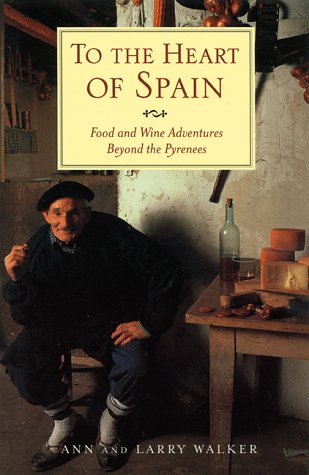
Of course, the food is important. The quality and variety of food is so important to the Spanish generally that it is said they spend a higher percentage of their disposable income on food than any other industrial nation. It is not because the cost of the food is higher in Spain than it is in France, Canada or Australia, but because the Spanish expect better food and a greater variety of it.–Ann and Larry Walker, To the Heart of Spain

Ann and Larry Walker are the authors of 6 books on food and wine, and regular contributors to numerous publications in the U.S. and abroad. They live near San Francisco in California.

Never miss a post
Name: 
Your email address:*
Please enter all required fields
Correct invalid entries

David Downie: Guanciale: An Obituary and a Homage to Rome’s Jowl Bacon, Part 1

Published by Tuesday, July 19, 2011 Permalink 0

by David Downie

Click here to read part 2

The inimitable guanciale — Italian “jowl bacon” — made for over half a century by the Carilli brothers in Rome is dead. Long live Rome’s guanciale!

Purists insist that without guanciale it’s impossible to make the true versions of the pasta sauces carbonara (olive oil, butter or lard, eggs, black pepper, pork jowl, and pecorino romano), gricia (subtract the eggs and black pepper, add hot chili and wine), or Food Wine Rome (add tomatoes to gricia).

But guanciale also finds its way onto bruschetta and into soups as well as myriad other pasta sauces, vegetable medleys, frittatas, poultry, beef, and pork. To my knowledge, the only course of a Roman meal in which guanciale does not appear is dessert.

C’ho passione! C’ho passione!” — “I’m passionate, I’m passionate!” sang white-haired pork butcher Salvatore Carilli when I interviewed him a few years back.  When I asked him about the trade his  family has been in for more generations than he can tell me, with paternal pride, the wiry and excitable Carilli, the eldest at 72 of three butcher brothers, thrust a wizened, pepper-dusted, triangular two-kilo hog jowl into my hands. He had cured it in dry salt and air-dried it for months.

Continue Reading…

Never miss a post
Name: 
Your email address:*
Please enter all required fields
Correct invalid entries

Simon Says: Daily Food Quote, July 18, 2011

Published by Monday, July 18, 2011 Permalink 0

by Simon de Swaan

I don’t altogether agree that a plain green salad ever becomes a bore — not, that is, if it’s made with fresh, well-drained crisp greenstuff and a properly seasoned dressing of good-quality olive oil and a sound wine vinegar. But I do agree that all this talk about ‘tossed salads’ is a bore; it seems to me that a salad and its dressing are things we should take more or less for granted at a meal, like bread and salt; and not carry on about them.–Elizabeth David, in The Spectator, 1961

Elizabeth David, food writer (1913-1992) who with wit, wisdom, and various cookery ingredients the British were obviously suspicious of, she introduced the English to fresh, flavorful fare and a sensual approach to the art of eating.

Many of her books are available in the Penguin classics series.


Never miss a post
Name: 
Your email address:*
Please enter all required fields
Correct invalid entries

Simon Says: Daily Food Quote, July 13, 2011

Published by Wednesday, July 13, 2011 Permalink 0

Grilling, broiling, barbecuing – whatever you want to call it – is an art, not just a matter of building a pyre and throwing on a piece of meat as a sacrifice to the gods of the stomach.–James Beard

James Beard, in Beard on Food, (1974). Beard was an American chef and food writer who authored 20 books and was instrumental in bringing French cooking to America in the 1950s. World Culinary Institute offers a brief biography. His legacy lives on with The James Beard Foundation.

Never miss a post
Name: 
Your email address:*
Please enter all required fields
Correct invalid entries

The art of making the most out of what is left over (in other words, what is still edible in our day and time)

Published by Tuesday, July 12, 2011 Permalink 0

Dictionnaire Universel du Painby Jean-Philippe de Tonnac, translated by Flo Makanai and Jonell Galloway

Click here to read this article in French

Review of Flo Makanai’s Les intolerances alimentaires: Cuisiner gourmand autrement (meaning literally, Food Intolerances: Epicurean Cooking with a Difference), published in French. Even though the book has not yet been published in English, we consider the information in this review helpful to an English-speaking audience.

When interviewed by Flo Makani, Nicolas Zamaria, with a Ph.D. in nutrition and director of a medical biology laboratory made a highly cogent point: “During the course of a life, 30 tons of food go through an individual’s digestive tube.” Imagine that before the era of synthetic pesticides that began in the 1930s (the word pesticide includes fungicides as well as weed and parasite killers], if there was to find a “Maginot” date, indicating an “after” and therefore a “before”, all of what that individual ingested, in other words, those 30 tons of food people ate before the 1930s, was organic. Yes, organic, without making any big deal about it! This was simply because farmers were not yet able to “rectify” nature’s big homeostatic equilibriums and therefore to endanger them. Today, rightfully, we are entitled — and in desperate need — to ask ourselves how that same digestive tube will treat the truly problematic situation, from a nutritional point of view, of the 30 tons of food it takes in these days. Because, of course, apart from the organic-labeled products (in France, 2.5% of the total cultivated area was devoted to organic farming in 2009), nothing else is organic anymore.

Continue Reading…

Never miss a post
Name: 
Your email address:*
Please enter all required fields
Correct invalid entries

Simon Says: Daily Food Quote, July 12, 2011

Published by Tuesday, July 12, 2011 Permalink 0

A number of rare or newly experienced foods have been claimed to be aphrodisiacs. At one time this quality was even ascribed to the tomato. Reflect on that when you are next preparing the family salad.–Jane Grigson

Jane Grigson, English food writer championed by Elizabeth David as a result of her first book Charcuterie and French Pork Cookery published in 1967 to high acclaim.


Never miss a post
Name: 
Your email address:*
Please enter all required fields
Correct invalid entries

Simon Says: Daily Food Quote, July 10, 2011

Published by Monday, July 11, 2011 Permalink 0

by Simón de Swaan

When devising a mixed salad be careful not to overdo the number of ingredients, or chop everything into small pieces, or mash them all up together into one indistinguishable morass;…–Elizabeth David, Summer Cooking


Never miss a post
Name: 
Your email address:*
Please enter all required fields
Correct invalid entries

Simon Says: Daily Food Quote, July 8, 2011

Published by Friday, July 8, 2011 Permalink 0

by Simón de Swaan

Poverty rather than wealth gives the good things of life their true significance. Home-made bread rubbed with garlic and sprinkled with olive oil, shared – with a flask of wine – between working people, can be more convivial than any feast.–Patience Gray, Honey from a Weed: Fasting and Feasting in Tuscany, Catalonia, the Cyclades and Apulia

Patience Gray was an English food writer who introduced Mediterranean tastes to Britain. She died in March of 2005. More can be read about her in The Guardian’s obituary.

Simon de Swaan, daily food quote, Simon Says. The Rambling Epicure. Editor, Jonell Galloway.


Never miss a post
Name: 
Your email address:*
Please enter all required fields
Correct invalid entries

Simon Says: Daily Food Quote, July 7, 2011

Published by Thursday, July 7, 2011 Permalink 0

In the summer there is also holiday cooking. That may well mean food cooked in an unfamiliar kitchen equipped, more than likely, in an impersonal and inadequate fashion by the owners of a house, holiday villa, or caravan hired out for the summer.–Elizabeth David (Summer Cooking, London, 1965)

Elizabeth David, British food writer (1913-1992), who helped change the way Britain saw food.


Never miss a post
Name: 
Your email address:*
Please enter all required fields
Correct invalid entries

Le grand art d’accommoder les restes (ce qu’on peut encore manger)

Published by Friday, July 1, 2011 Permalink 0

de Jean-Philippe de Tonnac

English adaptation in progress : The art of using up leftovers (or what can still be eaten)

La mise au point est faite par Nicolas Zamaria, directeur de laboratoire de biologie médicale, docteur ès nutrition, interrogé par Flo Makanai : « Au cours d’une vie, 30 tonnes d’aliments traversent le tube digestif d’un individu. » Imaginez vous qu’avant l’ère des pesticides de synthèse qui débute dans les années 1930 [le mot pesticide incluant insecticides, fongicides, herbicides et parasiticides], s’il fallait trouver une date Maginot désignant un « après » et donc un « avant », tout ce que cet individu ingérait, autrement dit ces 30 tonnes d’aliments, était bio. BIO ! Vous imaginez ! Tout simplement parce que l’homme cultivateur ne disposait pas encore des moyens de « rectifier » les grands équilibres homéostasiques de la nature ou, de les abîmer. Nous sommes légitimement en droit et devoir de nous interroger aujourd’hui sur la manière dont ce même tube digestif va traiter les 30 tonnes d’aliments tout à fait problématiques sur le plan nutritionnel qui lui seront proposés. Car, bien entendu, en dehors des produits étiquetés « bio » (2,5% de la surface agricole utile en France était consacrée en 2009 à l’agriculture biologique), plus rien n’est bio.

Continue Reading…

Never miss a post
Name: 
Your email address:*
Please enter all required fields
Correct invalid entries

UA-21892701-1