Do you know this painting? Well, here’s the recipe

Published by Friday, July 1, 2011 Permalink 0

by Miriam Garcia

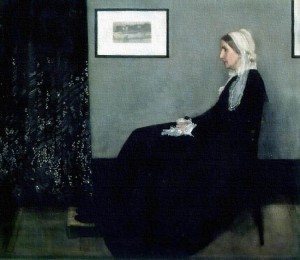
Do you know this painting?
Photography by courtesy of Wikimedia Commons

Its formal name is Arrangement in Grey and Black: The Artist’s Mother, but it is commonly known as Whistler’s Mother. Its creator, American artist James McNeill Whistler, happens to be one of my (many) favorite painters. In August 1995, while on vacation in London, I stumbled upon a little book with this painting grazing its front cover. It was Whistler’s mother’s cookbook, with the recipes collected by Anna McNeill Whistler (1804-1881) through the years. The recipes are recreated and annotated for the modern cook, but included the endearing original writing of Mrs. Whistler, with all its own spelling and punctuation errors. Go figure, a book that coupled two of my most serious addictions, cooking and painting. I had to buy it.

Whistler’s mother’s recipes were among a collection of books and letters that were bequeathed by Whistler’s sister-in-law to the University of Glasgow after his death. Whistler lived in Europe most of his working life. Mrs. Whistler led quite a remarkable life herself for a 19th-century housewife; she went from the United States, via Russia and sudden widowhood at a young age, to London with her son, where she recorded in her diaries visits to the Whistler household from such artists as Algernon Swinburne and Dante Gabriel Rossetti. The book’s fascinating account of the Whistler household in America, Russia and Britain offers a unique and delightful glimpse into 19th-century family life and cooking. The recipes are simple and transmit the flavors and aromas of good home cooking.

As a token of that age and to bring to the pressed 21st century some 19th century calm and simplicity, I have chosen to replicate a recipe of her apple pudding, called Marlborough pudding.

RECIPE

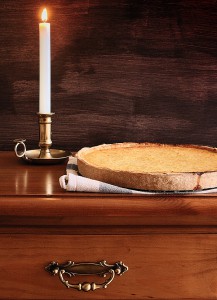
Apple Marlborough Pudding
Ingredients:

1 sheet of store-bought or homemade puff pastry or shortcrust
5 medium-sized cooking apples
1 lemon, juice and peel

200g (1 cup) sugar
5 medium eggs

200ml (4/5 cup) whipping cream
50ml (1/5 cup) whole milk

Click here for metric recipe converter

Method:

  1. Preheat the oven to 180°C if convection type, to 160°C if radiation.
  2. Prepare the pudding base: butter and flour a 30-cm (12inch) pie mold. Roll the crust, transfer to the mold and press to set. Trim the excess off the edges. Bake the crust blind for 10-15 minutes. Then take out of the oven and let cool a bit. Lower the oven temperature 20°C.
  3. Prepare the filling. Peel and core the apples, sprinkle them with lemon juice to prevent them from browning. Put them in a bowl, cover and microwave them 3-4 minutes, until tender.
  4. Transfer the apples to a food processor, add the rest of the ingredients: lemon juice and peel, sugar, cream, milk and eggs. Process to the desired “chunkiness”.
  5. Pour the mixture on the pie crust (this amount yields a large pie and a small cup of filling left) to the brim, then bake 1 hour. Watch it during the last stages to prevent it from excessive browning; lower the temperature if needed. After that baking time, take the pudding out and let cool completely.


I personally loved this Marlborough pudding. I love any dessert with apple though (well, except roast apples). It is lemony, creamy, light and only slightly crunchy. And as rustic and homely as I expected. Accompany it with a strong tea and open a snuff box for you to feel exactly like Whistler. And the next time you see this painting I’m sure you will remember that this lady baked delicious pies for her family.

Sources:
“Whistler’s mother and the West Coast”, BBC website
Whistler’s Mother Cook Book, Margaret McDonald

The Scottish Roots site says:

This unconventional portrait of a grey-garbed matron, commonly known as “Whistler’s Mother,” patiently sitting for her artistic son became an American icon and an emblem of motherhood. The subject of the painting, Anna Matilda McNeill Whistler, was born in North Carolina in 1804 to a middle class family of Scots descent.

Anna led a remarkable life for a 19th-century housewife; moving from the United States, via Tsarist Russia and sudden widowhood at a young age, to London with her son “Jemsie,” where she recorded in her diaries visits to the Whistler household from such literary and artistic luminaries as Algernon Swinburne and Dante Gabriel Rossetti. A traditional woman with a strong sense of morality, Anna Whistler upheld the conventional family values of the time, turning a blind eye to her artistic son’s bohemian amorous involvements in favour of encouraging his genius.

Widowed in 1849, she wore mourning for the rest of her life.

The book’s fascinating account of the Whistler household in America, Russia and Britain offers a rare and delightful glimpse into 19th-century family life and cooking. The recipes are simple and transmit the flavors and aromas of good home cooking.

Never miss a post
Name: 
Your email address:*
Please enter all required fields
Correct invalid entries

Wendell Berry: Daily Food Quote, June 30, 2011

Published by Thursday, June 30, 2011 Permalink 0

“A person who undertakes to grow a garden at home, by practices that will preserve rather than exploit the economy of the soil, has his mind precisely against what is wrong with us… What I am saying is that if we apply our minds directly and competently to the needs of the earth, then we will have begun to make fundamental and necessary changes in our minds. We will begin to understand and to mistrust and to change our wasteful economy, which markets not just the produce of earth, but also the earth’s ability to produce.” — Wendell Berry

Wendell Berry was born in Kentucky in 1934. He has always promoted a responsible kind of agriculture that is fully integrated into one’s everyday life. Because he promoted this vision of food and agriculture long before the Slow Food movement started, he is considered by many to have laid the foundation for the American Slow Food movement and the move toward a more sustainable and ethical agriculture.

The American Poetry Foundation says of Berry: Critics and scholars have acknowledged Wendell Berry as a master of many literary genres, but whether he is writing poetry, fiction, or essays, his message is essentially the same: humans must learn to live in harmony with the natural rhythms of the earth or perish. The Unsettling of America: Culture and Agriculture, which analyzes the many failures of modern, mechanized life, is one of the key texts of the environmental movement, but Berry, a political maverick, has criticized environmentalists as well as those involved with big businesses and land development. Berry strongly believes that small-scale farming is essential to healthy local economies, and that strong local economies are essential to the survival of the species and the well-being of the planet.

You can view his books and biography on the official Wendell Berry site.

Click here to listen to the 2-part series “Building a Slow Food Nation,” including an interview with Wendell Berry.

Never miss a post
Name: 
Your email address:*
Please enter all required fields
Correct invalid entries

Wendell Berry: Daily Food Quote, June 27, 2011

Published by Monday, June 27, 2011 Permalink 0

by Jonell Galloway

Better than any argument is to rise at dawn and pick dew-wet red berries in a cup.Wendell Berry

Continue Reading…

Never miss a post
Name: 
Your email address:*
Please enter all required fields
Correct invalid entries

Simon Says: Daily Food Quote, June 24, 2011

Published by Friday, June 24, 2011 Permalink 0

by Simón de Swaan

Food is a subject of conversation more spiritually refreshing even than the weather, for the number of possible remarks about the weather is limited, whereas of food you can talk on and on and on. Moreover, no heat of controversy is induced by mention of the atmospheric conditions (seeing that we are all agreed as to what is a good day and what is a bad one) and where there can be no controversy there can be no intimacy in agreement. But tastes in food differ so sharply…that a pronounced agreement in them is of all bonds a union the most intimate. Thus, if a man hates tapioca pudding he is a good fellow and my friend.–A. A. Milne, “Lunch” (1934)

Alan Alexander Milne was an English author, best known for his book about a teddy bear named Winnie the Pooh.

Never miss a post
Name: 
Your email address:*
Please enter all required fields
Correct invalid entries

Simon Says: Daily Food Quote, June 23, 2011

Published by Thursday, June 23, 2011 Permalink 0

by Simón de Swaan

I must….descant a little upon the mint-julep, as it is, with the thermometer at 100 degrees F., one of the most delightful and insinuating potations that ever was invented, and may be drunk with equal satisfaction when the thermometer is as low as 70 degrees.–Captain Frederick Marryat’s diary (1838)

Captain Frederick Marryat (July 10, 1792 – August 9, 1848) was an English Royal Navy officer, novelist, and a contemporary and acquaintance of Charles Dickens, noted as an early pioneer of the sea story. He is now known for a widely used system of maritime flag signaling.

Click here for a mint julep recipe.


Never miss a post
Name: 
Your email address:*
Please enter all required fields
Correct invalid entries

Simon Says: Daily Food Quote, June 16, 2011

Published by Thursday, June 16, 2011 Permalink 0

by Simón de Swaan

[A Comice pear is] sweetly and subtly perfumed…so soft it is best eaten with a spoon, a tenderness more appealing to gourmets than to those who have to pick, ship, handle and store it in constant fear of ruinous spoilage.–Waverley Root, Food

Waverly Root, author of Food: An Authoritative and Visual History and Dictionary of the Foods of the World, was an American journalist and writer, best known for the book The Food of France published originally in 1958, and is still in print today. He died in 1982. Click here to read his obituary.


Never miss a post
Name: 
Your email address:*
Please enter all required fields
Correct invalid entries

Simon Says: Daily Food Quote, June 15, 2011

Published by Wednesday, June 15, 2011 Permalink 0

by Simón de Swaan

A significant part of the pleasure of eating is in one’s accurate consciousness of the lives and the world from which the food comes.–Wendell Berry (1934-)

Wendell Berry is a Kentucky poet, novelist, essayist, philosopher and farmer. He has always remained close to the land, continuing to farm on his family farm, and this is reflected in much of his work. His most well known book, The Unsettling of America, provides a classic critique of industrial agriculture which is foundational to today’s agrarianism and a precursor of the Slow Food movement and the current food revolution taking place in the U.S.

The American Poetry Foundation says of Berry: “Critics and scholars have acknowledged Wendell Berry as a master of many literary genres, but whether he is writing poetry, fiction, or essays, his message is essentially the same: humans must learn to live in harmony with the natural rhythms of the earth or perish.”


Never miss a post
Name: 
Your email address:*
Please enter all required fields
Correct invalid entries

Simon Says: Daily Food Quote, June 14, 2011

Published by Tuesday, June 14, 2011 Permalink 0

by Simón de Swaan

How much cheese is a handful? How much more or less is a cupful? What is the capacity of a glass, a tumbler, or a soup ladle? What is the difference between a suspicion and a pinch? How much more is a good pinch? How much wine is a little, how many olives a few? When a book says a tin of chopped almonds or pomegranate juice what are you supposed to understand by that?–Elizabeth David (1913-1992), English food writer


Elizabeth David made significant contributiosn to the food world. Her book Spices, Salt & Aromatics in the English Kitchen is a classic.

Never miss a post
Name: 
Your email address:*
Please enter all required fields
Correct invalid entries

Food Poetry: Bread, by Linda Pastan

Published by Friday, June 10, 2011 Permalink 0

after Levchev


“It seems to be the five stages
of yeast, not grief,
you like to write about,”
my son says,
meaning that bread
is always rising
and falling, being broken
and eaten, in my poems.

And though he is only half serious,
I want to say to him
“bread rising in the bowl
is like breath rising in the body;”
or “if you knead the dough
with perfect tenderness,
it is like gently kneading flesh
when you make love.”
Baguette . . . pita . . . pane . . .
Challah . . . naan: bread is
the universal language, translatable
on the famished tongue.

Now it is time to open
the package of yeast
and moisten it with water,
watching for its fizz,
its blind energy–proofing
it’s called, the animate proof
of life. Everything
is ready: salt, flour, oil.
Breadcrumbs are what lead
the children home.


Continue Reading…

Never miss a post
Name: 
Your email address:*
Please enter all required fields
Correct invalid entries

How I got my recipes indexed by Google Recipe Search. A Spanish perspective.

Published by Wednesday, June 8, 2011 Permalink 0

by SandeeA

Para leer en español

How I got my recipes indexed by Google Recipe Search. A Spanish perspective.

The first thing you need to know is that I am no expert on this subject. This article is not intended to be an infallible guide, but rather a summary of the steps I have taken to succeed in getting my recipes included in the search results of Google Recipe Search.

1. What is Google Recipe Search?

Google Recipe Search is a tool Google launched a few months ago, and is already operating in Japan and the U.S. At some point it will undoubtedly be launched for other countries as well, including Spain.

Continue Reading…

Never miss a post
Name: 
Your email address:*
Please enter all required fields
Correct invalid entries

UA-21892701-1