Food Philosophy: British Economist E.F. Schumacher

Published by Friday, March 8, 2013 Permalink 0
Small is Beautiful - Economics as if People Ma...

E. F. Schumacher


A timely quote by the British economist E. F. Schumacher

E.F. Schumacher

“If greed were not the master of modern man — ably assisted by envy — how could it be that the frenzy of economism does not abate as higher “standards of living” are attained, and that it is precisely the richest societies which pursue their economic advantage with the greatest ruthlessness? How could we explain the almost universal refusal on the part of the rulers of the rich societies — where organized along private enterprise or collective enterprise lines — to work towards the humanisation of work? It is only necessary to assert that something would reduce the “standard of living” and every debate is instantly closed. That soul-destroying, meaningless, mechanical, monotonous, moronic work is an insult to human nature which must necessarily and inevitably produce either escapism or aggression, and that no amount of of “bread and circuses” can compensate for the damage done–these are facts which are neither denied nor acknowledged but are met with an unbreakable conspiracy of silence — because to deny them would be too obviously absurd and to acknowledge them would condemn the central preoccupation of modern society as a crime against humanity.”― E.F. Schumacher, Small Is Beautiful: Economics as if People Mattered

Never miss a post
Name: 
Your email address:*
Please enter all required fields
Correct invalid entries

The Low Hanging Fruit

Published by Wednesday, December 12, 2012 Permalink 0

by Alice DeLuca

As the Mayan-predicted end of the world is upon us, I am sitting on the precipice of civilization, looking at seemingly the last remaining pay phone in the world.  Pay phones used to be easy to find. They weren’t perfect. Some coin-operated telephones had broken cords, no handset, no phone book. Many phone booths had been used for unspeakable activities. Others were like a dream, with all parts intact, clean and working, the kind of place that Superman and Dr. Who might step in to, in an emergency.

When pay phones ruled the sidewalks, anyone with a dime could make a call, and if you had a pocketful of change you could talk for minutes, clanging in additional coin-of-the-realm whenever the operator “horned in” and threatened to disconnect the call.  College students shared the one pay phone on their dormitory hall to phone home. Women walking alone could seek assistance at any functioning pay phone. We knew where the pay phones were, even if we were a bit afraid of the voice of the operator, interrupting, in that all-powerful voice like Lily Tomlin’s Ernestine.

You could game the system if you were short of cash. If you called “collect” and hung up quickly after saying your name (“Will you accept a collect call from Fred?”), your friend could call you back “on their nickel.” Expats living in Paris knew that a long line of waiting immigrants standing in line by a phone signaled a phone that had been broken (now we would say “hacked”) so this special pay phone could be used for free to call home in some faraway country.

Today, the American pay phone industry claims there are just a one and a half million pay phones in existence. One hundred and forty million Americans have no cell phone, and fourteen million have no home phone either. That’s a lot of people who must still know where the pay phones are.

The pay phone was the automat of communication, but instead of opening a little door to pull out a piece of pie, as was possible at the Horn and Hardart automats in New York City, you put in your dime and presto! there was a person talking at the other end of a line. The automat, that magical drive-up window for pedestrians, is a thing of the past. So is the omnipotent “phone company,” and so is the shared experience of the pay phone.

The IPhone 5 is available now, and who doesn’t lust after its shiny, sleek profile holding a box of mysteries and enchantments? It will only cost you  $1,000 a year, all told, or ten thousand dimes. These phones work, their phone books don’t have pages missing, and they are personal and clean. But where do recent immigrants go to make a call at low cost?

And, where is the common experience that binds us all together in today’s America?

I find hope for the common experience at the increasing number of local diners run by recent immigrants, often from Central America and Brazil. At these local diners the coffee is hot, the plates are mismatched because there are no matching plates, not by design, and the prices are reasonable. The waitress prices your meal as “sides” to save any diner a few bucks.

You can tell you are in the right place because the menu includes an option of a large bowl of fruit.  Rich and poor, we all come in for the fruit. The fruit is uniformly fresh and juicy, never defrosted from a bag of institutional frozen fruit salad. Frozen melon has a squishy, spongy consistency because all the cell walls have been compromised by freezing. Frozen melon is not good, and there is nothing more to say about it. The local diner fruit bowl is truly the “low-hanging fruit”, to use a horrible term from business-speak, and I am picking it now, just before the end of the world.

To be continued…..

Never miss a post
Name: 
Your email address:*
Please enter all required fields
Correct invalid entries

My Favorite Hanukkah Foods: Grandma’s Latke Recipe

Published by Saturday, December 8, 2012 Permalink 0

by Warren Bobrow

From the archives

Hanukkah recipes are passed down from generation to generation. There are hundreds of recipes floating around on the Internet, but I thought it best to consult a friend with trained taste buds. Here is what Warren Bobrow has to say.–Jonell Galloway, Editor

My Favorite Hanukkah Foods

Of all the holiday foods I look forward to, there are two dishes that clearly connect my stomach to the past. The first is a rousing bowl of matzo ball soup. The other, specifically a Hanukkah dish, is a plate of crispy potato latkes, cooked in a heavy cast iron pan.

Ur-Bubby’s Latkes

I forewarn you. This is a Jewish story, so it is repetitive and sometimes fahklumpt (a confused story, for those who are not in the know), told by a kvetch (a complainer) who secretly loves life and food and words and work, and tells a story full of fond memories.

My great-grandmother Yetta made excellent latkes. During these eight days of Hanukkah (eight chances to get it right . . . to be exact), we celebrate the past by reliving these flavors and the stories that go with them each time we bite into a steaming morsel of grated potato, egg, onion and a bit of vegetable oil, made straight from her recipe.

Generations of cooks have grated potatoes for latkes in celebration of Hanukkah. You will not be the first or the last. And every family has their own special recipe, their own special stories.

Bubby Yetta was particularly interested in not scraping her knuckles. Even so, she used to say that if you don’t catch your knuckle on the potato grater, the latkes couldn’t possibly taste good. Something about the physical act of grating potatoes already connects me to the old days when Bubby made the latkes every evening during Hanukkah.

Onions also resonate in my memory:  the tears that ran down her cheeks as she grated the onions were not tears of joy. We heard the same kvetching every year, and carry on as we make our own history.

Every day of Hanukkah, Ur-Bubby Yetta would scrape and grate until the job was done. Much hushed conversation would follow. Were the latkes going to be good?  If not, what would we do, there was no place in those days to buy frozen latkes in the supermarket!

And with each potato and onion grated, each tear fallen, each latke fried, another memory was made. Years of latke conversation would follow . . . How about the ones we made twenty years ago? Did potatoes taste differently then, or was it a specific taste that stuck in our memories?

So careful with the grater, and accept that you’ll invariably catch your knuckle at least once, and that you may well have the battle scars to prove that you made them from scratch. And stories to tell.

Recipe

Continue Reading…

Never miss a post
Name: 
Your email address:*
Please enter all required fields
Correct invalid entries

From Tokyo: Quirk of Fate after the Quake

Published by Wednesday, November 14, 2012 Permalink 0

by Nancy Singleton Hachisu

From the archives, in celebration of Nancy Singleton Hachisu’s new book Japanese Farm Food, already on its way to becoming a classic

My Surreal Dinner at Les Créations de Narisawa Restaurant after the Quake in Tokyo

Just moments before the Great East Japan Earthquake began to shake I was thinking about food.

While making my way towards Tokyo Station to catch the bullet train back to my local area 100 kilometers northwest of Tokyo, I was toying with dropping by my regular sushi shop near Tokyo Station for a palate cleanser (to chase away a disappointing sushi lunch earlier). Though really, I was wishing I could stay in town for dinner. Alas, I knew this would not sit well with my husband as I had just gotten back a couple days earlier from a quick trip to the U.S. And I had been gone way too much this last year.

Nonetheless, the idea took hold.

That morning I had sat in on a brain storming session exploring logistics of bringing the next edition of Cook It Raw to Japan. As the talk flowed around me, my nascent desire to “experience” Yoshihiro Narisawa’s provocative Japanese-influenced French “food” swelled into an obsessive urge to eat at his Minami Aoyama restaurant, Les Créations de Narisawa that night. Impractical, crazy, costly…impossible. Or so I thought.

When the ground of the massive station building where I stood stopped rippling and the initial terror had passed, the other passengers and I all waited quietly with backs leaning against the station walls. All eyes were fixed on our cell phones in hand, trying unsuccessfully to get a signal. No one said a word.

I emailed my 14-year-old son, home sick from school that day, and got a return email immediately. The house and family were fine.

At that point I still thought the trains would be running again, because the JR announcements were telling us there had been a “big earthquake,” and to wait as they checked the train lines. I dutifully waited for 45 minutes before realizing it was pointless. And so I made my way through underground walkways to Tokyo Station and began to realize the enormity of what had just happened.

Student groups trapped on their way through Tokyo for the annual School Trip were seated on the floor as teachers gave instructions. The bullet train would not be running that day (or the next).

My first thought was getting a hotel (and that I could stay for dinner). I had already squandered a crucial hour waiting for the trains to run, so the streets had swollen with commuters by the time I surfaced outside of Tokyo Station. I only knew of a few hotels and was not sure which side of the station they were located. Tokyo Station is a massive behemoth spanning multiple city blocks. When I finally got my bearings, it was getting on towards 5pm, already 2 hours after the earthquake. The hotels were full, so I lined up for the payphone to call Les Créations de Narisawa. My iPhone battery was dying, I was getting cold, and I knew I needed to get to a safe haven to recoup my energy before the night ahead of me. I needed food and I needed good food.

It was now about 6pm. I glanced over at the hoards waiting for taxis and optimistically told the restaurant I would try to get there by 7:30, but gave them my email for contact.

I now had a destination and nothing would deter me from getting there. Nothing.

The line for taxis looked insanely long and seemed to feed in from different directions. I dithered. I stood in line for a while, still unable to commit: wait it out or find another way. I tried to gauge how long it would take by talking to others around me in line—I’m not sure what we were thinking. We somehow believed that if we stood there long enough, the taxi would take us where we wanted to go. But what exactly was, “long enough?” One hour…five?

The alternative was unthinkable. Walk.

But I didn’t have all night to passively wait. I had less than 2 hours to get to my asylum away from the massive surge of humanity that had filled the sidewalks and streets. I knew I could handle a night on the floor of Tokyo Station, but desperately needed something to ground me in the chaos. And the only thing that does that for me is a quiet room and thoughtful food.

So I set off walking. Power walking, that is.

Thanks to a fellow “traveler” met early on in my trek, I got to Minami Aoyama in about an hour and a half. We stopped one time on a pedestrian bridge over Aoyama Dori (a main thoroughfare). The vast sea of lights before us was from the cars that barely inched forward. No taxis were getting through that night. Walking had been a good decision.

A flute of champagne in hand, my iPhone charging, I heaved a huge sigh of relief. I was “home.”

For the next two hours, a surreal dinner like I had never had before unfolded. It almost seems obscene in retrospect: tree bark, tree sap…bread baked before my eyes in a small stone capsule. Unusual and whimsical morsels from land and sea played together on the equally fanciful “plates.” I was the only customer that night. Perhaps I was the only one crazy enough to take refuge in such a place. Shut off from the outside world, none of us in that hushed room of Les Créations de Narisawa really knew or understood the gravity of the earthquake and all the horror and devastation it had brought. Nor had any of us imagined the unthinkable happening as it has happened at Fukushima Daiichi.

That night at Les Créations de Narisawa, I was caught in a soft little bubble, coddled by the staff. All of us unaware of what awaited us when the bubble burst.

At 10 o’clock, I stepped back out into the brisk night and started my return voyage. Long (useless) waits for trains, a night spent shivering on the marble floor of Tokyo Station, and more endless lines later, I finally got home late the following day. And for now we are safe, though 215 kilometers does not seem far enough from Fukushima Daiichi. But hundreds of thousands of Japanese are still in shelters and many will not be able to go home for many years to come.

And in the aftermath, we try to pick up our lives. I am planting seeds for the summer and looking towards the future. I am trying to organize food for a shelter in our prefecture and to offer a family the vacant teacher apartment at our school, but the wheels grind slowly here and accepting help from outside sources means someone has to manage that. There seems to be an absence of organization to deal with donations and the shelter contacts prefer money or instant ramen over real food like a big pot of stew from farm chickens and local (non-irradiated) vegetables. But that’s Japan, it’s all about the face-to-face meeting, not phone arrangements. I suppose a road trip is in order.

 

Never miss a post
Name: 
Your email address:*
Please enter all required fields
Correct invalid entries

Culinary Chemistry: On the Technique of Brining

Published by Tuesday, November 13, 2012 Permalink 0

Culinary Chemistry: On the Technique of Brining

by Jenn Oliver

Hello and welcome to the first post of Culinary Chemistry with Jenn! I am Jenn, your resident scientist with a gluten-free husband who is curious about all things related to the how and why of cooking.  Today, we’re going to talk about brining, but each post will explore a different technique or phenomenon related to cooking/baking in the kitchen. Do you have questions or are curious about a particular aspect in the kitchen? Feel free to send me an email at jennoliver@theramblingepicure.com or on our online chat to the right of the screen, or join our Community and follow the Culinary Chemistry group and forum.

This past holiday season, families and friends gathered to share in their holiday traditions of a meal together — many of which surely included an oven-baked roast. Mine certainly did, as my husband and I celebrated our first Christmas abroad, a cozy romantic weekend together, marking our one-year anniversary since arriving to Switzerland, our current home. But just because the holidays are over doesn’t mean you have to swear off making roasts until next winter’s festivities roll around.

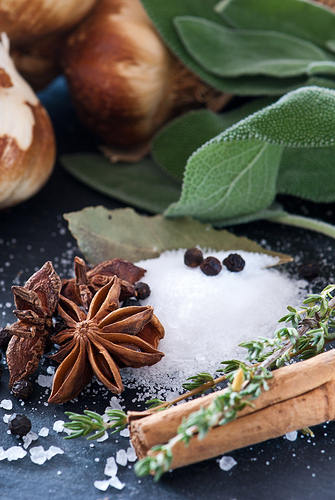
Spices for pork roast brine.


Continue Reading…

Never miss a post
Name: 
Your email address:*
Please enter all required fields
Correct invalid entries

A Look at Slow Food’s Salone del Gusto, October 2012, in Turin, Italy

Published by Saturday, November 3, 2012 Permalink 0

by Diana Zahuranec

Salone del Gusto ended on Monday 29, but I can’t stop thinking about it.

Salone del Gusto, held in Turin, Italy, is a Slow Food biannual food fair and conference. To sum it up in these few words undermines everything else it is, too, and its importance as an event that brings together producers from all over the world. These are producers that grow ancient varieties of grain to save genetic biodiversity, that make Slow Food Presidia cheeses or salumi, that pipe their cannoli full of the freshest organic ricotta you’ve ever tasted, and whose principles and values align with your own and, it goes without saying, Slow Food’s – good, clean, and fair food for all.

The Slow Food mascot

For all things Slow Food, here are some links courtesy of Scoop.it and Slow Food. To understand a few of those words in the paragraph above, just look at the end of the article.

This year, Salone del Gusto was a marriage of the original Salone del Gusto, first held in 2006, and Terra Madre, first held in 2004. While both events had food artisans and producers from all over the world, different activities were held at each and were not all accessible to the public. Salone del Gusto focused more on the exposition and sale of high quality foods and products, while Terra Madre was a gathering of a network of food producers from around the world. Having never been to either of these before, I can’t offer judgment on the differences of before and after. What I would love to do is share my first-time impressions of this year’s.

To say Salone is a food fair means that, like your down-home county fair, the place is jumping with activity – with a few notable differences. The funnel cakes are replaced with French butter cookies in 20 different flavors, the groundhog whacking game is replaced with the foodie’s (divisive word, I know) form of fun, that is vertical Barolo wine tastings, and that feeling of riding the Zipper right after you eat your funnel cake is replaced by the feeling of pressing up against crowds right after you drink your Barolo wines.

Continue Reading…

Never miss a post
Name: 
Your email address:*
Please enter all required fields
Correct invalid entries

Meetings with remarkable bakers: The baker from Kabul

Published by Friday, October 19, 2012 Permalink 0

Jean-Philippe de Tonnac

Click here to read original French version

Translated and adapted by Jonell Galloway

Dan de Mirmont, the baker from Kabul

How did it happen that you discovered French cuisine and bread making in Burma, and that today you’ve decided to teach the inhabitants of Kabul about it? This is about Dan de Mirmont’s surprising path, and the reopening of Le Bistro Bakery in October.

Ali, right, head of bread and pastry
baking, and Zobaid, left,
his assistant. Dan de Mirmont, center.

Continue Reading…

Never miss a post
Name: 
Your email address:*
Please enter all required fields
Correct invalid entries

Sauce for Thought: Coming in From the Cold – An Exploration of Soup

Published by Wednesday, October 3, 2012 Permalink 0

Sauce for Thought: Coming in From the Cold – An Exploration of Soup

by Alice DeLuca

We’re turning down the new thermostat daily, stubbornly staving off the inevitable start-up of the furnace for the coming home-heating season. It’s the hot soup season and the knitting season also, so there are reasons to celebrate. Animals are busy storing everything they can get their paws on, for a long winter of curled up dreaming. I picture them underground and know why some people covet their fur coats. My coat of choice is made from the knitted wool of sheep, and to the sheep I am grateful.

Our new Nest thermostat is “smart” in that it knows what we are doing, but we maintain the illusion of control by tweaking it via tablet technology, even from remote locations. The designers thought of everything, down to the specially designed stickers for labeling the wires during installation. We’re hoping we won’t have to fool this new thermostat in to turning on when the temperature dives like a submarine, the first week of January; nor will we be tempted to put a space heater under it to keep it warm so it won’t activate the furnace, as my father used to do with his mercury-switch driven thermostat from those days.

When the temperature drops, the Canada geese start making tracks. Often they are flying south, but sometimes they appear to be confused and fly east or north, which is because some of them winter-over. The V-formations of confused geese overhead is another clear indication that the time has come to consider hot soup.

Soup, japan dish, японская кухня, суп

Japanese soup


Continue Reading…

Never miss a post
Name: 
Your email address:*
Please enter all required fields
Correct invalid entries

What we’re reading: A recipe for American decline, food labeling in Australia, halal culinary guide, Le Marche wine and much more

Published by Tuesday, October 2, 2012 Permalink 0

by Jonell Galloway

Click here to keep up with the latest in world food and wine news.

Photo by Prerna Singh


Never miss a post
Name: 
Your email address:*
Please enter all required fields
Correct invalid entries

La Vendange: The Grape Harvest on a Small Country Estate in France

Published by Monday, September 24, 2012 Permalink 0

by Vendange

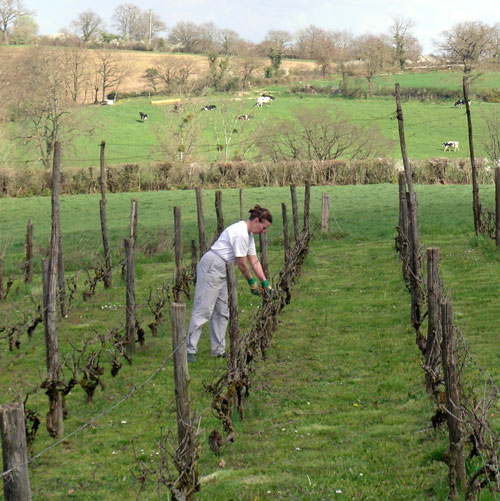
When we lived in the white wine we had vines. We were outrageously excited about the prospect of making our own wine. Of course, we were sure it would be wonderful. I mean, we had been drinking it for years, we should know how to do it, right?

Continue Reading…

Never miss a post
Name: 
Your email address:*
Please enter all required fields
Correct invalid entries

UA-21892701-1