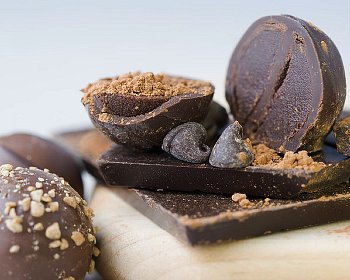
Truffles in Black and White: Part One: The Truffles of Alba, or Italian White Gold

by David Downie, with photos by Alison Harris
The Truffles of Italy’s Piedmont
In the vaulted cellars at Tartufi Morra, the longest-established truffle dealership in Alba, a town of 30,000 in Piedmont 60 kilometers by road south of Turin, manager Alessandro Bonino fielded telephone orders while sorting white truffles still clotted with soil. “Truffles are hypogeous fungi,” Bonino said, waving his left hand, “meaning mushrooms that grow underground.” Of the 60 known species, 25 grow in Italy. Tartufi bianchi d’Alba—white Alba truffles—are the rarest, most aromatic and, the businesslike Bonino confirmed, by far the most expensive.

“White truffles only grow wild and only in a limited geographical area,” Bonino explained to me. “That’s why they’re so scarce and costly, and also why the statistics on them aren’t reliable—how do you tabulate them when their surrounded by secrecy?”
Alba’s Centro Nazionale Studi Tartufi (CNST), a government-funded research agency, estimates average Italian truffle production per year for all edible species at 400 tons, including about 40 tons of premium tartufo nero (Tuber melanosporum), the black truffles of northern and central Italy, half of which are farmed. In an exceptionally good year the southwest of France also produces about 40 tons of nearly identical melanosporum, the northeast of Spain 20 tons, in both cases 80 to 90 percent farmed. Harvests for the last decade or more for Italian, French and Spanish melanosporum have been small, with wholesale prices ranging between 650-1,200 euros per kilo.

By comparison white truffles occur only near Alba and in other parts of Piedmont, and, in far smaller quantities, in the Acqualagna area of the Marches, the province of Savona on the Italian Riviera, and in Croatia, Slovenia and Hungary. In an average year about 2 tons are found overall, though, as Bonino noted, statistics are notoriously unreliable. Wholesale prices in the 2010-2011 season range from an astonishing 3,000 to 4,000 euros per kilogram, about the same as Sevruga caviar.
As with caviar, demand far outstrips supply for prized white and black truffles. Bonino sells both.
Black and white truffles are not as different as apples and oranges, according to Bonino and others in the business. Comparing them is tricky. “All truffles are mushrooms. Preference is strictly personal, a question of taste, budget and use.”
White Alba truffles are actually pale to straw yellow. They look and feel like small, warty potatoes. Their scientific name is Tuber magnatum pico. Though unwieldy the name is widely used in commerce to avoid confusion with other pale-colored species.
The white truffle season runs from late September to mid-February. Except during the war years 1939-1945, in the second half of October since 1929 Alba has hosted the Fiera Internazionale del Tartufo (International Truffle Fair). The fair lasts two weeks, drawing tens of thousands of visitors. It has helped make white truffles synonymous with the town and the surrounding Langhe, a region of tuck ‘n’ roll hills where most white truffles are found.

As is typical, during a November visit to the Piedmont I experienced cold, damp weather. Wearing a woolen sweater the trim, middle-aged Bonino led me through the Tartufi Morra cellar to a room where an assistant in a blue lab coat hand-brushed white truffles, rinsed them under cold, running water and placed them on a drainboard. Bonino demonstrated how to gauge the firmness of a truffle, pinching one between forefinger and thumb. “When ripe, truffles white or black are as firm as tennis balls,” he said. “Too hard and they’re unripe. Too soft and they’re overripe.”
The smell and flavor of a ripe, healthy white truffle evokes mild garlic, honey, hay and fresh mushrooms. Scents of ammonia, humus or mold indicate rot.
“For security and conservation the bulk of our truffles are cellared,” Bonino added. “With all truffles the soil stays on until we prepare them for shipping. They’re 80 percent water. Soil preserves humidity.” Unbrushed, unwashed truffles last 7 to 10 days in a cool, dark room. Brushed and washed, they should be used within a few days. “Diamonds are forever, truffles are for now,” Bonino quipped, nostrils flaring.

Upstairs in the retail shop a few fresh white truffles covered by a moist cloth were in a refrigerated case. Canned or bottled whole truffles, truffled purées, pâtés, chocolates and olive oil filled shelves. Such transportable, long-lasting products appeal to many consumers, especially tourists, and allow truffle sellers to work year-round. Natural truffle essence, derived from fresh truffles, is the Holy Grail of researchers and retailers but has yet to be perfected. Most top-end shops like Tartufi Morra do not sell artificial truffle flavoring, an ersatz substitute scorned by serious Piedmontese chefs and food lovers.
Outside in the medieval tangle of streets, truffle scents wafted from restaurants and food shops. The enjoyment of white truffles is primarily an olfactory experience. During white truffle season Alba is a delight to the nose, and the scent is free for the taking.
Formerly plentiful and cheap, since at least the 1300s truffles, particularly white truffles, have been prized in Piedmontese cuisine. Scarcity and cost have not thinned the ranks of cultish truffle lovers. The half-dozen chefs in and near Alba I met during my 5-day visit concurred that white truffles lose potency and flavor when cooked and therefore should be eaten raw.
At Villa Tiboldi, a restaurant and B&B where I stayed, near Canale, equidistant from Alba and Turin, chef Stefano Pagagnini dressed fresh tagliolini with melted butter, set a digital scale on my table, weighed a white truffle then quickly shaved approximately 10 grams off it onto the pasta. “The heat releases the raw truffle’s scent,” he explained. “Smell is most of the experience. Simple food like pasta is best because it doesn’t overwhelm the truffle.”
Pagagnini was right. The luscious simplicity of the dish exalted the truffle’s aroma, which subtly evoked garlic, honeysuckle and mushroom. Flavors and aromas melded. I was unable to separate them. Even when I lifted a truffle shaving off the pasta and tasted it alone the sensations came almost entirely through my nose.
The photos in this series of articles on truffles were taken by Alison Harris. You can see the entire set as a slide show in Food Art: Behind the Scenes of the Noble Truffle, food photography by Alison Harris.
Next segment: truffle hunters.
See also: David Downie: Truffles in Black and White: Part Two, Truffle Hunting in Piedmont, David Downie: Truffles in Black and White: Part Three: the Truffle Heartland of Southwest France, The Truffle-hunting Pig of Lalbenque
Related articles


|
|