WEEKENDS AWAY: TRASTEVERE, ROME, AND SANTA MARIA

Published by Saturday, February 15, 2014 Permalink 0

Jonell Galloway, The Rambling Epicure, Mindful Eating, Spontaneous Cuisine, Editor of The Rambling Epicure.WEEKENDS AWAY: TRASTEVERE, ROME, AND SANTA MARIA

by Jonell Galloway

A weekend in the Trastevere neighborhood of Rome lets you live and feast like a real Roman, if only for a short time. It is rich in history and culture, and plenty of fun and good food to boot. A little hotel we’ve found near Piazza Santa Maria will let you melt into this hidden corner of Rome.

A Little History about Trastevere

This side of the Tiber was Etruscan, until the Romans claimed it around the 6th century B.C. It was incorporated into the city of Rome’s 14 quarters by the Emperor Augustus with the “Trans Tiberim.” Thus the name, which means “across the Tevere,” the Roman name for the Tiber.
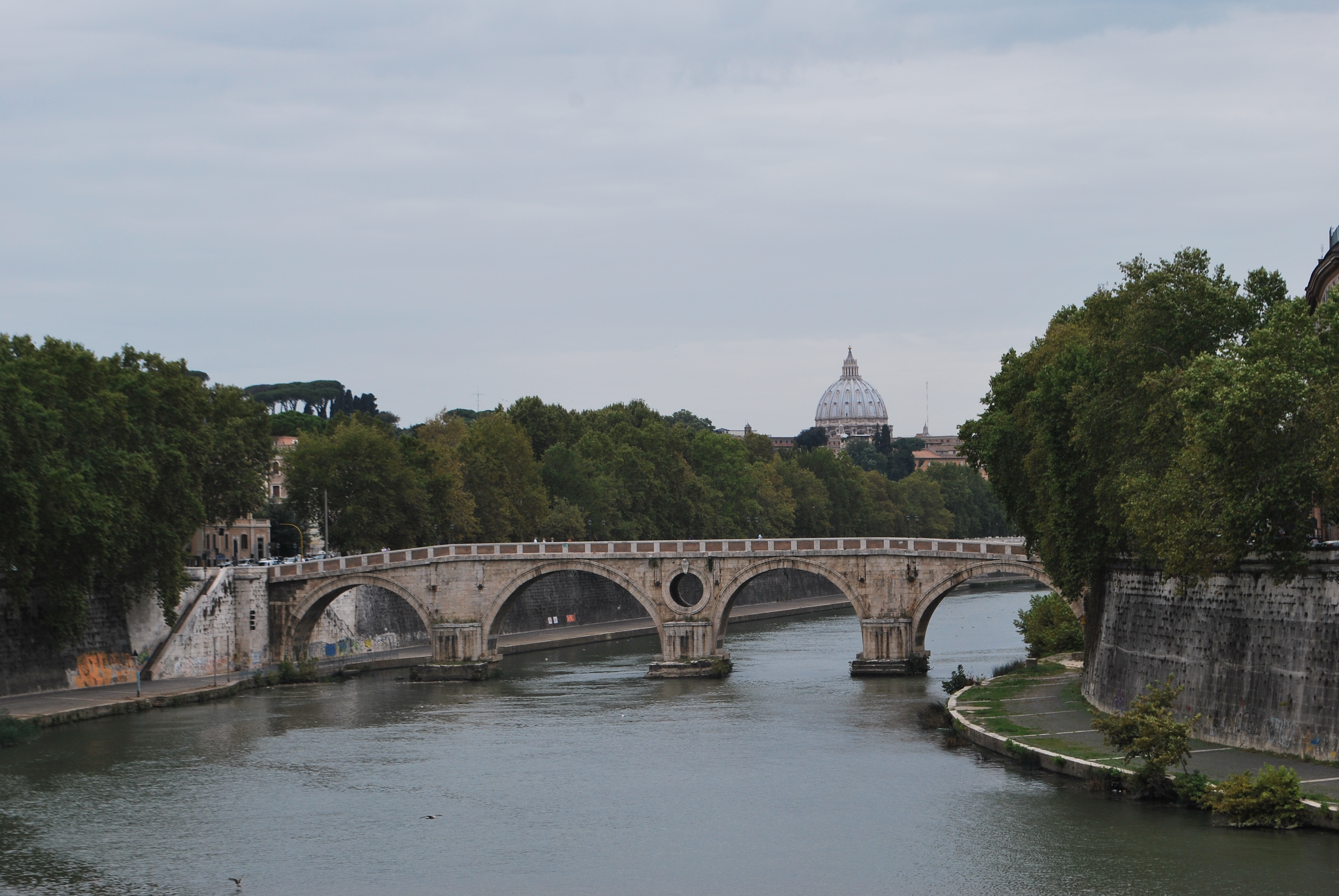
Bridge and River in Trastevere in Rome


It was a plebian quarter, where the servants and laborers and the free citizens of Rome’s as well as sailors, fishermen, Phoenicians and Jews lived. It would be the principal Jewish quarter of Rome until the end of the Middle Ages, when the Ghetto, across the river from Trastevere, became the residential area to which Jews were henceforth restricted.Rome Rione di Trastevere Logoastevere_logo


Renaissance Romans began building more noble villas around the edges of the ancient quarter, but the Trastevere of today retains its medieval, labyrinthine layout, full of narrow, winding alleys. It remains a working class neighborhood, with children playing soccer in the street, old people sitting on their stoops, and families gathering around a table in the street to visit. Trastevere lies between the western banks of the river Tiber and the Janiculum hill, one of Rome’s storied seven hills, that looms above it. It’s but a short 15-minute walk across the Tiber to the ruins of ancient Rome, the “salon” of Rome with its extravagant fountains, and only a little bit further by foot to St. Peter’s Square and the Vatican. One of the liveliest gathering places is the square in front of the church of Santa-Maria-in-Trastevere, construction of which began early in the 3rd century with the church completed in the mid-4th century, and ultimately completed in Romanesque style in the 12th century, then converted in several other centuries, giving it an unusual combination of Ancient Roman details and varied architectural features from later periods. The octagonal fountain in the piazza is an ancient Roman fountain restored and enlargened in the 17th century by Carlo Fontana.

Santa Maria Trastevere Roma Italy Carlo Fontana

Santa Maria with church, with ancient Roman foundation in center. The piazza is full of life at night.


What to See and Do in Trastevere

The Church of Santa Maria in Trastevere

Santa Maria in Trastevere is undoubtedly the oldest church in Rome, and deserves several visits if you want to appreciate its full architectural and historical depth. Most of the mosaics date from the 12th century. They are illuminated at night, and the golden light of the façade fills the piazza with a warm glow.
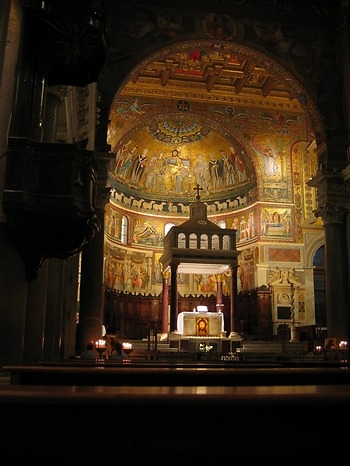
12th-century gold mosaics in Santa Maria in Trastevere, http://www.aztec-history.com/traditional-mexican-food.html

12th-century gold mosaics in Santa Maria in Trastevere


The 22 granite columns lining the nave are said to have come from the ruins of the Baths of Caracalla; the capitals are adorned with the heads of female pagan deities.
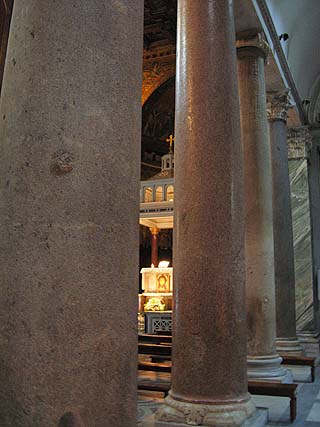
Granite columns in Santa Maria in Trastevere, from Baths of Caracalia

Numerous Roman funeral inscriptions can also be found in the church.

Ancient Roman etched gravestone in Santa Maria in Trastevere

Eating and Nightlife

There is no shortage of reasonably priced osterie, trattorie and restaurants that serve authentic Roman food in a no-frills setting. The neighborhood is timeless, with its mix of historical architectural periods and lively local residents; it remains quintessentially Roman. If you want to pretend you’re Roman for a weekend, this is the place to do it.


Old cellars and stables have been converted into bars, discos and cafés, providing a lively nightlife scene, with customers spreading out into the streets when the weather is fine.

DSC_0802


Signs like this demonstrate the colorful character of the locals, and offer contrast to our notion of contemporary, ultra-chic Italy.

Trastevere, Rugantino Trattoria Osteria Restaurant, Rome, Italy, photo by Jonell Galloway all rights reserved Jonell Galloway (R)


Sidewalk cafés and restaurants preserve the romantic character of Old Italy, spilling out onto the streets. My favorite source of restaurants in Rome is David Downie’s Food Wine Rome. David is half Roman, and sees food through the eyes of a Roman. His recommendations are all about the authentic and the unpretentious, and you’ll seldom find tourists in the places he recommends.

Hotel

While the Hotel Santa Maria is located in the very heart of the vibrant Santa Maria neighborhood just steps from the piazza, within the walls of this converted 16th-century convent, it’s so quiet and peaceful that you may think you’re staying in a remote Tuscan country house. The renovation is simple, but tasteful, with classic Roman terracotta floors and well-fitted bathrooms. Bedroom furnishings are tasteful, solid-wood reproductions. Almost all rooms are on the ground floor and give onto the courtyard. The few that do have a room above them (near the rooftop terrace) are not so quiet due to the tile floors. Otherwise, the clientele is quiet and respectful. Double Room Santa Maria Travestere, Rome, Italy


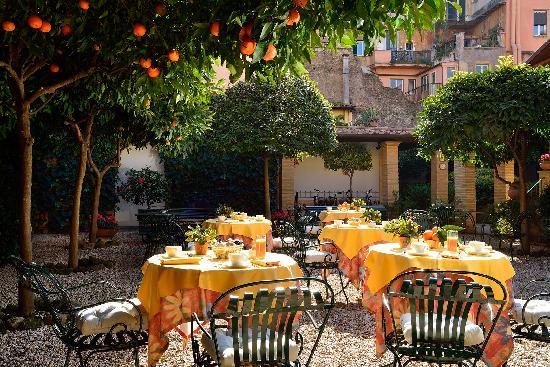
hotel-santa-maria Orange courtyard

Courtyard with orange trees where you can eat breakfast or have a drink

One enters the hotel courtyard through a large, locked iron gate, so security is good. The L-shaped convent-cum-hotel with an inner courtyard enclosing a small orange grove boasts wrought-iron tables and chairs for leisurely sitting in the sun or eating breakfast when weather permits. The breakfast room is in a converted cellar, with breakfast consisting of an international and Italian buffet with something to suit everyone, offering freshly squeezed orange juice and coffee from a professional espresso machine.

The small rooftop terrace is furnished with chic wooden lounge chairs and armchairs. It’s a great place to have a drink before dinner, read in the early evening, or sunbathe during the day. The view of the surrounding rooftops and balconies of Trastevere is a photographer’s dream. All rooms have satellite television and air conditioning, as well as Wi-Fi, which can sometimes be unstable. Bikes are available for rental at the reception.

How to Get There

If you’re flying, take the train from the Fiumicino Leonoardo da Vinci airport station to the Trastevere station, about a 30-minute train ride, then take a cab, which should take about 10 minutes. This should cost around 15 Euros all-inclusive, versus approximately 50 Euros with tip for a cab direct from the airport. A cab ride from the Termini train station to the hotel should cost around 15 Euros. The hotel is lost in a winding street and difficult to access by car. Even taxi drivers get confused with all the one-way and dead-end streets. Study your map and know the names of the surrounding streets and squares, because the driver may be forced to let you off in another street around the corner from the hotel.

Practical Info

Reservations: http://www.htlsantamaria.com Address Vicolo del Piede 2 – 00153 Rome – Italy Tel. (39) 06 5894626 – Fax: (39) 06 5894815 Click here for map: Map to Hotel Santa Maria


Jonell Galloway grew up on Wendell Berry and food straight from a backyard Kentucky garden. She is a freelance writer. She attended Le Cordon Bleu and La Varenne cooking schools in Paris and the Académie du Vin, worked for the GaultMillau restaurant guide and CityGuides in France and Paris and for Gannett Company in the U.S., and collaborated on Le tour du monde en 80 pains / Around the World with 80 Breads with Jean-Philippe de Tonnac in France; André Raboud, Sculptures 2002-2009 in Switzerland; Ma Cuisine Méditerranéenne with Christophe Certain in France, At the Table: Food and Family around the World with Ken Albala, and a biography of French chef Pierre Gagnaire. She ran a cooking school in France, and owned a farm-to-table restaurant, The Three Sisters’ Café, with her two sisters in the U.S. She organizes the Taste Unlocked bespoke food and wine tasting awareness workshops with James Flewellen, is an active member of Slow Food, and runs the food writing website The Rambling Epicure. Her work has been published in numerous international publications and she has been interviewed on international public radio in France, Switzerland, and the U.S. She has just signed on at In Search of Taste, a British print publication, and is now working on two books, What to Eat in France and What to Eat in Venice.

Related articles

Never miss a post
Name: 
Your email address:*
Please enter all required fields
Correct invalid entries

Our favorite food books of 2011

Published by Friday, December 23, 2011 Permalink 0

by Jonell Galloway

Cookbooks:

Ancient Grains for Modern Meals, by Maria Speck

My favorite cookbook of the year. Maria Speck knows how to incorporate ancient whole grains from around the world into dishes that remain rustic on the edges, but healthy, original and elegant at the same time. The technical explanations about ancient grains are excellent, as well as her explanations about general cooking techniques. The food stories she incorporates here and there about growing up in Greece and Germany add a touch of charm.

A must for any health-conscious real food lover who wants to eat interesting food combinations and dishes with a touch more sophistication that can pleasantly surprise guests, but not take them totally away from their references, because the dishes are for the most part influenced by Mediterranean cuisine.

For poetry-loving foodies:

The Poet’s Cookbook: Recipes from Germany, poems by 33 American poets with German translations

The Poet’s Cookbook: Recipes from Tuscany, poems by 28 Italian and American poets

I love the original concept of these books, pairing a food poem with a recipe. A poem by our Food Poetry Editor, Christina Daub, “Wine“, appears in the Tuscany version.

Farming: A Hand Book, by Wendell Berry

As a Kentuckian, Wendell Berry has forever been my mentor. He is, in my mind, the precursor of the Slow Food philosophy in the U.S., through the philosophy he has cultivated and spread for over 50 years now, well before Petrini and company started the Slow Food movement. Whether writing prose or poetry, he is always eloquent, and the same message of integrity, respect for others and for the land is the central message. This is one more inspiring book of poetry to add to our shelves of books to keep forever, that will comfort us in times of trouble, that we will pick up time and time again when we’re losing faith in humanity, devastated by the disrespect shown to the land, losing touch with our roots. Berry always says what he thinks in all his eloquence and with true gentillesse, but more than that, he lives the life he preaches, and that is consoling.

For food lovers, wine lovers, and culinary travelers:

Food Wine Rome, by David Downie and Alison Harris, published by The Little Bookroom, part of The Terroir Guides series

Food Wine Burgundy, by David Downie and Alison Harris, published by The Little Bookroom, part of The Terroir Guides series

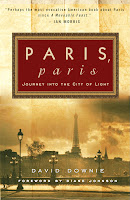
Paris, Paris: Journey into the City of Light, by David Downie

David Downie writes wonderful articles for The Rambling Epicure and Alison does exquisite food photo exhibits for our Food Art section. I can never get enough of their work, because the writing is exquisite and full of literary and historical references, and the photos are truly art. Downie always shows you the insider’s view of whatever he writes about, and Alison has a great eye for catching the very essence of what they’re covering, whether it be truffle hunting or discovering little out-of-the way restaurants in isolated villages. You can never go wrong with their books.

For bread lovers:

Dictionnaire Universel du Pain, by Jean-Philippe de Tonnac

Jean-Philippe de Tonnac also writes for The Rambling Epicure, and has recently become THE bread writer all bakers want to meet. This book should in my mind be translated into English immediately. It offers a wealth of information about bread from time immemorial, covering techniques and breads from around the world, as well as spirituality, sex, gluten intolerance, bakers as poets, bakers as prophets and much more. “Encyclopedia” would be a more appropriate term than “dictionary”.

Mindful eating:

The Self-Compassion Diet: Guided Practices to Lose Weight with Loving-Kindness by Jean Fain

Jean Fain has tried every diet out there, so she can speak with authority about the subject of weight loss. She is also affiliated with Harvard Medical School as a psychotherapist, so she has the credentials to talk about the subject. Her book takes a totally different approach to weight loss than any I’ve seen. She doesn’t count calories and restrict what you eat. Her approach is instead through the mind, to become mindful of what we eat, when we eat (when stressed or lonely, for example), why we eat (out of need to nourish ourselves or out of boredom or frustration); to appreciate what we eat, and above all to be conscious of our entire relationship with food.

The book teaches you how to take control of yourself and your relationship to food so that you can change the way you think about food in general, so that eating becomes a totally different experience. Jean does this through loving-kindness, self-hypnosis, meditation and numerous other weight-loss approaches, which you follow gradually, not all in one go. She also offers a CD including guided meditations to help patients after they have stopped therapy.

Her main thrust is self-love, that we must not be too hard on ourselves, or we’ll fall back in to our old and bad habits quickly. The beauty of the book and CD combination is that you can live half way around the planet and still follow her method.

For lovers of literature: food essays and prose:

Slow Food: Collected Thoughts on Taste, Tradition, and the Honest Pleasures of Food, by Carlo Petrini and Ben Watson

This book consists of an anthology of articles by the world’s top food writers, making me remember the old days when we’d visit the family in the countryside and how I thought it odd that they grew all their vegetables themselves and knew how to can them; how they drank milk straight from the cow (one of my fondest childhood memories), and how we relished in those meals, how it built bonds between us. “Drawn from five years of the quarterly journal Slow (only recently available in America), this book includes more than 100 articles covering eclectic topics from “Falafel” to “Fat City.” From the market at Ulan Bator in Mongolia to Slow Food Down Under, this book offers an armchair tour of the exotic and bizarre. You’ll pass through Vietnam’s Snake Tavern, enjoy the Post-Industrial Pint of Beer, and learn why the lascivious villain in Indian cinema always eats Tandoori Chicken.”

For pastry makers and lovers:

Mich Turner’s  Masterclass: The Ultimate Guide to Cake Decorating Perfection, by Mich Turner, published by Jacqui Small LLP, London

Mitch Turner’s cake decorating book is worthy of a fine art book in its presentation, and of an encyclopedia in terms of the detailed explanations about cake decorating. Her pastry and cakes are truly works of art. A must for all pastry makers, whether professional or amateur.

Food art:

From Plate to Pixel: Digital Food Photography, by Hélène Dujardin

This book is special for many reasons. There are lots of people out there trying to learn food photography without a clue as to even the basic techniques required and no possibility of taking a food photography workshop. This is the book for them, because all the basics plus quite a lot more are explained in a clear, direct manner. It also verges on being an art book, because it is illustrated by Dujardin’s beautiful food photography.


Never miss a post
Name: 
Your email address:*
Please enter all required fields
Correct invalid entries

David Downie: Christmas in Paris is All about Eating and Drinking, What Happened to Jesus?

Published by Monday, December 19, 2011 Permalink 0

In most Christian countries, Christmas is about celebrating the birth of Jesus, to more or lesser degrees. In consumer-driven countries, much of Jesus’ birthday is lost as people scurry around looking for the perfect Christmas gifts.

Birth of Jesus in a Kabyle Catholic book


David Downie thinks Christmas in Paris is focused mostly on food, and just a little on Jesus. The more foie gras, smoked salmon, champagne, and everything else rich under the sun you can slide down your gullet, the better. It’s about good food, but also about excess. It’s about dressing up all pretty and going from one meal or party to another. It’s about having a crise de foie or “liver attack”, as the French call it, after the holidays.

Read David Downie’s take on it.

Continue Reading…

Never miss a post
Name: 
Your email address:*
Please enter all required fields
Correct invalid entries

David Downie: Portofino, the Italian Riviera’s Most Glamorous Time Warp

Published by Friday, October 28, 2011 Permalink 0

by Wandering Liguria

Nobody knows Liguria better than David Downie. In fact he knows it so well, he’s just launched a new site about it, Wandering Liguria, to add to his exquisite Food Wine Burgundy and Food Wine Rome guidebooks for the thinking man who wants to avoid places frequented by busloads of tourists.

A picture-postcard faux fishing port, Portofino is the Riviera’s most glamorous time warp: the villas of the super-rich perch on pine-studded promontories jutting into the Mediterranean. Billionaires like Silvio Berlusconi spend precious leisure hours here. “Precious” is the operative word.

Five hundred years ago one irreverent overnight traveler noted that in Portofino “you were charged not only for the room but the very air you breathed.”

Click here to read more of David’s Gadling article on Portofino.

Never miss a post
Name: 
Your email address:*
Please enter all required fields
Correct invalid entries

David Downie and Alison Harris On Book Tour from April 20 to May 20 in NYC and SF Bay Area

Published by Thursday, March 31, 2011 Permalink 0

by David Downie

Food and travel writer David Downie and photographer Alison Harris are gearing up for their U.S. book tour, to beat the drum about their pair of newborn books: Quiet Corners of Rome and Paris, Paris: Journey into the City of Light (April 25, 2011) and (April 5, 2011). The covers, if you please!

Details about the books, book tours and links to their favorite book sellers are listed on David’s site, as well as on Facebook and Twitter.

Also featured on their tour and already available for purchase: Food Wine Burgundy, Food Wine Rome, Food Wine Italian Riviera & Genoa, and Cooking the Roman Way (the new e-book version).

What’s on the playbill? They’ll be showing slides (actually, Alison will do a PowerPoint presentation), talking, chatting, interacting via riveting Q&As, giving live radio interviews (most are still to be scheduled), and generally performing all the other tricks and great things writers and photographers do on book tours. Singing, dancing, walking tight ropes, jumping through hoops…

Continue Reading…

Never miss a post
Name: 
Your email address:*
Please enter all required fields
Correct invalid entries

David Downie and Alison Harris on Book Tour from April 20 to May 20 in NYC and SF Bay Area

Published by Wednesday, March 23, 2011 Permalink 0

by David Downie

Food and travel writer David Downie and photographer Alison Harris are gearing up for their U.S. book tour, to beat the drum about their pair of newborn books: Quiet Corners of Rome (April 25, 2011) and Paris, Paris: Journey into the City of Light (April 5, 2011). The covers, if you please!

Details about the books, book tours and links to their favorite book sellers are listed on David’s site, as well as on Twitter and Twitter.


Also featured on their tour and already available for purchase: Food Wine Burgundy, Food Wine Rome, Food Wine Italian Riviera & Genoa, and Cooking the Roman Way (the new e-book version).

What’s on the playbill? They’ll be showing slides (actually, Alison will do a PowerPoint presentation), talking, chatting, interacting via riveting Q&As, giving live radio interviews (most are still to be scheduled), and generally performing all the other tricks and great things writers and photographers do on book tours. Singing, dancing, walking tight ropes, jumping through hoops…

Crucial dates: They will be in New York from April 20-30.

NYC

Thursday, April 28, 5:30 – 7 pm
Rizzoli Bookstore, 31 West 57th St (5th-6th Ave.s)
Meet & Greet + Reading, Talk

They will be in the SF Bay Area/wine country May 1-18, and back home in Paris on May 19 and in operation on the 20th.

SF BAY AREA & Wine Country

Monday, May 2, 7 PM
Book Passage, 51 Tamal Vista Blvd, Corte Madera
Reading, Talk and slide show.

Tuesday, May 3, 7:30 PM
Readers’ Books, 130 E Napa St, Sonoma
National treasure Paula Wolfert introduces us.
Reading, Talk.

RADIO INTERVIEW
Saturday, May 7, 11:00 AM (Time may change but it will be between 10 am and 12:30 pm). KGO AM 810, “Dining Around with Gene Burns,” Live interview.

Saturday, May 7. 4:00 PM
Mrs. Dalloways Literary & Garden Arts, 2904 College Ave, Berkeley
Info: 510-704-8222
Reading, Talk.

Tuesday, May 11, 6:00 PM
Mechanics’ Institute Library, 57 Post Street, San Francisco
Info: 415-393-0114
Reading, Talk and slide show.

Wednesday, May 12, 6:00 – 7:00 pm
Omnivore Books, 3885A Cesar Chavez St, San Francisco
Info: 415-282-4712
Reading, Talk about food and travel writing in France and Italy.

Stay tuned, the above will evolve… And please spread the word…

Remember, if you can make it to one of our book events, and you can’t be in Paris this spring, you’ll always have Paris, Paris — the book!

Never miss a post
Name: 
Your email address:*
Please enter all required fields
Correct invalid entries

American Bomb, Focaccia al Formaggio and Fascists

Published by Thursday, January 27, 2011 Permalink 0

by David Downie, just back from the Italian Riviera, an opinion piece

There’s a reason “Wreck-Oh!” is the irreverent nickname for Recco, the Italian Riviera’s self-styled “culinary capital” and probable birthplace of the cheese-filled delicacy focaccia con formaggio.

This once-charming seaside village was flattened by RAF and USAF bombers in an 8-month period from summer 1943 to spring 1944. The goal: blow up the railroad viaduct spanning the Recco River. The Allies ran 20 bombing raids on Recco, a small place, smaller than an American shopping mall. The effects were devastating. Only a few buildings — and the railway viaduct — were left standing. Hundreds of people died.

Continue Reading…

Never miss a post
Name: 
Your email address:*
Please enter all required fields
Correct invalid entries

UA-21892701-1