Simple Sustenance: Green Goodness — Broccoli and Pepita Pesto

Published by Tuesday, April 10, 2012 Permalink 0

by Renu Chhabra

“When you’re green inside, you’re clean inside.” – Dr. Bernard Jensen

Today it’s all about green goodness in our diet. Yes, I mean green vegetables. We all know they are good for us, but why do some of us ignore them? Maybe, we just don’t like their taste, or they sound like diet food. In that case, we should try making them different ways than we usually do — something out of the box. Give them a new twist and explore a little. Who knows, they may surprise us.

Speaking of green vegetables, broccoli comes to my mind instantly. Its health benefits are several. But I know, it’s not an exciting vegetable for many of us. We have memories of eating bland steamed broccoli that we wished we could throw under the table. At times, it was topped with some plastic-like yellow cheese to make it more enticing. Even then it wasn’t very appealing. Since Mom insisted it was good for us, there wasn’t anyway to escape it except to wolf it down as fast as possible and forget about it until next time it showed up at the dinner table, staring at us.

Continue Reading…

Never miss a post
Name: 
Your email address:*
Please enter all required fields
Correct invalid entries

Thai Stinky Fruit: Durian

Published by Wednesday, March 21, 2012 Permalink 0

by Lenny Karpman

More than twenty years ago the King of Thailand was about to celebrate a landmark birthday, so he and his government planned a long list of special events and invited expatriate Thais from prominent families to return home and join the celebration. Yao, a Thai friend of mine was among the invitees. I went along.


“Let’s go find some durian, you know – the stinky fruit,” she proclaimed with a smile. I returned her smile with a little apprehension. I was usually impervious to all varieties of natural and synthetic aromas. Not so that Sunday in Bangkok. My diminutive soft-spoken friend from San Francisco was on the home turf of her family and her childhood. She was my guide for the day. Her feather-like hold on my arm steered me through the bustle of the Sunday crowds. There, at the weekend market on the edge of the city, thousands of shoppers gathered to buy everything from plaid boxer shorts and eyeliner to hundred kilo live pigs. We were on a durian quest.

Continue Reading…

Never miss a post
Name: 
Your email address:*
Please enter all required fields
Correct invalid entries

Food Art: Nuts, Seeds, Chocolate and Milk, food photography by Meeta Khurana Wolff

Published by Thursday, March 15, 2012 Permalink 0

See more food photo compositions at Meeta K. Wolff.

Continue Reading…

Never miss a post
Name: 
Your email address:*
Please enter all required fields
Correct invalid entries

Simple Sustenance: Healthy and Easy Bell Pepper, Garbanzo Bean, and Bulgur Salad

Published by Monday, March 12, 2012 Permalink 0

by Renu Chhabra

“Cookery is not chemistry. It is an art. It requires instinct and taste rather than exact measurements.” — Marcel Boulestin

Healthy and easy might not sound very complicated, but I’m not talking about a cup of yogurt or a bowl of fruit. I am thinking of something hearty and flavorful with a farm-fresh bite. When the vegetable drawer in the fridge is begging for a visit to the produce market, it can become challenging to bring farm-fresh bite to the plate. This was the dilemma I was facing last night.

When I opened my fridge, I found just a couple bell peppers and a bunch of parsley were keeping each other company in the vegetable drawer. While I was wondering how to make the most of what was available, I found two slender carrots and a lemon hidden in a corner of the drawer.  I was hoping to come up with something that would satisfy my appetite. A look in the pantry to find some bulgur and a can of garbanzo beans completed the recipe — a well balanced meal of vegetables, whole grains, and protein. It seemed like another victory over a culinary battle!

Continue Reading…

Never miss a post
Name: 
Your email address:*
Please enter all required fields
Correct invalid entries

Simon Says: Daily Food Quote, March 5, 2012

Published by Monday, March 5, 2012 Permalink 0

by Simón de Swaan

Food, like a loving touch or a glimpse of divine power, has the ability to comfort.–Norman Kolpas

Norman Kolpas has been a major player in lifestyle-related media for 25+ years, working with such prestigious publications as Time Life Books’ 14 series publication The Good Cook, Bon Appetit, and Food Network TV. He has published more than 40 cookbooks. He was an honors graduate of Yale University.


Related articles
Never miss a post
Name: 
Your email address:*
Please enter all required fields
Correct invalid entries

How to Make Perfect Brownies like your Grandma’s

Published by Thursday, February 16, 2012 Permalink 0

How to Make Perfect Brownies like your Grandma’s

We love this beautifully illustrated recipe for making the perfect brownies. This is a keeper!

Brownies stacked on a plate.


The explanations are better than a video because they let you go on with your work and refer back to the photos when you need to.

Click here to go to the recipe.

Never miss a post
Name: 
Your email address:*
Please enter all required fields
Correct invalid entries

Is Focaccia Pizza’s Rival?

Published by Thursday, February 16, 2012 Permalink 0

by Diana Zahuranic

“It’s the most dangerous competitor of pizza,” said the president of Recco’s Consorzio near Genova. What could possibly pose a risk to the hallowed Italian dish? The risk lies in a similar bread known as focaccia, an olive-oily, salt-crunchy, inch-thick fluffy white dough often cut into squares in the piazza’s panetteria, or bakery. Tomato sauce and ciliegini cherry tomatoes, may be dropped on top, as well as anchovies, thin potato slices with rosemary sprigs, zucchini, eggplant, olives and tomato – basically any ingredient that goes on a pizza sits comfortably on its fluffy focaccia pillow, too. And like pizza, mozzarella cheese is basically a given.


If focaccia is pizza’s most serious contender, then Focaccia di Recco is the Achilles of this battle – but Recco’s focaccia has no weak spot.

I went with my class from the University of Gastronomic Sciences, a Slow Food-founded school based in Piemonte, Italy, to the 150-year old Ristorante Vitturin. The owner applied for the IGP label for his focaccia, and is now waiting for it to pass. If the bread earns this Indicazione di Geografica Protetta, or Protected Geographic Indication, that will make it the first restaurant product with that label. Naples’ pizza likely regrets not applying for one every time a new “Napoletano style” pizzeria erects its greasy walls in small suburbs and big cities. If it gains the IGP label, then that’s Point One for Focaccia di Recco.

We walked down a flight of steps into a moodier section of the restaurant and the kitchen, open with a line of windows framing the working chefs who flip paper-thin focaccia dough in the air and mix potions of ingredients to create pestos and sauces. The bustle of a restaurant kitchen was unapparent, non-existent, at 2:30 in the afternoon. The chef had time to show us how to make Focaccia di Recco.

Three long tables were set up in a U at the end of the room, set with dough, flour and long, thin rolling pins that were more like sticks. The chef was cheerful and energetic and even a bit cheeky to the very sincere Consorzio leader/ restaurant owner, who explained to us why the Focaccia di Recco deserved the IGP label.

“We use a farina di forza,” he explained. This “flour of strength” is 100% Manitoba flour, its forza derived from the high gluten content. The chef let us feel the fine, fine flour. He began to roll out soft, warm piles of dough very quickly into a thin layer on the table.

“The cheese must be this kind,” he said, showing us the Formaggio fresco latte ligurie tracciato. It was a big, white, squishy brick. The chef laid out the first layer over the tray, and then pinched off chunks with his hands of this fresh goat’s cheese from Liguria and plopped them evenly onto the pie.

“We’ve used the same recipe since 1800,” said the owner. The recipe is also written on the brochure of the restaurant (although the cheese is described as crescenza, an Italian-style Philadelphia cream cheese, because few people will ever get their hands on the crucial ligurie tracciato cheese). We were pinching off moist bits of this rich, creamy cheese and popping them into our mouths as we watched the chef toss his next piece of dough high into the air until it was so thin it was transparent.

Formaggio fresco di latte ligurie tracciato

The chef gently laid the fragile dough over the cheesy bottom layer. Some cheese chunks broke through, which would burst through in an exquisite, oily sizzle when in the oven. He drizzled it with extra virgin olive oil, cut off the excess dough in one deft motion using the rolling pin, and smashed the leftovers into another dough ball. “We don’t waste anything,” he said. In fact, we ate hand-rolled corkscrew-shaped pasta later, called trofie or trofiette, made out of that very dough ball.

The focaccia was carefully cooked on hot coals, the traditional method, especially for us. When it was ready, it was sent up to the ground level by a veritable focaccia carousel – a large wheel with level platforms where focaccia was placed, sent up, up, up and lifted off by the waiter to be served, pizza-style, at the table. The place is known as the “restaurant of the wheel.”

The cheesy Focaccia di Recco was crunchy in all the right places, soft and gooey where you wanted it, and underlined by the wholesome nuttiness and vegetal taste of the extra virgin olive oil. My preference was the Focaccia di Recco covered in zesty, herby, house-made pesto. Interestingly, they proudly deemed this una ricetta nuova, a new recipe. Tradition runs strong in Italy, where changes are tested slowly and considered seriously.
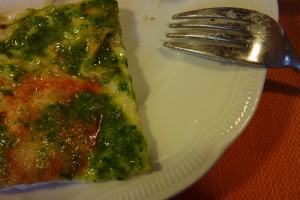
The pesto version of focaccia

Perhaps this answers the questionable “difference” between a focaccia and pizza. Focaccia is often thicker, and it is sometimes sold as “pizza a taglio,” “pizza by the slice,” even though everyone knows it is focaccia. In Italy, pizza is never one slice – it is a pie per person. And in Recco, the focaccia is thin and served on a round dish, one per person. These qualifications bring it dangerously close to pizza. When I asked the question, I was told that the ingredients in the dough are different than that of pizza dough.

And so it seems that pizza will remain pizza, focaccia will remain focaccia, and they will continue to be sold alongside one another for a long, long time as they always have. Don’t worry, pizza. Focaccia isn’t out to get you. Just don’t set up shop in Recco.

Related articles

Never miss a post
Name: 
Your email address:*
Please enter all required fields
Correct invalid entries

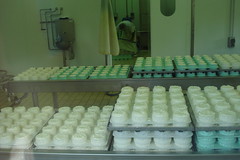
Cheesemaking: To know how cheese is made is different from knowing how to make cheese!

Published by Monday, February 6, 2012 Permalink 0

by Diana Zahuranic

“Let’s make cheese!” To my friends and me, the idea sounded satisfyingly artisanal. Cheesemaking is simple enough in practice so that anyone with some background can try their hand at it. The theory is more complicated, but because my friends and I had that part down pat, actually putting it to use would be an afternoon well-spent.

Cheesemakers in Chaource

Cheesemakers in Chaource


Or so we thought. Yes, the craft of cheesemaking is simple compared to the amazing, diverse world of cheese that it produces (or rather, that Europe produces, with no laws prohibiting unpasteurized cheese aged less than 60 days – which is 100s to 1000s of varieties). But the first thing the nine of us did in my friend’s tiny Italian kitchen was say, “Doesn’t anybody know how to make cheese?”

Continue Reading…

Never miss a post
Name: 
Your email address:*
Please enter all required fields
Correct invalid entries

Enfin, Food, Inc. en français on Swiss television!

Published by Thursday, November 24, 2011 Permalink 0

Swiss television station TSR has just produced a version of Food, Inc. in French.

Food, Inc.


Click here to watch it.

Continue Reading…

Never miss a post
Name: 
Your email address:*
Please enter all required fields
Correct invalid entries

European Food Fact: What’s a “bonbon”?

Published by Monday, November 21, 2011 Permalink 0

by Jonell Galloway

Bonbons, which we call in English sweets or candy, are a recent enough arrival on the European food scene. The Crusaders brought back sugar cane from the Orient, arriving first in Sicily, where Jewish scientists in Sicily carried out experiments on it in around 1230. Until then, Europeans made their sweets using fruit juice and honey, often flavored with cinnamon.

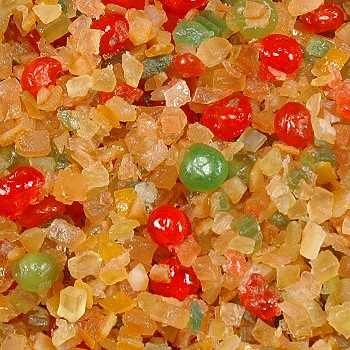
Candied fruit, fruit confit,
one of the first forms of bonbons or candy


Candy instantly became the rage and techniques were refined. During the Renaissance, men of means carried bonbonnières, or candy holders, in their pockets, often decorated with precious stones, and offered ladies candy from them.

Bonbonnière, traditional French
porcelain candy dish


Wikipedia notes that the  “Middle English word “candy” began to be used in the late 13th century, coming into English from the Old French çucre candi, derived in turn from Persian Qand (=قند) and Qandi (=قندی), ‘cane sugar’.”

Continue Reading…

Never miss a post
Name: 
Your email address:*
Please enter all required fields
Correct invalid entries

UA-21892701-1