What we’re reading: healthy food, happy cows; history of chocolate chip cookies; Russian organic food, etc.
Click here to keep up with the latest in world food and wine news.

Related articles
|
|

A Literary Culinary Journal
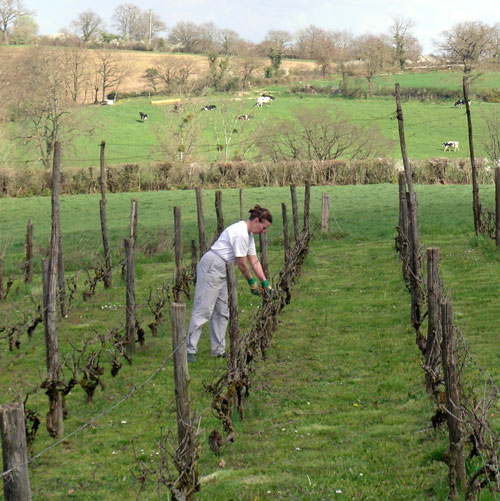
Migraine is a wine made from grapes grown around Auxerre in northern Burgundy.
|
|
Click here to keep up with the latest in world food and wine news.
|
|

by Jonell Galloway
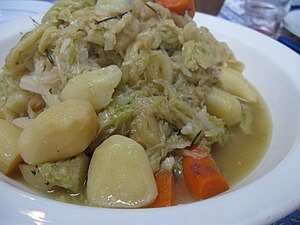
The term “potée” refers to dishes cooked in an earthenware pot, in particular soups and stews. Every region in France has its own version, and it can be compared to what the French refer as the “eternal pot.” Potée Lorraine from Alsace is the most widely known.
Most potées are made with pork and vegetables, the most frequent being cabbage and potatoes.
|
|
One of the advantages of cooking for others is that no matter how those you are cooking for might attempt to intervene in the process, offer advice, snoop on your activities & etc., in most cases they lack the expertise, aptitude, patience and experience to take your place in front of the stove. However much those individuals might seek to run mind games on you because you are, in a sense, doing some work that they might have helped finance, in the very short term their relation to you is one of dependence.
The people you’re feeding, typically family members, will almost always be hungrier than you. And they will lack your access to sharp knives and convenient missiles (fruits and vegetables, for example) needed to drive them off.
This power relationship can be reversed in the case of your relationship to kitchen appliances. Remember: those things were designed by engineers and programmers who themselves were oppressed by doltish marketing managers and senior executives. The engineers’ goals and values might have led them to seek the most efficient and graceful designs.

To you, a lovely kitchen stove; to the engineers who designed it,
a purgatory they’re enduring until they can design rocket ships and race cars.
|
|
 by Jonell Galloway
Cromesquis are back in fashion as an hors d’oeuvre. They are made with a salpicon wrapped in pig’s caul or slices of salt pork, then dipped in batter and deep-fried to make a croquette.
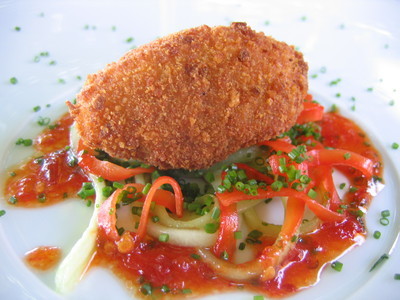
Contemporary chefs like to make the salpicon a little runny so that when you bite into the croquette, the liquid squirts into your mouth. I first ate the contemporary version of cromesquis at Ferran Adria’s El Bulli about 12 or 13 years ago.
|
|
 by Jonell Galloway
Bonbons, which we call in English sweets or candy, are a recent enough arrival on the European food scene. The Crusaders brought back sugar cane from the Orient, arriving first in Sicily, where Jewish scientists in Sicily carried out experiments on it in around 1230. Until then, Europeans made their sweets using fruit juice and honey, often flavored with cinnamon.
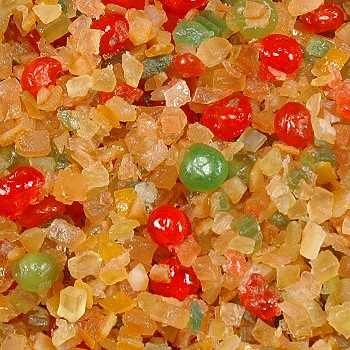
Candy instantly became the rage and techniques were refined. During the Renaissance, men of means carried bonbonnières, or candy holders, in their pockets, often decorated with precious stones, and offered ladies candy from them.

Wikipedia notes that the “Middle English word “candy” began to be used in the late 13th century, coming into English from the Old French çucre candi, derived in turn from Persian Qand (=قند) and Qandi (=قندی), ‘cane sugar’.”
|
|
by Julia Child
Julia Child would have turned 99 today.
Julia Child brought French food to post-war America. When her husband Paul was posted to Paris, she studied at L’Ecole du Cordon Bleu, and went on to form her own cooking school with fellow students Mastering the Art of French Cooking and Louisette Bertholle. The threesome went on to write the 2-volume classic Coq au Vin , which covered all the basic techniques and dishes of classic French cuisine.
And indeed she proved to be right. It is only now, 60 years later, that cooking has established itself as gastronomy, and only when referring to a few great American chefs.
This is Foodista’s list of their favorite Julia recipes.
Rooster cooked in red wine is a classic Burgundian dish made with red wine, mushrooms, onions, bacon and herbs.
Vichyssoise is actually the base of almost all French soups. This simple base — made of potatoes, leeks, and salt — is elaborated on in countless ways to make an endless variety of soup. When served cold in summer and cream is added, it is referred to as Vichyssoise.
Ratatouille brings all the flavors of the Southern sun together: red ripe tomatoes, eggplant, zucchini, bell peppers, garlic, onions and Provençal herbs. Today there are many other versions, many of them even in the oven, but this is the classic recipe.
The problem with duck is always the same: the fat spews all over the place and it is difficult to digest. The acid of the orange in this classic French dish helps digest the fat, and makes it tasty too. This is a favorite Julia Child recipe.
Boeuf Bourguignon is a fancy version of our classic beef stew. What makes it different is that it is cooked in red wine, and pearl onions and mushroom caps are added to it.
Not surprising that Julia loved Martinis. She added vermouth to just about any sauce she could work it in to.
Not all French pies are made with custard, but you often find this version in Normandy, the land of cream and butter. It can be served either cold or warm.
Clafoutis can be made with many different fruits, but plus and cherries are all-time French favorites. This tart has a custard-like consistency, but also contains ground almonds, giving it a salty edge.
Sabayon is a a cousin of the light, egg-based Italian dessert zabaglione. It is light and custard-like, and a standard in French as well as British cuisine.
|
|
 Meet Jonell Galloway, a freelance writer and editor specialized in French cuisine.


 by Vendange