The Kitchen at the Center of History: An Interview with Rachel Laudan

Published by Tuesday, July 23, 2013 Permalink 0


Rachel Lauden, author of Cusine & Empire

Rachel Laudan, author of Cuisine & Empire

by Elatia Harris

All photos courtesy of Rachel Laudan

Rachel Laudan is the prize-winning author of The Food of Paradise: Exploring Hawaii’s Culinary Heritage and a co-editor of the Oxford Companion to the History of Modern Science. In this wide-ranging interview, Rachel and I talk about her long-awaited book, Cuisine and Empire: Cooking in World History. Paul Freedman remarks that  the book is a riveting and unique combination of culinary ideas and exposition on the materiality of eating.” Other delighted early readers include Anne Willan, Naomi Duguid and Dan Headrick. As a food lover, a cook, a world traveler or a student of cultural history, you might have asked yourself: What is this thing called food? If so, this is the book for you. 

Laudan_Cuisine-001

ELATIA HARRIS: To begin, I would love to know what was involved in the transition from historian of science to historian of food. I can remember when there was no such academic discipline as food history, and I’ll warrant so can many readers.

RACHEL LAUDAN: I can remember when there was no such discipline as science history! I think history is the thread through my life. Growing up in history-heavy Wiltshire, I felt I had to escape the weight of the past. I studied the key historical science, geology, at university, although this was almost unheard of for a woman. I then changed to history and philosophy of science and technology. Then to history of food. History is my way of understanding things.

A lot of food writing is about how we feel about food, particularly about the good feelings that food induces. I’m more interested in how we think about food. In fact, I put culinary philosophy at the center of my book. Our culinary philosophy is the bridge between food and culture, between what we eat and how we relate to the natural world, including our bodies, to the social world, and to the gods or morality.

EH: Your earlier book, The Food of Paradise, necessarily dealt with food politics and food history. So many cultures were blended into local food in Hawaii. I treasure that book — almost a miniature of what you’re doing in Cuisine and Empire.

RL: Well, thank you. It came as a surprise to me that I had a subject for a book-length treatment of something to do with food or cooking — as interested in the subject as I certainly was. The only genre I knew was the cookbook, and I am not cut out to write recipes.  

It was prompted by a move to teach at the University of Hawaii in the mid-1980s. I went reluctantly, convinced by the tourist propaganda that the resources of the islands consisted of little more than sandy beaches and grass-skirted dancers doing the hula.

I couldn’t have been more wrong. These tiny islands, the most remote inhabited land on earth, have extraordinarily various peoples and environments. And as to the food, I was humiliatingly lost. The first morning in the office, Barbara Hoshida, the department secretary, held out a plate of golf-ball sized fried, well, fried whats? “These are Okinawan andagi,” she explained, “They’re just like Portuguese malasadas.”  I didn’t dare ask what Portuguese malasadas were. 

Before I knew it I had a stack of essays on the foods of the three diasporas that had ended up in the islands: the taro-based cuisine of the peoples from the South Pacific (the Hawaiians); the rice-based cuisine of the Asians (Koreans, Han and Hakka Chinese, Japanese, Okinawans, and Ilocanos and Tagalogs from the Philippines); and the bread-based cuisine of the Anglos (British and Americans).

Continue Reading…

Never miss a post
Name: 
Your email address:*
Please enter all required fields
Correct invalid entries

Culinary Chemistry: On the Technique of Brining

Published by Tuesday, November 13, 2012 Permalink 0

Culinary Chemistry: On the Technique of Brining

by Jenn Oliver

Hello and welcome to the first post of Culinary Chemistry with Jenn! I am Jenn, your resident scientist with a gluten-free husband who is curious about all things related to the how and why of cooking.  Today, we’re going to talk about brining, but each post will explore a different technique or phenomenon related to cooking/baking in the kitchen. Do you have questions or are curious about a particular aspect in the kitchen? Feel free to send me an email at jennoliver@theramblingepicure.com or on our online chat to the right of the screen, or join our Community and follow the Culinary Chemistry group and forum.

This past holiday season, families and friends gathered to share in their holiday traditions of a meal together — many of which surely included an oven-baked roast. Mine certainly did, as my husband and I celebrated our first Christmas abroad, a cozy romantic weekend together, marking our one-year anniversary since arriving to Switzerland, our current home. But just because the holidays are over doesn’t mean you have to swear off making roasts until next winter’s festivities roll around.

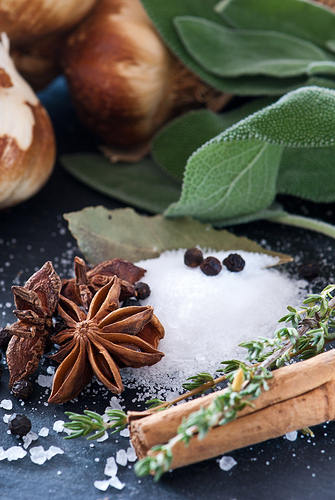
Spices for pork roast brine.


Continue Reading…

Never miss a post
Name: 
Your email address:*
Please enter all required fields
Correct invalid entries

Part 5: Kimchi vs. Sauerkraut – Fermenting Vegetables

Published by Wednesday, August 8, 2012 Permalink 3
cafemama / Foter / CC BY-NC-SA

Part 5 on Fermentation: Kimchi vs. Sauerkraut – Fermenting Vegetables

by Diana Zahuranec

Once again, Harold McGee’s The Science and Lore of the Kitchen comes to the rescue.

In fermented vegetables, remember that the two components that determine aroma and flavor are the salt concentration and temperature of fermentation. Those are the two main differences between kimchi and sauerkraut.

Bowl of kraut, by Diana Zahuranec for The Rambling Epicure, editor Jonell Galloway.

Bowl of kraut.


Sauerkraut, besides being cut more finely, has no other ingredients besides cabbage and brine. It ferments at 64-76 °F/18-24°C for 1 to 6 weeks. Its final salt content is 1-2%, and its final acidity level is 1-1.5%. That higher temperature for sauerkraut results in more lactic acid bacteria, giving it a tangier flavor.

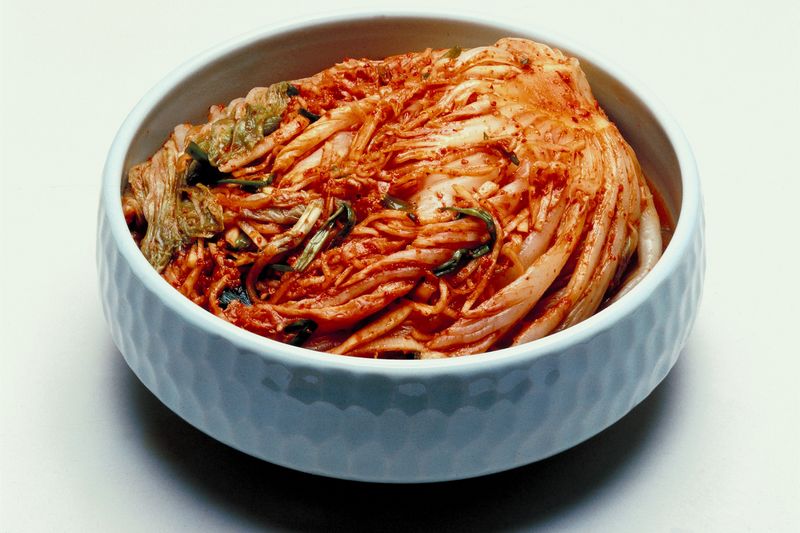
Kimchi is cut into larger chunks and includes plant leaves and stems, too; and hot Korean chili pepper, garlic, and fish sauce are added for flavor. It’s fermented at a lower temperature than sauerkraut at 41-57°F/5-14°C for 1-3 weeks, with a higher salt content in the end (3%) and lower acidity (0.4-0.8%).

Bowl of kimchi, Part 5 on Fermentation: Kimchi vs. Sauerkraut - Fermenting Vegetables, by Diana Zahuranec for The Rambling Epicure, editor, Jonell Galloway.

Bowl of kimchi.


Never miss a post
Name:

Your email address:*

Please enter all required fields
Correct invalid entries

Never miss a post
Name: 
Your email address:*
Please enter all required fields
Correct invalid entries

Part 3: What is Fermentation?

Published by Monday, July 30, 2012 Permalink 0

“Fermentation is one of the oldest and simplest means of preserving foods. It requires no particular kind of climate, no cooking, and so no expenditure of fuel: just a container, which can be a mere hole in the ground, and perhaps some salt or seawater,” quoted from the ever-insightful Harold McGee, author of On Food and Cooking: The Science and Lore of the Kitchen.

On Food and Cooking

Harold McGee’s “On Food and Cooking: The Science and Lore of the Kitchen”

vegetable


The third article in this mini-series is going to be scientific and a little bit nerdy. Get ready to learn the nitty-gritty behind fermentation.

Fermentation begins in the vegetable or fruit. The naturally-occurring microbes in the food proliferate under the right conditions – namely, under the lack of air. At the same time, these beneficial microbes suppress the growth of harmful microbes that rot the fruit or vegetable. The good microbes metabolize the plant’s sugars and carbohydrates before the bad microbes get a chance. In a way, fermentation is a “controlled-rotting” process: the difference between sauerkraut and rotting cabbage is which microbes are allowed to grow.

When protected from air, these microbes get to work producing lactic acid, alcohol, carbon dioxide, and other compounds and nutrients.

Ferments can be made by crushing the vegetables or fruit until enough liquid is let out, ensuring that the vegetables are covered and protected from the air. Usually, though, the vegetables need a little bit of help: salt draws out the liquids, sugars, and other nutrients, and so ferments are often dry-salted or submerged in a salt-and-water brine before being stored in a covered container.

Crushing: wine is also a form of fermentation

As the plants ferment, much of the material remains intact, hence crunchy kimchi and sauerkraut as opposed to being mushy or slimy (two problems which usually signify contact with air; check out a great troubleshooting link). As the vegetables ferment, not only do they retain their vitamins, but additional nutrients are formed in the process: namely Vitamin B, folate, and the production of enzymes. New flavors and aromas begin to develop, and continue to age and change for as long as you ferment your food.

The salt concentration of the brine and the temperature during fermentation are the two main components that determine which beneficial plant microbes flourish and, consequently, the flavors and aromas that result. Vegetables with a low-salt brine and fermentation under low temperatures will produce mild but complex flavors with Leuconostoc mesenteroides. Fermentation done in high temperatures will produce almost exclusively lactic acid bacteria, from the Lactobacillus plantarum microbe. Also, fermentations undergo a dual process: they produce the first microbe, Leuconostoc mesenteroides, which is then taken over by Lactobacillus plantarum during the second stage of fermentation.

Never miss a post
Name: 
Your email address:*
Please enter all required fields
Correct invalid entries

Part 1: Food Fermentation for Beginners

Published by Tuesday, July 24, 2012 Permalink 0

Part 1: Food Fermentation for Beginners

by Diana Zahuranec

Cultures all over the world and for thousands of years have developed fermented foods and drinks. Japanese miso, Korean kimchi, kefir from Eastern Europe and the Middle East, sauerkraut from Germany; yogurt, sourdough bread, and even chocolate are some examples. While scarfing down some quickly “pickled” carrots I had made, I thought, why not make real fermented vegetables? I have a penchant for salty, sour foods, so why not ferment a big batch of it? The nutritional value actually builds and multiplies in fermented foods. I would satisfy my cravings, indulge in a natural, traditional super-food, learn about an ancient practice, and have a project to boot.

To learn the scientific details behind fermenting, I picked up Harold McGee’s On Food and Cooking: The Science and Lore of the Kitchen. For fermentation how-to, I quickly found an article on Sandor Ellix Katz’s blog (who, before, helped my friends and I make cheese). For a fermentation step-by-step picture guide, I found Recipes from a German Grandma.


I wanted to settle the nagging doubt about using equipment no more advanced than big glass bowls picked up in a used goods store. Pickl-It jars, Harsch crocks , and other crocks aren’t found easily in Italy, my home-away-from-home, or if they were I wouldn’t carry them around on my back while biking from store to store in the sweltering heat. Ideally, I would use Pickl-It jars or a Harsch crock over my open crock method, because I’ve never fermented vegetables and believe I’ve already made a few mistakes (ahem…this I will find out in roughly two weeks). Small batches of fermenting veggies are prone to come into contact with air when using the open crock method, causing you to lose some of the precious little you’ve made.

I don’t know which I would choose over the other, but apparently there are Team Pickl-It and Team Harsch Crock sides to this debate.

Too late now. I’ll find out if my haphazard but enthusiastic open crock method works in about two weeks. That will be the turning point in my brief fermentation career in making a major decision: to buy or not to buy a Pickl-It jar.

Pickl-It jars


Along with growing doubts as I read about fermentation, the more fascinating information I find. This post will be just the beginning of a short fermentation series that sort of follows along with my own method: dive right in knowing the basics, then nervously twist a strand of hair as I read more about it, then fixate on all things fermentation.

Harsch crock. I didn’t have strong doubts about the open crock method. No one 500 or 2,000 years ago had Pickl-It jars or a standard Harsch crock. Unfortunately, and after I already had my kraut for a day and a half, the more I read about it, the more uncertain I’ve become. Sandor Ellix Katz’s directions seemed straightforward, but some other articles worried me.


Let the fermentation begin!

Here are some other links I found useful:

Make your own sauerkraut, by Mary E. Mennes
Comparison of Vegetable Fermentation Methods, by Kimi Harris
Homemade sauerkraut, by Jenny
Vegetable Fermentation Further Simplified, by WildAdmin
Fermented Foods Webinair, by Jenny

Never miss a post
Name: 
Your email address:*
Please enter all required fields
Correct invalid entries

UA-21892701-1