The 2012 Salone Internazionale de Gusto food fair started in Torino, Italy, today October 25, 2012, and will continue until Monday, October 29, 2012. Hope to see you there!

Related articles
|
|

A Literary Culinary Journal
The 2012 Salone Internazionale de Gusto food fair started in Torino, Italy, today October 25, 2012, and will continue until Monday, October 29, 2012. Hope to see you there!
|
|
by Diana Zahuranec 
This is too exciting not to share.
I have discovered an entire, legally downloadable Encyclopedia of Pasta by Oretta Zanini de Vita, translated by Maureen B. Fant, with hand-drawn sketches of over 300 traditional types of pasta. A description and production method, origins and with what recipe each kind is used are included for every pasta shape. Plus, there’s a lovely introduction about pasta.
Next to see if it is downloadable on a Kindle.
|
|
 by Jonell Galloway
This article was published earlier. We’re reprinting it to complement Guerani’s food photography exhibit, to be published today
I spend a lot of my life looking at food.
I look at the fruit and vegetables so beautifully and carefully stacked in the market stalls, forming masses of color and myriads of shapes. I look at the “masterpieces” of the great chefs who take so much care to artfully arrange the food on the plates so that it is as visually tempting as it is appetizing.
Without much success, I try my hand at photographing these beauties for my MarketDay and restaurant posts, but I never get it right. And when I develop recipes, I make the most embarrassingly amateur photos of what actually does taste good in the mouth, despite the lifeless-looking photo with its hit-or-miss compositions.
My point is that food photography is not as easy as it might seem. Like any photography or art form, you need the right lighting, composition and contrasts of colors. And above all, you need talent and a good, trained eye.
In my case, I often make everyone at the table wait to start eating while I try and get it just right, because I simply lack the true artistic talent and technical skills that it requires. That might partially be explained by the fact that I ran away from the classroom at the Cordon Bleu every time we had to arrange flowers, set tables, and do presentations, so what should I expect?
I look at food blogs and food photography, and no matter how much I look, my favorite photographer never seems to change. I think the secret of Alessandro Guerani’s success as a food photographer is that he is also a cook. He develops recipes and thinks with his taste buds, just like me, but he has the added gift of being capable of capturing visual beauty and essence, in the manner of the Flemish and Italian masters.
Food is not, after all, only a story of taste. It is about texture and how it feels in your mouth. It is about whether it looks appetizing, how it is presented on the plate. It is about the smells coming from the kitchen, gently seducing you to the table, and the taste you have while it’s in your mouth and the aftertaste that lingers. It can even be about sound, for example, when the alcohol goes up in flames as they flambé your crêpes Suzette.
The enjoyment of food is a coming together of all the senses, and when all the senses are happy and content, you come away from the table satisfied.
Alessandro Guerani was born in Bologna, Italy, in 1969, where he still lives. He started using cameras at the age of twenty while studying Medieval and Renaissance art history.
After college, Alessandro worked as an intern in a professional photography studio, and that’s where it all seems to have come together. Afterward, it was clear to him that food and still life photography were his calling.
But the underlying secret of Alessandro’s success is not as simple as that. He obviously has an exceptional visual sense and the technical skills required to turn this into art, but he also loves good food, especially traditional Italian cuisine, with its multitude of flavors and combinations. As a result, he knows how to make all the senses come alive in a seemingly simple photograph.
Guerani is a master of lighting, and is meticulous about every visual detail. His photos are full of color and contrast, making them rich and full of depth. They sometimes verge on the Medieval, and at other times, on the Renaissance or the Baroque. At still other times, they are spartan and ultra-contemporary, but they are always beautiful. And they always make my mouth water and my eye twinkle.
But above all, they are more than food photography. They are art. Slide-showing through his photos on my large-screen iMac truly makes feel like I’m walking through an art gallery. In the photos above, the vegetables, carrots and artichokes are worthy of a Chardin; the silver filigree platter with apricots is as rich in tone, texture and contrast as the great Italian Renaissance painters; the intermingling of the blue and white tones in the third photograph, so beautifully composed, bring back memories of blue Delft, French faience, and luxurious Italian country linen tablecloths. The knife handle is pointed toward the viewer, inviting the viewer to pick it up and take a taste.
True art is when all the criteria come together in a perfect balance. Guerani not only captures the image of the object he is photographing. He understands the very essence of its beauty and calls on every sense, thus making it much more than a simple picture on your run-of-the-mill food blog.
You can see more of Alessandro’s photos, as well as his recipes, on FotoGrafia, and a Baroque-like photo of pomegranates in What is Mindful Eating?
|
|
by Diana Zahuranec
‘Nduja (n-due-yah) is a spreadable, spicy, red pork meat that can be found everywhere in Calabria. Calabria is the southern Italian region that is the “toe” of the boot, so to speak. ‘Nduja Nduja is used for sauces, bruschetta, or on anything that spreadable meat – spalmabile – would be tasty, including a spoon.
‘Nduja is produced from the throat of a pig, called the guanciale meat, and also the guanciale – stomach meat – and the back lardo, or fat. The lardo, when mixed with salt and added to the meat, takes on another name that has no exact English translation, called sugna. This meat and fat mix is ground with salt, local peperoncino (the Italian chili pepper), and absolutely nothing else. Not even nitrates, a common preservative added to most sausages and cured meats (linked to a higher risk in cancer), adulterate this all-natural ‘nduja. Salt, the extended maturation, and the fact that 30% of ‘nduja is peperoncino, which acts as a natural preservative, defy the need for synthetic additives.

|
|
by Diana Zahuranec
A black trash bag is tossed onto my desk. When I peer inside, four rounds of cheese stare up at me, one with a small wedge like a Pac-Man smile sliced out of it.
These raw cow’s milk cheeses are the result of the efforts of a group of students from the University of Gastronomic Sciences who, for one January day, were cheese mongers. After a year of visiting cheese producers, tasting cheese in class, and going a little crazy at the biennial Slow Food Cheese 2011 fair, the next logical step was a DIY cheese-making party (see how here). Five and half weeks later, and the two big and two small rounds are set on the picnic table outside in the approaching spring’s warmth.
The knife squeaked when I pushed it through the small cheese with both hands. It definitely had grate-able potential. Tiny flecks of dark blue mold gathered on the bottom of the rind, but it was mostly creamy white and clean-looking. I sniffed the small cheese, and it smelled like butter. Tentatively biting a small piece, I tasted the saltiness first, and then a slight acidity cut through. It was crumbly and reminded one girl of pecorino cheese, nevermind that it’s cow’s milk, not sheep’s. It had a faint animal-like taste (normal enough in a cheese), but a weird, pungent aftertaste. A little salty overall, but not bad. A few friends thought otherwise. The most exciting thing about it was that we had made it.

|
|
 by Diana Zahuranec
The most terrifying ride of my life was up a slick, steep mountain road in Alto Adige. Alto Adige is the northernmost region of Italy that touches Austria and melds with its language, architecture, and mountainous geography. This little-known region to the usual American tourist is prosperous, picturesque, and culturally stimulating. Before its annexation from Austria-Hungary as part of the Treaty of Saint-Germain in 1919, Alto Adige had been part of the Austrian Empire and the Holy Roman Empire for centuries. The identity of the region has been tugged between Austria and Italy ever since its annexation, a dual identity that is seen on everything from road signs to cultural heritage sites.

Alto Adige itself is divided into two other regions, Südtirol, or South Tyrol in the north, and Trentino in the south. The closer one gets to Austria, the stronger the Germanic influence is. In the northernmost parts of Alto Adige, the Austrian culture can be seen as the primary one, while the language and culture of Italy is definitely secondary.
The field trip that took a class of 26 and I to the Dolomite Mountains of the region was part of the curriculum of the University of Gastronomic Sciences, a school in Piemonte, Italy. Our journey was to begin with a monster of a man at odds with his traditional wear of embroidered, tan leather lederhosen, and end with the rare Villnösser Brillenschaf sheep breed with black fur “glasses” framing their dark eyes and black-dipped ears.
The man was burly, tall, straight out of a German-Austrian fairy-tale that could involve lumberjacks fighting giants, and he was our driver. We stood huddled in a damp group at the bottom of a hill, ready to be transported to the top of the mountain to see the sheep and learn about them. The charter bus we usually took could not go up the mountain, because it was too big. We were ushered into two large vans. The driver of mine was Herr Lumberjack (he was not a lumberjack, that I know of; but for lack of a name, this is it). I regret that I didn’t take a photograph of him, but he was a bit intimidating even with embroidered lederhosen. I felt – we all felt – we were in sure hands up this mountain road that grew steeper every ten feet, and which a charter bus could not hope to climb.

The road was much like other frightening mountain roads: unpaved, steep, narrow, and sans guardrail. I was not nervous at first, but the road was longer and steeper than we thought. The rain came down heavier and our breaths fogged the windows as we climbed in altitude into cold clouds. The hairpin turns were stomach-churning when Herr Lumberjack stopped, backed up a few inches towards the cliff – and a few more for room to turn – and looked back, grinning widely through the hand-wiped back windows to determine how much further he could go (answer: not another inch).
Looking over the edge from up high in a large van, my stomach dropped. It seemed from the high vantage point that the road’s edge was exactly at the tire’s edge. The trees were cut back at intervals, and the cliff of the mountainside fell away to reveal beautiful, jewel-toned landscapes, wet and saturated with color. I snapped a few hurried photos when I wasn’t gripping the headrest in front of me, because it was safer than closing my eyes and less frightening to look through a lens. All the photos turned out blurry; and talk about a photo not doing the real thing justice.
When the last switchback was so narrow that the inching, maneuvering wheels were too close even for our driver; when there was actually not enough room to turn at all; when Herr Lumberjack’s face was serious in concentration and not grinning manically; and when we were all sweating and silent from nerves was when we stopped to walk the rest of the way to the top. My legs were shaky, and the gravel slippery when I climbed down to solid ground from the steamy van. The air was cold, colder on the top of the mountain, and our breath came out in foggy, hot puffs. We hiked to the top.

We were greeted with a beautiful pastoral scene. In the dipping center of two hilltops was a small, wet wood cabin. Scattered between and up the vibrantly green hills was a small flock of sweet, white sheep, all with black glasses patterns circling their eyes. We walked with restraint, eager to see the peaceful scene with the stormy backdrop while not frightening the animals. Threatening, grey clouds opened to a steady, cold drizzle as the shepherds told us the history of the sheep. We huddled under shared umbrellas.
The Furchetta company, named after the mountain chain, tends to one of only two flocks of this breed of sheep, which is the oldest race in Alto Adige. It is seemingly a mixed breed with its black markings on white fur, and so had a tough time surviving during the Second World War when Hitler was bent on eliminating anything not of “pure” race. The Villnösser Brillenschaf was nearly eliminated, and about 400 survive today thanks to the shepherds and farmers of companies like Furchetta. The particular breed is also a Slow Food Presidia, which both protects and promotes it.

Furchetta’s main product is cooked lamb prosciutto, which we had the pleasure of eating at lunch only an hour later at a restaurant in the foothills; but the farmers also realized that the high-quality wool was often going to waste. The price of wool has dropped significantly in recent decades and producing wool products is expensive. Furchetta strives to capitalize on the fact that, because the Villnösser Brillenschaf breed has extra-oily wool, its heat-retention and water-wicking properties are superior. The high quality and excellent taste of the prosciutto and various lamb salumi have encouraged chefs of Michelin star restaurants of the area to purchase the meat.

I would like to experience a little adventure like this for every food I eat. The harrowing ride into the clouds and the perfect scene at the end, offset to biting cold and wet weather with the promise of a full, hot meal at the end, were stimulating. The memories of the Villnösser Brillenschaf sheep and how we arrived to see them in their mountain environment connect to the meal we ate later, a meal whose memory would have already faded had it not been for all the elements of the experience.
|
|
NPR’s Losing ‘Virginity’: Olive Oil’s ‘Scandalous’ Fraud gives a good overview of the importance of olive oil labeling and the tricks used to get around the rules, with Tom Mueller, author of Extra Virginity: The Sublime and Scandalous World of Olive Oil.

|
|
by Tamar Chamlian
Lasagne doesn’t have to be fattening. Here are five easy steps to make your lasagne healthy while keeping it delicious!

Bon Appetit!
|
|
by David Downie
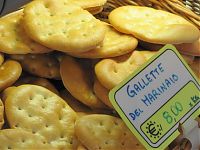
Everyone knows about the focaccia of Genoa and the Italian Riviera. But who remembers the region’s hardtack?
Sea biscuits: those hard, dry crackers that sailors would take with them on long journeys, because normal bread got moldy within days?
In Italian, sea biscuits are called “gallette.” The same word is used for the surf-worn, flattened stones you find on beaches. That’s because sea biscuits look very much like those stones, with pock marks.
There used to be hundreds of bakeries up and down the coast of Italy, and in America too, that baked sea biscuits. Now only a handful continue the tradition, most of them in Liguria, and only one makes gallette in the old-fashioned way, meaning the way they were made in the nineteenth and early twentieth centuries.
|
|
by Rosa Mayland

I don’t know if you have the same uncomfortable feeling as I, but I have the impression this year is flying by, and that we are more than ever racing against time, without being able to get a grip on the present moment or connect with the now. It is insane and quite confusing…
As incredible and shocking as it might seem, September has already arrived and so has autumn (and by the way, just in case you have already got the creeps, we are dangerously approaching Christmas – only 3 1/2 months to go before the ludicrous craze!). Even if you try “lying” to yourself, you cannot do anything other than confirm that the hot season is over and the slow decline of nature is taking its toll. As sad as it might sound, we have no other choice than to bid goodbye to the joys of summer and to the delightful sensation of lightness as well as worry-free days, it is a harbinger for the cold, dark, gloomy days that gently weasel their way into our lives. All those changes are real, visible and can be perceived very clearly.
|
|
 Meet Jonell Galloway, a freelance writer and editor specialized in French cuisine.


