What is Spontaneous Cuisine?

Published by Thursday, June 27, 2013 Permalink 0

Jonell Galloway, Slow Food, Spontaneous Cuisine, Slow Food, Editor of The Rambling Epicure, Mindful EatingMy Spontaneous Cuisine, by Jonell Galloway

Spontaneous Cuisine is an approach to cooking that I “invented” 25 years ago, around the same time as Paul Bocuse started talking about la cuisine du marché, or “market cuisine.”

Happy Thanksgiving


The Spontaneous Cuisine method consists of writing out a tentative menu based on seasonal, local products; going shopping for the products, and adapting the menu according to what is available and fresh; going to the wine seller to select a wine to go with the menu, then going home and cooking all afternoon with my students. A day in the classroom-kitchen usually ends with a candlelight dinner at the château (in my past life in France), and now, at my 1,000-year-old chapel converted into a house in Chartres.

Never miss a post
Name: 
Your email address:*
Please enter all required fields
Correct invalid entries

Kids in the Kitchen: Teach Your Kids How to Shop for Food

Published by Monday, June 17, 2013 Permalink 0


//

The Rambling Epicure, Editor, Jonell Galloway, food writer.Kids in the Kitchen: Teach Your Kids How to Shop for Food

by Jonell Galloway

Summertime is the perfect time to start!

Farmers Market

Going to the farmers market can be made into an exciting, weekly event. Summer offers lots of fresh fruit that they can choose to make their smoothies, to put on their breakfast cereal, or to make fruit salads. Vegetables are tastier in summer than in winter, and there is a larger selection, so it is also an occasion to encourage them to try more vegetables. If they choose fruit and vegetables themselves, they will feel more part of the process, and are more likely to eat them.

Making the Shopping List

Start by discussing the fruits and vegetables that are in season with your child before you go to the market. For the Lake Geneva region, you can look at our MarketDay photo albums, published regularly, to get an idea of what you can expect to find. If you are planning on making a meal together, choose the dishes and ingredients together when making your shopping list. If it’s fruit for snacks or smoothies, let them decide which ones they prefer.

It is a good idea to put up a food pyramid and a seasonal products chart somewhere in the kitchen, so you can refer to it when planning meals with the children, and also to explain why they must eat food such as green vegetables or fruit, for example. More suggestions are available in our 9 May 2009 post A fun, interactive guide for teaching your children good eating habits.

Explain the importance of buying local when possible. It is not only cheaper, but fresher, and therefore has more vitamins.

At the Market

Once you’re at the market, let them start looking for the items on the list. When they’ve spotted them, explain how to choose, by color, smell, touch, ripeness, etc., but make sure to ask the vendor if it’s all right to touch first.

This is also a time to let them look for products that have a local origin written on the tags, and to explain that if the products are local, they are also more ecological, because the cost of transport is less, and that in turn makes them more economical. It takes a lot of fuel to bring tomatoes from Holland in July and August when we have them right here in the region. Reduced transport also cuts pollution.

Buying from local producers allows children to have direct contact with the farmers, and to ask questions if they like. Farmers love to talk about what they have lovingly produced, and this in turn encourages children to appreciate farmers’ hard work and the satisfaction that it brings them. There is a reciprocity: the farmer gives you something he or she has produced with care, and you in turn get to satisfy your tastebuds.

Make kids part of the entire process by letting them help prepare the meal or dish afterwards. Once again, they are more likely to eat it if they help prepare it.


//

Never miss a post
Name: 
Your email address:*
Please enter all required fields
Correct invalid entries

Culinary Travel: Jonell Eats her Way through Paris in June, a Photo Essay

Published by Friday, June 7, 2013 Permalink 0


There’s no better time to eat your way through Paris than in June. It is abundant with local fresh fruits and vegetables, sunshine and flowers. It’s a sensual experience that one must experience at least once in a lifetime.

This slide show gives you a glimpse of just how beautiful and sensual it is. Enjoy.


Never miss a post
Name: 
Your email address:*
Please enter all required fields
Correct invalid entries

Culinary Travel: Jonell Takes a Jaunt to Petite France in Strasbourg, a photo essay

Published by Thursday, June 6, 2013 Permalink 0


Culinary Travel: Jonell Takes a Jaunt to Petite France in Strasbourg

Husband Peter and I recently took a jaunt to Strasbourg with our German “family”, the Joerchels, to eat in a cozy little bistro in the heart of Petite France, the canal district of Strasbourg. Here’s a sample of the architecture and atmosphere of Petite France.


Never miss a post
Name: 
Your email address:*
Please enter all required fields
Correct invalid entries

Food Art: The Incredible Sensuality of a Lemon, a still life painting by Ralf Heynen

Published by Wednesday, June 5, 2013 Permalink 0


Ralf Heynen is a contemporary still life and portrait painter from the Netherlands.

The incredible twists of the lemon peel bring a particular energy to this painting. Although it appears to be simple, the lemon peel is hanging on to the pulp of the lemon itself for dear life, just by a string. Meanwhile, the lemon is staid, still, unflinching in its almost perfect roundness. It looks heavy and sure of itself as compared to the peel, which is thick and rough and “struggling” to wrench itself from the body of the fruit or “mother”.

Click here to see more of Ralf’s work.

Never miss a post
Name: 
Your email address:*
Please enter all required fields
Correct invalid entries

A Mesolithic Dinner: Food, Wine and Art by Jane Le Besque

Published by Tuesday, June 4, 2013 Permalink 0

by Jonell Galloway

A Mesolithic Dinner: Food, Wine and Art by Jane Le Besque


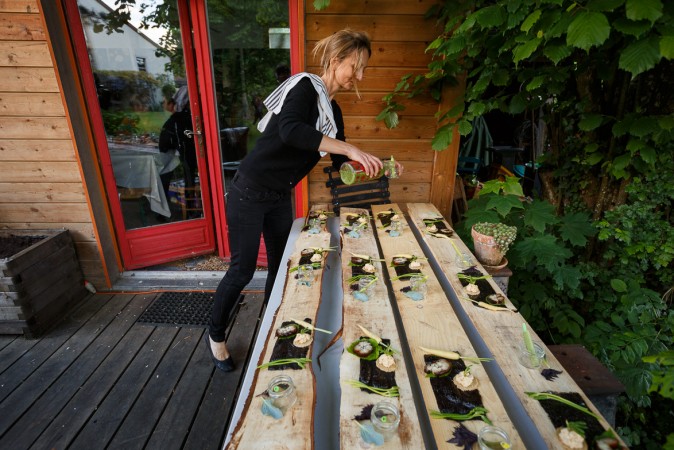
Jane Le Besque hosted a “mesolithic dinner” on June 30, 2013, in her home in the Pays de Gex just over the border in France, an event sponsored by Slow Food Geneva. The dinner was cooked using ancient flavor combinations and techniques, and served on split logs onto which slate plates were placed and used as plates.

What Food Did Jane Le Besque Serve at Her Mesolithic Dinner?

Although Jane’s dinner was labeled “Mesolithic”, it was indeed much more than that. She covered the evolution of food from the post-glacial hunter-gather periods, through the Mesolithic and Neolithic, and going on to the Ancient Greeks and Romans, centering on Europe.

It started with the Mesolithic era, with an assortment of coastal and lake fish, eel, root vegetables and wild greens. The meal then slipped in to the Neolithic era with galettes made from ground lentils, peas and barley, served with spit-roasted boar. The menu ended with an Iron-Age “travelers pack” of dried fruits and dried-porridge slices fried in cumin and butter. The Bronze Age brought blue cheese and butter.

Drinks consisted of mead, more often referred to as “honey wine,” more in the style of the ancient Greeks and Romans than of more ancient peoples, and beer.

What is the Mesolithic?

As a reminder, the Mesolithic Age refers to the pre-agricultural period between 10,000 and 5,000 BCE in Europe, and variations of this period in other parts of the world. The term “pre-agricultural” is key in understanding what ingredients were available. The three terms paleolithic, mesolithic and mesolithic refer to what is generally called the “Stone Age,” i.e. the post-glacial hunter-gatherer period, when humans started to use stone tools and food was gathered rather than farmed.


During the early Stone Ages or paleolithic (2.6 million years ago to around 10,000 BP), humans used some stone tools and utensils, but many tools were made from organic matter such as bone, fibers, and wood. Hunting and gathering were the chief ways of providing food. During the neolithic, starting around 10,200 BCE and ending between 4,500 to 2,000 BCE, depending on the location, we saw the beginning of farming. The mesolithic overlapped the other two ages, once again, at different times in different places. Metal tools brought these three Stone Ages to an end.

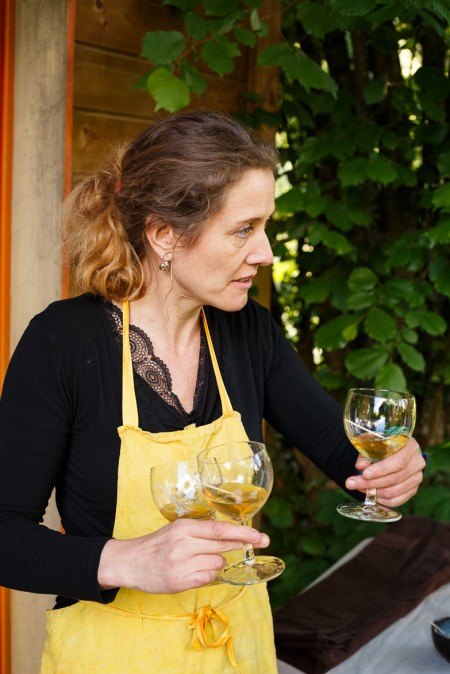
Jane Le Besque, artist and Mesolithic chef, serving mead


Early Stone Age cooking was generally on leaves or directly over the embers, although clay cookware has recently been found in China dating from 19,2000–20,000 years ago, during the ice age. Stone Age plates usually consisted of a rock or other flattish surface found in nature, such as the flattened split logs Jane used in the same manner as we use wooden tables today. Earthenware did not appear on the dinner table until much later.

What Did You Usually Eat at Mesolithic Dinners?

What did they eat? Pretty much whatever they found and killed that was edible: meat, fish, wild plants. The specifics of this depended on the location, climate and season. Meals included the day’s finds. This might consist of berries, wild greens and other wild vegetables and plants.

Meat and later fish were not an everyday affair. They were difficult to come by and difficult to preserve, depending on the location (salt was found in Romania as early as 10,000 years ago). Stone  Age people ate very little grain, since agriculture didn’t exist yet. Hazelnuts and other nuts were often roasted, and stored for winter. Wild boar was common; dairy products and cheese were on the menu, although a limited variety.

About Jane Le Besque

Jane Le Besque lives and works with her family at the foot of the French Jura, a few minutes from Geneva, in the foothills of the Jura mountains.

She was born in England and has a Breton grandfather, hence the name. Since graduating from Birmingham Art College in 1986, she continued her studies at l’Ecole des Beaux Arts in Paris. She afterwards lived and worked in Toulouse, London, and now outside Geneva.


Jane has always painted. She is her happiest walking through the woods and gathering berries, mushrooms, acorns, flowers and leaves to use in her cooking and painting.

One might say Jane has been interested in mesolithic cooking even before she learned the word. As a child, she spent her time gathering the wild things she now uses in her paintings,  making dresses out of them.

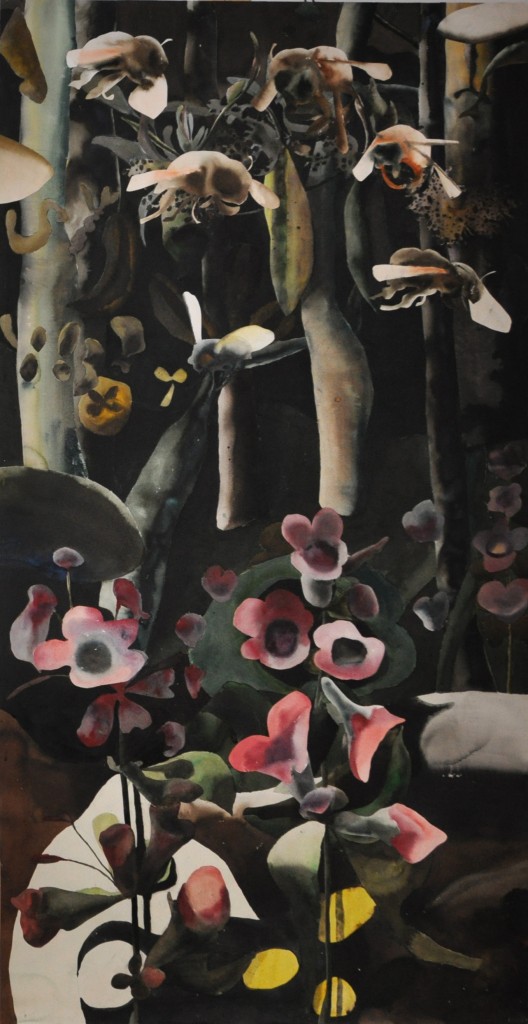
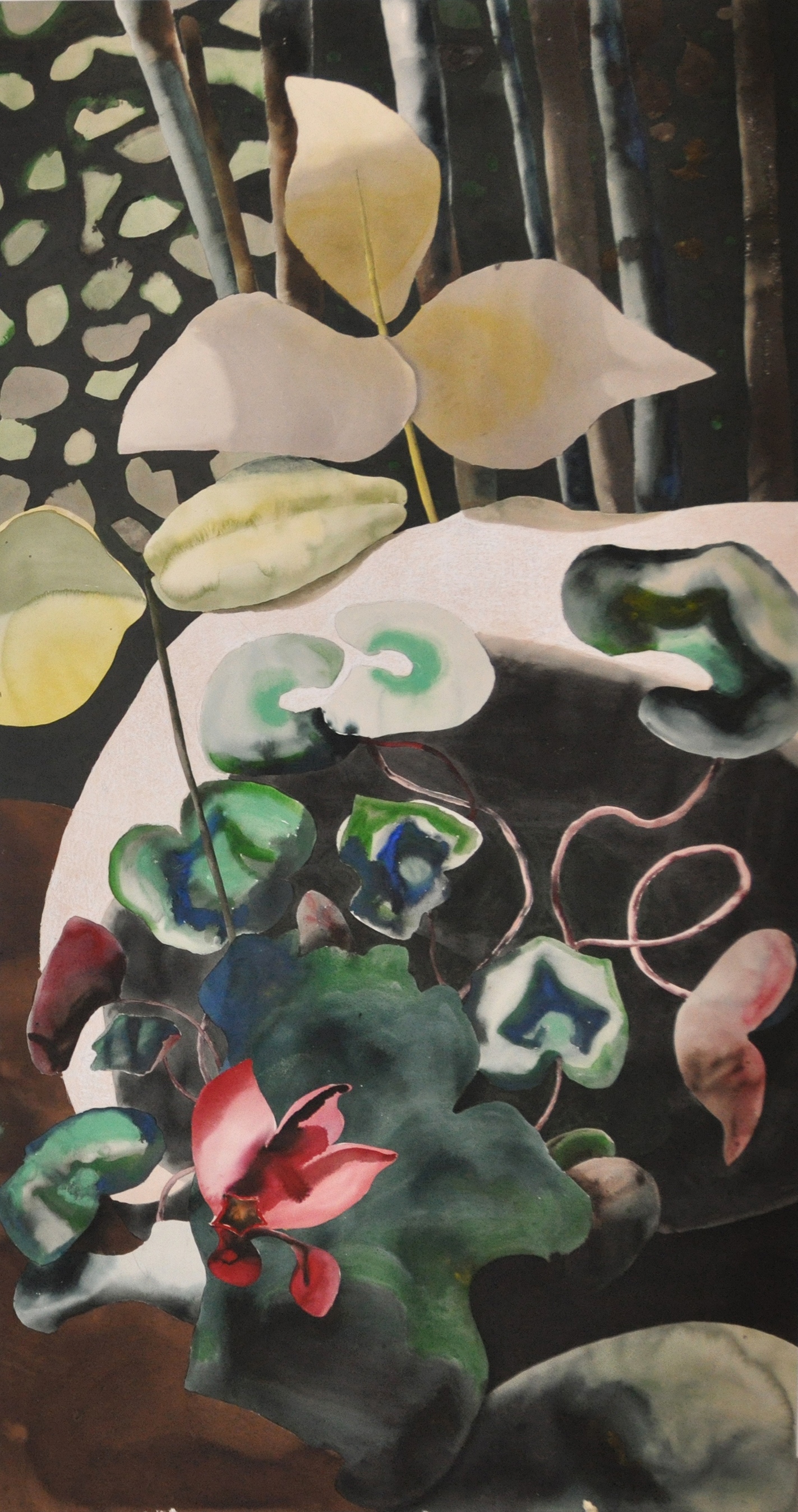
Her paintings are an intense reflection of her “gatherer” spirit. The Mesolithic dinner was held in her studio, lined with her paintings of flora of all types.


Never miss a post
Name: 
Your email address:*
Please enter all required fields
Correct invalid entries

Culinary Travel: Jonell Eats her Way through Mannheim, Germany

Published by Sunday, June 2, 2013 Permalink 0

Culinary Travel: Jonell Galloway Eats her Way through Mannheim, Germany

Photos from my culinary travels in Mannheim, Germany. Mannheim is not known for its cuisine, but it is known for its white asparagus, just like in Alsace. So we took a jaunt to the farmers market and bought the choicest spears from a vendor who sells only white asparagus. The Mannheim cheesecake we bought in the market is the best I’ve ever eaten.

Never miss a post
Name: 
Your email address:*
Please enter all required fields
Correct invalid entries

The Rambling Epicure Made Loads of New Friends at the Wendell Berry Conference 2013

Published by Tuesday, April 23, 2013 Permalink 0

by Jonell Galloway

“A Rambling Epicure”: a short article about my work

One great thing about spending 3 days with a group of like-minded people, who have come from all over the country (and Switzerland) to pay homage to their “spiritual guide”, Wendell Berry, is that the audience is already filtered, and you can be sure to meet people you can relate to and that you will stay in contact with.

Wendell Berry speaking in Frankfort, Indiana

Wendell Berry speaking in Frankfort, Indiana


Such is the case with Elias Crim, a native Texan who spent “several good years studying classics and medieval Italian at U.C. Berkeley before wasting several more years in financial journalism around Chicago.” Crim has also written for The American Scholar, The American Conservative, the Washington Times and The Chicago Observer.

This is the only photo ID I could muster up and I think it rather amusing.


He also runs a website, Solidarity Hall, which he describes as “as a hospitable old hostelry, a mental oasis in the deserted landscapes that surround us. We no longer have the coffeehouses of eighteenth-century London, where Samuel Johnson and his friends said more of substance in an hour than our blogs today could manage in a week. Nor do we have a local culture of pubs such as Chesterton’s Old Cheshire Cheese, where friendship could flourish easily, even amidst clashing opinions.” I thoroughly recommend that you take a look and start a conversation of your own.

Elias was so kind to publish this article, “A Rambling Epicure,” about my work after the Wendell Berry conference. I invite you to take a look.

Start here and then continue on Solidarity Hall:

Jonell Galloway is surely the only person from Hardinsburg, Kentucky, to ever study Sanskrit. But that’s secondary. More important is the way this spiritual daughter of Wendell Berry has developed the Rambling Epicure, an encyclopedic and literate website which describes itself thusly: “A gastronome’s guide to mindful eating. A serious approach to real-food shopping, cooking, and dining.”

Click here to continue.


Never miss a post
Name: 
Your email address:*
Please enter all required fields
Correct invalid entries

Jonell Galloway: Mindful Eating: Farmers, the Land, and Local Economy

Published by Monday, April 1, 2013 Permalink 0

Mindful Eating: Farmers, the Land, and Local Economy

by Jonell Galloway

Many times, after I have finished a lecture on the decline of American farming and rural life, someone in the audience has asked, “What can city people do?” “Eat responsibly,” I have usually answered. Of course, I have tried to explain what I mean by that, but afterwards I have invariably felt there was more to be said than I had been able to say. Now I would like to attempt a better explanation.

 I begin with the proposition that eating is an agricultural act. Eating ends the annual drama of the food economy that begins with planting and birth. Most eaters, however, are no longer aware that this is true. They think of food as an agricultural product, perhaps, but they do not think of themselves as participants in agriculture. They think of themselves as “consumers.”

—Wendell Berry, The Pleasures of Eating, Center for Ecoliteracy

The Times They are a-Changin’: Move Towards a Local Economy

After a few very difficult years, we are now only starting  to talk about the importance, and even necessity, of maintaining and supporting a local economy. This is important not only to our health and taste buds, but also to our vital economic self-sufficiency. It is perfectly in line with the concept of Mindful Eating, and, by definition, involves local farmers as well as others who contribute to eating and drinking.

Continue Reading…

Never miss a post
Name: 
Your email address:*
Please enter all required fields
Correct invalid entries

Wendell Berry Interview, by Mark Bittman

Published by Friday, March 15, 2013 Permalink 0

by Jonell Galloway

There’s probably no better short overview of Wendell Berry‘s views on agriculture and sustainability than Mark Bittman‘s interview of Berry in The New York Times in 2012.

Wendell Berry speaking in Frankfort, Indiana

Wendell Berry speaking in Frankfort, Indiana


Here are a few excerpts about agriculture and sustainability:

“That’s one of Wendell’s recurring themes: Listen to the land.”

“If you imitate nature, you’ll use the land wisely.”

“The two great aims of industrialism — replacement of people by technology and concentration of wealth into the hands of a small plutocracy — seem close to fulfillment.”

Mark Bittman

Mark Bittman (Photo credit: rebuildingdemocracy)


“You can describe the predicament that we’re in as an emergency, and your trial is to learn to be patient in an emergency.”

“[N]o great feat is going to happen to change all this; you’re going to have to humble yourself to be willing to do it one little bit at a time. You can’t make people do this. What you have to do is notice that they’re already doing it.”

“I’ve been thinking about that question about what city people can do. The main thing is to realize that country people can’t invent a better agriculture by ourselves. Industrial agriculture wasn’t invented by us, and we can’t uninvent it. We’ll need some help with that.”

Read The New York Times entire article here.


Never miss a post
Name: 
Your email address:*
Please enter all required fields
Correct invalid entries

UA-21892701-1